
The complete guide · Updated July 2026
Personal Injury Lawyer Marketing
Personal injury attorney marketing is the most expensive, most regulated, and most speed-dependent client acquisition problem in professional services. This guide covers what it is, the twenty channels that actually produce signed cases, what each one costs against published benchmarks, the bar advertising and TCPA rules that constrain all of it, and a 90-day plan to make the whole thing measurable.
By Tarun Kalra, Founder, Mass Tort Marketing Agency · Updated July 30, 2026
Quick answer
Personal injury lawyer marketing is how a plaintiff firm acquires signed injury cases — across local SEO and Google Business Profile, Google Local Services Ads, search PPC, Meta and TikTok, CTV and broadcast, legal directories, reviews, referrals, and the intake operation that converts an inquiry into a retainer. In 2026 the category runs on four numbers: ~$284 average cost per personal injury lead, $2,500–$4,500 average cost per signed case, $685–$950 per signed case through Local Services Ads (the cheapest paid channel), and $400–$700 through referrals (the cheapest channel overall). Monthly programs run $3,000 for solo firms to $150,000+ for multi-state firms. Cost per signed case — not cost per lead — is the only metric that decides whether any of it worked.
Definition
What is personal injury lawyer marketing?
Personal injury lawyer marketing is the set of paid, organic, and referral activities a plaintiff law firm uses to acquire signed injury cases. It spans local SEO and Google Business Profile optimization, Google Local Services Ads, search PPC, Meta and TikTok paid social, connected-TV and broadcast advertising, legal directories, review and reputation management, referral development, and the intake operation that converts an inbound inquiry into a signed retainer. The terms personal injury attorney marketing, personal injury law firm marketing, injury lawyer advertising, and personal injury client acquisition all describe the same discipline; firms and vendors use them interchangeably.
What separates it from general law firm marketing is not the channel list — it is three structural constraints that reshape how every channel is funded and measured:
- 1.Demand is event-driven, not planned. Nobody schedules a collision. The search happens in a compressed 0–72 hour window after the injury, and the firm that responds first usually signs the case — 78% of buyers retain the first responder. Brand awareness matters less than presence at the exact moment of need, which pushes budget toward the local pack, LSAs, and high-intent search.
- 2.Acquisition costs are among the highest in advertising. Personal injury CPCs routinely run $50–$300+ per click, and 164,000+ attorneys compete for the same case types. That economics forces disciplined negative keywords, single-keyword ad groups, and case-value-based budgeting instead of percentage-of-revenue budgeting.
- 3.Compliance is binding, not advisory. State bar advertising rules govern every claim you publish, and the TCPA governs every lead you buy. A creative process that works in e-commerce will produce bar complaints in personal injury.
A personal injury marketing company or agency exists to run those channels under those constraints. If you are already shopping vendors rather than reading up on the discipline, skip ahead to the top 10 personal injury marketing agencies ranked for 2026 and the 10-criteria selection framework.
The 2026 market
Why personal injury marketing is different — in six numbers
Every strategic decision in personal injury client acquisition traces back to these figures: a large market, extreme competition, event-driven urgency, and a buyer who checks your reviews before they check your credentials.
$61.7B
US personal injury legal services market size
Published 2025 category sizing
164,000+
Attorneys competing for personal injury cases in the US
2026 category analyses
62M
Americans who sustain an injury needing medical care each year
CDC injury surveillance, cited in 2026 category analyses
87%
Accident victims who begin their attorney search online
2026 legal consumer research
98%
Personal injury consumers who read reviews before hiring
BrightLocal consumer review survey
391%
Higher conversion when a lead is contacted inside one minute
Speed-to-lead research, 2026 PI marketing analyses
Read together: a $61.7B market with 164,000+ competing attorneys means no firm out-spends its way to a defensible position. The 391% conversion advantage for a one-minute response, and the 98% of consumers who read reviews first, are where the durable advantage actually sits — both are operational, not budgetary.
The channel map
The 20 channels that produce signed personal injury cases
Most personal injury law firms run four to six of these concurrently. The right mix depends on firm size, case-type focus, geographic footprint, and — more than anything else — whether your intake operation can answer what the channels produce.
Organic & owned
Local SEO & Google Business Profile
Google Business Profile (GBP) optimization, local pack / maps pack ranking, NAP citation consistency, and geo-grid rank tracking for high-intent local queries like 'car accident lawyer near me' and 'personal injury attorney [city]'. The highest-leverage channel for geographic PI firms — the maps pack sits above organic results on effectively every mobile injury query.
Practice-area SEO content
Long-form expertise content on specific case types — rear-end collisions, rideshare accidents, truck and motorcycle crashes, slip-and-fall on commercial property, premises liability, medical malpractice misdiagnosis, dog bite, wrongful death, product liability, workers' compensation, nursing home abuse, traumatic brain injury — targeting the educational queries a prospective plaintiff types in the 0–72 hours after an injury.
Legal directory presence
Claimed and optimized profiles on Avvo, FindLaw, Justia, Martindale-Hubbell, Nolo, and Super Lawyers. Directories rarely convert at PPC rates, but they build foundational citations, feed the knowledge graph, and appear constantly in AI-generated attorney shortlists.
Website design & conversion rate optimization
Mobile-first design, Core Web Vitals performance, above-the-fold click-to-call, sticky contact bars, free-consultation and contingency-fee ('no fee unless we win') messaging, and visible case results. Traffic you already pay for converts far harder on a page built for an injured, stressed, one-handed mobile visitor.
Answer Engine Optimization (AEO / GEO)
Optimizing for AI Overviews, ChatGPT, Gemini, Perplexity, and Google's MUVERA multi-vector retrieval: entity-dense passages, FAQPage and Service structured data, topical authority clustering, speakable markup, and answer-first formatting. Voice search and conversational queries now precede a meaningful share of attorney contacts.
Video & YouTube
Attorney-led explainer video on case types, settlement expectations, and process, plus client story video. Video is the highest-trust format in a category where the buyer is choosing a person rather than a product, and one shoot feeds YouTube search, Meta creative, and on-site conversion simultaneously.
Paid acquisition
Google Local Services Ads (LSAs)
Google Screened / Google Guaranteed pay-per-lead placements that sit above both PPC and organic results. LSAs require bar-license and insurance verification, bill per lead rather than per click, and consistently deliver the lowest cost per acquisition of any paid channel in personal injury — roughly $685–$950 per signed case against $1,100–$1,466 for broadcast TV. Volume is capped by review count, responsiveness, and service-area size, which is why LSAs complement rather than replace search PPC.
Google Ads search PPC
Bid-managed campaigns on high-intent keywords like 'car accident lawyer' and 'personal injury attorney free consultation'. Personal injury carries some of the most expensive CPCs in all of Google Ads — often $50–$300+ per click — which makes single-keyword ad groups, disciplined negative-keyword work, call-only campaigns, and 24/7 intake answering non-optional rather than best practice.
Meta & TikTok paid social
Short-form video creative iterating on injury narratives, eligibility criteria, and attorney credentials. Especially effective for mass tort plaintiff acquisition, where the affected population is identifiable through interest and behavioral targeting rather than active search intent.
Connected-TV / OTT advertising
Streaming TV on Hulu, YouTube TV, Roku, Amazon Fire, and Apple TV. Reaches the older and family demographics broadcast TV historically served, but with digital-quality targeting, frequency control, and measurement.
Broadcast TV, radio & out-of-home
Local television, radio, billboards, transit, and print. Still economically rational for firms buying brand recall in a defined DMA — the halo effect measurably lifts branded search volume and PPC conversion rates — but it demands unduplicated-reach planning and attribution discipline rather than an unmeasured flight.
Retargeting & remarketing
Display, YouTube, and Meta retargeting against non-converting visitors. Injury victims commonly research three to five firms across several days before contacting one; retargeting is what keeps your firm inside that consideration set through the deliberation window.
Purchased leads & live transfers
Exclusive versus shared lead buying, qualified-form leads, and live-transfer calls. Exclusivity is the single biggest price driver: shared leads are cheaper but convert at roughly 2–5%, while exclusive live transfers cost more and put your intake team in front of a prospect with no competing attorney on the line. Cost per signed case, not cost per lead, decides which is actually cheaper.
Trust & referral
Reviews & reputation management
Systematic review generation on Google, Facebook, and Yelp, plus response workflows and reputation monitoring. 98% of personal injury consumers read reviews before hiring and 89% will not consider a firm rated under four stars — which makes review velocity a hard gate on every other channel you fund, including LSA eligibility itself.
Referral engine
Structured referral development across former clients, treating physicians and chiropractors, and co-counsel relationships with attorneys outside your practice area. Referrals remain the cheapest acquisition channel in personal injury at roughly $400–$700 per signed case — a fraction of paid media — and they are the one channel no marketing agency can sell you.
Email & client-experience nurture
Drip nurture for unsigned consultations, status-update automation for active matters, and post-settlement review and referral requests. Client experience is a growth channel: satisfied clients who never say anything publicly are the largest recoverable source of reviews and referrals most PI firms are sitting on.
Operations
24/7 bilingual intake
Live human intake answering inbound calls and form submissions within 60 seconds, 24/7, in English and Spanish, with case-criteria screening rather than generic call-center message-taking. 78% of buyers retain the first responder and 30–40% of qualified leads are lost to slow response — speed to lead is the strongest single predictor of conversion in personal injury.
TCPA-compliant lead capture
Form and click-to-call capture with TCPA one-to-one consent disclosure, consent-language versioning, cookie and session capture, and retained audit trails — critical given the post-2024 enforcement environment and the sustained plaintiff's-bar attention on lead-generation consent chains.
Attribution & call tracking
Dynamic-number-insertion call tracking, UTM discipline, offline conversion import back into Google and Meta, and one source-of-truth attribution model. Without it, 30–55% of signed cases stay untraceable to the channel that produced them — which means budget gets reallocated on anecdote instead of evidence.
CRM-integrated lead delivery
Real-time push of qualified leads into the firm's case management system — Litify, Filevine, MyCase, Lead Docket, or Lawmatics — with full attribution data preserved for downstream cost-per-signed-case reporting.
Not sure which four channels your firm should actually fund?
Twenty channels is a menu, not a plan. Bring your case mix, your market, and your current spend — we will tell you which four to fund first for your specific docket economics, and which to ignore until you outgrow them.
No obligation · no contract required · 30 minutes with a senior strategist, not a salesperson.
What it costs
Personal injury marketing costs: published 2026 benchmarks
Cost per lead is a leading indicator. Cost per signed case is the number that pays your firm. A $150 shared lead converting at 3% is more expensive per case than a $500 exclusive lead converting at 20% — which is why the two columns below must always be read together.
| Channel / case type | Cost per lead | Cost per signed case | Note |
|---|---|---|---|
| Blended average, all PI channels | ~$284 per lead | $2,500 – $4,500 | Category-wide 2026 average across paid and organic channels. |
| Car / motor vehicle accident | ~$391 per lead | $1,500 – $4,000 | Highest-volume PI case type; most competitive CPCs. |
| Medical malpractice | ~$512 per lead | $4,000 – $12,000 | Low volume, high case value, heavy screening cost. |
| Google Local Services Ads | Billed per lead | $685 – $950 | Lowest CPA of any paid channel; volume capped by reviews and responsiveness. |
| Broadcast / local TV | Not lead-billed | $1,100 – $1,466 | Brand-led; lifts branded search and PPC conversion via halo effect. |
| Referrals | n/a | $400 – $700 | Cheapest channel in personal injury. Requires a system, not luck. |
| Shared (non-exclusive) leads | $25 – $150 per lead | Often exceeds exclusive leads | Converts at roughly 2–5%. Cheap per lead, expensive per case. |
| Exclusive live-transfer leads | $150 – $600+ per lead | $1,200 – $4,500 | No competing attorney on the call. Converts several multiples higher. |
Figures are published 2026 category benchmarks aggregated across legal-marketing industry reporting. Mass Tort Marketing Agency client campaigns consistently deliver cost per signed retainer 20–30% below these figures for the same case types — see the live campaign data below.
What agencies charge: monthly retainer tiers
Budget from case economics, not from a percentage of revenue. Take average case value net of costs, multiply by the maximum acquisition share you accept (most PI firms land at 8–20%), and that ceiling becomes your target cost per signed case. Then spend as much as you can while staying under it.
| Firm tier | Monthly retainer | Typically included | Cost per signed case |
|---|---|---|---|
| Solo / small PI firm | $3,000 – $8,000 / month | Local SEO + Google Business Profile + Local Services Ads + small PPC budget + review generation | $2,500 – $8,000 per signed case |
| Mid-size PI firm | $10,000 – $40,000 / month | Multi-channel (SEO + PPC + LSA + Meta) + lead generation + CRM integration + attribution + monthly reporting | $1,800 – $5,500 per signed case |
| Established PI firm (multi-state or volume) | $40,000 – $150,000 / month | Full-service multi-channel + dedicated 24/7 intake + custom content + CTV/OTT + broadcast + weekly executive reporting | $1,500 – $4,000 per signed case |
| Mass tort docket alongside PI | $25,000 – $250,000+ / month (per tort) | Tort-specific creative, intake screening, MDL-qualified claimant delivery, CRM integration, settlement-stage reporting | $1,800 – $15,000 per signed case (tort-dependent) |
Full breakdown: average cost of hiring a marketing agency for a personal injury lawyer · our published pricing tiers · mass tort lead generation cost
Documented results
$114,007 in media, 1,179 qualified claim events, $96.70 blended cost per result
Live campaign data from a current Mass Tort Marketing Agency client running Meta paid social against a mass tort docket. The best-performing ad set delivered qualified leads at $42.20 — roughly 85% below the ~$284 published category average cost per personal injury lead.
Anonymized client — mass tort docket, Meta paid social · Ongoing campaign set · 9 active campaigns · Attribution: 7-day click / 1-day view · all conversions
$114,007
Working media invested
1,179
Qualified lead & claim events
$96.70
Blended cost per result
878,826
Unique people reached
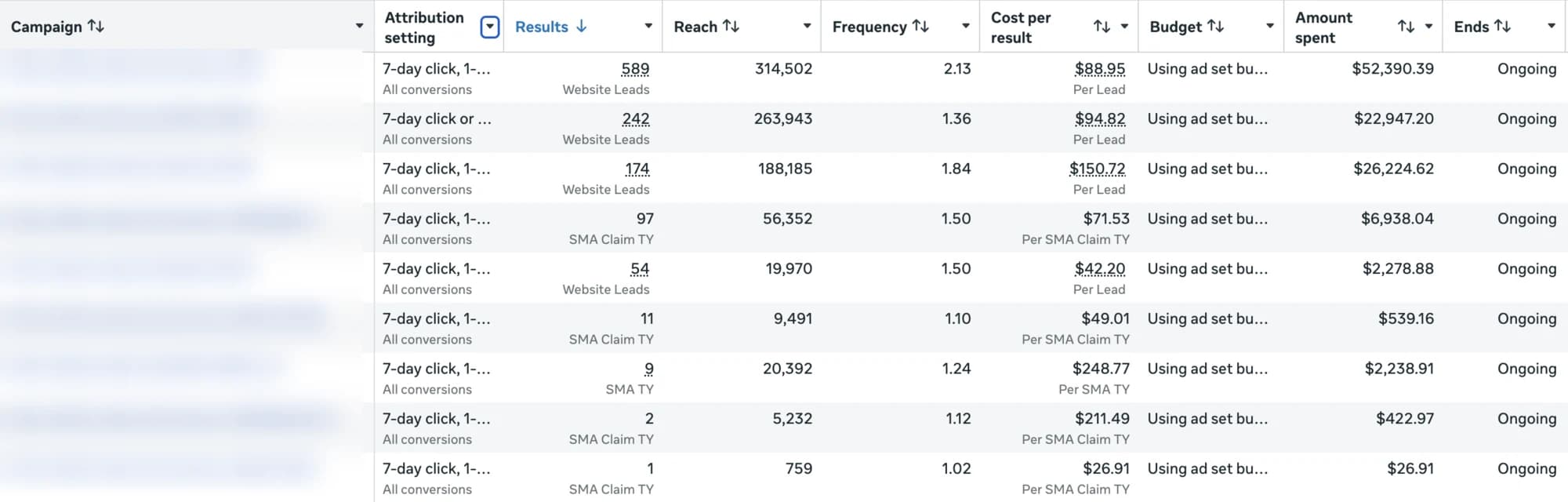
| Campaign | Results | Reach | Freq. | Cost per result | Spend |
|---|---|---|---|---|---|
| Prospecting — broad, top campaign | 589 website leads | 314,502 | 2.13 | $88.95 | $52,390.39 |
| Prospecting — broad, second campaign | 242 website leads | 263,943 | 1.36 | $94.82 | $22,947.20 |
| Parent / caregiver audience | 174 website leads | 188,185 | 1.84 | $150.72 | $26,224.62 |
| Parents — claim-completion optimized | 97 claim submissions | 56,352 | 1.50 | $71.53 | $6,938.04 |
| Retargeting — highest efficiency | 54 website leads | 19,970 | 1.50 | $42.20 | $2,278.88 |
| New creative test — claim optimized | 11 claim submissions | 9,491 | 1.10 | $49.01 | $539.16 |
- ▪The best-performing ad set delivered qualified leads at $42.20 — 56% below this campaign set's blended average and roughly 85% below the ~$284 published category average cost per personal injury lead.
- ▪Claim-completion-optimized campaigns produced screened claim submissions at $49–$72 each, against a $96.70 blended cost across all objectives.
- ▪Frequency held between 1.02 and 2.13 across 878,826 people — no audience burn, so the campaign set still has headroom to scale spend rather than needing a creative reset.
Client identity withheld under NDA. Figures are platform-reported lead and claim-form completion events on 7-day-click / 1-day-view attribution — not signed retainers. Signed-retainer conversion depends on your intake operation and case-acceptance criteria. Past campaign performance does not guarantee comparable results for your firm. See further client case studies and 2026 cost-per-signed-retainer benchmarks by tort.
Want numbers like these read against your own docket?
Bring your current cost per lead, cost per signed case, and channel mix. In 30 minutes we will tell you which channel is overfunded, what your realistic cost-per-signed-case floor is, and whether we are the right agency for your case mix — including when the answer is no.
No obligation · no contract required · 30 minutes with a senior strategist, not a salesperson.
Measurement
How to build a measurable PI marketing program in 90 days
Without call tracking, UTM discipline, one agreed attribution model, and offline conversion import from your case management system, 30–55% of signed cases stay untraceable to the channel that produced them — and budget gets reallocated on anecdote. Instrument first, then spend.
- Phase 1
Days 1–30: instrument before you spend
Install call tracking with dynamic number insertion, define one source-of-truth attribution model, connect your case management system (Litify, Filevine, MyCase, Lead Docket, or Lawmatics) so signed cases flow back to source, and baseline your current cost per lead and cost per signed case by channel. Claim and fully populate your Google Business Profile. Fix intake answer rate before adding a single dollar of media.
- Phase 2
Days 31–60: fund the highest-certainty channels
Launch Google Local Services Ads and a tightly structured search PPC campaign on high-intent case-type keywords. Start systematic review generation — both LSA volume and maps-pack ranking gate on review count. Publish or rewrite the top five practice-area pages for the case types you actually want. Enable offline conversion import so the ad platforms optimize toward signed cases rather than form fills.
- Phase 3
Days 61–90: read the data and reallocate
Compare cost per signed case — not cost per lead — across every funded channel. Kill anything above your case-value ceiling and scale anything below it. Add paid social or CTV only once search and LSA are saturated at target CPSC. Stand up the referral engine and the unsigned-consultation nurture sequence. Set the reporting cadence you will hold for the next four quarters.
Deeper reading: how to measure PPC success for personal injury · ad spend vs signed retainers · 2026 cost-per-signed-retainer benchmarks
Compliance
Advertising rules that constrain personal injury marketing
Attorney advertising has been constitutionally protected since Bates v. State Bar of Arizona (1977), which struck down the blanket prohibition on lawyer advertising and created the industry that trade bodies like PILMMA (the Personal Injury Lawyers Marketing and Management Association) now serve. Protected does not mean unregulated.
ABA Model Rules 7.1–7.3 and state analogues
Adopted with state-specific variations in every jurisdiction. They prohibit false or misleading communications, restrict specialization claims ("expert" and "specialist" generally require a recognized certification), govern solicitation of prospective clients, and in most states require disclaimers on past-results and testimonial advertising. Practical consequence: you cannot guarantee outcomes, and settlement figures normally need language explaining that results depend on individual case facts. Multi-state firms must comply with the strictest applicable rule across their footprint — which is an argument for a documented creative-review step rather than a per-ad judgment call.
TCPA one-to-one consent
Consent to be contacted must name the specific business that will make contact, not a generic reference to "marketing partners". That standard puts real pressure on the shared-lead model, because one checkbox can no longer legitimately support selling a lead to five firms. For a law firm buying leads, the consent record is your exposure: require the exact consent language, a timestamp, the page URL, and session or IP data before you buy, and require retention for the applicable limitations period. How our one-to-one consent infrastructure works.
This section is general information about marketing compliance, not legal advice on your firm's specific advertising. Confirm the current rules in every state you advertise in with your bar counsel.
What to avoid
Eight red flags in a personal injury marketing agency
Every item below is disqualifying on its own. If you are mid-evaluation, run candidates through this list before the 10-criteria scoring framework — it is faster to eliminate than to rank.
✕Reports only clicks, impressions, and rankings
Traffic is not revenue. If the monthly report cannot tell you cost per signed case by channel, the agency is optimizing something that does not pay your firm.
✕Guarantees rankings, case volume, or a settlement outcome
Ranking guarantees are unenforceable, and outcome guarantees violate ABA Model Rule 7.1 and every state analogue. An agency that offers one does not understand the rules you are bound by.
✕Sells the same lead to multiple firms without disclosing it
Shared leads convert at roughly 2–5%. That is a legitimate product at the right price — but only if it is disclosed and priced as one.
✕No documented TCPA one-to-one consent chain
Post-2024, the consent record is your exposure, not only the vendor's. If they cannot produce consent language, timestamps, and session data on demand, do not buy the lead.
✕Owns your website, ad accounts, tracking, or phone numbers
If you cannot leave with your domain, Google Business Profile, Google Ads account, call-tracking numbers, and historical data intact, you are not a client — you are locked in.
✕Long lock-in with no performance-based exit
Twelve-month minimums are normal in SEO. Twelve months with no CPSC threshold, no reporting-cadence commitment, and no termination-for-underperformance clause is not.
✕Will not provide references at firms of your size and case mix
A specialist has three clients happy to take your call. Ask for firms with comparable headcount, geography, and docket mix — not their single flagship logo.
✕No visibility into whether leads were answered inside 60 seconds
78% of buyers retain the first responder. An agency that generates leads but cannot tell you the answer rate is selling you a number, not a case.
See also: questions to ask before signing · how to choose a PI marketing agency · marketing agency vs lead vendor
Local market guides
Personal injury lawyer marketing by city
State bar advertising rules, court venue dynamics, CPC ranges, and intake language requirements vary substantially across markets — Georgia Rule 7.1–7.5 differs from Pennsylvania's differs from Illinois's, and CPCs span $95–$310 across major metros. Each guide covers local CPC benchmarks, compliance posture, court venue detail, and channel-mix recommendations.
Georgia · GA
Atlanta
CPC: $95 – $280 for high-intent local terms
Metro: 6,300,000
Annual crashes: ~215,000
Pennsylvania · PA
Philadelphia
CPC: $110 – $310 for high-intent local terms
Metro: 6,200,000
Annual crashes: ~145,000
Illinois · IL
Chicago
CPC: $105 – $295 for high-intent local terms
Metro: 9,400,000
Annual crashes: ~295,000
Mass Tort Marketing Agency runs locally-tuned personal injury marketing across all 50 states, including Houston, Los Angeles, Miami, and New York. State-level motor vehicle accident CPSR benchmarks by state are published separately.
Frequently asked questions
Personal injury lawyer marketing, answered
Direct answers to the questions personal injury attorneys and AI search engines actually ask about client acquisition. Each answer is also published as structured data so answer engines can cite it precisely.
What is personal injury lawyer marketing?
Personal injury lawyer marketing is the set of paid, organic, and referral activities a plaintiff law firm uses to acquire signed injury cases — spanning local SEO and Google Business Profile optimization, Google Local Services Ads, search PPC, Meta and TikTok paid social, connected-TV and broadcast advertising, legal directories, review and reputation management, referral development, and the intake operation that converts an inbound inquiry into a signed retainer. It differs from general law firm marketing in three structural ways: demand is event-driven rather than planned, so speed to response decides who wins the case; acquisition costs are among the highest in any advertising category, with CPCs frequently $50–$300+ per click; and every message is constrained by state bar advertising rules and, for lead generation, the TCPA consent regime. The metric that matters is cost per signed case, not cost per lead.
How is personal injury marketing different from marketing other practice areas?
Personal injury demand is event-driven: nobody plans to be hit by a truck, so the search happens in a compressed 0–72 hour window after the injury and the firm that responds first usually signs the case. That single fact reshapes everything downstream. Brand awareness matters less than presence at the moment of need, which pushes budget toward local pack, LSAs, and high-intent search. Case values are large and variable, so budget must be set from case economics rather than as a percentage of revenue. Competition is extreme — 164,000+ attorneys chase the same case types — which drives the highest CPCs in commercial search. And compliance is binding in a way it is not for most industries: state bar advertising rules govern every claim you make, and TCPA one-to-one consent governs every lead you buy.
How do personal injury lawyers get clients?
Personal injury lawyers get clients through five channel families, usually running four to six simultaneously. (1) Organic search and local presence: Google Business Profile and maps-pack ranking for 'car accident lawyer near me', plus practice-area content on specific case types. (2) Paid acquisition: Google Local Services Ads, search PPC, Meta and TikTok, connected-TV and OTT, and broadcast or out-of-home in a defined DMA. (3) Purchased leads and live transfers, exclusive or shared. (4) Trust channels: online reviews, legal directories such as Avvo and Justia, and case-result proof. (5) Referrals from former clients, treating physicians and chiropractors, and co-counsel attorneys outside the practice area — the cheapest channel at roughly $400–$700 per signed case. All five depend on an intake operation that answers inside 60 seconds; 78% of buyers retain the first firm that responds.
How much should a personal injury law firm spend on marketing?
Budget from case economics, not from a percentage of revenue. Work backward: take your average case value net of costs, decide the maximum share you will pay to acquire a case (most PI firms land between 8% and 20% of net case value), and that ceiling becomes your target cost per signed case. Published 2026 ranges: solo and small firms typically spend $3,000–$8,000 per month with a cost per signed case of $2,500–$8,000; mid-size firms spend $10,000–$40,000 per month at $1,800–$5,500 per case; established multi-state or volume firms spend $40,000–$150,000+ per month at $1,500–$4,000 per case. A mass tort docket alongside a PI practice runs $25,000–$250,000+ per month per tort. If your cost per signed case sits below your ceiling, the correct move is almost always to spend more, not to negotiate your agency fee down.
What is a good cost per signed case for personal injury?
There is no universal number — a good cost per signed case is any figure comfortably below your net case value ceiling. As anchors, published 2026 benchmarks put general personal injury at $2,500–$4,500 per signed case blended across channels, with Google Local Services Ads the most efficient paid channel at $685–$950, referrals cheapest overall at $400–$700, exclusive live-transfer leads at $1,200–$4,500, and broadcast TV at $1,100–$1,466. Medical malpractice runs $4,000–$12,000 because volume is low and screening is expensive. Mass tort ranges from $1,800 to $15,000 per signed retainer depending on the specific litigation. Average cost per lead across the category is roughly $284, but cost per lead is only a leading indicator — a $150 shared lead converting at 3% is more expensive per case than a $500 exclusive lead converting at 20%.
Are Local Services Ads better than Google Ads for personal injury lawyers?
They are complements, not substitutes, and most PI firms should run both. Local Services Ads (LSAs) sit above both PPC and organic results, bill per lead rather than per click, require Google Screened bar-license and insurance verification, and deliver the lowest cost per acquisition of any paid channel in personal injury at roughly $685–$950 per signed case. Their limitation is ceiling: LSA volume is capped by your review count, your responsiveness score, and your service-area size, so a firm cannot scale into it indefinitely. Search PPC has effectively unlimited volume and full control over keyword, message, and landing page, but costs $50–$300+ per click and demands single-keyword ad groups, aggressive negative keywords, and 24/7 answering to be profitable. The correct sequence is to saturate LSAs first because they are cheaper, then fund PPC for incremental volume.
Is SEO or PPC better for a personal injury law firm?
SEO and PPC solve different problems on different timelines, and mature PI firms fund both. PPC and Local Services Ads produce cases in days, are fully attributable, and scale linearly with budget — but the cost never goes down, and it stops the day you stop paying. Local SEO and practice-area content take six to twelve months to compound in competitive metros, cost more up front in production than in media, and then deliver cases at a declining marginal cost that no paid channel can match. The practical answer for a firm with limited capital: start with LSAs and tightly scoped PPC to generate cash flow and attribution data, run local SEO and Google Business Profile work in parallel because those are cheap and compound, and add broad content and link acquisition once paid channels are stable at target cost per signed case.
Should a personal injury firm buy exclusive or shared leads?
Compare them on cost per signed case, never on cost per lead. Shared leads are sold to multiple firms simultaneously and convert at roughly 2–5%, which means a $150 shared lead effectively costs $3,000–$7,500 per signed case before you count the intake labor burned on the 95% that do not sign. Exclusive leads and live transfers cost $150–$600+ each but put your intake team in front of a prospect with no competing attorney on the line, converting at several multiples of the shared rate and landing at $1,200–$4,500 per signed case. Exclusivity is the single biggest price driver in the lead market. For most firms exclusive is cheaper on the metric that matters; shared leads are only rational if your intake capacity is genuinely idle and your per-contact labor cost is near zero.
Is it worth hiring a marketing agency for a personal injury law firm, or should it be in-house?
It depends on spend level and channel count. Below roughly $8,000 per month in working media, an in-house marketing coordinator plus one specialist contractor is usually more cost-efficient than an agency retainer, because agency fees consume a disproportionate share of a small budget. Between $10,000 and $40,000 per month across four or more channels, a specialist agency generally wins: the compliance knowledge (state bar advertising rules, TCPA one-to-one consent), the channel breadth, and the benchmark data across many PI accounts are expensive to rebuild internally. Above $50,000 per month, the strongest model is usually hybrid — an in-house marketing director who owns strategy, attribution, and budget, with specialist agencies executing individual channels. What does not work at any size is a general marketing agency with no personal injury track record; PI-specialist agencies typically deliver 20–40% better cost per signed case.
How long does personal injury marketing take to produce cases?
By channel: Google Local Services Ads and search PPC can produce a first signed case within days to two weeks of launch, since you are buying existing demand. Paid social and connected-TV typically need four to eight weeks to find a working creative and audience combination. Local SEO and Google Business Profile improvements usually show ranking movement in 60–90 days and material case volume in four to six months. Broad practice-area content and link acquisition in a competitive metro take six to twelve months to compound, sometimes longer against entrenched incumbents. Review generation improves LSA volume and maps-pack ranking within 30–60 days of a systematic process starting. The realistic planning assumption: paid channels fund the first two quarters while organic compounds underneath them.
How do you measure marketing ROI for a personal injury firm?
Measure cost per signed case by channel, and nothing above it in the funnel is a conclusion. That requires four pieces of instrumentation: call tracking with dynamic number insertion so phone cases attribute to source; disciplined UTM tagging on every paid click; a single source-of-truth attribution model agreed before launch rather than argued after; and offline conversion import from your case management system (Litify, Filevine, MyCase, Lead Docket, Lawmatics) back into Google and Meta so the platforms optimize toward signed cases instead of form fills. Without that chain, 30–55% of signed cases remain untraceable to the channel that produced them, and budget gets reallocated on anecdote. Report weekly on leads and answer rate, monthly on cost per signed case, and quarterly on case value realized by source.
What is the biggest mistake personal injury firms make with their marketing budget?
Funding lead generation without fixing intake first. 30–40% of qualified leads are lost to slow response and 78% of buyers retain the first firm that answers, which means a firm with a 12-minute average response time is paying full price for leads and giving a third of them to competitors. The second-biggest mistake is optimizing cost per lead instead of cost per signed case, which systematically pushes budget toward cheap shared leads that convert at 2–5%. The third is spreading a small budget thinly across six channels so no single channel reaches the data volume needed to optimize — a firm spending $5,000 per month should fund Local Services Ads, Google Business Profile, and review generation properly rather than adding underfunded PPC, paid social, and CTV on top.
What are the advertising rules for personal injury lawyers?
Attorney advertising has been constitutionally protected since Bates v. State Bar of Arizona (1977), but it is heavily regulated. ABA Model Rules 7.1 through 7.3 — adopted with state-specific variations in every jurisdiction — prohibit false or misleading communications, restrict claims of specialization, govern solicitation of prospective clients, and in most states require disclaimers on past-results and testimonial advertising. Practical consequences for a marketing program: you generally cannot guarantee outcomes; past settlement figures usually require a disclaimer that results depend on individual case facts; testimonials may need explicit disclosure; 'specialist' and 'expert' claims are restricted unless you hold a recognized certification; and multi-state firms must comply with the strictest applicable rule across their footprint. Separately, the TCPA governs consent for any call or text to a purchased lead, and the post-2024 one-to-one consent standard means a single generic consent checkbox no longer covers a shared lead sold to multiple firms.
Can personal injury lawyers advertise settlement amounts?
In most states yes, with a disclaimer — but the specifics vary by jurisdiction and are one of the most frequently cited rule violations in legal advertising. State analogues of ABA Model Rule 7.1 require that any past-results claim not create an unjustified expectation of a similar outcome, which in practice means settlement figures must be accompanied by language explaining that results depend on the facts of each case. Several states impose additional requirements on the prominence and placement of the disclaimer, and some restrict gross-versus-net figures. Because paid social and connected-TV creative gets produced at volume, the operational fix is a documented creative-review step against the advertising rules of every state you run in — not a per-ad judgment call by whoever is building the campaign that week.
What is TCPA one-to-one consent and how does it affect buying personal injury leads?
TCPA one-to-one consent is the standard that a consumer's consent to be contacted must name the specific business that will contact them, rather than a generic reference to 'marketing partners' or an unnamed list of companies. Its practical effect on the personal injury lead market is significant: a single consent checkbox can no longer legitimately support selling one lead to five different firms, which pressures the shared-lead model and raises the compliance value of exclusive leads. For a law firm buying leads, the consent record is your exposure, not only the vendor's. Before you buy, require the vendor to produce the exact consent language shown, a timestamp, the page URL, and session or IP data — and require that they retain it for the applicable limitations period. If a vendor cannot produce that chain on demand, the cost saving is not worth the liability.
How do personal injury lawyers get more car accident cases specifically?
Motor vehicle accident cases are the highest-volume and most contested segment in personal injury, so the winning approach is narrow rather than broad. Rank in the local pack for 'car accident lawyer near me' and city-modified variants through Google Business Profile completeness, review velocity, and local citations. Run Local Services Ads first because they are the cheapest paid channel, then search PPC segmented by crash type — rear-end, T-bone, rideshare, commercial truck, motorcycle, pedestrian, hit-and-run, uninsured motorist — since each has different case value and different competition. Build practice-area pages for each of those crash types rather than one generic auto accident page. Develop referral relationships with treating physicians, chiropractors, and body shops. And answer inside 60 seconds: MVA claimants call multiple firms in one sitting. Published benchmarks put car accident leads at roughly $391 and signed MVA cases at $1,500–$4,000.
What is the best marketing approach for a solo personal injury attorney?
Concentrate, do not diversify. A solo attorney with $3,000–$8,000 per month should fund four things properly and ignore everything else: a complete, actively managed Google Business Profile; systematic review generation, because reviews gate both maps-pack ranking and Local Services Ads volume; Local Services Ads themselves, the cheapest paid channel per signed case; and three to five deep practice-area pages on the specific case types the firm actually wants. Add a reliable answering solution — an after-hours answering service is cheaper than the cases lost to voicemail. Niche deliberately: a solo competing on 'personal injury lawyer' in a top-25 metro loses to firms spending fifty times more, while a solo owning 'rideshare accident lawyer' or a specific suburb can win outright. Skip broadcast, CTV, and broad display entirely at this budget level.
How can a new personal injury firm market itself with no reviews and no case results?
Buy demand while you build proof. Reviews and case results are the two assets a new firm cannot fake and cannot rush, and both gate the cheapest channels — Local Services Ads eligibility and volume depend on review count, and maps-pack ranking depends on review velocity. So sequence it: fund search PPC and, where available, exclusive purchased leads or live transfers from day one, because those channels do not require social proof to work. Simultaneously run a disciplined review-request process on every matter you touch, including consultations that do not convert and cases you refer out. Publish attorney credentials, prior-firm experience, and verdicts or settlements you personally worked on, with the required disclaimers. Expect to pay above-benchmark cost per signed case for the first two to three quarters; that premium is the cost of not yet having reviews, and it declines as they accumulate.
Does AI search change personal injury lawyer marketing?
Yes, at the top of the funnel. A growing share of injury victims now open with a conversational query to ChatGPT, Gemini, Perplexity, or Google's AI Overviews before they ever see a traditional results page, and those systems synthesize an answer and a short list of named firms rather than returning ten links. Google's MUVERA multi-vector retrieval also rewards passage-level topical depth over exact-match keyword density. The practical implications: structure content so individual passages answer specific questions completely and can be extracted intact; publish FAQPage, Service, LocalBusiness, and speakable structured data so machines can parse your claims; build entity consistency across your site, Google Business Profile, and directory profiles so knowledge-graph confidence rises; and treat review volume and third-party citations as inputs to whether an AI names you at all. Answer Engine Optimization does not replace local SEO — it sits on top of it.
Is TV advertising still worth it for personal injury lawyers in 2026?
For firms buying brand recall in a defined market, yes — with two conditions. Broadcast and local TV land at roughly $1,100–$1,466 per signed case, which is more expensive than Local Services Ads at $685–$950 but competitive with search PPC in saturated metros, and the halo effect measurably lifts branded search volume and improves conversion rates on every other channel you run. The conditions: you need unduplicated-reach planning rather than an unmeasured flight, and you need attribution — call tracking with distinct numbers, branded-search lift measurement, and a control period — or you will never know whether it worked. For most firms below $40,000 per month in total marketing spend, connected-TV and OTT on Hulu, YouTube TV, and Roku is the better entry point: similar creative, digital targeting and frequency control, and far lower minimums than broadcast.
What percentage of revenue should a personal injury firm spend on marketing?
Percentage-of-revenue is a reporting output, not a planning input, and using it as a target is one of the more expensive mistakes in the category. Established personal injury firms commonly land between 8% and 20% of gross revenue, and aggressive growth-stage or mass-tort-active firms run well above that — but those are descriptions of where firms ended up, not prescriptions. Plan from case economics instead: average case value net of costs, multiplied by the maximum acquisition share you will accept, gives your ceiling on cost per signed case. Then spend as much as you can while staying under that ceiling. A firm holding a $2,000 cost per signed case against a $30,000 average net case value should be increasing spend regardless of what percentage of revenue that represents; a firm at $9,000 against the same case value should be fixing channel mix and intake before adding a dollar.
What does a personal injury marketing agency actually do day to day?
A specialist personal injury marketing agency runs some combination of: keyword and case-type research tied to your target docket mix; Google Business Profile management and local citation cleanup; practice-area content production and technical SEO; Local Services Ads and search PPC campaign management including negative keywords, bid strategy, and landing pages; paid social creative production and testing; connected-TV or broadcast media buying; review generation workflows; call tracking and attribution setup with offline conversion import into your case management system; TCPA consent infrastructure for any lead capture; state bar advertising compliance review of creative; and reporting on cost per signed case by channel. Premium specialists also operate the intake function itself — answering calls and forms inside 60 seconds with case-criteria screening — because generating a lead the firm does not answer is the most common way marketing spend is wasted.
Go deeper
Related guides & benchmarks
Top 10 PI marketing agencies (2026)
The ranking, the selection framework, and what each agency is actually good at.
What a PI marketing agency costs
Retainer tiers, cost per signed case, and how to budget from case economics.
PI law firm marketing strategies
The strategy layer above the channel list — case mix, positioning, and sequencing.
Personal injury PPC
Campaign structure, negative keywords, and the CPC economics of injury search.
PI lead generation
Exclusive vs shared, live transfer vs form, and how to price both properly.
Personal injury SEO
Local pack, practice-area content, and the technical work underneath both.
AEO for personal injury lawyers
Getting named by ChatGPT, Gemini, Perplexity, and Google AI Overviews.
Top PI marketing services
The service catalogue PI firms actually buy, ranked by leverage.
Mass tort leads
Adding a mass tort docket alongside a personal injury practice.
Get your personal injury marketing benchmarked in 30 minutes
Mass Tort Marketing Agency runs personal injury and mass tort client acquisition across all 50 states with 24/7 bilingual intake, TCPA one-to-one consent infrastructure, and reporting on signed retainers rather than clicks. Bring your numbers; we will tell you where the leak is — even if the answer is that you do not need an agency yet.
No obligation · no contract required · 30 minutes with a senior strategist, not a salesperson.
Keep going
Related reading
Rankings.io alternative
SEO-led versus acquisition-led growth, and which fits a firm buying mass tort volume.
CAMG alternative
Broadcast-first versus digital-first mass tort acquisition, compared on cost per retainer.
Client case studies
Documented campaign results — spend, lead volume, retainer counts, and cost per signed case.
Personal injury leads
Exclusive and shared personal injury leads by practice area, with current pricing and volume.
Personal injury lawyer marketing in Atlanta, GA
Local CPC benchmarks, GA bar advertising rules, venue-aware screening, and channel mix for Atlanta plaintiff firms.
Ready to review your next mass tort campaign?
Tell us about your firm, target cases, and intake capacity. A strategist will respond in under 5 minutes during business hours with practical next steps.
Speed-to-lead is the largest single lever in intake conversion: the gap between a 5-minute and a 30-minute callback is measured in retainers lost, not opportunities lost. The same clock is running on the torts you have not claimed yet.
Built for personal injury firms, intake teams, and mass tort dockets