
Motor Vehicle Accident Leads in Alabama
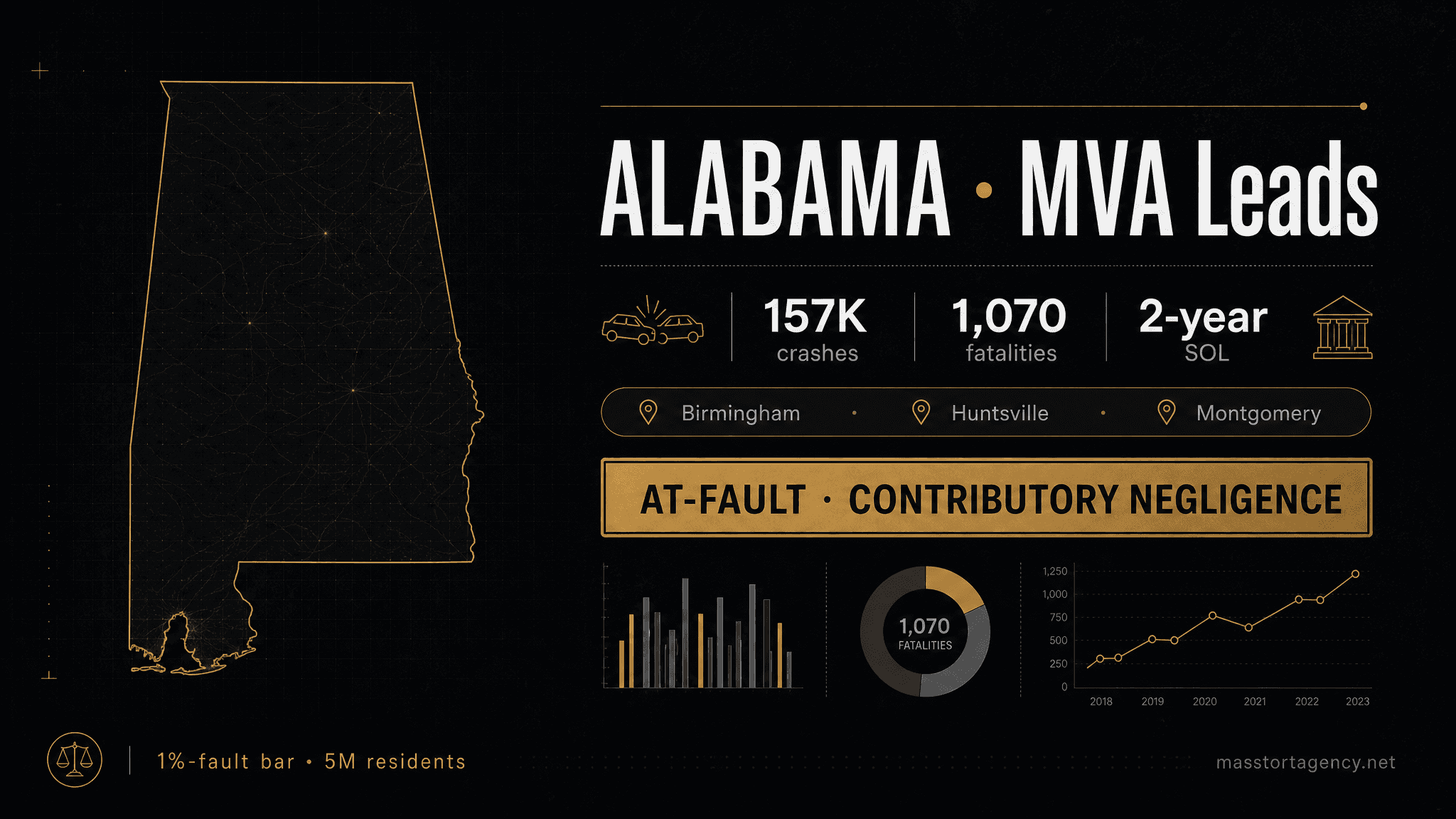
Alabama is one of four U.S. jurisdictions still using pure contributory negligence — 1% claimant fault bars recovery. The Huntsville aerospace corridor adds federal-contractor coverage overlays, and Birmingham's plaintiff bar is the most concentrated in the Southeast outside Atlanta.
South
Alabama · AL
157,000 crashes/yr
Alabama · Market Size
Source: NHTSA + AL DOT
157,000
Reported crashes / yr
1,070
Annual fatalities
47,400
Injured claimants / yr
5.10M
State population
Alabama · Quick Reference
The 5 facts that drive Alabama MVA lead qualification
Liability
At-fault
Negligence
Contributory — 1%
PI SOL
2 years
PIP
Not required
Min. liability
25/50/25
Bottom line · At-fault + pure contributory + Huntsville aerospace federal-contractor overlay + Birmingham plaintiff-bar concentration = Alabama requires 0%-fault filtering, employment-status capture, and Birmingham-metro pricing tier. Treat AL like Georgia and contributory negligence will wash out leads that would convert next door.
The opportunity in Alabama
Alabama MVA: contributory + the Huntsville aerospace overlay
Alabama reports 158,000 traffic crashes annually with 982 fatalities. Birmingham–Hoover metro produces 36,400 of those crashes — about 23% of statewide volume — on the I-20/I-65/I-59 interchange complex through the heart of the state. Huntsville (14,900) anchors the aerospace and defense-contractor corridor (Redstone Arsenal, NASA Marshall Space Flight Center). Mobile (12,800) carries Gulf Coast and Port of Mobile commercial-vehicle volume; Montgomery (10,400) is state-capital plaintiff bar concentration; Tuscaloosa (5,800) carries University of Alabama overlay.
Alabama is one of only four U.S. jurisdictions still using pure contributory negligence (joined by Maryland, Virginia, North Carolina, and DC). The Alabama Supreme Court has consistently re-affirmed the doctrine — most recently in Williams v. Delta Int'l Mach. Corp. (2005) and follow-on appellate decisions: a claimant even 1% at fault recovers nothing. Alabama's last-clear-chance doctrine provides a workaround, but Alabama courts apply it more narrowly than North Carolina or Maryland. Wantonness — Alabama's heightened-fault standard under Ala. Code § 6-11-20 — is the more important workaround: claimant contributory negligence does not bar recovery against a wanton defendant.
Alabama's structural overlay is Huntsville. The Redstone Arsenal / NASA Marshall / Cummings Research Park complex hosts more PhDs per capita than any U.S. metro outside the Bay Area, anchored by federal-defense contractors (Northrop Grumman, Boeing, Lockheed Martin, SAIC, Raytheon). Federal-employee and defense-contractor MVA claimants in Huntsville carry FEHB, Tricare, and DBA (Defense Base Act) coverage profiles that affect medical-bill recovery and subrogation math. Lead vendors who don't capture employment-status at Huntsville intake miss a coverage-coordination field unique to that metro.
Liability framework
How Alabama liability works — and why it matters at intake
Liability system
At-fault
Comparative negligence
Pure contributory negligence
PIP requirement
Not required
PI statute of limitations
2 years
Property damage SOL
6 years
Mandatory liability minimums
25/50/25
(BI per person / per accident / property damage, in thousands)
Alabama is at-fault: the responsible driver's carrier pays. No PIP mandate. Alabama is one of only four U.S. jurisdictions still using pure contributory negligence — any fault by the claimant bars recovery completely. The Alabama Supreme Court reaffirmed the doctrine in Wyser v. Ray Sumlin Construction (2003).
Alabama is one of four pure contributory negligence states. Any claimant fault bars recovery. Last-clear-chance doctrine and wanton/willful conduct exceptions provide narrow workarounds. Fault apportionment at intake is critical.
Where the volume is
Top Alabama claim markets
Birmingham–Hoover's 36,400 crashes concentrate on I-20/I-65/I-59 and the Red Mountain Expressway. The metro hosts UAB Medical Center (largest hospital in Alabama by admissions) and disproportionate plaintiff-bar density — Beasley Allen, Cory Watson, Hare Wynn, and other firms anchor a verdict-history significantly above the rest of the state. Huntsville's 14,900 anchor on I-565 / Memorial Parkway with Redstone Arsenal and the NASA Marshall complex. Mobile's 12,800 carry Gulf Coast hurricane-season crash patterns plus Port of Mobile commercial-vehicle volume. Montgomery is state-capital concentration; Tuscaloosa is University of Alabama football-Saturday traffic and academic-population overlay.
Birmingham–Hoover
36,400
Huntsville
14,900
Mobile
12,800
Montgomery
11,400
Tuscaloosa
6,800
Qualified MVA lead criteria
What "qualified" means in Alabama
In Alabama, "qualified" means clearing the contributory-negligence filter (0% claimant fault, or wantonness/last-clear-chance facts documented) AND capturing employment-status at intake for Huntsville-area leads where federal-contractor coverage is common. The seven criteria below operationalize both.
Accident date & SOL margin
Within 60 days of the wreck. Alabama's 2-year personal injury SOL compresses the case-management window — older leads burn the firm's pipeline.
Alabama jurisdiction
Accident occurred in-state with a police report on file. Report number captured at intake.
Fault apportionment
Claimant 0% at fault. Alabama contributory negligence bars any recovery if claimant is even 1% at fault — strictest rule in the country.
Coverage profile
Alabama does not mandate PIP. Capture UM/UIM, MedPay, and health insurance status — first-dollar coverage varies widely.
Medical treatment
Active or completed care, with treatment provider documented. Injury severity captures the qualified-lead threshold.
No prior representation
Conflict-check release signed at intake. Lead is the firm's exclusive opportunity.
TCPA consent
Express written consent record on file: IP, timestamp, user agent, consent language all captured.
Alabama · Pricing benchmarks
What Alabama MVA leads actually cost in 2026
Alabama live-transfer CPL runs $255–410 — among the lowest in the Southeast Tier-2 set. Birmingham commands a 15–20% premium over the statewide average reflecting Birmingham's plaintiff-bar concentration; Huntsville runs at the statewide median; Mobile and Montgomery run at or below. CPSR $1,700–3,000 reflects contributory-negligence drag — leads wash out at higher rates than in non-contributory states, but Birmingham-anchored case values offset.
Cost per signed retainer · Alabama
$1,700–$3,000
· midpoint $2,350
Typical Alabama CPSR band, inclusive of media + intake + signed-retainer attribution. Variance driven by liability complexity and metro mix, not media cost alone.
CPL by tier
Tier 1 — Live Transfer
$255–$410
CPL · Inbound caller, pre-qualified
Tier 2 — Qualified Form
$105–$195
CPL · Form fill, screened ≤15 min
Tier 3 — Data Lead
$30–$52
CPL · Volume tier, firm-screened
How we operate in Alabama
Channel mix + compliance
Channels that work in Alabama
Birmingham has a meaningful African-American urban media segment with gospel, AM/FM talk, and Black-owned newspapers (Birmingham Times) over-indexing for working-class MVA claimants. Huntsville has growing Indian-American and Asian populations from the aerospace-corridor talent influx. Mobile carries the Vietnamese-American shrimp/fishing community concentration in Bayou La Batre — Vietnamese-language intake matters in zip codes 36509 and 36523. Alabama Rules of Professional Conduct 7.3 restrict in-person and live-telephone solicitation; the Alabama State Bar's Office of General Counsel enforces.
TCPA + DPPA · federal
Express written consent records on every outbound contact — timestamp, IP, user agent, consent language. DPPA enforced for any driver-record-derived data.
Alabama bar advertising rules
Alabama Rules of Professional Conduct 7.1–7.5. Direct in-person and live-telephone solicitation of MVA victims is restricted — lead vendors must source via opt-in inbound channels only.
Alabama MVA leads · FAQ
Questions Alabama firms ask before buying
How does Alabama's contributory negligence rule affect MVA case selection?
Alabama is one of four U.S. jurisdictions where any claimant fault bars recovery entirely. The Alabama Supreme Court reaffirmed the doctrine in Wyser v. Ray Sumlin Construction (2003) and shows no signal of changing. Qualified AL MVA leads require rigorous fault screening — wanton-conduct exceptions provide the primary workaround (defendant's wanton conduct doesn't trigger the contributory-negligence bar).
What's the wanton-conduct workaround for Alabama's contributory negligence?
Under Alabama law, contributory negligence does not bar recovery against a defendant whose conduct was 'wanton' (conscious disregard of likely injury). Drunk driving, excessive speeding, and reckless behavior often qualify as wanton conduct. Qualified Alabama leads with any claimant fault should be screened for wanton-conduct facts.
What's the typical CPL for buying MVA leads in Alabama?
Alabama runs $255–410 CPL on live-transfer and $105–195 on qualified-form — same CPL band as Indiana and Tennessee, but CPSR runs 12–18% higher due to the contributory-negligence intake-wash rate.
Why is Birmingham's MVA volume higher than its population would suggest?
Birmingham (Jefferson County) has approximately 23% of statewide MVA case volume despite holding about 14% of the state's population. I-20 + I-65 interchange traffic, commuter density, and a higher proportion of multi-vehicle crashes drive the over-index.
What MVA case types are most valuable in Alabama?
Commercial vehicle / trucking cases (federal HOS violations often establish wanton conduct), drunk-driving cases (the wanton exception applies), and serious-injury passenger vehicle cases in Birmingham. Cases involving clear-fault scenarios (rear-end at stop, T-bone running red light) survive the contributory-negligence filter at high rates.
Regional MVA markets