
Florida MVA Leads, Screened Through the No-Fault Gate
Florida reports roughly 395,000 crashes a year and converts a far smaller share of them into recoverable bodily injury claims than its volume suggests. Three statutory filters decide which is which, and most national vendors screen for none of them.
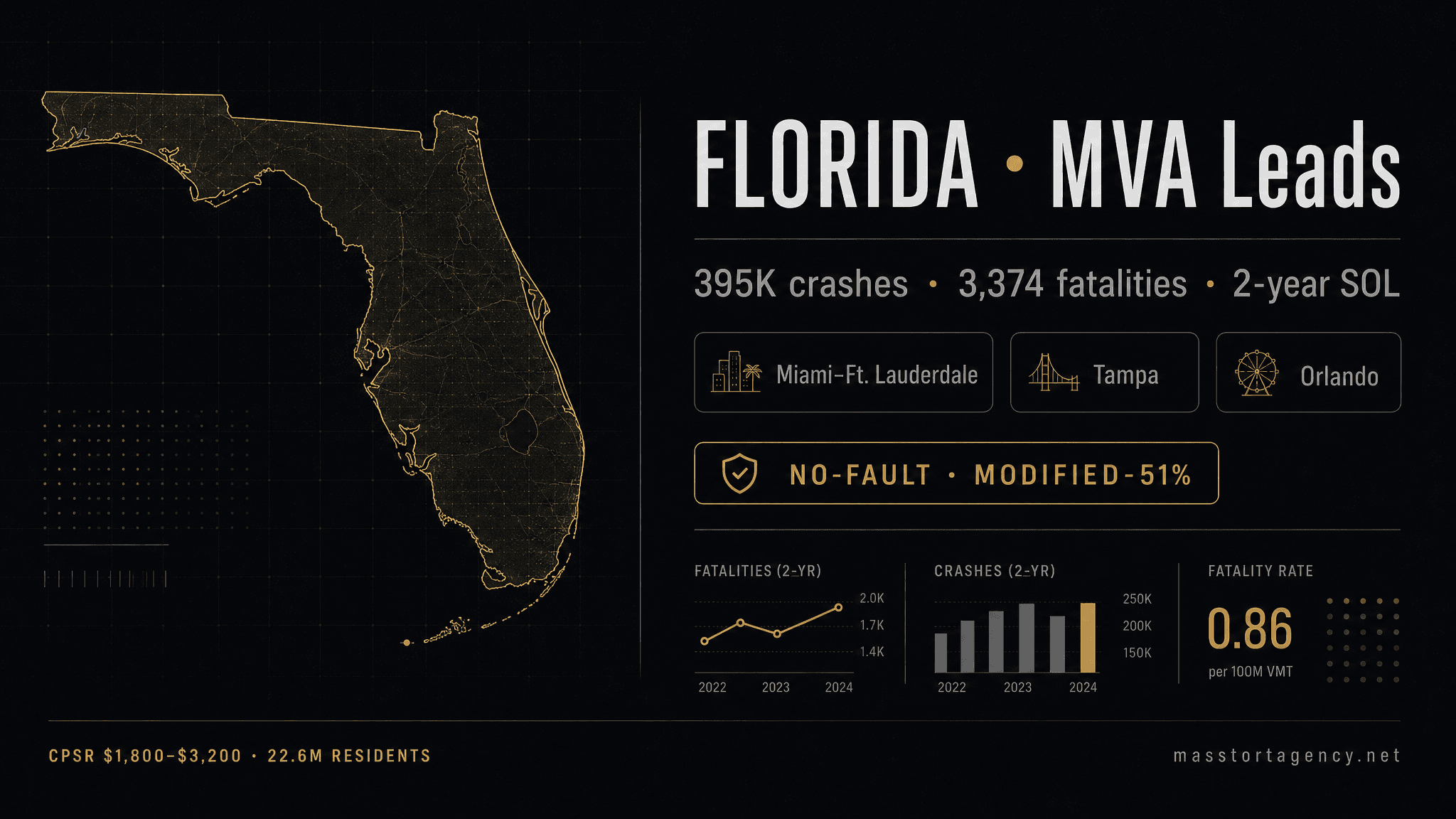
Southeast
Florida · FL
395,000 crashes/yr
Florida · Market Size
Source: NHTSA + FL DOT
395,000
Reported crashes / yr
3,374
Annual fatalities
252,000
Injured claimants / yr
22.6M
State population
Florida · Quick Reference
The 5 facts that drive Florida MVA lead qualification
Liability
No-fault
Negligence
51% bar
PI SOL
2 years
PIP
$10,000 req'd
Min. liability
10/20/10
Bottom line · No-fault + modified-51% + 2-year SOL = leads must clear three filters before they're worth buying. Post-HB 837 Florida is not the same market it was 36 months ago — pricing, intake, and case-management math all reset.
The opportunity in Florida
Florida MVA: post-HB 837 economics
Florida is the second-largest MVA market in the U.S. by raw volume — 395,000 reported crashes annually, concentrated on the I-95 / I-4 / I-75 spine that runs Miami → Tampa → Orlando → Jacksonville. The market is sustained year-round by 22.6 million residents and a winter snowbird population that adds roughly 1.5 million temporary drivers between October and April.
But Florida's volume is not Florida's signed retainers. The state's true no-fault PIP framework caps first-dollar medical recovery at $10,000 — adequate for a fender-bender, exhausted in two weeks for a serious-injury case. Tort recovery against the at-fault driver requires clearing the serious-injury threshold under Fla. Stat. § 627.737: permanent injury within a reasonable degree of medical probability, significant and permanent scarring or disfigurement, or significant and permanent loss of an important bodily function.
March 2023's HB 837 layered a second filter on top: comparative negligence shifted from pure to modified-51%, and the personal injury SOL dropped from 4 years to 2. National vendors who haven't recalibrated their Florida intake since the reform are sending firms cases that would have settled in 2022 but get washed out at the verdict line in 2026. The reform compressed every margin in Florida MVA economics, and lead pricing reset accordingly.
Liability framework
How Florida liability works — and why it matters at intake
Liability system
No-fault
Comparative negligence
Modified comparative — 51% bar
PIP requirement
Required · $10,000 min.
PI statute of limitations
2 years
Property damage SOL
4 years
Mandatory liability minimums
10/20/10
(BI per person / per accident / property damage, in thousands)
Florida is a true no-fault state with mandatory $10,000 PIP. The serious-injury threshold (permanent injury, significant scarring, or significant/permanent loss of an important bodily function) controls when a claimant can step outside PIP and pursue the at-fault driver.
Florida shifted from pure to modified-51% comparative negligence under HB 837 (March 2023). Claimants more than 50% at fault recover nothing — a major case-value filter that didn't exist before.
Where the volume is
Top Florida claim markets
Florida MVA volume is concentrated on the I-95 / I-4 / I-75 spine. The Miami–Fort Lauderdale corridor alone produces over 100,000 reported crashes per year — more than Orlando and Jacksonville combined and roughly 26% of statewide volume. Each metro carries a distinct claimant profile: Miami is bilingual-first with heavy snowbird and tourist overlay; Tampa is at-fault-fact-pattern-rich because of I-275 and the Sunshine Skyway corridor; Orlando is rideshare-heavy from the theme park and convention traffic.
Miami–Fort Lauderdale
101,400
Tampa–St. Petersburg
56,800
Orlando–Kissimmee
49,200
Jacksonville
27,400
West Palm Beach
22,900
Qualified MVA lead criteria
What "qualified" means in Florida
In Florida, "qualified" means clearing three layered filters: timing under the 2-year SOL, fault under the 51% bar, and severity at the § 627.737 serious-injury threshold. The seven criteria below capture all three plus the federal compliance posture every PI firm needs at intake.
Accident date & SOL margin
Within 60 days of the wreck. Florida's 2-year personal injury SOL compresses the case-management window — older leads burn the firm's pipeline.
Florida jurisdiction
Accident occurred in-state with a police report on file. Report number captured at intake.
Fault apportionment
Claimant 50% or less at fault under Florida's 51% bar.
Coverage profile
PIP confirmed — Florida mandates $10,000 minimum. Capture PIP exhaustion status for case-value math.
Medical treatment
Active or completed care, with treatment provider documented. Injury severity captures the qualified-lead threshold.
No prior representation
Conflict-check release signed at intake. Lead is the firm's exclusive opportunity.
TCPA consent
Express written consent record on file: IP, timestamp, user agent, consent language all captured.
Florida · Pricing benchmarks
What Florida MVA leads actually cost in 2026
Florida CPL recalibrated meaningfully after HB 837. The 2-year SOL compressed the intake window from the prior 4-year runway, lifting live-transfer pricing 12–18% over 2022 levels because vendors must clear the qualification work faster. CPSR widened because the modified-51% bar washes out a slice of cases that would have settled under pure comparative. The numbers below reflect 2024–2026 Florida buy cycles — not pre-reform benchmarks.
Cost per signed retainer · Florida
$1,800–$3,200
· midpoint $2,500
Typical Florida CPSR band, inclusive of media + intake + signed-retainer attribution. Variance driven by liability complexity and metro mix, not media cost alone.
CPL by tier
Tier 1 — Live Transfer
$300–$500
CPL · Inbound caller, pre-qualified
Tier 2 — Qualified Form
$125–$225
CPL · Form fill, screened ≤15 min
Tier 3 — Data Lead
$35–$65
CPL · Volume tier, firm-screened
How we operate in Florida
Channel mix + compliance
Channels that work in Florida
Florida is the most language-diverse MVA market in the country. Spanish-language inbound volume is the Miami DMA's structural baseline — the bilingual intake premium adds 8–12% to CPL but signed-retainer rate runs 4–6 points higher because vendor competition is thinner in that segment. Haitian Creole captures a meaningful slice in Broward and Palm Beach counties; Brazilian Portuguese surfaces in pockets of Orlando and Boca Raton.
TCPA + DPPA · federal
Express written consent records on every outbound contact — timestamp, IP, user agent, consent language. DPPA enforced for any driver-record-derived data.
Florida bar advertising rules
Florida Bar Rule 4-7 (Information About Legal Services). Direct in-person and live-telephone solicitation of MVA victims is restricted — lead vendors must source via opt-in inbound channels only.
The short version
Florida is a true no-fault state. Every injured claimant recovers first from their own $10,000 PIP policy under Fla. Stat. § 627.736, regardless of fault, and cannot pursue the at-fault driver for bodily injury damages at all unless the claim clears the serious-injury threshold in § 627.737.
Two filters sit in front of that threshold and remove a large share of raw Florida crash volume before fault is ever analysed. Initial treatment must begin within 14 days of the crash, and a licensed provider must find an emergency medical condition — without that finding, the claimant's PIP entitlement drops from $10,000 to $2,500.
HB 837, signed March 24 2023, added a third and a fourth filter: comparative negligence moved from pure to a modified 51% bar, and the limitations period for negligence actions fell from four years to two.
A Florida MVA lead is therefore only worth buying if it clears all four. We screen the treatment date, the emergency-medical-condition finding, the threshold category, the fault posture, and the coverage stack before a claimant reaches your intake team.
The $10,000 gate that most Florida lead volume never clears
Florida is the second largest motor vehicle accident market in the United States by raw crash count. Roughly 395,000 reported crashes a year produce about 252,000 injuries across a resident population of 22.6 million, concentrated along the I-95, I-4 and I-75 spine that links Miami to Tampa, Orlando and Jacksonville. Between October and April a seasonal population of well over a million additional drivers arrives, and crash frequency in the southern counties rises with it.
None of that volume tells you anything useful about how many signed retainers Florida will produce, because Florida is a true no-fault jurisdiction. Under Fla. Stat. § 627.736 every injured person turns first to their own personal injury protection coverage, irrespective of who caused the crash. That coverage pays 80% of reasonable medical expenses and 60% of lost wages, up to a combined statutory maximum of $10,000. It is compulsory for every registered vehicle in the state.
Ten thousand dollars is a meaningful sum for a soft-tissue claim treated conservatively over a few weeks. It is close to irrelevant in a case involving surgery, a hospital admission, or sustained specialist care, where it is commonly exhausted inside the first fortnight of treatment. The entire question in Florida MVA case selection is whether a claimant can step outside that first-party system and reach the at-fault driver — and the statute makes that a gate, not a default.
Section 627.737 grants the owner or operator of a motor vehicle immunity from tort liability for damages arising out of bodily injury unless the injury falls into one of four enumerated categories. That immunity is the reason a Florida lead file cannot be evaluated the way a file from a conventional at-fault state can. In Georgia or Texas, a claimant with documented injuries and a liable defendant has a claim. In Florida the same claimant has a PIP entitlement and nothing else until the threshold is satisfied.
This is not a subtlety that affects a small number of files at the margin. It determines whether the majority of Florida crash volume is convertible at all. A vendor selling Florida leads on the basis of crash counts, injury counts, or population is selling you the top of a funnel whose narrowest point is statutory and occurs before your intake team ever sees the file.
What this means for lead buying
Florida crash volume is not a proxy for Florida case volume. A campaign priced against raw injury counts will systematically overstate the convertible population, because a statutory immunity removes most of it before fault, damages, or coverage are ever reached.
Related: how we build MVA campaigns · intake handling after delivery
The 14-day rule: the filter that removes files before anyone looks at fault
Florida's PIP statute contains a deadline that has no equivalent in most states and that disqualifies a substantial share of otherwise viable claimants. Under § 627.736(1)(a), personal injury protection benefits are payable only if the injured person receives initial services and care within 14 days of the motor vehicle accident. Treatment that begins on day 15 does not attract reduced benefits. It attracts none.
The practical consequence at intake is severe, and it runs directly against ordinary human behaviour after a crash. A claimant who feels shaken but ambulatory, declines transport at the scene, waits to see whether the stiffness resolves, and finally presents to a clinic three weeks later has forfeited PIP entirely. They may still have a threshold injury. They will have no first-party benefits to fund the diagnostic workup that would prove it, and no billing record from the critical early window.
This is the single most common reason a Florida lead that looks strong on the intake form is worthless by the time a firm has ordered records. The claimant describes a serious crash and a real injury. The treatment date fails the statute. Nothing downstream rescues the file.
A national vendor running one intake script across all fifty states will not ask this question, because in forty-nine of them it does not matter. We ask for the date of the crash and the date of first treatment as separate fields on every Florida lead, and we treat any gap approaching 14 days as a disqualifying condition rather than a note in the comments.
There is a narrow secondary point worth capturing at the same time. The statute requires initial services within the window, not the completion of a course of treatment. A claimant who presented to an emergency department on the day of the crash and did not resume care for a month has satisfied § 627.736(1)(a) even though the treatment record looks discontinuous. The screening question is the date of first contact with a qualifying provider, not the continuity of care that followed. Vendors who screen on 'treatment' generally rather than on first-contact date reject viable files and accept dead ones in roughly equal measure.
- Capture crash date and first-treatment date as separate, explicit fields — never as a single narrative answer.
- Treat a gap of 11 days or more as requiring documentary confirmation before the file is delivered.
- Record the provider type at first contact: emergency department, urgent care, primary care physician, or chiropractor.
- A claimant who declined transport at the scene is not disqualified, but the file needs a confirmed first-treatment date before it has any value.
Screening consequence
Crash date and first-treatment date are two fields, not one. A vendor that captures 'did you seek treatment?' as a yes or no is not screening Florida — they are screening a generic at-fault state and shipping you the difference.
Related: our intake screening standard · Florida MVA overview
The emergency medical condition finding: $10,000 or $2,500
The second filter is less well known than the 14-day rule and does more quiet damage to Florida case economics. Personal injury protection benefits are capped at $10,000 only where a qualified provider has determined that the claimant suffered an emergency medical condition. Absent that determination, the statutory entitlement is $2,500.
An emergency medical condition is defined by reference to acute symptoms of sufficient severity that the absence of immediate medical attention could reasonably be expected to result in serious jeopardy to health, serious impairment to bodily functions, or serious dysfunction of a bodily organ or part. The finding must be made and documented by a physician, osteopathic physician, dentist, physician assistant or advanced practice registered nurse. Chiropractors cannot make it.
That last point is the one that decides files. A very large share of Florida soft-tissue claimants present first, and sometimes exclusively, to a chiropractor. The treatment may be entirely appropriate and the injury entirely real. But if no qualifying provider ever documents an emergency medical condition, the claimant's first-party entitlement is $2,500, and $2,500 will not fund the imaging and specialist opinion that a permanency finding under § 627.737 normally requires.
The result is a category of Florida file that looks convertible and is not: a genuinely injured claimant, treating consistently, inside the 14-day window, with no emergency-medical-condition determination anywhere in the record and no realistic funding path to obtain the evidence the threshold demands. Firms that buy on injury description alone acquire these files in volume.
We therefore capture the emergency-medical-condition status as a discrete screening field, along with the provider type that made or could make the determination. Where the finding has not yet been made but the claimant is being seen by a qualifying provider, we record the file as conditional rather than qualified, and we say so on delivery. A conditional Florida file is worth buying at a different price from a confirmed one, and pretending the two are the same is how vendors manufacture apparent volume.
| Status | PIP entitlement | Practical effect on the tort claim |
|---|---|---|
| EMC determined and documented by a qualifying provider | $10,000 | Funds the diagnostic workup that a permanency opinion under § 627.737 normally requires. |
| No EMC determination in the record | $2,500 | Rarely sufficient to fund imaging plus specialist opinion; threshold evidence often never gets built. |
| Treated exclusively by a chiropractor | $2,500 unless a qualifying provider also assesses | Chiropractors cannot make the EMC determination. Common cause of an otherwise real injury failing to reach the threshold. |
| No treatment within 14 days | $0 | PIP forfeited entirely under § 627.736(1)(a). No first-party funding at all. |
Related: screening criteria we apply · personal injury lead standards
The serious injury threshold: the four categories that open the tort claim
Only after the first two filters are satisfied does the question that most people think of as 'the Florida threshold' arise. Section 627.737(2) removes the tort immunity where the injury or disease consists in whole or in part of one of four categories.
The categories are: significant and permanent loss of an important bodily function; permanent injury within a reasonable degree of medical probability, other than scarring or disfigurement; significant and permanent scarring or disfigurement; and death. They are not a sliding scale of severity and they are not satisfied by pain, by duration of treatment, or by the size of a medical bill. Each is a specific evidentiary proposition that has to be supported by an opinion a physician is willing to put their name to.
The second category does most of the work in practice and is the one that intake screening most often gets wrong. Permanency within a reasonable degree of medical probability is a medical opinion about the future, not a description of the present. A claimant with six months of documented treatment, consistent complaints, and a positive MRI does not thereby have a permanent injury. They have a strong evidentiary foundation for a physician to reach that opinion, which is a different thing, and whether any treating physician will actually reach it is frequently unknown at the moment a lead is sold.
This is why we screen for injury type and diagnostic findings rather than for treatment duration or subjective severity. Herniation with radicular findings, a documented fracture, surgical intervention or a recommendation for it, and traumatic brain injury with objective correlates are the categories that most reliably support a permanency opinion. Sustained soft-tissue complaints without imaging correlates do not, however sincere the claimant and however long the treatment.
The scarring and disfigurement category is narrower than it sounds and is frequently misread by vendors as covering any visible mark. The statute requires that the scarring be both significant and permanent. Location matters to how that is assessed in practice, and a file whose entire threshold theory rests on a small, well-healed scar is not a file to price as though it clears the gate.
Permanent injury within a reasonable degree of medical probability
The most commonly pleaded category and the most evidence-dependent. It requires a treating or examining physician to state, to the applicable standard, that the claimant's injury is permanent. Objective diagnostic correlates materially increase the likelihood that such an opinion will be available, which is why we capture imaging status on every Florida file rather than treating it as optional detail.
- Disc herniation or protrusion with corresponding radicular symptoms
- Fracture confirmed on imaging
- Surgical intervention performed or formally recommended
- Traumatic brain injury with objective findings or documented neuropsychological deficit
- Documented nerve injury or persistent measurable range-of-motion loss
Significant and permanent loss of an important bodily function
Overlaps heavily with the permanency category in practice but is pleaded distinctly. It is most useful where function loss is demonstrable and measurable even if a permanency opinion on the underlying structural injury is contested. Screening should capture what the claimant can no longer do, in concrete terms, rather than a severity rating.
Significant and permanent scarring or disfigurement
Narrow, and dependent on both the extent and the permanence of the mark. Useful as a standalone threshold theory in a limited set of files — typically burns, lacerations requiring substantial repair, and degloving injuries. It should not be relied on as the sole threshold basis for a file priced as fully qualified.
Death
Wrongful death claims proceed under the Florida Wrongful Death Act, §§ 768.16 to 768.26, which has its own two-year limitations period running from the date of death rather than the date of the crash. The statute defines who may recover and what each class of survivor may recover, and those definitions do not map onto general negligence intuitions. A fatality file is a different product and should be screened, priced and delivered as one.
Related: car accident lead criteria · our full lead inventory
What HB 837 changed, and why 2022 benchmarks no longer describe this market
House Bill 837 was signed on March 24, 2023 and is the most consequential change to Florida civil practice in a generation. For lead buyers the relevant effects are two, and both compress case economics.
First, comparative negligence moved from pure to modified. Section 768.81 now bars recovery entirely for a claimant found to be more than 50% at fault. Before the reform, a claimant 80% responsible for their own injuries recovered 20% of their damages. Now they recover nothing. A fault posture that was merely expensive is now terminal.
Second, the limitations period for general negligence actions in § 95.11 fell from four years to two, applying to causes of action accruing on or after the effective date. The practical effect on lead buying is not only that older files expire sooner — it is that the entire intake, investigation and filing sequence has half the runway it used to have.
HB 837 also altered the evidentiary treatment of medical damages and made changes to bad faith practice, both discussed in their own sections below. And it made substantial changes to attorney fee provisions, including the treatment of one-way fee entitlement in insurance litigation, which changes the economics of smaller claims in ways that affect which files a firm should want at all.
The consequence for anyone buying Florida leads is straightforward. Any pricing benchmark, conversion rate, or vendor performance claim drawn from before March 2023 describes a different statutory regime. A vendor still quoting Florida economics on pre-reform conversion data is either not tracking cohorts by accrual date or is hoping you are not.
The cohort question to ask any Florida vendor
Ask for conversion data segmented by accrual date, split at March 24, 2023. A vendor that cannot produce it is quoting you performance from a statutory regime that no longer exists.
| Element | Before March 24, 2023 | On and after March 24, 2023 |
|---|---|---|
| Comparative negligence | Pure — recovery at any fault share | Modified — barred above 50% fault (§ 768.81) |
| Negligence limitations period | 4 years | 2 years (§ 95.11) |
| Evidence of medical damages | Generally billed amounts | Statutory framework under § 768.0427 |
| Intake runway | Long — files viable years after the crash | Compressed — investigation and filing inside 24 months |
Related: cost per signed retainer in 2026 · State Qualification Index
The 51% bar, and why fault apportionment is now a screening field
Under the modified comparative scheme a Florida claimant found more than 50% responsible recovers nothing at all. At exactly 50% they still recover, reduced by half. The single percentage point between 50 and 51 is the difference between a reduced recovery and no case.
This makes fault apportionment a screening field rather than a matter to be worked out later. In a rear-end collision with a clear liable party it is uncontroversial and can be recorded quickly. In the fact patterns that generate a large share of Florida volume — intersection collisions, lane-change disputes, multi-vehicle chain reactions on interstate corridors, pedestrian and cyclist incidents outside marked crossings — it is genuinely contested, and a file can move from valuable to worthless on the apportionment finding alone.
A well-run Florida intake captures the mechanism of the collision in enough detail to support a preliminary apportionment view, the existence of a police report and its narrative conclusion, whether any citation was issued and to whom, and whether independent witnesses exist. None of that is complicated. It is simply absent from the generic intake scripts that national vendors run.
There is a second-order effect worth understanding. Because Florida abolished joint and several liability in negligence actions, a defendant found 30% responsible pays 30% of the damages and no more. In a multi-defendant crash, the apportionment question is not only whether the claimant is under the bar — it is whether the recoverable share sits with a defendant who has meaningful coverage. A file with a clearly liable but uninsured defendant and a marginally liable but well-insured one is a materially worse file than the fault narrative alone suggests.
- Record collision mechanism in structured form, not as free-text narrative.
- Capture police report existence, report number, and whether a citation issued — and to which driver.
- Flag contested-apportionment fact patterns explicitly rather than letting them pass as ordinary files.
- In multi-vehicle files, record the number of defendants and the apparent coverage position of each.
- Treat any file where the claimant's own share plausibly approaches 50% as requiring firm review before delivery.
Related: how fault rules differ by state · Georgia's 50% bar compared
Florida does not require bodily injury liability coverage — and that changes everything downstream
Florida's financial responsibility scheme contains an omission that surprises attorneys who practise primarily in other states and that national lead vendors almost universally fail to screen for. To register a vehicle in Florida a driver must carry $10,000 in personal injury protection and $10,000 in property damage liability. Bodily injury liability coverage is not part of that baseline requirement for ordinary registration.
The consequence is that a materially large share of Florida drivers are on the road with no coverage at all for the bodily injuries they cause. A claimant can clear the 14-day rule, obtain an emergency medical condition determination, exhaust PIP, sustain an unambiguously permanent injury, face a defendant who is one hundred per cent at fault, and still have no realistic source of recovery from that defendant, because the defendant has no bodily injury policy and no assets worth pursuing.
This is the defining structural feature of Florida MVA practice and it inverts the usual order of case evaluation. In a conventional at-fault state the sequence runs liability, damages, then coverage, because coverage is usually present in some form. In Florida the coverage question has to come first, because a substantial portion of files fail on it regardless of how strong the liability and damages positions are.
Bodily injury coverage does become compulsory in defined circumstances — most relevantly following certain serious violations and as a condition of reinstatement after particular licence actions, and separately for some commercial and for-hire vehicles. But those categories describe a minority of the driving population, and none of them can be assumed present on a given file.
A vendor selling Florida bodily injury leads without capturing the coverage position of the at-fault driver is selling you liability narratives. Some fraction of them will be uncollectable in principle rather than merely difficult, and that fraction is not small. The economics of a Florida campaign are decided substantially by how early in the funnel this question is asked.
The question that separates Florida from every other large MVA market
Ask any prospective Florida vendor what percentage of their delivered files carry confirmed or probable bodily injury coverage on the at-fault driver. If they do not track it, the answer for your campaign will be whatever the Florida driving population happens to produce — which is not a number you want to discover after you have paid for the volume.
Related: how we screen coverage · intake and qualification
Uninsured and underinsured motorist coverage as the primary recovery source
Because bodily injury coverage is optional for ordinary Florida registration, uninsured and underinsured motorist coverage under § 627.727 is not a backstop in this state. For a large share of serious Florida files it is the recovery. A claimant's own UM policy is frequently the deepest and sometimes the only meaningful source of funds available.
Florida insurers must offer UM coverage in an amount equal to the insured's bodily injury liability limits, and a rejection of that coverage, or an election of lower limits, must be made on an approved form. That formality matters at intake for a reason that is easy to miss: a defective or absent rejection can leave coverage in place that the claimant believes they do not have. A claimant who says they have no UM coverage is reporting their belief, not the legal position, and the two diverge often enough that the answer should be recorded as unverified until the declarations page is seen.
Florida also distinguishes between stacked and non-stacked UM coverage, and the distinction has a direct effect on the size of the available pool. Stacked coverage aggregates the limits across the vehicles on a policy; non-stacked does not. A household with three insured vehicles and stacked coverage may have three times the apparent per-vehicle limit available. Non-stacking must be elected on an approved form, and the election carries a premium reduction, which is why a meaningful share of policies are non-stacked and why the question cannot be assumed either way.
The screening implication is that the single most valuable data point on many Florida files is not the at-fault driver's insurer but the claimant's own declarations page. A file with a severely injured claimant, an uninsured tortfeasor, and $250,000 of stacked UM coverage is a strong file. The same claimant with the same injuries and a properly executed UM rejection is, in most practical terms, not a file at all.
We capture UM status as a three-state field rather than a yes or no: confirmed present with limits, confirmed rejected on an executed form, or unverified. The third category is the honest answer for most leads at the point of delivery, and describing it accurately is more useful to a firm than a confident guess.
| Source | Typical availability | What decides it |
|---|---|---|
| Claimant's own PIP | Near-universal | 14-day treatment rule; EMC determination sets $10,000 vs $2,500 cap |
| Claimant's UM / UIM | Common but far from universal | Whether coverage was rejected on an approved form; stacked vs non-stacked election |
| At-fault driver's BI liability | Frequently absent | Not required for ordinary Florida registration |
| Commercial / employer policy | Where a vehicle was in business use | Course-and-scope analysis; commercial vehicles carry higher mandatory limits |
| Vehicle owner (non-driver) | Situational | Dangerous instrumentality doctrine; statutory caps apply to lessors and lenders |
| Personal assets | Rare and slow | Almost never a practical recovery route on a standard MVA file |
Related: car accident lead standards · Florida campaign overview
Reading the Florida coverage stack at intake
A Florida file's value is a function of the total recoverable pool, not of the severity of the injury in isolation. Two claimants with identical surgical spinal injuries can be separated by an order of magnitude in realistic outcome purely by the coverage architecture sitting behind their respective crashes. Building a view of that architecture is intake work, not litigation work, and it can be substantially completed on a screening call.
The stack has a predictable order. First-party PIP sits at the base and is nearly always present, though capped and frequently reduced to $2,500 by the absence of an emergency medical condition finding. The claimant's own UM or UIM coverage sits above it and is often the largest available layer. The at-fault driver's bodily injury liability coverage, where it exists at all, sits alongside. Commercial policies, employer liability where the at-fault driver was in the course of employment, and owner liability under the dangerous instrumentality doctrine add further layers in specific fact patterns.
The fact patterns that reliably produce depth are worth screening for by name rather than hoping they surface in a narrative. A collision with a commercial vehicle, a delivery driver, a rideshare vehicle with the application active, a government vehicle, or a rental car all change the coverage picture materially and are all answerable with a single direct question at intake.
Rideshare in particular has a coverage structure that varies by the driver's status at the moment of the collision, and the difference between a driver who was offline, a driver who was logged in and waiting, and a driver who was en route to or carrying a passenger is the difference between a personal policy and a substantial commercial layer. A file that records 'Uber driver' without recording the app status has captured the least useful half of the information.
None of this requires legal analysis at the point of intake. It requires a structured set of questions asked consistently, and a delivery format that reports the answers rather than compressing them into a severity score. A firm can evaluate a Florida file in under a minute if the coverage fields are populated, and cannot evaluate it at all if they are not.
- Was any vehicle involved commercial, for-hire, government-owned, or a rental?
- If rideshare: was the application offline, logged in and waiting, en route to a pickup, or carrying a passenger?
- Was the at-fault driver operating a vehicle they owned, or someone else's?
- Was the at-fault driver working at the time of the collision?
- Does the claimant have UM coverage — confirmed present, confirmed rejected, or unverified?
- How many vehicles are on the claimant's policy, and is the coverage stacked?
Related: rideshare accident leads · truck accident leads
The dangerous instrumentality doctrine and owner liability
Florida applies the dangerous instrumentality doctrine to motor vehicles, which makes the owner of a vehicle vicariously liable for the negligence of anyone operating it with the owner's consent. This is a significantly broader rule than the permissive-use provisions found in most states and it regularly supplies a recovery source where the driver alone would supply none.
The practical effect at intake is that the identity of the vehicle's owner is a separate and material question from the identity of its driver. A young driver with no assets and minimal coverage operating a vehicle titled to a parent, an employer, or a business entity presents a very different file from the same driver operating a vehicle they own outright. The question is simple, it is answerable on the screening call, and most generic intake scripts never ask it.
The doctrine is subject to statutory limits that matter in specific contexts. Liability for owners who are natural persons loaning a vehicle is capped by statute at defined amounts where the operator is insured, and the federal Graves Amendment preempts vicarious liability claims against vehicle lessors and rental companies engaged in the business of renting or leasing, absent negligence or criminal wrongdoing on their own part. A file whose entire theory of recovery rests on suing a rental company for the negligence of its renter is, without more, not a viable file.
Those limits do not diminish the doctrine's screening value. They shape which owner relationships are worth capturing. Business and employer ownership remain among the most valuable facts that can appear on a Florida lead, because they open a corporate policy that the driver's personal position would never reach.
Related: commercial vehicle files · how our PI campaigns are built
Section 768.0427 and the evidentiary treatment of medical damages
HB 837 introduced a statutory framework governing how evidence of medical damages is presented, codified at § 768.0427. The reform addressed a long-running dispute about whether a jury should hear the amount a provider billed, the amount actually paid or payable, or some other measure, and it constrains the presentation of past and future medical damages accordingly.
The practical consequence for case selection is that the headline medical bill is a materially weaker proxy for case value than it was before 2023. A file carrying a large billed figure generated substantially through letters of protection now sits inside an evidentiary framework designed to test that figure rather than to accept it. Firms that select Florida files on billed totals are selecting on a number the statute has specifically made contestable.
This does not make treatment volume irrelevant. It makes the composition of the treatment record more important than its total. Care funded through PIP and health insurance, with documented payment amounts, presents differently from care accumulated under letters of protection with no payment history. A file with $40,000 in billed charges of which a substantial share was actually paid by a health insurer is, in evidentiary terms, a stronger file than one with $90,000 billed and nothing paid.
The screening implication is that we capture payer type alongside treatment. Whether the claimant had health insurance, whether PIP was exhausted and when, and whether any treatment was provided under a letter of protection are all simple intake questions whose answers change how a firm should value the file. Vendors who report only a bill total are reporting the least durable number on the page.
What to screen instead of billed totals
Payer composition. Health-insurer-funded and PIP-funded treatment with documented payments carries evidentiary weight that letter-of-protection billing does not. Capture the payer, not just the amount.
Related: how case economics are changing · what our intake captures
Bad faith practice after HB 837
Florida's statutory bad faith remedy under § 624.155 has historically been a significant driver of settlement behaviour on files where the available policy limits are low relative to the injuries. Where an insurer fails to settle within limits in circumstances where a reasonable insurer would have done so, exposure can extend beyond the policy.
HB 837 altered this landscape. Among other changes it introduced a mechanism under which an insurer that tenders the lesser of the policy limits or the amount demanded within a defined window after receiving actual notice of a claim is protected from a bad faith action arising from that failure to settle. It also codified that mere negligence alone is not sufficient to constitute bad faith, and addressed the conduct of claimants and their representatives in the claims process.
For lead buying the relevance is timing. The value of a low-limits Florida file with catastrophic injuries has historically depended substantially on how the claim was presented to the insurer and how early. A statutory tender window compresses that sequence. A file that reaches a firm months after the crash, with the insurer already on notice and any tender window long closed, is a different economic proposition from the same file delivered in the first weeks.
This is one of several reasons speed to delivery matters more in Florida than in most states. The two-year limitations period compresses the outer boundary; the bad faith framework compresses the early sequence. A vendor delivering aged Florida inventory is selling files whose most valuable procedural window may already have passed, and aged Florida inventory should be priced on that basis rather than on the same curve as fresh volume.
Related: live transfer and speed to lead · speed-to-contact standards
Two years, and the exceptions that change the calculation
For negligence causes of action accruing on or after March 24, 2023, the Florida limitations period is two years under § 95.11. For causes of action that accrued before that date the prior four-year period continues to apply. Both cohorts are still moving through the system, which means an accurate Florida intake has to establish the accrual date before it can assess whether a file is timely at all.
Wrongful death claims run on their own two-year period under the Florida Wrongful Death Act, measured from the date of death rather than the date of the incident. Where death follows some period after the crash, those dates diverge and the distinction is material.
Claims against government entities carry an entirely separate and much more demanding procedure. Section 768.28 requires presentation of a written notice of claim to the appropriate agency, and to the Department of Financial Services where the state or one of its agencies is involved, before suit may be brought, together with a waiting period for the agency to respond. It also imposes statutory caps on recovery against government entities, with amounts above those caps payable only through a claim bill passed by the Legislature. A file involving a government vehicle, a road defect, or a municipal employee is a specialist file with its own clock and its own ceiling, and it should be routed accordingly rather than delivered as ordinary MVA volume.
Minority tolls the limitations period in defined circumstances, and the interaction between tolling for minor claimants and the general period is not something an intake team should attempt to resolve. The correct intake behaviour is to record the claimant's date of birth and flag the file, not to make a timeliness determination.
The screening consequence of all of this is that date of loss is the most important single field on a Florida lead and it must be captured as an actual date. A file recording 'about six months ago' is not screenable. Across a campaign, imprecise date capture produces a steady trickle of files that are discovered to be untimely only after a firm has invested intake and record-ordering effort in them.
Non-negotiable intake field
Date of loss must be captured as an actual calendar date on every Florida file. Not a range, not a relative description. The two-year period leaves no room for an approximate answer.
| Claim type | Period | Runs from | Notes |
|---|---|---|---|
| Negligence — accrued on/after 24 Mar 2023 | 2 years | Date of accrual | § 95.11 as amended by HB 837 |
| Negligence — accrued before 24 Mar 2023 | 4 years | Date of accrual | Prior period continues to apply to that cohort |
| Wrongful death | 2 years | Date of death | Florida Wrongful Death Act, §§ 768.16–768.26 |
| Property damage | 4 years | Date of accrual | Separate from the bodily injury period |
| Claims against government entities | Shortened and procedural | Varies | § 768.28 pre-suit notice, waiting period, and statutory caps |
Related: State Qualification Index · no-fault vs at-fault systems
Where Florida volume actually is, and how each market behaves
Florida crash volume is not evenly distributed and the markets do not behave alike. Five metropolitan areas account for the substantial majority of reported crashes, and each presents a different combination of claimant demographics, coverage depth, language requirements, and venue characteristics. A statewide campaign that buys Florida as a single unit will overpay in some markets and miss convertible volume in others.
The differences are not cosmetic. Media cost per thousand impressions varies by a wide margin across these DMAs. Spanish-language requirement varies from essential to negligible. The proportion of at-fault drivers carrying bodily injury coverage varies with the economic profile of the area. And venue characteristics differ enough that the same fact pattern carries a different practical value depending on which circuit it lands in.
The correct unit of purchase in Florida is the metro, and in the largest markets the county. A firm licensed statewide but with an intake operation calibrated for one region will convert unevenly across a statewide buy, and the resulting blended cost per signed retainer will conceal the fact that one market is subsidising another.
Miami–Fort Lauderdale
The largest Florida market by a wide margin, at roughly 101,400 reported crashes a year across Miami-Dade, Broward and the surrounding corridor. It is also the most operationally demanding. Spanish-language intake is not an optional enhancement here; a campaign running English-only in Miami-Dade forfeits a large share of the addressable claimant population, and an intake team that cannot handle a Spanish-language first contact will lose files that were successfully acquired.
Media costs are the highest in the state and the competitive density among plaintiff firms is correspondingly high. The tri-county area also carries a high volume of rental, rideshare and commercial vehicle traffic, which raises the average depth of the coverage stack relative to the rest of the state and partially offsets the acquisition cost.
The market rewards firms that can move quickly and handle volume, and punishes firms that treat it as an extension of a statewide buy. It should be budgeted, staffed and measured separately.
- Spanish-language intake capability is a prerequisite, not an upgrade
- Highest media cost in the state; highest competitive density
- Elevated share of rideshare, rental and commercial vehicle involvement
- Miami-Dade and Broward behave differently enough to warrant separate tracking
Tampa–St. Petersburg
Roughly 56,800 reported crashes annually across the Tampa Bay region. The market is structurally attractive for lead buying because it combines substantial volume with media costs materially below the Miami market and a claimant population that skews toward conventional passenger-vehicle collisions rather than the commercial and for-hire mix that characterises South Florida.
The I-4 corridor running east toward Orlando produces a steady flow of higher-severity collisions, and the interstate fact patterns tend to involve clearer liability positions than the dense urban intersection collisions that dominate Miami-Dade volume. For firms building a Florida presence on a controlled budget, Tampa is usually the most efficient entry point.
Orlando–Kissimmee
Approximately 49,200 reported crashes a year, with a distinctive composition driven by tourism. A substantial share of Orlando-area collisions involve out-of-state drivers, rental vehicles, and visitors who return home shortly after the crash. Each of those facts changes the file.
Out-of-state claimants create follow-up and treatment-continuity problems that depress conversion unless the intake process is built for them. Rental vehicle involvement changes the coverage analysis and brings the Graves Amendment into play on any theory against the rental company itself. And a claimant who has flown home three days after the crash will frequently fail the 14-day treatment rule not through neglect but through geography.
Orlando volume is real and the media costs are reasonable, but the conversion rate on unscreened Orlando inventory is materially below the state average for these structural reasons. It is a market that rewards tight screening and punishes volume buying.
- High incidence of out-of-state and visiting claimants
- Elevated rental vehicle involvement; Graves Amendment limits claims against rental companies
- 14-day treatment rule failure is disproportionately common among departing visitors
- Requires explicit residency and treatment-location screening
Jacksonville
About 27,400 reported crashes annually. The least expensive of the major Florida markets on a media basis and the least competitive among plaintiff firms. The claimant population is more residentially stable than Orlando's and less linguistically complex than Miami's, which makes conversion mechanics simpler.
The trade-off is ceiling. Jacksonville will not supply the volume a large docket requires on its own, and a firm building capacity around it will exhaust the market faster than in Tampa or the tri-county area. It works best as a cost-efficient component of a multi-metro Florida buy rather than as a standalone campaign.
West Palm Beach and the Treasure Coast
Roughly 22,900 reported crashes a year. The market carries an older resident population and a pronounced seasonal swing, with crash frequency rising materially through the winter months as seasonal residents arrive.
The demographic profile has two effects that pull in opposite directions. Older claimants are more likely to carry meaningful coverage, including stacked UM, which raises the average recoverable pool. They are also more likely to have pre-existing degenerative findings on imaging, which complicates the permanency opinion that § 627.737 requires and gives the defence a causation argument that would not exist on a younger claimant with the same mechanism of injury.
This is a market where screening for prior injury history and prior imaging is worth more than in any other part of the state.
| Market | Reported crashes / yr | Defining characteristic |
|---|---|---|
| Miami–Fort Lauderdale | 101,400 | Highest volume and cost; Spanish-language intake essential |
| Tampa–St. Petersburg | 56,800 | Best volume-to-cost ratio; conventional passenger collisions |
| Orlando–Kissimmee | 49,200 | Tourism-driven; out-of-state and rental complications |
| Jacksonville | 27,400 | Lowest cost, lowest competition, limited ceiling |
| West Palm Beach | 22,900 | Older, better-insured claimants; degenerative-findings risk |
Related: Miami MVA leads · Tampa MVA leads · Orlando MVA leads
Venue, circuit structure, and why the county on the file matters
Florida's trial courts are organised into twenty judicial circuits, with circuit courts handling the higher-value civil matters and county courts handling claims below the statutory jurisdictional threshold. Venue in a negligence action is governed by § 47.011, which generally permits suit where the defendant resides, where the cause of action accrued, or where the property in litigation is located.
For lead evaluation the relevant consequence is that the county recorded on a file is not merely a geographic label. It carries information about which circuit will hear the matter, what the practical timeline to resolution looks like in that circuit, and how the jury pool in that venue has historically approached comparable claims. Those factors differ enough across Florida that the same fact pattern is not worth the same amount everywhere.
There is also a straightforward operational point. A firm that is not admitted, staffed, or practically able to litigate in a given circuit should not be buying leads from it, and a vendor that sells statewide volume to a firm with a regional footprint is selling files that will be referred out at a fraction of their value or declined outright. We ask which counties a firm actually wants before a Florida campaign is configured, and we exclude the rest rather than delivering them as bonus volume.
Where a claimant resides in one county and the collision occurred in another — extremely common along the I-4 and I-95 corridors and universal in the Orlando tourism market — both counties should be captured. The venue analysis and the treatment-location analysis can point in different directions, and a file recording only one of them has lost information that affects both.
- Capture county of collision and county of claimant residence as separate fields
- Confirm the firm's actual litigating footprint before configuring geography
- Exclude counties the firm cannot serve rather than delivering them as additional volume
- Flag files where collision and residence counties diverge across circuit boundaries
Related: Florida campaign configuration · how a campaign is scoped
What the Florida crash data does and does not tell you
Florida reports approximately 395,000 crashes annually, producing around 252,000 injuries and roughly 3,374 fatalities. Those figures are frequently quoted in vendor materials as evidence of market opportunity, and on their own they are close to meaningless for lead buying.
The injury figure in particular invites a specific error. It counts reported injuries of every severity, the overwhelming majority of which are minor and resolve within the PIP layer without ever approaching the § 627.737 threshold. Treating 252,000 as the addressable market for bodily injury representation overstates it by a very wide margin.
The fatality figure is more useful in a narrow sense, because a fatality file is categorically past the threshold. But wrongful death claims proceed under a distinct statutory scheme with its own limitations period, its own definition of who may recover, and its own damages structure. They are a separate product line, not the top end of the MVA file distribution.
The figures that actually predict campaign performance are not published in crash statistics. They are the share of at-fault drivers carrying bodily injury coverage, the share of claimants carrying UM coverage and whether it is stacked, the share of claimants who treat within 14 days, and the share who obtain an emergency medical condition determination. A vendor who has run enough Florida volume to know their own numbers on those four dimensions can tell you what a campaign will do. A vendor quoting state crash totals is telling you about Florida, not about your campaign.
The four numbers that actually matter
Share of files with BI coverage on the at-fault driver; share with confirmed UM; share treating inside 14 days; share with a documented emergency medical condition. Everything else is context.
Related: cost per signed retainer benchmarks · campaign case studies
Your vendor's intake script is deciding your Florida conversion rate
Most national lead vendors run a single intake script across every state they sell. It captures the crash date, a description of the injuries, whether the claimant has a lawyer, and a phone number. In forty-plus states that script is adequate, because those states ask no threshold question that a firm cannot resolve later from records.
In Florida that script is the reason the campaign underperforms. It does not ask when treatment began, so files that forfeited PIP under the 14-day rule pass through undetected. It does not ask who made the emergency medical condition determination, so files capped at $2,500 with no funding path to threshold evidence pass through as though they were $10,000 files. It does not ask whether the at-fault driver carried bodily injury coverage, in a state where a large share of drivers do not. And it does not ask about the claimant's own UM position, which is frequently the only recovery source that matters.
The result is a delivery in which the failures are invisible at the point of sale and expensive at the point of work-up. The firm pays for volume, staffs intake against it, orders records, and discovers the statutory problems weeks later, by which time the acquisition cost is sunk and the limitations clock has advanced.
This is not a hypothetical criticism and it is straightforward to test. Ask any vendor quoting you Florida volume to send their actual Florida intake script. Not a summary of it, the script. Then check it against five questions: date of first treatment as a distinct field, emergency medical condition status, provider type at first contact, at-fault bodily injury coverage, and claimant UM status. A script missing those is not screening Florida.
We publish our Florida screening specification in the section above precisely so that it can be compared against whatever else you are being offered. A vendor who will not show you their script is asking you to buy the one part of the process that determines whether any of the rest of it works.
Five questions that separate a Florida script from a generic one
Date of first treatment as its own field. Emergency medical condition status. Provider type at first contact. At-fault bodily injury coverage. Claimant UM position. A script that asks none of these is a national script with Florida written at the top.
Related: our published intake standard · how to compare providers · choosing an agency
Channel strategy for Florida acquisition
Florida rewards a multi-channel approach more than most MVA markets, because the claimant population is unusually heterogeneous across language, age, residency and geography. A single-channel campaign will reach one segment efficiently and miss the rest entirely.
Paid search captures claimants who have already connected their injury to a potential legal claim and are actively looking. It is the highest-intent channel and the most expensive per click in the major Florida DMAs, and it is capacity-limited: there are only so many people searching on a given day, and in Miami-Dade the auction is dense.
Paid social, principally Meta, reaches the substantially larger population who have been injured but have not yet begun looking for representation. It is where the volume is, and it is where Spanish-language creative does the most work. Creative discipline matters more here than in search, because the claimant is not in a legal mindset when the advertisement appears.
Connected television and over-the-top placement performs well in Florida's older-skewing markets, particularly along the Treasure Coast and in the retirement-heavy interior counties, where streaming penetration is high and traditional broadcast viewing persists. It is a reach channel rather than a response channel and should be measured as one.
Spanish-language radio remains genuinely effective in the Miami DMA in a way that it is not in most of the country. It reaches a claimant population that indexes low on English-language digital channels and it carries a trust characteristic that digital placement does not replicate.
The correct mix varies by metro and by the firm's capacity. A firm that cannot handle Spanish-language intake should not be buying Miami-Dade social volume at all, and a firm without evening intake coverage should weight away from channels that generate evening response. The channel plan follows the intake operation, not the other way round.
| Channel | Reaches | Strength | Constraint |
|---|---|---|---|
| Paid search | Claimants already seeking representation | Highest intent, fastest conversion | Capacity-limited; highest CPC in Miami-Dade |
| Meta / paid social | Injured population not yet searching | Largest addressable volume; Spanish creative | Requires creative discipline and fast follow-up |
| OTT / connected TV | Older, streaming-heavy markets | Reach in Treasure Coast and interior counties | Attribution weaker; measure as reach not response |
| Spanish-language radio | Miami DMA Hispanic population | Trust characteristic digital does not replicate | Requires Spanish-capable intake or it is wasted |
| Programmatic display | Broad retargeting and extension | Fills mid-funnel cheaply | Lowest intent; management overhead |
Related: channel landscape in depth · paid social campaigns · the full marketing guide
Seasonality: the Florida campaign year is not flat
Florida crash volume has a pronounced seasonal structure that most campaign plans ignore and that materially affects both cost and composition. Between roughly October and April the state's driving population expands substantially as seasonal residents and winter visitors arrive, concentrated in the southern and coastal counties.
The effect is not simply more crashes. The composition changes. Winter volume carries a higher proportion of out-of-state claimants, rental vehicles, and unfamiliar drivers, which raises the incidence of the fact patterns that complicate files: residency problems, treatment-continuity problems, and the 14-day failures that follow when a visitor flies home before seeking care.
Summer volume is more residentially stable and converts more cleanly per file, but there is less of it in the southern markets, and the interior and northern markets carry a larger share of the total. Media costs also move, with competitive density rising through the winter season as firms chase the same expanded population.
A campaign budgeted flat across twelve months will therefore overpay for winter volume that converts worse and underbuy summer volume that converts better. The correct approach is to plan the year with the seasonal structure explicit: tighter screening and higher qualification thresholds through the winter influx, and a willingness to increase volume through the more stable summer months when the cost per qualified file is lower.
Firms entering Florida for the first time should be aware that a launch timed to the winter peak will produce the worst possible first impression of the market's conversion characteristics, because it lands the firm in the highest-cost, lowest-conversion part of the year with no baseline to compare against.
Related: campaign scoping and timing · Florida campaign overview
How Florida compares to the other large MVA markets
Florida's combination of filters is unusual, and understanding how it differs from the other high-volume states clarifies why Florida intake cannot be borrowed from elsewhere.
Texas has no no-fault system and no threshold. A Texas claimant with a liable defendant has a claim immediately, and the decisive questions are the coverage stack and the Stowers demand sequence. Screening a Texas file well means understanding insurance towers; screening a Florida file well means understanding statutory eligibility.
New York has a no-fault system and a serious injury threshold that resembles Florida's in structure, but the New York threshold contains enumerated categories including specific duration-based tests that have no Florida analogue, and New York requires bodily injury liability coverage where Florida does not. A New York script is closer to portable than a Texas one, but it is still not a Florida script.
Michigan is no-fault with a coverage-tier structure that caps first-party medical benefits at a level the claimant selected before the crash. The screening question there is which tier was chosen, which has no Florida equivalent at all.
Georgia, directly to the north and frequently bought in the same campaign, is a conventional at-fault state with a 50% comparative bar and no threshold whatsoever. A file that would be worthless in Florida for failing the 14-day rule is entirely unaffected by that rule in Georgia. Firms running a combined Southeast campaign routinely apply Florida screening logic to Georgia volume and reject good files as a result.
The general point is that MVA screening is not a portable skill across state lines in the way that lead generation vendors frequently present it. The mechanics of media buying are portable. The qualification logic is not.
| State | System | Threshold to reach tort | Decisive screening question |
|---|---|---|---|
| Florida | No-fault | § 627.737 serious injury threshold | 14-day treatment, EMC status, coverage presence |
| Texas | At-fault | None | Coverage tower depth and Stowers posture |
| New York | No-fault | Serious injury threshold with enumerated categories | Which threshold category and its evidentiary support |
| Michigan | No-fault | Threshold plus PIP coverage tier | Which PIP tier the claimant selected pre-crash |
| Georgia | At-fault | None | Fault apportionment against the 50% bar |
| Pennsylvania | Choice no-fault | Tort election made at policy purchase | Full or limited tort election |
Related: Texas MVA leads · New York MVA leads · Georgia MVA leads · no-fault vs at-fault explained
What a Florida claimant can actually recover
Once a file clears the threshold, the recoverable categories follow ordinary Florida negligence principles, subject to the comparative reduction and to the evidentiary framework governing medical damages. Understanding the categories matters at intake because they determine which facts are worth capturing.
Economic damages cover past and future medical expenses, past and future lost earnings, loss of earning capacity, and out-of-pocket costs. The most commonly under-captured of these at intake is loss of earning capacity, which is distinct from lost wages and frequently larger. A claimant who returns to work but can no longer perform the physically demanding parts of their occupation has an earning capacity claim that a wage-loss question will never surface.
Non-economic damages cover pain and suffering, mental anguish, inconvenience, and loss of capacity for the enjoyment of life. In a no-fault state these are only available once the threshold is cleared, which is precisely why the threshold analysis dominates Florida case selection. The non-economic component is frequently the larger share of a serious Florida file's value, and it is entirely unavailable below the gate.
Punitive damages are available in narrow circumstances requiring a heightened showing and are subject to statutory limits and a pleading procedure that requires a reasonable evidentiary basis before the claim may be asserted. Intoxication fact patterns are the most common route to a punitive claim in the MVA context. A file recording that the at-fault driver was arrested for driving under the influence is materially more valuable than the same file without that fact, and it is a single intake question.
Loss of consortium is available to a spouse as a derivative claim and depends on the injured claimant's own claim succeeding. It is worth capturing marital status at intake for this reason alone.
- Capture occupation and physical demands of the job, not merely whether the claimant missed work
- Ask directly whether the at-fault driver was arrested, cited for DUI, or suspected of impairment
- Record marital status for derivative consortium claims
- Distinguish wage loss already incurred from capacity to earn going forward
- Capture out-of-pocket costs the claimant has already absorbed — these are routinely forgotten and routinely recoverable
Related: what our intake captures · personal injury lead standards
Liens, subrogation, and the net recovery problem
A Florida file's gross value and its net value to the claimant can diverge dramatically, and the divergence is driven by claims against the recovery that exist before the firm ever appears. This matters for lead buying because a file whose net recovery is negligible will frequently not be worth the firm's time regardless of how strong the liability position is.
Health insurer subrogation and reimbursement rights attach to medical expenses paid on the claimant's behalf. Where the claimant was covered by a federal programme, the applicable reimbursement framework carries its own rules and procedures that must be resolved before disbursement. Medicare and Medicaid interests in particular are not negotiable in the way that a private lien sometimes is, and a file involving a Medicare beneficiary carries an administrative burden that affects its practical economics.
Letters of protection create provider claims against the recovery that, in combination with the evidentiary framework introduced by HB 837, now sit in a more contested position than they once did. A file carrying a large letter-of-protection balance is a file where a substantial share of any recovery is already committed.
Personal injury protection benefits paid are themselves relevant to the calculation, since the tort claim is generally for damages exceeding those recovered through the no-fault system.
The screening consequence is that health insurance status and payer composition are not administrative details, they are value-determining facts. We capture whether the claimant had health insurance at the time of the crash, whether they are a Medicare or Medicaid beneficiary, and whether any treatment has been provided under a letter of protection. A firm reviewing a delivered file can form a view on net recovery in seconds with those three fields and cannot form one at all without them.
Three fields that predict net recovery
Health insurance status at the time of the crash. Medicare or Medicaid beneficiary status. Whether any treatment is under a letter of protection. These decide how much of a gross recovery actually reaches the claimant and the firm.
Related: intake fields and delivery format · delivery FAQs
Prior injuries, degenerative findings, and the causation argument
Florida's permanency requirement makes prior injury history unusually consequential. The threshold asks whether this crash caused a permanent injury, and a defence that the findings on imaging predate the collision attacks the threshold itself rather than merely reducing damages.
Degenerative change is the most common form this takes. Disc desiccation, spondylosis and facet arthropathy are close to universal in imaging of claimants past middle age, and their presence gives the defence a ready argument that the abnormality on the post-crash film is age-related rather than traumatic. This does not defeat the claim, but it converts a straightforward permanency opinion into a contested one and materially changes the file's economics.
The practical screening response is not to reject older claimants, which would eliminate a large and well-insured share of the Florida market, particularly along the Treasure Coast. It is to capture prior injury and prior imaging history explicitly so that a firm can price the causation risk at the point of acquisition rather than discovering it at the records stage.
Two questions do most of the work. Has the claimant previously been treated for the same body region, and has the claimant previously had imaging of that region. A claimant with no prior treatment and no prior films is a materially cleaner file than one with a decade of intermittent back complaints, even where the crash and the current findings are identical.
The corollary is that a claimant with prior imaging showing a stable baseline can be a stronger file than one with no imaging at all, because the comparison film converts a contested causation question into a documented change. This is one of the few places in Florida screening where a fact that sounds adverse is frequently favourable.
- Ask about prior treatment to the same body region, not prior injury generally
- Ask specifically about prior imaging of the same region and whether the films are obtainable
- Record claimant age; degenerative-findings risk rises with it and affects the permanency opinion
- A documented pre-crash baseline film can strengthen rather than weaken a file
- Do not reject older claimants as a class — the Treasure Coast and interior markets depend on them
Related: Florida screening in practice · qualification standards
Minor claimants and wrongful death files
Two categories of Florida file require handling that differs enough from standard MVA volume that they should be routed separately rather than delivered into a general intake queue.
Claims involving minor claimants carry tolling considerations that affect the limitations analysis, and any settlement involving a minor is subject to court approval procedures that add time and cost to resolution. The intake behaviour that matters is simply to capture the claimant's date of birth accurately and flag the file, rather than attempting any timeliness determination at the screening stage. A vendor that treats a minor claimant as ordinary volume is creating work the firm has not priced for.
Wrongful death claims proceed under the Florida Wrongful Death Act at §§ 768.16 to 768.26, which operates as a distinct statutory scheme rather than as an extension of the negligence claim. The Act defines who may bring the action, who counts as a survivor, and what each category of survivor may recover, and those definitions do not track ordinary intuitions about family relationships. The two-year limitations period runs from the date of death, which may differ substantially from the date of the collision.
Fatality files should be screened for the identity of the personal representative or the prospect of appointing one, the surviving family structure, and the date of death as distinct from the date of the crash. They should be priced as a separate product line, because the work-up, the timeline and the value distribution all differ from a standard injury file.
We do not deliver fatality files into general MVA inventory. A firm that wants them should say so, and a firm that does not should not be receiving them mixed into ordinary volume where they will be worked by an intake process that is not built for the conversation.
Related: specialist file routing · configuring your campaign criteria
Why a Florida-calibrated campaign converts differently
Everything set out on this page reduces to a single operational claim: a Florida MVA campaign is a screening problem before it is a media problem. The media mechanics — audience targeting, creative, channel mix, bid management — are broadly portable across states. The qualification logic is not, and in Florida the qualification logic removes more volume than anywhere else in the top five markets.
Our Florida campaigns are built around the statutory sequence rather than around lead volume. Files are tested against the 14-day rule before anything else, because a file that fails it cannot be rescued downstream. Emergency medical condition status is captured as a three-state field so that conditional files are priced and labelled as conditional. Coverage position is asked on both sides, because in a state that does not require bodily injury liability coverage the coverage question frequently decides the file before fault is ever reached. Fault apportionment is recorded against the 51% bar rather than described narratively. And the date of loss is captured as an actual date because the two-year period leaves no room for anything else.
The result is lower raw volume per dollar than a national vendor will quote you, and a materially higher share of delivered files that a firm can actually convert. That trade is the entire proposition. If a campaign is being judged on cost per lead, a Florida-calibrated screen will always look expensive. Judged on cost per signed retainer, which is the number that determines whether the campaign made money, it is the only way the market works.
We report on signed retainers by cohort, segmented either side of the HB 837 accrual date, and we will tell you when a Florida campaign is the wrong purchase for a given firm. That happens more often here than in most states.
Related: how we work · campaign case studies · request Florida pricing · the full marketing guide
Motorcycle files bypass the no-fault gate entirely
There is an exception to everything described above that is worth more than any other single fact in Florida MVA lead buying, and most vendors do not screen for it because they do not know it exists.
Motorcycles are not subject to Florida's personal injury protection requirement. A motorcycle operator is not required to carry PIP, and in practice the overwhelming majority do not. The consequence is that the no-fault framework that governs every other Florida claimant does not govern them in the same way. A motorcyclist who is injured by a negligent driver is not required to clear the § 627.737 serious injury threshold before pursuing non-economic damages, because the tort exemption operates by reference to the security the statute requires.
Read that consequence carefully, because it inverts the entire Florida analysis. Every filter set out on this page — the 14-day treatment rule, the emergency medical condition determination, the $10,000 cap, the serious injury threshold — exists because the claimant is inside the no-fault system. A motorcycle claimant is generally outside it. Their claim is evaluated much more like a claim in a conventional at-fault state: liability, damages, coverage.
For lead buying this makes Florida motorcycle files categorically different from Florida automobile files, and far more likely to be convertible on comparable facts. A motorcycle claimant with a soft-tissue injury that would never clear the threshold in a passenger vehicle has a claim for pain and suffering. The severity distribution also runs higher, because motorcycle collisions produce a greater proportion of serious injuries per crash than passenger-vehicle collisions do.
The corresponding weakness is on the recovery side. Motorcyclists frequently carry thinner coverage than passenger-vehicle drivers, and because they generally hold no PIP they have no first-party medical benefit at all to fund early treatment. A motorcycle claimant with no health insurance and no PIP faces a genuine funding problem in building the medical record, even though the legal path is clearer. Uninsured motorist coverage on the motorcycle policy, where it exists, becomes correspondingly important.
A vendor selling undifferentiated Florida MVA volume is mixing two populations with different legal tests, different conversion profiles and different screening requirements. We separate them, and we screen motorcycle files on coverage and health-insurance status rather than on threshold category, because the threshold question that dominates automobile files largely does not arise.
The single most valuable Florida screening distinction
Motorcycle claimants are generally outside the no-fault system, which means they are not required to clear the serious injury threshold to recover non-economic damages. Screen them on coverage and health insurance, not on threshold category. A vendor delivering undifferentiated Florida volume is mixing two legally distinct populations.
Related: motorcycle accident leads · Florida campaign configuration
Pedestrian and cyclist claims in the Florida framework
Florida consistently records among the highest pedestrian and cyclist fatality rates in the country, and the volume of serious pedestrian and cyclist injury is substantial across all five major metros. These files sit in a distinctive position within the no-fault framework that is frequently misunderstood at intake.
A pedestrian or cyclist struck by a motor vehicle generally looks first to their own personal injury protection coverage if they have it through a household automobile policy, because Florida PIP follows the person rather than only the vehicle. A pedestrian who owns an insured car is covered by their own PIP for injuries sustained while walking. A pedestrian who owns no vehicle and lives in no household with one may have no PIP available at all, which changes the funding picture entirely.
That single question — does the claimant, or anyone in their household, own an insured vehicle — is therefore the most important thing to establish on a Florida pedestrian file, and it has no analogue on a standard automobile file where the answer is definitionally yes.
The fault analysis also carries particular weight in this category. Pedestrian and cyclist collisions away from marked crossings frequently generate contested apportionment, and under the modified comparative bar a claimant found more than half responsible recovers nothing. Crossing location, lighting conditions, time of day, and whether the claimant was in a crosswalk are all screening fields on these files rather than narrative colour.
Severity in this category runs high, which means the threshold question is usually satisfied where PIP applies at all. The limiting factors are coverage and apportionment, not injury magnitude.
- Establish whether the claimant or any household member owns an insured vehicle — this determines PIP availability
- Capture crossing location and whether the claimant was within a marked crosswalk
- Record lighting and time of day; both bear heavily on apportionment
- Identify the striking vehicle's coverage position early, as with any Florida file
- Expect severity to clear the threshold; expect coverage and fault to be the constraints
Related: personal injury lead types · MVA campaign structure
Commercial and trucking files within a Florida campaign
Commercial motor vehicle collisions change every dimension of a Florida file simultaneously, and they are worth screening for explicitly rather than allowing them to surface incidentally in a narrative.
Coverage depth is the most obvious difference. Interstate motor carriers operate under federal minimum financial responsibility requirements that are an order of magnitude above Florida's passenger-vehicle baseline, and in a state where a large share of at-fault drivers carry no bodily injury coverage at all, a commercial defendant transforms the recovery picture.
The liability analysis also expands. Beyond the driver, a commercial file can reach the motor carrier through respondeat superior and through independent theories of negligent hiring, training, retention and supervision. Maintenance records, hours-of-service records, electronic logging data and driver qualification files all become relevant, and the evidentiary preservation question becomes urgent in a way it never is on a passenger-vehicle file.
That urgency is the practical reason commercial files should be identified at intake rather than at work-up. Evidence in a commercial collision is held by the defendant and is subject to retention schedules that are measured in months. A commercial file delivered promptly and identified as commercial gives the firm a chance to issue a preservation letter while the records still exist. The same file delivered as ordinary MVA volume and worked in sequence may arrive after the electronic data has cycled.
Florida's interstate corridors — I-95 along the east coast, I-75 up the west, I-4 across the middle, and the Turnpike — carry very heavy freight volume, which means commercial involvement is materially more common in Florida MVA inventory than the national average. A campaign that does not flag it is leaving the most valuable files in the delivery indistinguishable from the least valuable.
- Flag any collision involving a commercial or for-hire vehicle at the point of intake, not at work-up
- Capture carrier name and any visible USDOT identifier where the claimant can provide it
- Record whether a police report exists and whether the commercial vehicle was cited
- Deliver commercial files on an expedited path so a preservation letter can issue early
- Expect materially deeper coverage than any passenger-vehicle file in the same campaign
Related: truck accident leads · expedited file routing
The corridor structure of Florida crash volume
Florida crash volume follows the state's road geography with unusual clarity, and understanding the corridor structure helps explain why the metro markets behave as differently as they do.
Interstate 95 runs the length of the east coast from the Jacksonville area through the Treasure Coast and into the tri-county region. It carries heavy commuter volume at its southern end, heavy seasonal volume through the winter, and substantial freight throughout. Collisions on this corridor skew toward higher speeds and therefore higher severity than urban surface-street volume.
Interstate 4 crosses the peninsula from Tampa through Orlando to Daytona and has a long-standing reputation for crash frequency. It combines commuter traffic, tourism traffic unfamiliar with the road, and freight, which produces a distinctive mix of multi-vehicle incidents with contested apportionment.
Interstate 75 runs up the west coast and inland, carrying both the seasonal influx into the southwest Florida markets and significant freight volume. The Alligator Alley section connecting the southwest to the tri-county area produces a particular pattern of high-speed, low-density collisions.
The Turnpike system supplements these corridors through the centre and east of the state and carries its own volume profile.
The practical value of the corridor view is that interstate collisions and urban surface-street collisions are different products. Interstate files tend toward clearer liability, higher severity and more frequent commercial involvement. Urban surface-street files tend toward contested apportionment, lower average severity and thinner coverage. A campaign can be weighted toward one or the other through channel and geographic targeting, and a firm's preference between them should be established before the campaign is configured rather than discovered from the delivery.
Related: Miami market detail · Tampa market detail · Orlando market detail
Running the campaign: budget, pacing and what to measure
A Florida campaign fails operationally more often than it fails strategically. The screening logic can be correct and the media plan sound, and the campaign will still underperform if the intake operation is not built to receive what the campaign produces.
Intake capacity is the binding constraint and should be established before budget. A campaign generating forty qualified files a week into an intake team that can work fifteen is not a successful campaign with a bottleneck; it is a campaign whose effective cost per signed retainer is nearly three times the quoted figure, because the unworked files decay. The correct sequence is to size the campaign to the intake operation and grow both together.
Speed to first contact is the single largest controllable variable in conversion, and it matters more in Florida than in most states because of the compressed limitations period and the bad faith tender sequence. A firm that cannot commit to sub-five-minute contact during calling hours should buy live transfers rather than form leads, and should accept the higher per-unit cost as the price of not losing the files.
Pacing should account for the seasonal structure. A flat twelve-month budget overpays for winter volume that converts worse and underbuys summer volume that converts better. Planning the year with the seasonality explicit typically improves blended cost per signed retainer without changing total spend.
Measurement should be on signed retainers, segmented by metro and by accrual date either side of the HB 837 change. Blended statewide numbers conceal the fact that Miami-Dade and Jacksonville behave nothing alike, and blended numbers across the reform date compare two different statutory regimes. A campaign reported only as a single statewide cost-per-lead figure cannot be optimised, because the figure contains no information about which part of it is working.
Finally, campaigns should be reviewed against the four diagnostic ratios rather than against volume: share of delivered files with bodily injury coverage on the at-fault driver, share with confirmed uninsured motorist coverage, share treating inside the 14-day window, and share with a documented emergency medical condition. Those four ratios explain almost all of the variance in Florida campaign performance, and a vendor who cannot report them is not measuring the thing that determines the outcome.
| Metric | Cadence | What it tells you |
|---|---|---|
| Cost per signed retainer by metro | Weekly | Which markets are actually carrying the campaign |
| Share with at-fault BI coverage | Weekly | Whether the coverage screen is holding |
| Share with confirmed UM | Weekly | Depth of the recovery pool in delivered inventory |
| Share treating inside 14 days | Weekly | Whether the statutory screen is being applied at source |
| Share with documented EMC | Weekly | How many files are genuinely $10,000 files |
| Time to first contact | Daily | The largest controllable conversion variable |
| Cohort split either side of 24 Mar 2023 | Monthly | Whether comparisons are measuring the same regime |
Related: scoping a campaign · intake capacity planning · how campaigns performed · request pricing
Worked screening scenarios
The screening logic is easier to evaluate against concrete files than in the abstract. The scenarios below illustrate how the Florida framework applies to fact patterns that occur constantly in real inventory. They describe screening outcomes and the reasoning behind them. They are not predictions about case value, and no scenario below should be read as a representation about what any particular claim is worth.
Scenario one: the file that looks strong and is not
A claimant is rear-ended on the Palmetto Expressway. Liability is uncontested and the other driver was cited. The claimant reports significant ongoing neck and shoulder pain, has been treating with a chiropractor three times a week for two months, and describes the pain as severe. The intake form records a serious injury and clear liability.
Screened against the Florida framework, three problems appear immediately. First, the claimant first sought care nineteen days after the collision, having initially assumed the stiffness would resolve. That forfeits personal injury protection entirely under § 627.736(1)(a). Second, no qualifying provider has assessed the claimant, so even had the timing worked, no emergency medical condition determination exists and the entitlement would have been $2,500. Third, there is no imaging and no physician opinion, so there is no evidentiary basis on which a permanency finding under § 627.737 could currently be made.
The liability position is excellent and irrelevant. Without threshold evidence the claimant cannot reach the at-fault driver for non-economic damages at all, and without PIP there is no funding mechanism to build that evidence. A generic intake script records this as a strong file. A Florida screen rejects it.
Scenario two: the file that looks marginal and is not
A claimant is struck at an intersection in Hillsborough County in circumstances where fault is genuinely disputed — both drivers claim a green light, no citation issued, one independent witness whose account is equivocal. The claimant went to an emergency department the same evening, was assessed by a physician who documented an emergency medical condition, and an MRI two weeks later showed a disc herniation with corresponding radicular symptoms. A surgical consultation has been recommended.
On the intake narrative this reads as a problem file because liability is contested. Screened properly it is a strong file with a known risk. The claimant is inside the 14-day window with room to spare, has a documented emergency medical condition supporting the full $10,000 entitlement, and has objective imaging findings with a surgical recommendation that will ordinarily support a permanency opinion. The threshold question is close to resolved.
What remains is apportionment, and that is a risk a firm can price. The correct handling is to deliver the file with the apportionment risk flagged explicitly rather than to reject it because the liability narrative is untidy. The distinction between a file that fails on statute and a file that carries litigable risk is exactly the distinction generic screening cannot make.
Scenario three: the coverage problem
A claimant sustains a documented fracture in a collision in Polk County. The at-fault driver is unambiguously responsible and was cited. The claimant treated immediately, has an emergency medical condition determination, and the injury plainly clears the threshold. Every filter discussed on this page is satisfied.
The at-fault driver carries the Florida registration minimum: $10,000 PIP and $10,000 property damage liability, and no bodily injury liability coverage at all. They have no meaningful assets. The claimant rejected uninsured motorist coverage on an approved form when they bought their policy.
There is no realistic source of recovery. The claim is legally sound and practically uncollectable. This is the fact pattern that most distinguishes Florida from the other large MVA markets, and it is why the coverage question has to be asked before fault rather than after it. A file that reaches work-up before this is discovered has consumed intake time, record-ordering cost and calendar against the two-year period, and produced nothing.
Scenario four: the motorcycle file
A motorcyclist is struck by a turning vehicle in Duval County. The injuries are moderate — road rash, a wrist injury, ongoing shoulder pain — and would not obviously clear the serious injury threshold if this were a passenger-vehicle file. The rider carries no personal injury protection, as most Florida motorcyclists do not.
Because motorcycles sit outside Florida's no-fault requirement, the threshold analysis that would dominate an equivalent automobile file largely does not arise. The rider is not required to clear § 627.737 to pursue non-economic damages. The file is evaluated on liability, damages and coverage in much the way it would be in a conventional at-fault state.
The screening focus shifts accordingly. The questions that matter are the at-fault driver's bodily injury coverage, the rider's own uninsured motorist coverage, and whether the rider has health insurance to fund treatment in the absence of any first-party benefit. This is the clearest example on the page of why a single Florida intake script applied to all vehicle classes produces systematically wrong answers in both directions.
Scenario five: the visiting claimant
A claimant from Ohio is injured in a rental vehicle on International Drive in Orlando. They are treated at an urgent care clinic the following day, fly home four days after the collision, and resume treatment with their own physician in Ohio three weeks later.
The 14-day rule is satisfied — initial services occurred the day after the crash, and the statute requires initial care within the window, not continuous care thereafter. Whether an emergency medical condition determination exists depends on what the urgent care provider documented, which is a question to resolve rather than assume. The rental vehicle raises the Graves Amendment, which will generally preempt a vicarious liability theory against the rental company itself, though it does not affect claims against the negligent driver.
The real issues are practical rather than statutory: treatment continuity across states, the availability of Florida PIP given out-of-state residency and policy structure, and the logistics of representation and venue. The file is not disqualified, but it is materially more work than a resident file with identical injuries, and it should be priced and staffed as such rather than dropped into the general queue.
Related: how we screen and deliver · motorcycle files · set your case criteria
Florida MVA terminology used on this page
The terms below recur throughout Florida practice and appear in the delivery fields on every file we send. They are defined here in the sense in which Florida uses them, which occasionally differs from ordinary usage or from the meaning the same term carries in another state.
| Term | Meaning in Florida practice |
|---|---|
| Personal injury protection (PIP) | Compulsory first-party coverage under § 627.736 paying 80% of reasonable medical expenses and 60% of lost wages up to a combined $10,000, regardless of fault. |
| 14-day rule | The requirement that initial services and care be received within 14 days of the crash for any PIP entitlement to exist at all. |
| Emergency medical condition (EMC) | A determination by a qualifying provider that sets the PIP entitlement at $10,000 rather than $2,500. Cannot be made by a chiropractor. |
| Serious injury threshold | The § 627.737 test a claimant must clear to pursue the at-fault driver for bodily injury damages: permanency, significant and permanent loss of an important bodily function, significant and permanent scarring or disfigurement, or death. |
| Modified comparative negligence | Since HB 837, a claimant more than 50% at fault recovers nothing. At exactly 50% they recover, halved. |
| Uninsured / underinsured motorist (UM/UIM) | First-party coverage under § 627.727 that, in Florida, is frequently the primary rather than the secondary recovery source. |
| Stacking | Aggregating UM limits across the vehicles on a policy. Non-stacking must be elected on an approved form and reduces the available pool. |
| Dangerous instrumentality doctrine | Florida's rule making a vehicle owner vicariously liable for the negligence of a consensual operator — broader than ordinary permissive-use rules. |
| Graves Amendment | Federal preemption of vicarious liability claims against vehicle lessors and rental companies acting as such, absent their own negligence. |
| Letter of protection (LOP) | An arrangement under which a provider treats against the future recovery. Now sits inside the evidentiary framework at § 768.0427. |
| Tort exemption | The immunity from bodily injury liability that § 627.737 grants unless the threshold is cleared. |
| Accrual date | The date the cause of action arose, which determines whether the two-year or the prior four-year limitations period applies. |
Related: full glossary · no-fault vs at-fault
The mistakes that cost Florida campaigns the most money
Across Florida campaigns the same failures recur, and almost all of them are screening or operational rather than strategic.
Buying on cost per lead. The statutory filters make the gap between a lead and a case wider in Florida than almost anywhere, and cost per lead cannot distinguish a screened campaign from an unscreened one. It is the single most expensive metric a Florida buyer can optimise against.
Applying one intake script across state lines. The media mechanics port between states. The qualification logic does not. A script that works in Georgia will systematically pass dead Florida files and, run in reverse, will reject perfectly good Georgia files for failing a Florida rule that does not apply there.
Treating crash statistics as market size. Florida's 252,000 annual reported injuries overwhelmingly resolve inside the PIP layer without approaching the threshold. Sizing a campaign against that figure overstates the convertible population by a wide margin.
Ignoring the coverage question until work-up. In a state that does not require bodily injury liability coverage for ordinary registration, coverage is a screening field, not a discovery item. Files discovered to be uncollectable at the records stage have consumed cost and calendar for nothing.
Buying statewide with a regional footprint. Volume from counties a firm cannot litigate in gets referred out at a fraction of its value or declined, and it dilutes every blended performance number the campaign reports.
Comparing performance across the HB 837 line. Cohorts either side of 24 March 2023 sit under different comparative negligence rules and different limitations periods. A blended comparison across that date is comparing two regimes and attributing the difference to campaign quality.
Launching at the winter peak. A first Florida campaign timed to the seasonal influx lands in the highest-cost, lowest-conversion part of the year with no baseline, and produces a permanently distorted impression of the market.
Related: why CPSR is the operative metric · comparing providers · the full marketing guide
What we capture on every Florida lead
Everything above reduces to a screening specification. The Florida statutory framework asks a specific set of questions, and a lead that answers them is evaluable in under a minute while a lead that does not is a research project the firm has paid for.
The fields below are not a wish list. They are the minimum set required to determine whether a Florida file can clear the no-fault gate, and every one of them is answerable during a screening call without medical records, without a police report, and without legal analysis. A vendor telling you these questions cannot be asked at intake is telling you their intake is not built for Florida.
We deliver these as structured fields rather than as narrative. A firm's intake team should be able to sort, filter and triage a day's Florida delivery on the fields alone, and should never have to read a paragraph of free text to discover that a file failed the 14-day rule.
The delivery standard
Structured fields, not narrative. Your intake team should be able to triage an entire day's Florida delivery from the field values without reading a single paragraph of free text.
Timing and statutory eligibility
The fields that determine whether a claim exists at all. These are captured first because a failure on any of them ends the call, and there is no reason to spend screening time on injury detail for a file that cannot proceed.
- Date of loss — actual calendar date, never a relative description
- Date of first medical treatment — captured separately from date of loss
- Interval between the two, computed and flagged at 11 days or more
- Whether the claim accrued before or after 24 March 2023, determining the applicable limitations period
- Claimant date of birth, for minority tolling flags
- Whether any government entity, vehicle, or road condition is implicated
Medical and threshold posture
The fields that determine whether the claim can escape the PIP layer. Emergency medical condition status is captured as a three-state field because the honest answer at the point of delivery is frequently that the determination has not yet been made.
- Emergency medical condition determined — yes, no, or not yet assessed
- Provider type at first contact — emergency department, urgent care, physician, or chiropractor
- Whether the claimant has been seen by a provider qualified to make the EMC determination
- Imaging performed and findings, where reported
- Surgery performed or formally recommended
- Injury category mapped to the four § 627.737 threshold categories
- Prior injury to the same body region, and any prior imaging
Fault and apportionment
The fields that determine whether the claimant sits under the 51% bar and whether the recoverable share sits with a solvent defendant.
- Collision mechanism, recorded in structured form
- Police report existence and report number
- Citation issued, and to which driver
- Independent witnesses present
- Number of vehicles and apparent number of potentially liable parties
- Any claimant conduct that plausibly raises their own share toward 50%
Coverage architecture
The fields that determine whether there is anything to recover from. In Florida these are the most predictive fields on the file and they are the ones most commonly missing from national vendor inventory.
- At-fault driver bodily injury coverage — confirmed, denied, or unverified
- Claimant UM / UIM coverage — confirmed present with limits, confirmed rejected, or unverified
- Number of vehicles on the claimant's policy and stacked or non-stacked election where known
- Whether any involved vehicle was commercial, for-hire, government-owned or rented
- Rideshare application status at the moment of collision, where applicable
- Whether the at-fault driver owned the vehicle or was operating another party's vehicle
- Whether the at-fault driver was working at the time
- Health insurance status and payer composition of treatment to date
Consent, contactability and representation
The compliance and operational fields. A file that fails here is not merely low quality, it is a liability, and it should never reach a firm's dialler.
- TCPA consent captured with a certified consent record preserving the disclosure shown at submission
- Confirmation the claimant is not currently represented by counsel on this matter
- Best contact number and time, and preferred language
- County of collision and county of residence
- Whether the claimant is a Florida resident or was visiting at the time
Related: our intake and screening process · what exclusivity means here · lead delivery FAQs
Florida lead products and how to choose between them
A Florida campaign can be delivered in several formats, and the right choice depends far more on the firm's intake capacity than on the relative price of the formats. The most common and most expensive mistake is buying a format the intake operation cannot absorb, which converts a pricing advantage into a conversion loss several times larger.
Live transfer places a screened claimant on the phone with the firm's intake team in real time. It carries the highest per-unit cost and the highest conversion, and it is the only format that fully protects against the speed decay that dominates MVA conversion. It requires the firm to have staffed intake available during the campaign's calling hours, and a live transfer into an unanswered phone is the most expensive possible way to lose a file.
Qualified form leads arrive as structured records for the firm to contact. They cost materially less per unit and convert materially lower, and the gap between the two is almost entirely a function of time to first contact. A firm that contacts within five minutes will see form leads perform close to transfers; a firm contacting the next morning will not.
Signed retainer cases are delivered with the representation agreement already executed. The per-unit cost is the highest of any format and the economics are the most predictable, because the firm is buying a case rather than an opportunity. This format suits firms with capacity to litigate but limited capacity or appetite to run intake.
Data leads are the least expensive and the least qualified, and in Florida specifically they are the format where the statutory filters do the most damage. An unscreened Florida data file has not been tested against the 14-day rule, the emergency medical condition question, or the coverage position, which means the buyer inherits the entire qualification burden on a population where a large share will fail.
| Format | What arrives | Best fit | Principal risk |
|---|---|---|---|
| Live transfer | Screened claimant on the phone in real time | Firms with staffed intake during calling hours | Unanswered transfers are the costliest possible loss |
| Qualified form lead | Structured record, pre-screened | Firms with disciplined sub-five-minute callback | Conversion decays sharply with time to first contact |
| Signed retainer case | Executed representation agreement | Firms with litigation capacity but limited intake | Highest per-unit cost; requires clear case criteria up front |
| Data lead | Contact record, minimally screened | High-capacity intake operations only | Statutory filters untested; buyer absorbs the qualification burden |
Related: full lead inventory · intake capacity planning · campaign pricing
Pricing, keyed to the no-fault gate
Florida pricing sits above the national median for motor vehicle accident leads, and the reason is structural rather than competitive. Every one of the statutory filters described above has to be tested before a file can be represented as qualified, and each test costs screening time. A vendor pricing Florida at national-average levels is either not performing those tests or is absorbing a loss they will eventually recover through volume or quality.
The number that should govern the decision is cost per signed retainer, not cost per lead. A cheaper Florida lead that fails the 14-day rule or arrives with no coverage on either side is not a discount. It is a full-price acquisition of nothing, plus the intake time spent discovering that.
Live transfer pricing in Florida typically runs meaningfully above the qualified-form range because the screening burden is front-loaded into a real-time conversation. Qualified form leads sit in the middle. Data leads are inexpensive per unit and, in Florida more than in most states, carry a conversion profile that frequently makes them the most expensive route to a signed case.
The current ranges we quote for Florida, together with the cost-per-signed-retainer band they imply, are published in the pricing section of this page and are drawn from live Florida buy cycles rather than from national benchmarks. They moved after HB 837 and any figure predating March 2023 describes a different market.
One further pricing point specific to Florida. Aged inventory should not be priced on the same curve as fresh volume here, because two separate clocks are running. The two-year limitations period sets the outer boundary, and the bad faith tender framework compresses the early sequence in which a low-limits file is most efficiently worked. A ninety-day-old Florida file is not a fresh file at a discount; it is a different product.
How to compare Florida quotes
Ask for cost per signed retainer segmented by accrual date either side of 24 March 2023, and ask what share of delivered files carried confirmed bodily injury or UM coverage. Cost per lead alone cannot distinguish a well-screened Florida campaign from a badly screened one.
Related: lead generation cost breakdown · CPSR benchmarks for 2026 · request campaign pricing
Compliance: Florida Bar advertising rules and TCPA consent
Two compliance surfaces govern a Florida MVA campaign, and responsibility for both sits with the firm whose name appears on the advertising, not with the vendor who produced it.
The Florida Bar regulates lawyer advertising under Rule 4-7, which addresses the content of communications about legal services, required disclosures, statements about results, and the review process applicable to certain categories of advertisement. Florida's regime is among the more prescriptive in the country, and a campaign built from generic national creative will frequently fail it in ways that are obvious to a regulator and invisible to a marketer. Any creative running under a Florida firm's name should be reviewed against Rule 4-7 before it goes live, and a vendor unwilling to submit creative for that review is a vendor creating exposure for the firm.
The federal Telephone Consumer Protection Act governs the contact itself. Every lead delivered should carry a certified consent record preserving the exact disclosure language shown to the claimant at the point of submission, together with the session evidence. Consent captured through a generic form that does not name the firm, or that names a long list of unrelated parties, is materially weaker than consent naming the receiving firm.
Consent requirements in this area have moved repeatedly over the last several years and continue to be litigated. We do not treat any particular regulatory formulation as settled, and neither should a vendor selling you leads. The durable position is documentary: capture the disclosure, preserve the session record, name the receiving party, and retain the evidence. A vendor whose compliance answer is an assurance rather than a record is offering you nothing you could use if the question were ever tested.
A final operational point. Because Miami-Dade requires Spanish-language intake to reach a large share of the claimant population, the consent disclosure has to exist in Spanish too, and it has to be the disclosure the claimant actually saw. An English-language consent record attached to a Spanish-language acquisition is not a record of anything.
- Florida Bar Rule 4-7 governs the advertising; responsibility sits with the firm, not the vendor
- Creative should be reviewed against Rule 4-7 before launch, not after a complaint
- Every lead carries a certified consent record preserving the disclosure as shown
- Consent naming the receiving firm is materially stronger than generic multi-party consent
- Spanish-language acquisition requires a Spanish-language consent record
- Retain session evidence; assurances are not a compliance position
Related: TCPA handling at intake · legal notices · privacy policy
Where we are a bad fit
We would rather lose the deal than sell you volume you cannot convert. Do not run this campaign if any of the following is true.
- Your intake cannot make first contact inside five minutes during agreed calling hours. Florida conversion decays faster than most markets because two clocks are running — the two-year limitations period and the bad faith tender sequence — and a delivery worked the next morning has already lost value that cannot be recovered later.
- You want Miami-Dade volume but have no Spanish-language intake capability. You will pay for acquisition you cannot convert, and the consent records will not reflect the disclosure the claimant actually saw.
- You are judging the campaign on cost per lead. A Florida-calibrated screen will always look expensive on that metric, because the statutory filters remove volume before delivery rather than after it. If cost per lead is the number that governs the decision, buy from someone else.
- You need immediate volume and cannot wait for qualification. The 14-day rule, the emergency medical condition determination and the coverage position all have to be tested before a file can honestly be called qualified, and that testing is the reason the campaign works.
- Your firm does not litigate in the counties you want to buy. Statewide Florida volume delivered to a regional footprint gets referred out at a fraction of its value or declined outright.
- You want fatality or government-entity files mixed into general MVA inventory. Both are specialist products with their own limitations clocks, procedures and ceilings, and they should be routed deliberately or not at all.
Florida MVA leads · FAQ
Questions Florida firms ask before buying
What changed about Florida MVA cases after the 2023 tort reform (HB 837)?
Two things: the personal injury statute of limitations dropped from 4 years to 2 years (so leads expire faster), and comparative negligence shifted from pure to modified-51% (claimants more than 50% at fault recover nothing). Lead criteria now have to filter on apparent fault percentage before delivery, not just liability presence.
Do I need to screen for the Florida 'serious injury threshold' before buying a lead?
Yes. Florida no-fault confines most claimants to PIP recovery unless they meet the serious-injury threshold (permanent injury, significant scarring, or significant/permanent loss of an important bodily function). A qualified MVA lead in Florida should carry initial injury documentation that supports threshold crossing, not just PIP-grade soft tissue.
What is a typical CPL for Florida live-transfer MVA leads in 2026?
Florida live-transfer MVA leads range $300–500 CPL depending on metro saturation. Miami–Fort Lauderdale runs at the top of the band due to volume + bilingual intake premium. Statewide qualified-form CPL averages $125–225.
How much should a signed retainer cost in Florida?
Florida CPSR (cost per signed retainer) typically runs $1,800–3,200 inclusive of media + intake + signed-retainer attribution loss. The variance is driven by liability complexity (uninsured-motorist heavy metros raise CPSR), not media cost.
What's the Florida statute of limitations on a motor vehicle accident lead?
Two years from the date of the accident for personal injury (post-HB 837, accidents on or after March 24, 2023). Property damage is 4 years. Older leads are still buyable but the SOL math has to work for signed-retainer conversion within the firm's pipeline.
Are TCPA + DPPA compliance requirements different for Florida MVA lead vendors?
TCPA is federal, so no. DPPA is also federal but Florida adds the Florida Information Protection Act (FIPA) for breach disclosure, plus Florida Bar Rule 4-7 governs how the firm itself can use the lead in solicitation (no in-person or live-telephone solicitation within 30 days of the accident).
Why do Florida MVA leads convert lower than leads from at-fault states?
Because Florida places statutory filters between a crash and a recoverable bodily injury claim that at-fault states do not have. A claimant must have begun treatment within 14 days of the crash to hold any PIP entitlement at all, must have an emergency medical condition determination from a qualifying provider for that entitlement to be $10,000 rather than $2,500, and must clear the serious injury threshold in Fla. Stat. § 627.737 before they can pursue the at-fault driver for bodily injury damages. A file can have a sympathetic claimant, a real injury and a clearly liable defendant and still fail all three.
What is the 14-day rule and how often does it disqualify a Florida lead?
Fla. Stat. § 627.736(1)(a) requires that an injured person receive initial services and care within 14 days of the crash to be eligible for personal injury protection benefits. Treatment beginning on day 15 attracts no PIP at all, not reduced PIP. It disqualifies a meaningful share of otherwise viable Florida claimants, because the natural human response to a crash without obvious injury is to wait and see whether the symptoms resolve. It is the single most common reason a Florida file that looks strong at intake is worthless by the records stage.
What is an emergency medical condition determination and why does it matter?
It is a finding by a qualifying provider that the claimant suffered acute symptoms severe enough that the absence of immediate attention could reasonably be expected to place their health in serious jeopardy. Without it, PIP is capped at $2,500 rather than $10,000. The finding can be made by a physician, osteopathic physician, dentist, physician assistant or advanced practice registered nurse. It cannot be made by a chiropractor, which matters because a large share of Florida soft-tissue claimants present first and sometimes only to chiropractic care.
Does Florida require drivers to carry bodily injury liability coverage?
Not as part of the baseline requirement for ordinary vehicle registration. Florida requires $10,000 in personal injury protection and $10,000 in property damage liability. Bodily injury liability coverage becomes compulsory only in defined circumstances, including after certain serious violations and for particular commercial and for-hire categories. The practical consequence is that a substantial share of at-fault Florida drivers have no coverage at all for the injuries they cause, which is why the coverage question has to be asked before fault in this state rather than after it.
If the at-fault driver has no bodily injury coverage, is the file worthless?
Not necessarily, and this is where uninsured and underinsured motorist coverage becomes the centre of Florida practice rather than a backstop. A claimant's own UM policy under § 627.727 is frequently the deepest available layer and sometimes the only meaningful one. Whether it exists depends on whether the claimant rejected it on an approved form, and whether it is stacked across the vehicles on the policy. A claimant's belief about their own coverage is not reliable, so the position should be recorded as unverified until the declarations page is seen.
What is the Florida statute of limitations for a car accident claim?
Two years for negligence causes of action accruing on or after 24 March 2023, under § 95.11 as amended by HB 837. Causes of action that accrued before that date remain subject to the prior four-year period, so both cohorts are still moving through the system and the accrual date has to be established before timeliness can be assessed. Wrongful death claims run on their own two-year period measured from the date of death. Claims against government entities are governed by § 768.28 and carry pre-suit notice requirements, waiting periods and statutory caps.
What did HB 837 change for Florida motor vehicle accident claims?
The two changes that matter most for lead buying are the shift from pure to modified comparative negligence, barring recovery entirely above 50% fault under § 768.81, and the reduction of the negligence limitations period from four years to two under § 95.11. It also introduced a statutory framework for the evidentiary treatment of medical damages at § 768.0427 and made changes to bad faith practice and attorney fee provisions. Any Florida conversion benchmark drawn from before March 2023 describes a different statutory regime.
Was the 2023 Florida tort reform SB 236 or HB 837?
HB 837, signed on 24 March 2023. The bill is sometimes misidentified in marketing material, including in earlier versions of our own content, which we have corrected. If a vendor's Florida material cites a different bill number for the comparative negligence and limitations changes, it is a reasonable signal about how carefully the rest of their Florida content has been checked.
How does the 51% comparative bar change which leads are worth buying?
A claimant found more than 50% at fault recovers nothing, where before the reform they would have recovered a reduced share at any fault percentage. At exactly 50% they still recover, halved. That single percentage point makes fault apportionment a screening field rather than something to resolve later. It matters most in the contested fact patterns that generate much of Florida's volume: intersection collisions, lane-change disputes, multi-vehicle interstate chain reactions, and pedestrian or cyclist incidents away from marked crossings.
What injury types most reliably clear the Florida serious injury threshold?
Those that support a permanency opinion within a reasonable degree of medical probability. In practice that means disc herniation with corresponding radicular findings, fractures confirmed on imaging, surgical intervention performed or formally recommended, traumatic brain injury with objective correlates, and documented nerve injury or measurable persistent range-of-motion loss. Sustained soft-tissue complaints without imaging correlates do not reliably support the opinion, however long the treatment and however genuine the claimant.
Do you screen for the treatment date, or just ask whether the claimant saw a doctor?
Crash date and first-treatment date are captured as separate explicit fields on every Florida file, and the interval is computed and flagged at 11 days or more. A vendor asking only whether the claimant sought treatment is running a script built for at-fault states, where the answer carries no statutory consequence. In Florida it decides whether any first-party benefit exists at all.
How much do Florida MVA leads cost?
Florida sits above the national median, and the reason is structural rather than competitive: each statutory filter has to be tested before a file can honestly be called qualified, and each test costs screening time. Current live-transfer, qualified-form and data ranges, together with the cost-per-signed-retainer band they imply, are published in the pricing section of this page and are drawn from live Florida buy cycles rather than national benchmarks. They reset after HB 837.
Why should I look at cost per signed retainer rather than cost per lead in Florida?
Because the statutory filters mean the gap between a lead and a case is wider here than in almost any other market. A cheaper Florida lead that failed the 14-day rule, or that carries no coverage on either side, is not a discount — it is a full-price acquisition of nothing, plus the intake time spent discovering that. Cost per lead cannot distinguish a well-screened Florida campaign from a badly screened one. Cost per signed retainer can.
Are your Florida leads exclusive?
Yes. Every Florida lead is delivered to one firm only and is never resold, syndicated or shared with a competing firm. The firm owns the contact data, the consent records and the call recordings. In a state where the convertible share of raw volume is already narrowed by statute, splitting that share across multiple firms would make the economics unworkable for all of them.
Which Florida metro should a firm start with?
Tampa–St. Petersburg is usually the most efficient entry point: substantial volume at media costs materially below Miami, with a claimant population skewed toward conventional passenger-vehicle collisions. Miami–Fort Lauderdale carries the largest volume but requires Spanish-language intake capability and the highest budget. Orlando volume is real but carries structural conversion problems from tourism. Jacksonville is the cheapest and least competitive but will not supply a large docket alone.
Do I need Spanish-language intake to run a Florida campaign?
For Miami-Dade, effectively yes. A campaign running English-only in that market forfeits a large share of the addressable claimant population, and an intake team that cannot handle a Spanish-language first contact will lose files that were successfully acquired and paid for. It also means the TCPA consent disclosure has to exist in Spanish, because the record has to reflect the disclosure the claimant actually saw. Elsewhere in the state it is valuable but not a prerequisite.
How does tourism affect Orlando lead quality?
A substantial share of Orlando-area collisions involve out-of-state visitors and rental vehicles. Visitors frequently fly home within days of the crash, which produces 14-day rule failures through geography rather than neglect, and creates treatment-continuity problems that depress conversion. Rental involvement brings the Graves Amendment into play, which preempts vicarious liability claims against rental companies absent their own negligence. Orlando rewards tight residency and treatment-location screening and punishes volume buying.
Does the dangerous instrumentality doctrine help on Florida files?
Often, yes. Florida holds the owner of a vehicle vicariously liable for the negligence of anyone operating it with consent, which is broader than the permissive-use rules in most states. It frequently supplies a recovery source where the driver alone would supply none — a young driver in a parent's or employer's vehicle, for example. Statutory caps limit liability for natural-person owners in defined circumstances, and the federal Graves Amendment preempts claims against rental and leasing companies acting as such.
Why do you ask about rideshare application status rather than just whether it was an Uber?
Because the coverage structure changes entirely with the driver's status at the moment of the collision. A driver who was offline is on a personal policy. A driver logged in and waiting for a request sits under one contingent layer. A driver en route to a pickup or carrying a passenger sits under a substantially larger commercial layer. A file recording only that a rideshare vehicle was involved has captured the least useful half of the information.
How does HB 837 affect the value of medical bills on a Florida file?
Section 768.0427 introduced a statutory framework governing how evidence of past and future medical damages is presented, which makes the headline billed figure a materially weaker proxy for case value than it was before 2023. Treatment funded through PIP and health insurance with documented payment amounts now carries evidentiary weight that letter-of-protection billing does not. We capture payer composition alongside treatment for this reason — the payer matters more than the total.
Do you sell aged Florida leads?
We will, but not priced on the same curve as fresh volume, because two clocks are running in Florida rather than one. The two-year limitations period sets the outer boundary, and the bad faith tender framework introduced by HB 837 compresses the early sequence in which a low-limits file is most efficiently worked. A ninety-day-old Florida file is not a fresh file at a discount; it is a different product and should be priced as one.
What happens to a file where the claimant was treated only by a chiropractor?
It is flagged as conditional rather than qualified. Chiropractors cannot make the emergency medical condition determination, so unless a qualifying provider has also assessed the claimant, the PIP entitlement is $2,500 rather than $10,000 — rarely enough to fund the imaging and specialist opinion that a permanency finding normally requires. The injury may be entirely real. The funding path to proving it usually is not there.
Should older claimants be excluded because of degenerative findings?
No, and doing so would eliminate a large and comparatively well-insured share of the Florida market, particularly along the Treasure Coast. Degenerative change gives the defence a causation argument that complicates the permanency opinion, but it does not defeat the claim. The correct response is to capture prior treatment and prior imaging of the same body region so the causation risk can be priced at acquisition. A claimant with a documented pre-crash baseline film can be a stronger file than one with no imaging at all.
Do you deliver fatality files into general MVA inventory?
No. Wrongful death claims proceed under a distinct statutory scheme at §§ 768.16–768.26 with its own limitations period running from the date of death, its own definitions of who may recover, and its own damages structure. They require different screening, different handling and different pricing. A firm that wants them should say so, and a firm that does not should not receive them mixed into ordinary volume where they will be worked by an intake process not built for the conversation.
How do claims involving government vehicles or road defects differ?
They are governed by § 768.28, which requires written pre-suit notice to the appropriate agency, and to the Department of Financial Services where the state or a state agency is involved, together with a waiting period before suit. It also imposes statutory caps on recovery, with amounts above those caps payable only through a legislative claim bill. These are specialist files with their own clock and their own ceiling, and they should be routed to a firm that wants them rather than delivered as ordinary MVA volume.
What compliance obligations apply to Florida legal advertising?
The Florida Bar regulates lawyer advertising under Rule 4-7, covering the content of communications about legal services, required disclosures, statements about results, and a review process for certain categories of advertisement. Florida's regime is among the more prescriptive in the country, and generic national creative frequently fails it. Responsibility sits with the firm whose name appears on the advertising, not with the vendor who produced it, which is why creative should be reviewed against Rule 4-7 before launch.
How is TCPA consent handled on Florida leads?
Every lead carries a certified consent record preserving the exact disclosure language shown to the claimant at submission, together with the session evidence. Consent naming the receiving firm is materially stronger than generic multi-party consent. Requirements in this area have moved repeatedly in recent years and continue to be litigated, so we do not treat any particular formulation as settled — the durable position is documentary rather than declaratory.
How quickly do you deliver Florida leads?
Live transfers are delivered in real time during agreed calling hours. Qualified form leads are delivered within minutes of qualification. Speed matters more in Florida than in most states because of the compressed limitations period and because the bad faith tender framework compresses the early sequence on low-limits files. A Florida delivery sitting in a queue overnight has lost value that cannot be recovered by working it harder later.
Can I run Florida and Georgia in the same campaign?
You can buy them together, but they should not share screening logic. Georgia is a conventional at-fault state with a 50% comparative bar and no threshold whatsoever — a file that would be worthless in Florida for failing the 14-day rule is entirely unaffected by that rule in Georgia. Firms running combined Southeast campaigns routinely apply Florida qualification logic to Georgia volume and reject good files as a result. The media buying is shared; the qualification is not.
What should I ask a Florida vendor before buying?
Ask to see their actual Florida intake script, not a summary. Check it for five things: date of first treatment as a distinct field, emergency medical condition status, provider type at first contact, at-fault bodily injury coverage, and claimant UM position. Then ask for conversion data segmented by accrual date either side of 24 March 2023. A vendor who cannot produce the script or the cohort split is quoting you performance from a regime that no longer exists, screened by a process not built for this state.
Florida metro markets
MVA leads by Florida metro
Regional MVA markets