
Motor Vehicle Accident Leads in North Carolina
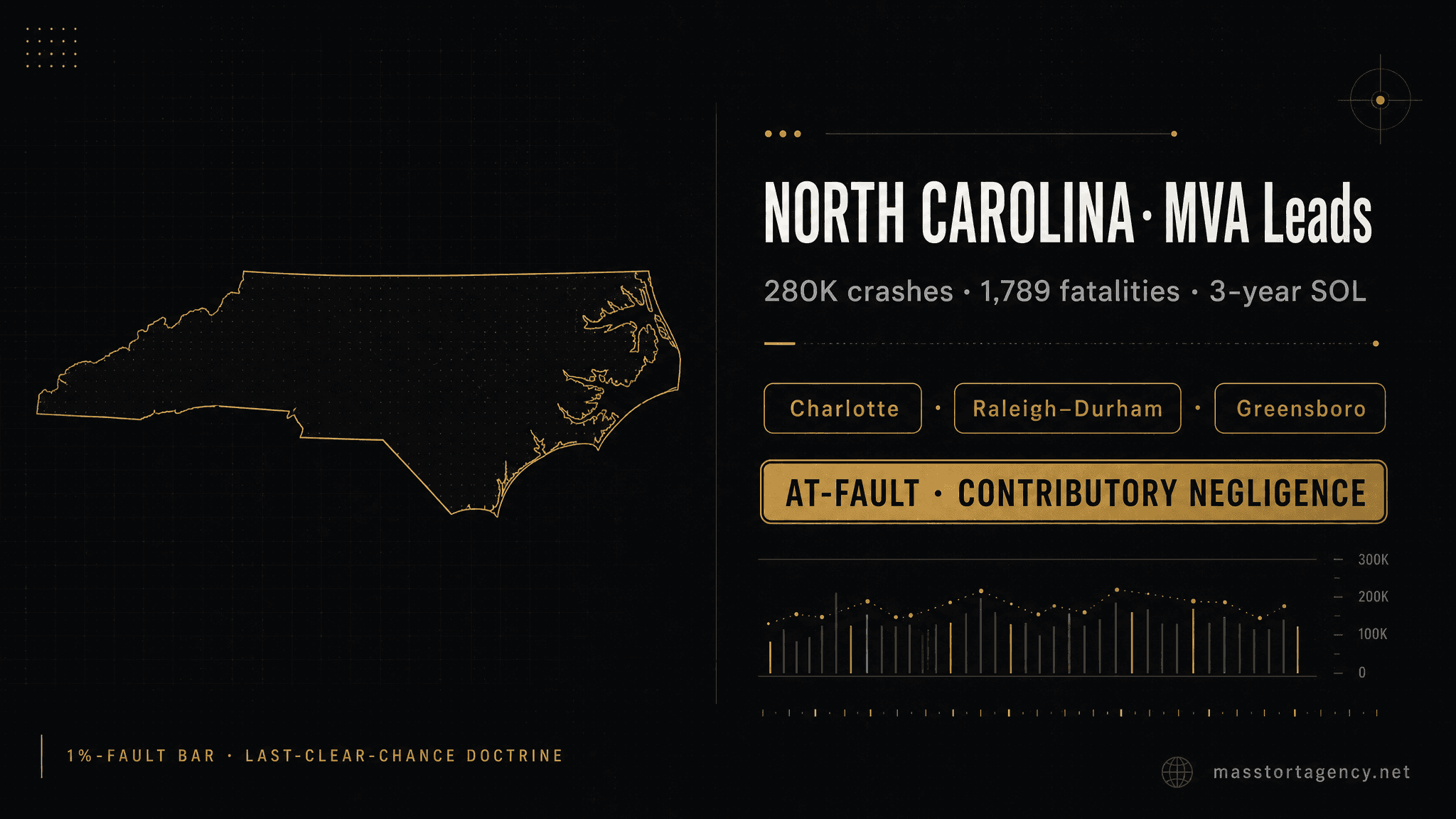
North Carolina is one of four US jurisdictions still using pure contributory negligence — 1% claimant fault bars all recovery. The last-clear-chance doctrine and the doctrine of imputed negligence are the workarounds. Lead vendors who don't engineer for them are quietly burning your CPL.
Southeast
North Carolina · NC
280,000 crashes/yr
North Carolina · Market Size
Source: NHTSA + NC DOT
280,000
Reported crashes / yr
1,789
Annual fatalities
95,400
Injured claimants / yr
10.8M
State population
North Carolina · Quick Reference
The 5 facts that drive North Carolina MVA lead qualification
Liability
At-fault
Negligence
Contributory — 1%
PI SOL
3 years
PIP
Not required
Min. liability
30/60/25
Bottom line · At-fault + pure contributory negligence + 3-year SOL = North Carolina rewards lead vendors who can engineer for the last-clear-chance doctrine and the 0% claimant-fault filter. Treat NC like Georgia and you'll buy leads that wash out at summary judgment.
The opportunity in North Carolina
North Carolina MVA: the 1%-fault problem
North Carolina reports 280,000 traffic crashes annually with 1,789 fatalities — the highest fatality rate per capita among Tier-1 Southeast states. Volume concentrates on the I-40 / I-85 / I-95 spine running Charlotte → Greensboro → Raleigh-Durham, with the Charlotte and Raleigh-Durham metros producing 70,300 reported crashes combined. The state's 10.8M residents drive sustained personal injury volume year-round.
But raw volume hits a structural ceiling in North Carolina: pure contributory negligence. Under Smith v. Fiber Controls Corp. (1980), a claimant even 1% at fault recovers nothing. North Carolina is one of only four US jurisdictions still using this rule (joined by Alabama, Maryland, Virginia, and DC). The practical effect: cases that would convert cleanly under modified-51% (TX/FL/IL) or pure comparative (CA/NY) wash out in NC at the verdict line. Lead qualification has to filter at 0% claimant fault — not just "low fault" — and the documentation chain has to withstand defense-counsel pressure on contributory facts.
Two doctrines mitigate the harshness. The last-clear-chance doctrine — affirmed in North Carolina as recently as Nealy v. Green (1981) and applied throughout 20th-century appellate decisions — allows recovery despite claimant negligence if the defendant had the last clear opportunity to avoid the accident and failed to act. Imputed negligence rules limit when a passenger's own negligence is attributed to them. Qualified MVA leads in NC should be screened for last-clear-chance facts at intake — particularly in commercial-vehicle, pedestrian, and cyclist cases where defendant fault is more visible. The 3-year SOL under N.C.G.S. § 1-52(16) gives more case-management runway than 2-year states.
Liability framework
How North Carolina liability works — and why it matters at intake
Liability system
At-fault
Comparative negligence
Pure contributory negligence
PIP requirement
Not required
PI statute of limitations
3 years
Property damage SOL
3 years
Mandatory liability minimums
30/60/25
(BI per person / per accident / property damage, in thousands)
North Carolina is one of only four U.S. jurisdictions still using pure contributory negligence (along with Alabama, Maryland, Virginia, and DC). A claimant even 1% at fault recovers nothing. This dramatically narrows lead-qualification criteria and raises CPSR.
North Carolina is one of four pure contributory negligence states. Any fault — even 1% — bars recovery completely. This is the most claimant-unfriendly negligence rule in the country and requires aggressive fault-apportionment screening at lead intake.
Where the volume is
Top North Carolina claim markets
Charlotte metro produces 38,900 reported crashes per year — anchored by the I-77 / I-85 / I-485 interchanges and the Charlotte Douglas International Airport corridor. Raleigh-Durham adds 31,400 across the Research Triangle (RTP), with disproportionately high commercial vehicle volume on I-40 / I-85 from RDU airport and the FedEx hub. Greensboro at 15,200 carries the I-40 / I-85 textile-corridor heritage with mixed commercial and passenger volume. Winston-Salem and Fayetteville round out the practical market, with Fayetteville adding Fort Liberty (formerly Fort Bragg) military overlay.
Charlotte
38,900
Raleigh–Durham
31,400
Greensboro
15,200
Winston-Salem
9,600
Fayetteville
8,700
Qualified MVA lead criteria
What "qualified" means in North Carolina
In North Carolina, "qualified" means clearing the contributory-negligence filter at intake — claimant must be at 0% fault, or the fact pattern must support a last-clear-chance theory. The seven criteria below operationalize that filter plus standard documentation. Commercial vehicle cases (where defendant fault is often clearer) and pedestrian/cyclist cases (where the doctrine is more sympathetic) tend to survive the contributory filter at higher rates than passenger rear-end cases.
Accident date & SOL margin
Within 90 days of the wreck. North Carolina's 3-year personal injury SOL compresses the case-management window — older leads burn the firm's pipeline.
North Carolina jurisdiction
Accident occurred in-state with a police report on file. Report number captured at intake.
Fault apportionment
Claimant 0% at fault. North Carolina contributory negligence bars any recovery if claimant is even 1% at fault — strictest rule in the country.
Coverage profile
North Carolina does not mandate PIP. Capture UM/UIM, MedPay, and health insurance status — first-dollar coverage varies widely.
Medical treatment
Active or completed care, with treatment provider documented. Injury severity captures the qualified-lead threshold.
No prior representation
Conflict-check release signed at intake. Lead is the firm's exclusive opportunity.
TCPA consent
Express written consent record on file: IP, timestamp, user agent, consent language all captured.
North Carolina · Pricing benchmarks
What North Carolina MVA leads actually cost in 2026
North Carolina's pricing reflects the contributory-negligence drag. Live-transfer CPL $290–460 looks similar to Georgia or South Carolina, but CPSR runs 18–25% higher because contributory washes out a meaningful slice of leads that would convert under any other negligence rule. The 3-year SOL helps lead-aging math, but the math doesn't help if the underlying case fails on 1% claimant fault. Vendors who price NC like a modified-51% state are selling firms cases that won't sign.
Cost per signed retainer · North Carolina
$1,800–$3,100
· midpoint $2,450
Typical North Carolina CPSR band, inclusive of media + intake + signed-retainer attribution. Variance driven by liability complexity and metro mix, not media cost alone.
CPL by tier
Tier 1 — Live Transfer
$290–$460
CPL · Inbound caller, pre-qualified
Tier 2 — Qualified Form
$120–$220
CPL · Form fill, screened ≤15 min
Tier 3 — Data Lead
$33–$60
CPL · Volume tier, firm-screened
How we operate in North Carolina
Channel mix + compliance
Channels that work in North Carolina
Charlotte carries a meaningful and growing Spanish-speaking population, particularly in Mecklenburg and the surrounding I-77 corridor. Raleigh-Durham has international tech and academic populations (RTP, Duke, UNC) that affect demographic mix but not language demand significantly. Fayetteville's military population drives VA coverage interactions and tricare claim coordination. North Carolina Rule 7.3 follows the standard restriction on in-person and live-telephone solicitation; the State Bar Grievance Committee enforces actively in the Wake County and Mecklenburg disciplinary districts.
TCPA + DPPA · federal
Express written consent records on every outbound contact — timestamp, IP, user agent, consent language. DPPA enforced for any driver-record-derived data.
North Carolina bar advertising rules
North Carolina Rules of Professional Conduct 7.1–7.3. Direct in-person and live-telephone solicitation of MVA victims is restricted — lead vendors must source via opt-in inbound channels only.
North Carolina MVA leads · FAQ
Questions North Carolina firms ask before buying
How does North Carolina's pure contributory negligence affect MVA lead value?
Drastically. North Carolina is one of only four U.S. jurisdictions where any fault by the claimant (even 1%) bars recovery entirely. This means lead qualification has to be much stricter on fault apportionment than in any modified-51% or pure-comparative state. CPSR is correspondingly higher because more leads get washed out in pre-screening.
What's the workaround for North Carolina's contributory negligence rule?
The doctrine of 'last clear chance' — if the defendant had the last clear chance to avoid the accident and failed to take it, the claimant can still recover despite their own negligence. Qualified NC MVA leads should be screened for last-clear-chance facts (e.g., the at-fault driver had time to react but didn't) when contributory negligence is in play.
What's the typical CPL for buying MVA leads in North Carolina?
NC live-transfer runs $290–460 CPL, qualified-form $120–220. CPL is similar to GA/SC, but CPSR is 18–25% higher because contributory negligence washes out leads that would convert in a comparative-negligence state.
How does North Carolina's 3-year SOL compare to the Southeast neighbors?
NC gives 3 years from accident date for both personal injury and property damage — longer than Georgia's 2-year PI SOL, Florida's 2-year PI SOL, and South Carolina's 3-year. The extra time helps lead aging math (older leads remain convertible) but doesn't change the contributory-negligence intake filter.
What MVA case types are most valuable in North Carolina?
Commercial vehicle / trucking cases (federal Hours of Service violations often establish clear defendant fault) and pedestrian / cyclist cases (where defendant fault is more obvious) tend to survive the contributory-negligence filter at higher rates than passenger-vehicle rear-end cases.
Regional MVA markets