
Motor Vehicle Accident Leads in Kentucky
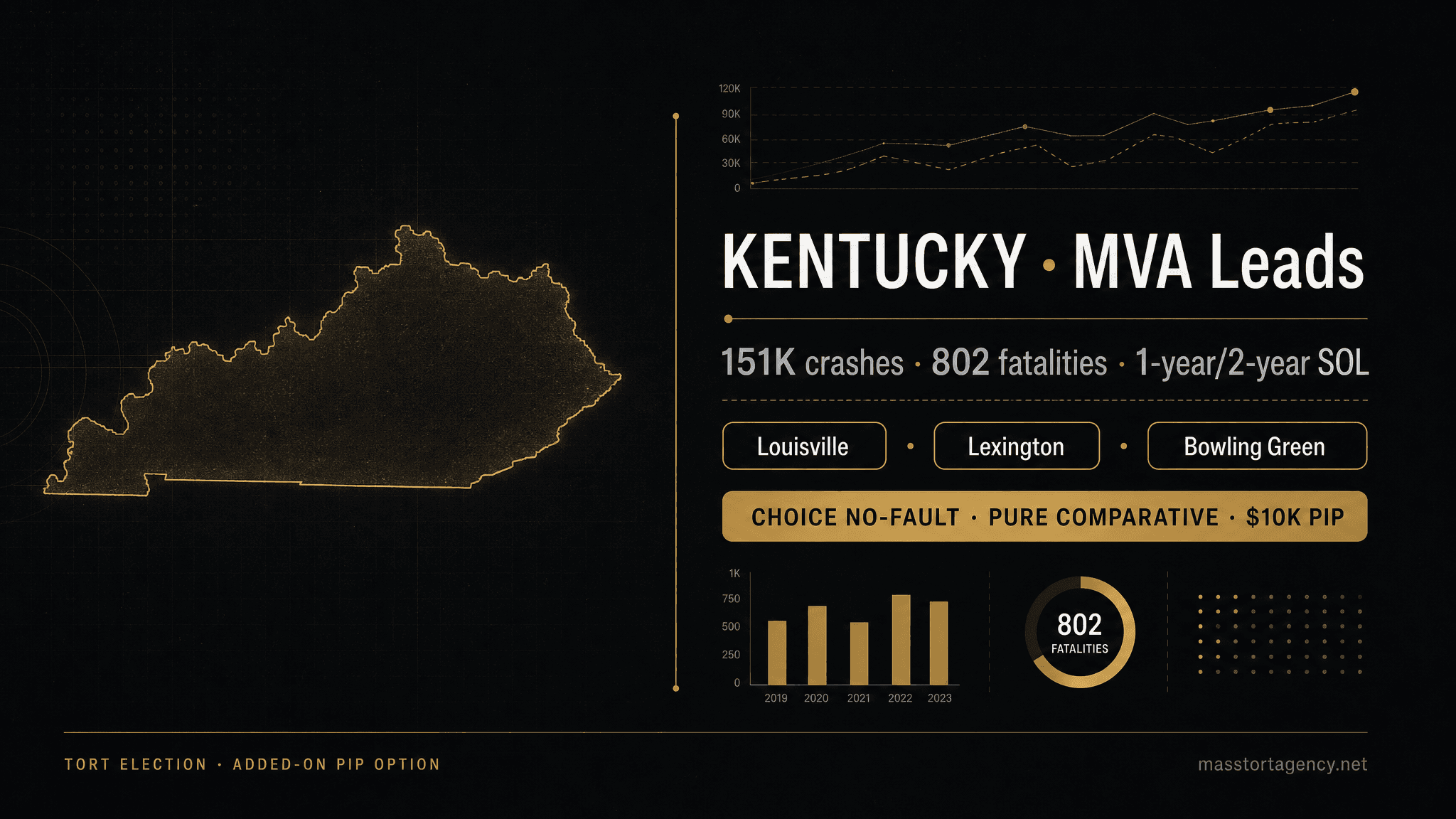
Kentucky is one of just three choice-no-fault states (with PA and NJ) — and every Kentucky auto policy defaults to no-fault unless the driver rejected it in writing before the accident. Combined with a 1-year tort SOL that doesn't start running until the last PIP payment (KMVRA tolling), Kentucky has the country's most unusual case-management runway.
South
Kentucky · KY
151,000 crashes/yr
Kentucky · Market Size
Source: NHTSA + KY DOT
151,000
Reported crashes / yr
802
Annual fatalities
25,400
Injured claimants / yr
4.50M
State population
Kentucky · Quick Reference
The 5 facts that drive Kentucky MVA lead qualification
Liability
Choice no-fault
Negligence
Pure comparative
PI SOL
1 year
PIP
$10,000 req'd
Min. liability
25/50/25
Bottom line · Choice no-fault + 22% rejection rate + 1-year SOL with KMVRA tolling + $1K tort threshold + Louisville UPS commercial volume = Kentucky requires no-fault rejection status AND PIP exhaustion date captured at intake to correctly model both the threshold and the SOL clock. The tolling rule rewards firms that operationalize for it.
The opportunity in Kentucky
Kentucky MVA: choice no-fault + KMVRA tolling
Kentucky reports 138,000 traffic crashes annually with 832 fatalities. Volume concentrates in Louisville-Jefferson County (32,400 crashes/yr) on I-65/I-64/I-71 plus the Watterson Expressway, Lexington-Fayette (18,700) at the I-64/I-75 split, Bowling Green (8,400) on I-65, Owensboro on the Ohio River, and Northern Kentucky (Covington, Newport, Florence) which sits in the Cincinnati DMA and operates as a Cincinnati-suburb media market.
Kentucky's defining MVA qualification filter is the Kentucky Motor Vehicle Reparations Act (KMVRA, KRS 304.39). By default, every Kentucky auto policy includes $10,000 mandatory PIP — and the driver is bound by Kentucky's tort threshold, which requires medical expenses to exceed $1,000, OR a qualifying injury (death, broken bone, permanent disfigurement, permanent injury, or permanent loss of body function). About 22% of Kentucky drivers have rejected no-fault in writing under KRS 304.39-060(4), regaining unlimited tort rights but losing PIP protection. Lead vendors who don't capture no-fault rejection status at intake can't determine whether the threshold applies.
Kentucky uses pure comparative negligence under Hilen v. Hays (1984) — claimants recover at any fault percentage. But the structural quirk that distinguishes Kentucky from every neighbor is the KMVRA tolling rule under KRS 304.39-230(6): the 1-year tort SOL doesn't start running until the latest of (a) the date of the accident or (b) the date of the last PIP payment. The practical effect: PIP exhaustion timing controls when the SOL clock starts. A claimant receiving PIP payments for 18 months post-accident has the 1-year tort SOL start at month 18, not at the accident date. This is the most generous tolling rule in the country.
Liability framework
How Kentucky liability works — and why it matters at intake
Liability system
Choice no-fault
Comparative negligence
Pure comparative negligence
PIP requirement
Required · $10,000 min.
PI statute of limitations
1 year
Property damage SOL
2 years
Mandatory liability minimums
25/50/25
(BI per person / per accident / property damage, in thousands)
Kentucky uses a choice no-fault system (added on, opt-out by written rejection). Default $10,000 PIP unless rejected. Claimants who reject no-fault retain unlimited tort right; those who don't reject are bound by the threshold limitations. Pure comparative negligence applies.
Kentucky uses pure comparative negligence (Hilen v. Hays, 1984). Combined with the choice no-fault structure, KY MVA lead qualification requires capturing whether the claimant rejected no-fault in writing — that election determines tort threshold applicability.
Where the volume is
Top Kentucky claim markets
Louisville-Jefferson County's 32,400 crashes concentrate on I-65/I-64/I-71 and the Sherman Minton, Kennedy, and Lincoln bridges (Ohio River crossings into Indiana). The metro hosts UPS Worldport (the single largest air-cargo hub on Earth), driving disproportionate commercial-vehicle volume and trucking-corridor injury patterns. Lexington-Fayette's 18,700 anchor on I-64/I-75 with horse-industry, Toyota Georgetown manufacturing, and University of Kentucky overlay. Northern Kentucky (Covington, Newport, Florence) sits in the Cincinnati DMA — pricing NoKY means buying Cincinnati media. Bowling Green carries the I-65 / Western Kentucky University academic-population overlay.
Louisville (Jefferson County)
32,400
Lexington–Fayette
18,700
Bowling Green
8,400
Owensboro
5,900
Covington (NoKY)
7,200
Qualified MVA lead criteria
What "qualified" means in Kentucky
In Kentucky, "qualified" requires no-fault rejection status capture at intake (was no-fault rejected in writing before the accident? — determines whether the tort threshold applies). Plus PIP-exhaustion-date capture under KMVRA tolling to correctly compute the SOL window. The seven criteria below operationalize both.
Accident date & SOL margin
Within 90 days of the wreck. Kentucky's 1-year personal injury SOL compresses the case-management window — older leads burn the firm's pipeline.
Kentucky jurisdiction
Accident occurred in-state with a police report on file. Report number captured at intake.
Fault apportionment
Claimant fault percentage captured. Kentucky pure comparative — recovery preserved at any fault level, reduced proportionally.
Coverage profile
PIP confirmed — Kentucky mandates $10,000 minimum. Capture PIP exhaustion status for case-value math.
Medical treatment
Active or completed care, with treatment provider documented. Injury severity captures the qualified-lead threshold.
No prior representation
Conflict-check release signed at intake. Lead is the firm's exclusive opportunity.
TCPA consent
Express written consent record on file: IP, timestamp, user agent, consent language all captured.
Kentucky · Pricing benchmarks
What Kentucky MVA leads actually cost in 2026
Kentucky live-transfer CPL runs $250–405 — comparable to Indiana and Ohio. Louisville commands a 15–20% premium reflecting UPS Worldport commercial-vehicle case-value math; Northern Kentucky runs at Cincinnati DMA pricing (meaningfully more expensive). CPSR $1,500–2,650 holds because the KMVRA tolling rule effectively extends case-management runway beyond the 1-year SOL face value — PIP exhaustion can push the tort clock 12–24+ months from accident date.
Cost per signed retainer · Kentucky
$1,500–$2,600
· midpoint $2,050
Typical Kentucky CPSR band, inclusive of media + intake + signed-retainer attribution. Variance driven by liability complexity and metro mix, not media cost alone.
CPL by tier
Tier 1 — Live Transfer
$255–$405
CPL · Inbound caller, pre-qualified
Tier 2 — Qualified Form
$104–$190
CPL · Form fill, screened ≤15 min
Tier 3 — Data Lead
$30–$52
CPL · Volume tier, firm-screened
How we operate in Kentucky
Channel mix + compliance
Channels that work in Kentucky
Louisville has a meaningful African-American urban media segment (West End, California neighborhood) plus growing Cuban-American population from refugee resettlement. Lexington has Toyota-related Japanese-American population overlay. Northern Kentucky's Cincinnati DMA media buy reaches Ohio claimants — careful jurisdictional capture is essential. Kentucky Rules of Professional Conduct SCR 3.130 (7.1 through 7.5) regulate lawyer advertising; the Office of Bar Counsel enforces. Kentucky is also a strong Coca-Cola distribution / commercial vehicle market — fleet-driver case patterns are common.
TCPA + DPPA · federal
Express written consent records on every outbound contact — timestamp, IP, user agent, consent language. DPPA enforced for any driver-record-derived data.
Kentucky bar advertising rules
Kentucky Rules of Professional Conduct SCR 3.130(7.1)–(7.5). Direct in-person and live-telephone solicitation of MVA victims is restricted — lead vendors must source via opt-in inbound channels only.
Kentucky MVA leads · FAQ
Questions Kentucky firms ask before buying
How does Kentucky's choice no-fault work and what does it mean for MVA leads?
Default: every KY auto policy includes $10K PIP and a tort threshold. To regain unlimited tort rights, the claimant must have rejected no-fault in writing before the accident. About 22% of KY drivers have rejected. Qualified KY MVA leads should capture no-fault rejection status at intake — it determines whether the tort threshold applies.
What is Kentucky's tort threshold under no-fault?
Under KRS 304.39-060, a claimant who hasn't rejected no-fault can sue for pain-and-suffering damages only if they meet one of: $1,000+ in reasonable and necessary medical expenses, OR a permanent disfigurement, OR fracture of a weight-bearing bone, OR a compound/comminuted/displaced/compressed fracture, OR loss of body member, OR permanent injury, OR permanent loss of body function, OR death.
Why does Kentucky's 1-year SOL matter for MVA lead procurement?
Kentucky has a 1-year SOL for personal injury under KRS 413.140(1)(a) — the same as Tennessee, and the shortest in the country. Lead vintage matters enormously: qualified KY leads should be in active intake within 14–30 days of accident date for the case-management math to work.
Does Northern Kentucky use Cincinnati media pricing?
Yes — Kenton, Boone, and Campbell Counties (Northern Kentucky) are in the Cincinnati DMA. About 7% of statewide MVA volume comes from NoKY, with media costs reflecting Cincinnati DMA pricing.
What MVA case types are most valuable in Kentucky?
Commercial vehicle / trucking cases on I-65, I-75, and I-71 (cross-country corridors), drunk-driving cases, and serious-injury passenger vehicle cases in Louisville and Lexington. No-fault-rejection claimants are higher-value because they retain unlimited tort rights without the threshold filter.
Regional MVA markets