
Motor Vehicle Accident Leads in Ohio
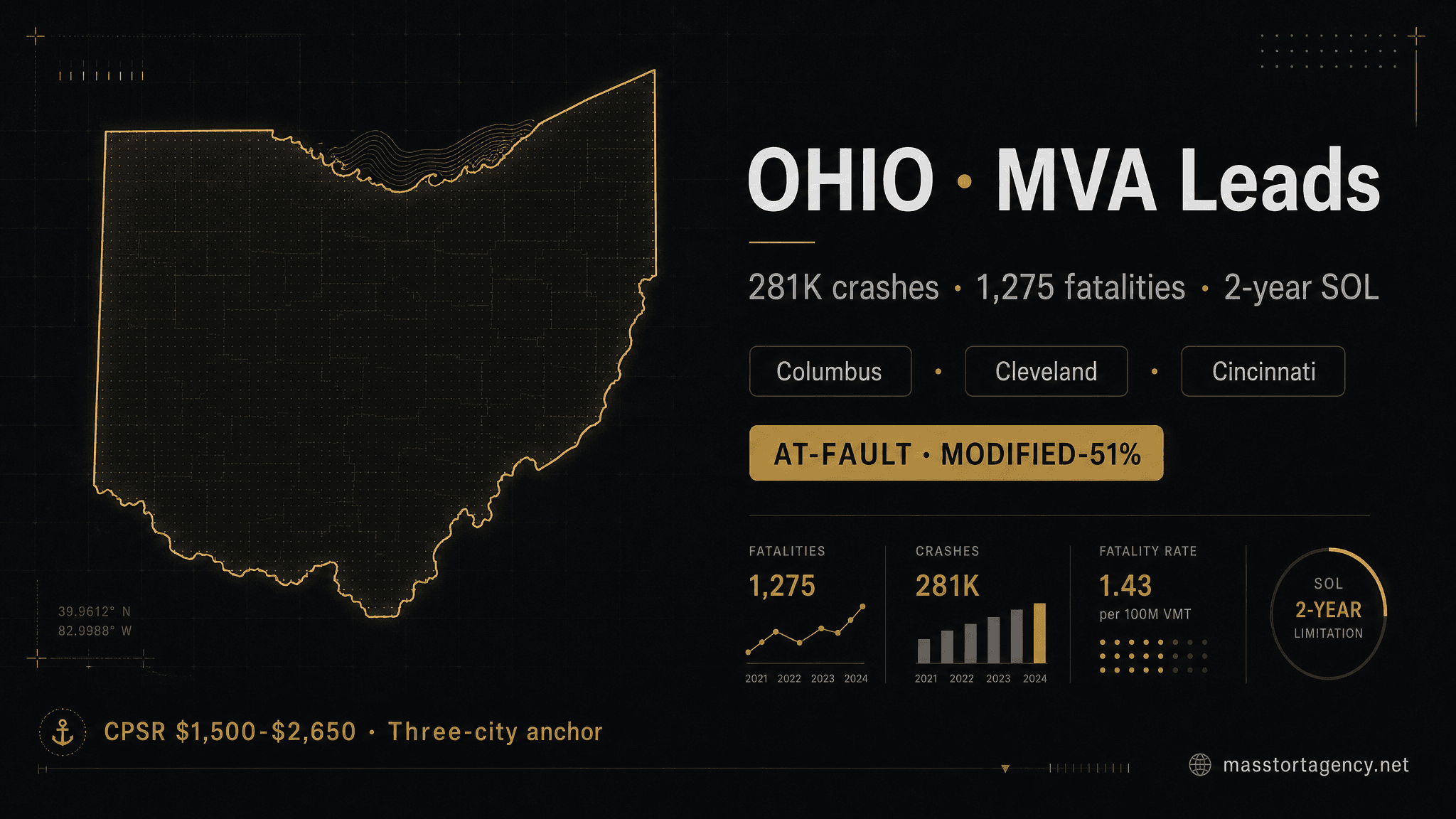
Ohio is a three-city anchor market — Columbus, Cleveland, and Cincinnati together produce 70% of statewide MVA case volume, but each metro carries a different jury pattern and demographic mix. Procurement-grade media planning treats Ohio as three sub-markets in a trench coat.
Midwest
Ohio · OH
281,000 crashes/yr
Ohio · Market Size
Source: NHTSA + OH DOT
281,000
Reported crashes / yr
1,275
Annual fatalities
82,900
Injured claimants / yr
11.8M
State population
Ohio · Quick Reference
The 5 facts that drive Ohio MVA lead qualification
Liability
At-fault
Negligence
51% bar
PI SOL
2 years
PIP
Not required
Min. liability
25/50/25
Bottom line · At-fault + 51% bar + three-city anchor concentration + lowest Tier-1 Midwest CPL = Ohio rewards firms that can model metro mix at intake and run all three DMAs simultaneously. National vendors who treat Ohio as a single market miss the Cleveland verdict premium and the Cincinnati cross-jurisdictional complexity.
The opportunity in Ohio
Ohio MVA: three-city anchor economics
Ohio reports 281,000 traffic crashes annually with 1,275 fatalities. The statewide volume is anchored by three metros that operate as distinct markets: Columbus (36,400 crashes/yr) is the youngest claimant base with disproportionate rideshare volume, anchored by Ohio State University and Nationwide Children's; Cleveland (28,900) carries higher jury verdicts particularly on commercial vehicle cases on I-90 / I-71; Cincinnati (24,200) straddles the Kentucky border and triggers cross-jurisdictional analysis when accidents involve I-71 / I-75 commuter traffic.
Ohio's at-fault framework with the 51% comparative-negligence bar (O.R.C. § 2315.33) converts cleanly when intake captures fault apportionment correctly. The 2-year SOL under O.R.C. § 2305.10 applies to both personal injury and property damage. No PIP mandate — first-dollar coverage varies widely across Ohio drivers, making UM/UIM and MedPay capture essential at intake.
Ohio's structural advantage for buyers is fragmented plaintiff bar competition. Unlike Illinois (Cook County stacked), Florida (four large metros), or Texas (four large metros), Ohio's plaintiff bar splits across three mid-sized cities. The result: live-transfer CPL runs $255–410, the lowest band in the Tier-1 Midwest. The catch: media planning has to run three TV markets simultaneously, and conversion math differs by metro (Cleveland verdicts pull case value up, Columbus rideshare claims pull case mix toward soft tissue).
Liability framework
How Ohio liability works — and why it matters at intake
Liability system
At-fault
Comparative negligence
Modified comparative — 51% bar
PIP requirement
Not required
PI statute of limitations
2 years
Property damage SOL
2 years
Mandatory liability minimums
25/50/25
(BI per person / per accident / property damage, in thousands)
Ohio is at-fault: the responsible driver's carrier pays. No PIP mandate. Mandatory minimum liability is 25/50/25 — middle of the pack. Ohio's modified-51% rule and the three-city anchor structure (Columbus / Cleveland / Cincinnati) drive most of the statewide case volume.
Ohio uses the 51% bar — claimants more than 50% at fault recover nothing. Ohio Civil Rule 49 has the jury allocate fault percentage explicitly, which makes the bar enforceable at the verdict level.
Where the volume is
Top Ohio claim markets
Columbus operates as a tech-corridor and rideshare-heavy metro — Ohio State University, Nationwide Children's, and the Battelle / Honda manufacturing belt drive a younger claimant profile. Cleveland anchors I-90 / I-71 / I-77 commercial vehicle volume with the Cuyahoga County jury pool returning the state's highest MVA verdicts. Cincinnati's tri-state position (OH / KY / IN) triggers cross-jurisdictional issues on I-71 / I-75 with Northern Kentucky commuter traffic. Toledo carries Lake Erie weather-pattern crashes plus I-75 / I-90 commercial truck volume; Akron sits at the I-77 / I-76 interchange with Bridgestone / Goodyear corporate insurance overlap.
Columbus
36,400
Cleveland
28,900
Cincinnati
24,200
Toledo
14,800
Akron
12,300
Qualified MVA lead criteria
What "qualified" means in Ohio
In Ohio, "qualified" means metro-tier sourcing. The seven criteria below operationalize standard at-fault qualification plus the metro-specific filters: Cleveland-county zip codes carry case-value premiums, Cincinnati-area leads need cross-jurisdictional analysis for KY commuter cases, and Columbus leads tilt toward rideshare and commercial-vehicle fact patterns. Lead vendors should report metro mix at delivery, not just lead count.
Accident date & SOL margin
Within 60 days of the wreck. Ohio's 2-year personal injury SOL compresses the case-management window — older leads burn the firm's pipeline.
Ohio jurisdiction
Accident occurred in-state with a police report on file. Report number captured at intake.
Fault apportionment
Claimant 50% or less at fault under Ohio's 51% bar.
Coverage profile
Ohio does not mandate PIP. Capture UM/UIM, MedPay, and health insurance status — first-dollar coverage varies widely.
Medical treatment
Active or completed care, with treatment provider documented. Injury severity captures the qualified-lead threshold.
No prior representation
Conflict-check release signed at intake. Lead is the firm's exclusive opportunity.
TCPA consent
Express written consent record on file: IP, timestamp, user agent, consent language all captured.
Ohio · Pricing benchmarks
What Ohio MVA leads actually cost in 2026
Ohio runs the lowest CPL band among Tier-1 Midwest states. Live-transfer $255–410, qualified-form $105–190 — both 15–20% under Illinois and 18–25% under Michigan. The discount reflects fragmented plaintiff-bar competition across three metros rather than concentration in one. CPSR $1,500–2,650 holds because Ohio's clean at-fault framework converts predictably. The numbers below cover 2024–2026 buy cycles across Columbus, Cleveland, and Cincinnati DMAs.
Cost per signed retainer · Ohio
$1,500–$2,650
· midpoint $2,075
Typical Ohio CPSR band, inclusive of media + intake + signed-retainer attribution. Variance driven by liability complexity and metro mix, not media cost alone.
CPL by tier
Tier 1 — Live Transfer
$255–$410
CPL · Inbound caller, pre-qualified
Tier 2 — Qualified Form
$105–$190
CPL · Form fill, screened ≤15 min
Tier 3 — Data Lead
$30–$52
CPL · Volume tier, firm-screened
How we operate in Ohio
Channel mix + compliance
Channels that work in Ohio
Ohio's three-DMA media planning means buying Columbus, Cleveland, and Cincinnati simultaneously rather than running a single statewide campaign. Linear TV still over-indexes in all three metros at significantly lower CPMs than the coasts. Cleveland has a meaningful Spanish-speaking population in the West Side neighborhoods (Clark-Fulton, Stockyards). Columbus has growing Somali, Bhutanese, and Nepali populations in north and east neighborhoods — multilingual capacity matters even though the percentages are lower than Houston or LA. Ohio Rule 7.3 follows the standard restriction on in-person and live-telephone solicitation.
TCPA + DPPA · federal
Express written consent records on every outbound contact — timestamp, IP, user agent, consent language. DPPA enforced for any driver-record-derived data.
Ohio bar advertising rules
Ohio Rules of Professional Conduct 7.1–7.3. Direct in-person and live-telephone solicitation of MVA victims is restricted — lead vendors must source via opt-in inbound channels only.
Ohio MVA leads · FAQ
Questions Ohio firms ask before buying
How does Ohio split MVA case volume across its three major metros?
Columbus (36K crashes/yr), Cleveland (29K), and Cincinnati (24K) together produce about 70% of statewide MVA case volume. Each metro has distinct claimant demographics and jury patterns — Cleveland tends toward higher verdicts on commercial vehicle cases; Columbus has a younger claimant base and more rideshare cases; Cincinnati straddles the Kentucky border, which complicates jurisdictional analysis.
What's the typical CPL for buying MVA leads in Ohio?
Ohio runs $255–410 CPL on live-transfer and $105–190 on qualified-form — the lowest CPL band among the Tier 1 Midwest states because plaintiff bar competition is fragmented across three metros instead of concentrated in one.
Are Ohio MVA leads SOL'd at 2 years like Florida and Texas?
Yes — 2 years for both personal injury and property damage under O.R.C. § 2305.10. Discovery rule applies in limited circumstances (e.g., latent injury), but most MVA leads have a 2-year window from accident date to filing.
Does Ohio's lack of PIP mandate affect lead conversion math?
Yes — many Ohio drivers carry only the state minimum 25/50/25 liability with no PIP or MedPay, which means the medical-bills documentation has to come from the claimant directly (or from a treating provider's lien). Qualified Ohio MVA leads should capture insurance status (UM/UIM, MedPay, health insurance coordination) at intake.
What channels work best for MVA lead generation in Ohio?
Linear TV remains effective in Ohio at lower cost-per-thousand than NYC or LA. OTT (Hulu, YouTube TV) over-indexes in Columbus due to the younger demographic. Meta + Google Search drive most qualified-form volume. Spanish-language media is less impactful than in TX/CA/FL but Cleveland has a meaningful Spanish-speaking population.
Regional MVA markets