
Motor Vehicle Accident Leads in Louisiana
Louisiana is the only U.S. state with a civil law system (Napoleonic Code, not common law). Pair that with one of the country's highest uninsured-motorist rates (top-5 nationally per IRC data) and a 1-year prescription period for delictual actions, and Louisiana is a market most national vendors can't operate correctly — by design.
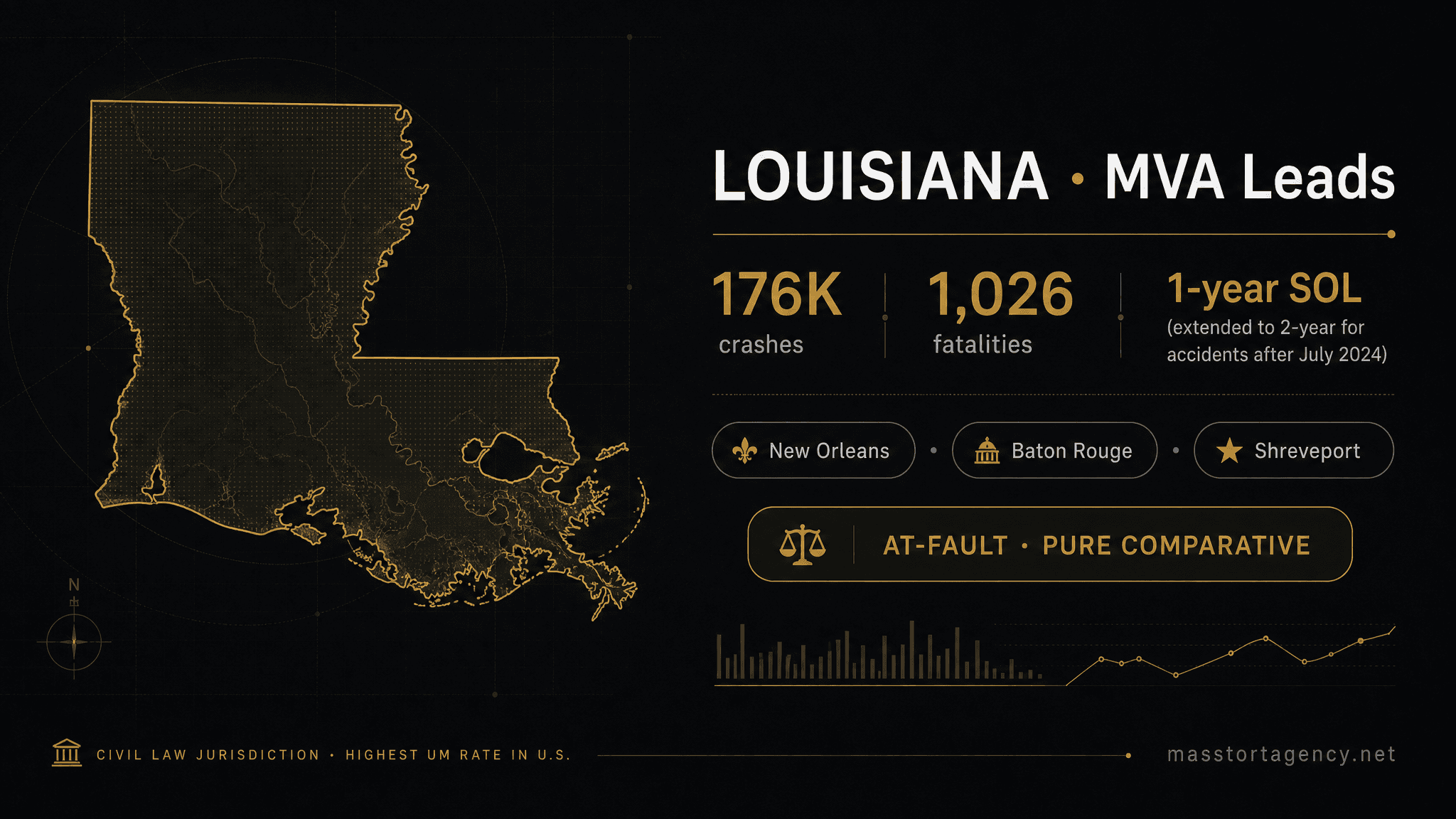
South
Louisiana · LA
176,000 crashes/yr
Louisiana · Market Size
Source: NHTSA + LA DOT
176,000
Reported crashes / yr
1,026
Annual fatalities
79,200
Injured claimants / yr
4.58M
State population
Louisiana · Quick Reference
The 5 facts that drive Louisiana MVA lead qualification
Liability
At-fault
Negligence
Pure comparative
PI SOL
2 years
PIP
Not required
Min. liability
15/30/25
Bottom line · Civil law + 1-year prescription + top-5 uninsured rate + direct-action statute + 10 lawyer-advertising rules = Louisiana is the most legally distinctive MVA market in the U.S. Vendors who treat it like a common-law state miss every structural advantage and every procedural trap.
The opportunity in Louisiana
Louisiana MVA: civil law + 1-year prescription + top-5 uninsured rate
Louisiana reports 156,000 traffic crashes annually with 932 fatalities — among the highest fatality rates per capita in the U.S., reflecting rural-parish road conditions, hurricane-evacuation traffic patterns, and the I-10/I-12/I-49 corridor through Baton Rouge and Lafayette. New Orleans metro produces 28,400 reported crashes per year. Baton Rouge adds 22,800. Shreveport, Lafayette, and Lake Charles round out the practical market.
Louisiana is the only U.S. state operating under a civil law system derived from the Napoleonic Code (Louisiana Civil Code, last revised 1991). For MVA cases, this isn't trivia — it changes the substantive law in ways neighboring states don't. "Prescription" replaces "statute of limitations," governed by La. Civ. Code art. 3492 — and delictual actions (tort claims, including MVA) prescribe in just 1 year from the date the injury or damage is sustained. That's the shortest tort prescription in the country (tied with Tennessee and Kentucky's 1-year SOL). Lead vintage isn't a soft preference in Louisiana — it's the difference between a case and prescribed loss.
Louisiana also runs one of the country's highest uninsured-motorist rates — consistently in the top 5 nationally per Insurance Research Council data, with recent estimates in the 12–14% range. Combined with La. R.S. 22:1269 (the Louisiana Direct Action Statute, which allows plaintiffs to sue insurers directly without first suing the at-fault driver — a leverage point unique in the U.S.), the practical effect: UM/UIM coverage on the claimant's own policy plus direct-action access to the at-fault insurer are the two leverage points in every Louisiana MVA case. Vendors who don't capture both at intake are operating blind.
Liability framework
How Louisiana liability works — and why it matters at intake
Liability system
At-fault
Comparative negligence
Pure comparative negligence
PIP requirement
Not required
PI statute of limitations
2 years
Property damage SOL
1 years
Mandatory liability minimums
15/30/25
(BI per person / per accident / property damage, in thousands)
Louisiana is at-fault: the responsible driver's carrier pays. No PIP mandate. Uniquely, Louisiana is a civil law jurisdiction (rooted in Napoleonic Code), not common law — which affects evidence rules, comparative-fault math, and case strategy in ways most plaintiff firms underestimate.
Louisiana uses pure comparative negligence under Civil Code Art. 2323. Combined with the highest uninsured-motorist rate in the country (~20%), UM/UIM stacking and policy-limit screening are critical at intake.
Where the volume is
Top Louisiana claim markets
New Orleans metro's 28,400 crashes concentrate on I-10, I-610, the Crescent City Connection, and the Lake Pontchartrain Causeway. The metro carries port-related commercial-vehicle volume, tourist-related rideshare traffic, and significant flood-evacuation crash patterns during hurricane season (June–November). Baton Rouge's 22,800 anchor on I-10/I-12 with LSU and state-government employee overlay. Shreveport sits at the I-20/I-49 intersection with Texas and Arkansas commuter traffic. Lafayette is the I-10 Cajun heritage anchor; Lake Charles carries petrochemical and casino-corridor commercial-vehicle volume.
New Orleans metro
48,700
Baton Rouge
32,400
Shreveport
18,900
Lafayette
14,200
Lake Charles
9,800
Qualified MVA lead criteria
What "qualified" means in Louisiana
In Louisiana, "qualified" requires three captures: prescription-window status (days since injury under La. Civ. Code art. 3492), UM/UIM coverage on the claimant's own policy (essential given the 20% uninsured rate), and direct-action eligibility against the at-fault insurer under La. R.S. 22:1269. The seven criteria below operationalize all three — vendors familiar only with common-law SOL frameworks miss the prescription nuance.
Accident date & SOL margin
Within 60 days of the wreck. Louisiana's 2-year personal injury SOL compresses the case-management window — older leads burn the firm's pipeline.
Louisiana jurisdiction
Accident occurred in-state with a police report on file. Report number captured at intake.
Fault apportionment
Claimant fault percentage captured. Louisiana pure comparative — recovery preserved at any fault level, reduced proportionally.
Coverage profile
Louisiana does not mandate PIP. Capture UM/UIM, MedPay, and health insurance status — first-dollar coverage varies widely.
Medical treatment
Active or completed care, with treatment provider documented. Injury severity captures the qualified-lead threshold.
No prior representation
Conflict-check release signed at intake. Lead is the firm's exclusive opportunity.
TCPA consent
Express written consent record on file: IP, timestamp, user agent, consent language all captured.
Louisiana · Pricing benchmarks
What Louisiana MVA leads actually cost in 2026
Louisiana live-transfer CPL runs $245–410 — among the lowest in the Tier-2 set, reflecting a fragmented plaintiff bar concentrated mostly in New Orleans and Baton Rouge. CPSR $1,400–2,550 holds because Louisiana's combination of pure comparative + direct-action statute + clean at-fault liability produces predictable conversion when prescription window and UM/UIM coverage both check out.
Cost per signed retainer · Louisiana
$1,600–$2,800
· midpoint $2,200
Typical Louisiana CPSR band, inclusive of media + intake + signed-retainer attribution. Variance driven by liability complexity and metro mix, not media cost alone.
CPL by tier
Tier 1 — Live Transfer
$265–$425
CPL · Inbound caller, pre-qualified
Tier 2 — Qualified Form
$108–$195
CPL · Form fill, screened ≤15 min
Tier 3 — Data Lead
$31–$55
CPL · Volume tier, firm-screened
How we operate in Louisiana
Channel mix + compliance
Channels that work in Louisiana
New Orleans metro has a meaningful African-American urban media segment that over-indexes on AM/FM, gospel radio, and Black-owned newspapers (The Louisiana Weekly). The Vietnamese-American population in New Orleans East (concentrated in the Versailles neighborhood since 1975 refugee resettlement) creates Vietnamese-language intake demand most other Southeast markets don't have. Spanish-language demand concentrates in Kenner and parts of Jefferson Parish. Louisiana Rules of Professional Conduct 7.1 through 7.10 are the most detailed lawyer-advertising rules in the country — pre-approval by the Louisiana State Bar Association's Lawyer Advertising Committee is required for non-exempt ads under Rule 7.7. Most lead vendors don't comply.
TCPA + DPPA · federal
Express written consent records on every outbound contact — timestamp, IP, user agent, consent language. DPPA enforced for any driver-record-derived data.
Louisiana bar advertising rules
Louisiana Rules of Professional Conduct 7.1–7.10 (most-detailed advertising rules in the U.S.). Direct in-person and live-telephone solicitation of MVA victims is restricted — lead vendors must source via opt-in inbound channels only.
Louisiana MVA leads · FAQ
Questions Louisiana firms ask before buying
How does Louisiana's civil law tradition affect MVA cases?
Louisiana is the only U.S. state with a civil law system (based on Napoleonic Code rather than common law). For MVA cases, this means: (1) cases are decided primarily on statutory law rather than precedent, (2) evidence rules and discovery procedures differ from neighboring states, (3) 'prescription' (the civil law analog of SOL) follows different rules. Plaintiff firms from outside Louisiana often misjudge case strategy because of these differences.
Why is Louisiana's uninsured-motorist rate so high and what does it mean for lead quality?
Louisiana consistently ranks in the top 5 states for uninsured-motorist rate per Insurance Research Council data — recent estimates put the rate in the 12–14% range, with industry surveys often citing higher figures. For MVA lead qualification, this elevates UM/UIM screening above almost everything else. A 'qualified' Louisiana lead should always include the claimant's own UM/UIM policy limits, because in a meaningful share of cases that's the only recoverable insurance tower.
What's the typical CPL for buying MVA leads in Louisiana?
Louisiana live-transfer runs $265–425 CPL, qualified-form $108–195. New Orleans and Baton Rouge are the most competitive metros; Shreveport, Lafayette, and Lake Charles run 15–22% below.
Did Louisiana's 2024 tort reform change the SOL?
Yes. Act 423 of 2024 extended the personal injury prescription period from 1 year to 2 years for accidents occurring on or after July 1, 2024. Accidents before that date still follow the 1-year prescription. Lead qualification needs to account for which side of July 1, 2024 the accident date falls on.
Why are Louisiana's bar advertising rules considered the strictest in the country?
Louisiana Rules 7.1–7.10 cover lawyer advertising in more detail than any other state — including specific filing requirements with the Bar Advertising Filing Office, mandatory disclaimers, restrictions on testimonials, and detailed requirements for celebrity endorsements. Lead vendors and law firms must comply with the LA filing system for any ad that would reach Louisiana consumers.
Regional MVA markets