
Motor Vehicle Accident Leads in Texas
Texas runs the largest MVA market in the U.S. — 614,000 reported crashes a year. But with a 14% uninsured-motorist rate and an optional-PIP framework, UM/UIM screening at intake is the line between a signed retainer and an unrecoverable case.
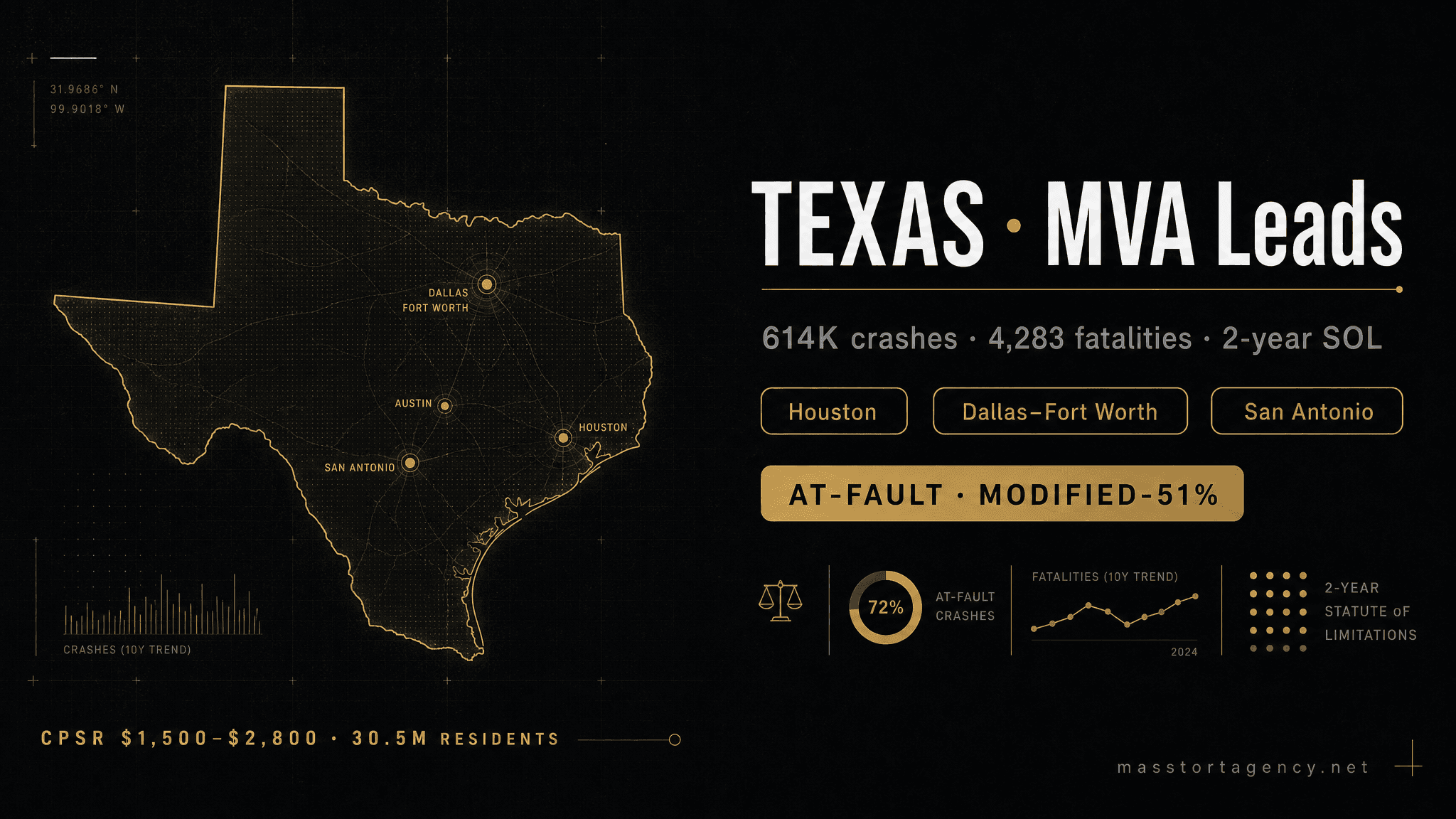
Southwest
Texas · TX
614,000 crashes/yr
Texas · Market Size
Source: NHTSA + TX DOT
614,000
Reported crashes / yr
4,283
Annual fatalities
240,800
Injured claimants / yr
30.5M
State population
Texas · Quick Reference
The 5 facts that drive Texas MVA lead qualification
Liability
At-fault
Negligence
51% bar
PI SOL
2 years
PIP
Not required
Min. liability
30/60/25
Bottom line · At-fault + 51% bar + 14% uninsured-motorist rate = UM/UIM screening at intake is non-negotiable. Texas's volume advantage doesn't help if the at-fault driver can't pay.
The opportunity in Texas
Texas MVA: volume meets the UM/UIM bottleneck
Texas is the largest MVA market in the United States by raw volume — 614,000 reported crashes annually, roughly 56% more than second-place Florida. The volume concentrates along the Texas Triangle: I-10 running Houston → San Antonio → El Paso, I-35 running Dallas → Austin → San Antonio, and I-45 running Houston → Dallas. Houston metro alone produces 73,500 reported crashes per year; the DFW metroplex produces 88,200 across its two anchor cities.
But Texas volume hides a structural defect. The Insurance Research Council's 2024 study estimates 14% of Texas drivers carry no liability insurance — one of the highest uninsured rates in the country. PIP is offered as part of Texas's standard auto coverage framework (Tex. Ins. Code ch. 1952) but is rejectable in writing, and a meaningful share of Texas drivers opt out. The practical effect: a claimant injured by an uninsured at-fault driver has no recovery against the at-fault carrier and must rely on their own UM/UIM coverage, MedPay, or health insurance. Lead vendors who don't capture UM/UIM coverage status at intake are quietly selling firms cases with hidden coverage cliffs.
Texas's 51% Proportionate Responsibility bar (Chapter 33, Civil Practice & Remedies Code) layers a second filter on top of the coverage question. Claimants more than 50% at fault recover nothing. Combined with the 2-year SOL on both personal injury and property damage, the qualified-lead window in Texas compresses to roughly 30 days from accident date for live-transfer pricing economics to work cleanly through intake.
Liability framework
How Texas liability works — and why it matters at intake
Liability system
At-fault
Comparative negligence
Modified comparative — 51% bar
PIP requirement
Not required
PI statute of limitations
2 years
Property damage SOL
2 years
Mandatory liability minimums
30/60/25
(BI per person / per accident / property damage, in thousands)
Texas is a pure at-fault state — the driver who caused the wreck (or their carrier) pays. There is no PIP mandate, although carriers must offer it; opt-out PIP coverage is common, which affects how 'qualified' is defined at intake.
Texas uses the 51% bar (Proportionate Responsibility): a claimant more than 50% at fault recovers nothing. Damages are reduced by the claimant's own fault percentage up to that bar.
Where the volume is
Top Texas claim markets
Texas MVA volume runs along the Texas Triangle — Houston, DFW, San Antonio, Austin — plus a fourth corridor at El Paso along the I-10 / Mexico border. Each anchor metro carries a distinct claimant profile: Houston is petrochemical and ship-channel heavy with disproportionately high commercial-vehicle case values; the DFW metroplex is the country's largest rideshare market by daily trips; San Antonio is military-heavy (Fort Sam Houston + Joint Base San Antonio) with VA coverage interactions; Austin is a tech-corridor influx with younger claimants and disproportionately high rideshare/scooter incidents; El Paso carries cross-border jurisdictional complexity with Mexico.
Houston
73,500
Dallas–Fort Worth
88,200
San Antonio
38,800
Austin–Round Rock
27,900
El Paso
14,200
Qualified MVA lead criteria
What "qualified" means in Texas
In Texas, "qualified" means clearing three gates: coverage (UM/UIM and MedPay status confirmed at intake), fault (≤50% under the 51% Proportionate Responsibility bar), and severity (medical treatment underway with documented runway under the 2-year SOL). The seven criteria below operationalize all three — including UM/UIM data capture that national vendors routinely skip.
Accident date & SOL margin
Within 60 days of the wreck. Texas's 2-year personal injury SOL compresses the case-management window — older leads burn the firm's pipeline.
Texas jurisdiction
Accident occurred in-state with a police report on file. Report number captured at intake.
Fault apportionment
Claimant 50% or less at fault under Texas's 51% bar.
Coverage profile
Texas does not mandate PIP. Capture UM/UIM, MedPay, and health insurance status — first-dollar coverage varies widely.
Medical treatment
Active or completed care, with treatment provider documented. Injury severity captures the qualified-lead threshold.
No prior representation
Conflict-check release signed at intake. Lead is the firm's exclusive opportunity.
TCPA consent
Express written consent record on file: IP, timestamp, user agent, consent language all captured.
Texas · Pricing benchmarks
What Texas MVA leads actually cost in 2026
Texas live-transfer CPL runs 12–25% under California for similar fact patterns, primarily because plaintiff-bar concentration is fragmented across four metros instead of stacked into a single Los Angeles market. CPSR is competitive with Florida because Texas's clean at-fault framework converts predictably — when liability is established and coverage is in place, retainers sign at consistent rates. The numbers below reflect 2024–2026 Texas buy cycles across Houston, DFW, San Antonio, and the Rio Grande Valley.
Cost per signed retainer · Texas
$1,500–$2,800
· midpoint $2,150
Typical Texas CPSR band, inclusive of media + intake + signed-retainer attribution. Variance driven by liability complexity and metro mix, not media cost alone.
CPL by tier
Tier 1 — Live Transfer
$275–$450
CPL · Inbound caller, pre-qualified
Tier 2 — Qualified Form
$110–$200
CPL · Form fill, screened ≤15 min
Tier 3 — Data Lead
$30–$55
CPL · Volume tier, firm-screened
How we operate in Texas
Channel mix + compliance
Channels that work in Texas
Texas is a bilingual-first market. Spanish-language intake is the structural baseline across the Rio Grande Valley (McAllen, Harlingen, Laredo), San Antonio, and the Hispanic-population belts of Houston and DFW. Bilingual CPL runs 10–18% higher than English-only but signed-retainer rate runs 6–9 points higher because vendor competition is thinner. Texas Disciplinary Rule 7.02 also requires ad pre-approval by the State Bar's Advertising Review Committee for non-exempt formats — a regulatory step most lead vendors skip and we don't.
TCPA + DPPA · federal
Express written consent records on every outbound contact — timestamp, IP, user agent, consent language. DPPA enforced for any driver-record-derived data.
Texas bar advertising rules
Texas Disciplinary Rules of Professional Conduct Part VII (Information About Legal Services). Direct in-person and live-telephone solicitation of MVA victims is restricted — lead vendors must source via opt-in inbound channels only.
Texas MVA leads · FAQ
Questions Texas firms ask before buying
What's the difference between buying MVA leads in Texas vs Florida?
Texas is at-fault: the at-fault driver's liability carrier pays. Florida is no-fault: the claimant's own PIP pays first, and they must meet a serious-injury threshold to step outside PIP. Lead qualification in Texas focuses on fault percentage (must be ≤50% to recover); in Florida it focuses on injury severity meeting the threshold.
Does Texas's lack of mandatory PIP affect MVA lead quality?
Yes — meaningfully. Many Texas drivers opt out of the offered PIP, so claimants without their own PIP rely entirely on the at-fault carrier and their own UM/UIM coverage. Lead vendors should capture both PIP-status and UM/UIM-status at intake to predict recoverable damages, because uninsured/underinsured drivers cause ~14% of Texas crashes.
What's the typical CPL for buying MVA leads in Texas?
Texas runs $275–450 CPL for live-transfer and $110–200 CPL for qualified form. Houston and DFW are the most competitive metros (top of the band); secondary metros like El Paso and Lubbock are 15–20% under the band.
How long do I have to convert a Texas MVA lead before SOL runs out?
Two years from the date of the wreck for personal injury and for property damage. That's a tighter window than the 3-year SOLs in NY, NC, or MI — qualified-form Texas leads need to be in active intake within 30 days of accident date for the conversion math to work.
Are Spanish-language MVA leads more expensive in Texas?
Roughly 10–18% higher CPL because the intake premium is higher (bilingual qualifying), but signed-retainer rate runs 6–9 points above English-language leads in Houston, DFW, and the Rio Grande Valley because of less competition for that segment.
What does the Texas State Bar require for MVA lead advertising compliance?
Texas Disciplinary Rule 7.02 (Communications About Services) and Rule 7.03 (Solicitation) govern. Lawyer ads must be approved by the State Bar's Advertising Review Committee for non-exempt ads, and direct in-person solicitation of an MVA victim within 30 days of the accident is prohibited unless the lawyer is responding to the prospect's specific request.
Texas metro markets
MVA leads by Texas metro
Regional MVA markets