
Motor Vehicle Accident Leads in Missouri
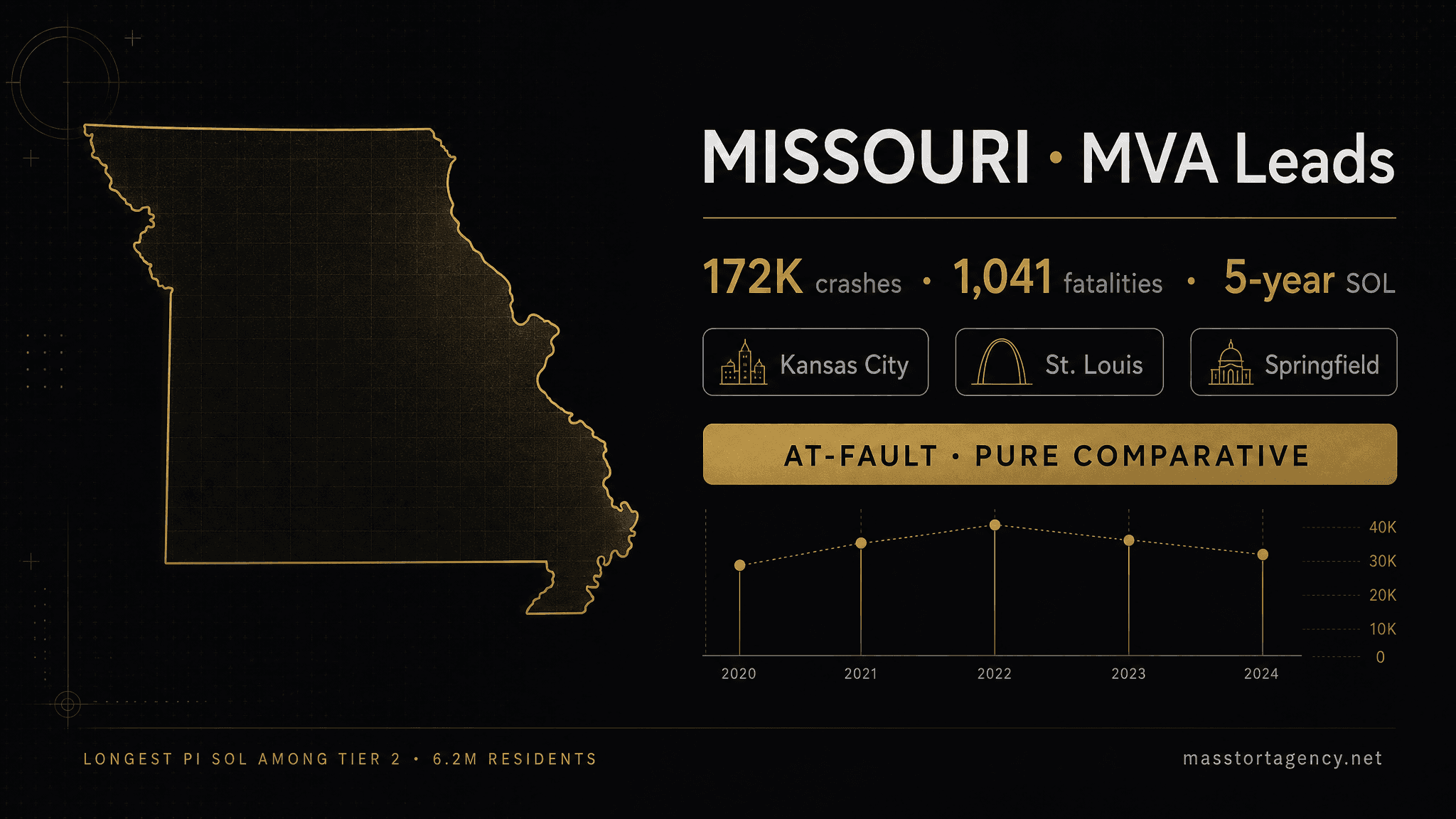
Missouri gives plaintiff firms the longest personal injury runway in the country at 5 years (Mo. Rev. Stat. § 516.120). Combined with pure comparative negligence and the bimodal Kansas City / St. Louis market structure, Missouri rewards firms that can convert older lead vintage where most states would already be SOL-barred.
Midwest
Missouri · MO
172,000 crashes/yr
Missouri · Market Size
Source: NHTSA + MO DOT
172,000
Reported crashes / yr
1,041
Annual fatalities
50,700
Injured claimants / yr
6.20M
State population
Missouri · Quick Reference
The 5 facts that drive Missouri MVA lead qualification
Liability
At-fault
Negligence
Pure comparative
PI SOL
5 years
PIP
Not required
Min. liability
25/50/25
Bottom line · At-fault + pure comparative + 5-year SOL + bimodal KC/STL with cross-border jurisdictional capture = Missouri gives plaintiff firms the country's roomiest case-management runway. Older leads still convert here — vendors who specialize in vintage data tiers should price Missouri accordingly.
The opportunity in Missouri
Missouri MVA: the 5-year SOL runway
Missouri reports 142,000 traffic crashes annually with 988 fatalities. Volume splits across two distinct metropolitan markets sitting on opposite borders of the state: Kansas City metro (38,400 crashes/yr) on the Missouri-Kansas border with the I-70/I-35/I-435 interchange complex; and St. Louis metro (35,900) on the Missouri-Illinois border with I-70/I-64/I-44 and the Mississippi River bridge crossings. Springfield, Columbia, and Jefferson City make up the rest of the practical market.
Missouri's structural advantage is the longest personal injury SOL among comparable states — 5 years under Mo. Rev. Stat. § 516.120. Combined with the property damage SOL also at 5 years, Missouri gives plaintiff firms 2.5x the case-management runway of Florida or Texas (2 years), and 5x the runway of Tennessee, Louisiana, or Kentucky (1 year). Lead-aging math is fundamentally different: a Missouri lead 12–18 months post-accident is still convertible, where the same lead would be expired in any 1-year state and expiring in any 2-year state. This makes Missouri a strong market for data-tier and qualified-form leads sold from older claim pools.
Missouri uses pure comparative negligence under Mo. Rev. Stat. § 537.765 — claimants recover at any fault percentage, damages reduced proportionally. The state's bimodal market structure creates jurisdictional complexity: KC-area accidents frequently involve Kansas drivers (Johnson County, Wyandotte County); St. Louis-area accidents frequently involve Illinois drivers (Madison, St. Clair counties on the IL side). Lead vendors must capture jurisdictional facts cleanly because choice-of-law analysis can flip the comparative-negligence rule applied (Kansas is modified-49%; Illinois is modified-51%).
Liability framework
How Missouri liability works — and why it matters at intake
Liability system
At-fault
Comparative negligence
Pure comparative negligence
PIP requirement
Not required
PI statute of limitations
5 years
Property damage SOL
5 years
Mandatory liability minimums
25/50/25
(BI per person / per accident / property damage, in thousands)
Missouri is at-fault: the responsible driver's carrier pays. No PIP mandate. Missouri uses pure comparative negligence and has one of the longer personal injury SOLs at 5 years — the longest among Tier 2 states — giving lead aging math significant runway.
Missouri uses pure comparative negligence (Gustafson v. Benda, 1983). A claimant 80% at fault still recovers 20% of damages. Combined with the 5-year SOL, MO offers the most flexible lead-vintage tolerance among Tier 2.
Where the volume is
Top Missouri claim markets
Kansas City metro's 38,400 crashes concentrate on I-70, I-35, I-29, and the I-435 outer loop. The metro includes both Missouri-side counties (Jackson, Clay, Platte) and Kansas-side counties (Johnson, Wyandotte) — cross-border jurisdictional analysis is essential. St. Louis metro's 35,900 split between Missouri-side (St. Louis City, St. Louis County, St. Charles) and Illinois-side metro East (Madison, St. Clair counties). Springfield anchors the I-44 / US-65 commercial corridor; Columbia sits at the I-70 / US-63 split with University of Missouri academic-population overlay; Jefferson City carries state-government-employee claimants.
Kansas City
38,400
St. Louis
35,900
Springfield
12,800
Columbia
6,400
Jefferson City
4,200
Qualified MVA lead criteria
What "qualified" means in Missouri
In Missouri, "qualified" benefits from the 5-year SOL flexibility — leads up to 24 months post-accident can still convert cleanly. But the bimodal KC/STL market makes jurisdictional capture essential: cross-border cases with Kansas or Illinois drivers trigger choice-of-law analysis that can flip the negligence framework. The seven criteria below operationalize standard at-fault qualification plus the jurisdictional capture that Missouri specifically requires.
Accident date & SOL margin
Within 90 days of the wreck. Missouri's 5-year personal injury SOL compresses the case-management window — older leads burn the firm's pipeline.
Missouri jurisdiction
Accident occurred in-state with a police report on file. Report number captured at intake.
Fault apportionment
Claimant fault percentage captured. Missouri pure comparative — recovery preserved at any fault level, reduced proportionally.
Coverage profile
Missouri does not mandate PIP. Capture UM/UIM, MedPay, and health insurance status — first-dollar coverage varies widely.
Medical treatment
Active or completed care, with treatment provider documented. Injury severity captures the qualified-lead threshold.
No prior representation
Conflict-check release signed at intake. Lead is the firm's exclusive opportunity.
TCPA consent
Express written consent record on file: IP, timestamp, user agent, consent language all captured.
Missouri · Pricing benchmarks
What Missouri MVA leads actually cost in 2026
Missouri live-transfer CPL runs $260–415 — comparable to Ohio and Indiana. The 5-year SOL drives down the urgency premium versus 1- and 2-year states, allowing vendors to monetize older claim data tiers more aggressively. CPSR $1,550–2,700 holds because pure comparative + clean at-fault conversion + roomy SOL window produces the most predictable case economics among Tier-2 states.
Cost per signed retainer · Missouri
$1,550–$2,700
· midpoint $2,125
Typical Missouri CPSR band, inclusive of media + intake + signed-retainer attribution. Variance driven by liability complexity and metro mix, not media cost alone.
CPL by tier
Tier 1 — Live Transfer
$260–$415
CPL · Inbound caller, pre-qualified
Tier 2 — Qualified Form
$106–$195
CPL · Form fill, screened ≤15 min
Tier 3 — Data Lead
$31–$54
CPL · Volume tier, firm-screened
How we operate in Missouri
Channel mix + compliance
Channels that work in Missouri
Kansas City has a meaningful African-American urban media segment (north and east KC) plus growing Spanish-language demand on the Kansas side. St. Louis has a meaningful Bosnian-American population in South City (the largest Bosnian community outside of Sarajevo and Bosnia itself) — Bosnian-language intake matters in zip codes 63116 and 63139. Springfield carries Ozark country/talk radio dominance. Missouri Rule 4-7.3 restricts in-person and live-telephone solicitation; the Office of Chief Disciplinary Counsel enforces. Missouri also has unique "Bauer letter" practice — pre-suit demand letters in MVA cases trigger specific insurer-response obligations under Mo. Rev. Stat. § 537.058.
TCPA + DPPA · federal
Express written consent records on every outbound contact — timestamp, IP, user agent, consent language. DPPA enforced for any driver-record-derived data.
Missouri bar advertising rules
Missouri Rules of Professional Conduct 4-7.1 to 4-7.5. Direct in-person and live-telephone solicitation of MVA victims is restricted — lead vendors must source via opt-in inbound channels only.
Missouri MVA leads · FAQ
Questions Missouri firms ask before buying
Why does Missouri's 5-year SOL matter for MVA lead procurement?
Missouri has the longest personal injury SOL among Tier 2 states at 5 years (Mo. Rev. Stat. § 516.120). Lead-aging math is much more forgiving: leads 12–18 months post-accident remain convertible, where they'd be expiring or expired in 1-year (TN) or 2-year states. This makes Missouri a strong market for data-tier and qualified-form leads sold from older claim pools.
What's the typical CPL for buying MVA leads in Missouri?
Missouri runs $260–415 CPL on live-transfer and $106–195 on qualified-form. Kansas City and St. Louis are the most competitive metros (about 75% of statewide volume between them); Springfield, Columbia, and Jefferson City run 20–25% below.
How does Missouri's pure comparative negligence interact with case value?
Claimants recover at any fault percentage, reduced proportionally. Combined with above-average jury verdicts in Jackson County (KC) and St. Louis City, even shared-fault cases retain meaningful value. Qualified Missouri leads should capture preliminary fault apportionment but don't need the strict <50% filter required in modified-bar states.
Are Kansas City MVA cases priced differently from St. Louis MVA cases?
Roughly comparable CPL — both cities sit at the top of the Missouri band. KC has a more concentrated plaintiff bar and faster case-cycle times; St. Louis has more catastrophic-injury and commercial vehicle cases due to I-70/I-44/I-55 traffic. Per-case CPSR is similar but case mix differs.
What MVA case types are most valuable in Missouri?
Commercial vehicle / trucking cases on I-70 and I-44 (cross-country commercial corridors), serious-injury passenger vehicle cases, and pedestrian cases in the urban cores of KC and St. Louis. Catastrophic-injury cases benefit from the 5-year SOL because complex medical buildup has more runway.
Regional MVA markets