
Motor Vehicle Accident Leads in Illinois
Cook County still anchors 75% of Illinois's MVA case-value pipeline, and the state's at-fault framework + 51% bar converts cleanly when intake clears fault apportionment. Illinois's catch: the Biometric Information Privacy Act (BIPA) puts a quiet compliance floor under vendor intake tooling that most national operators ignore.
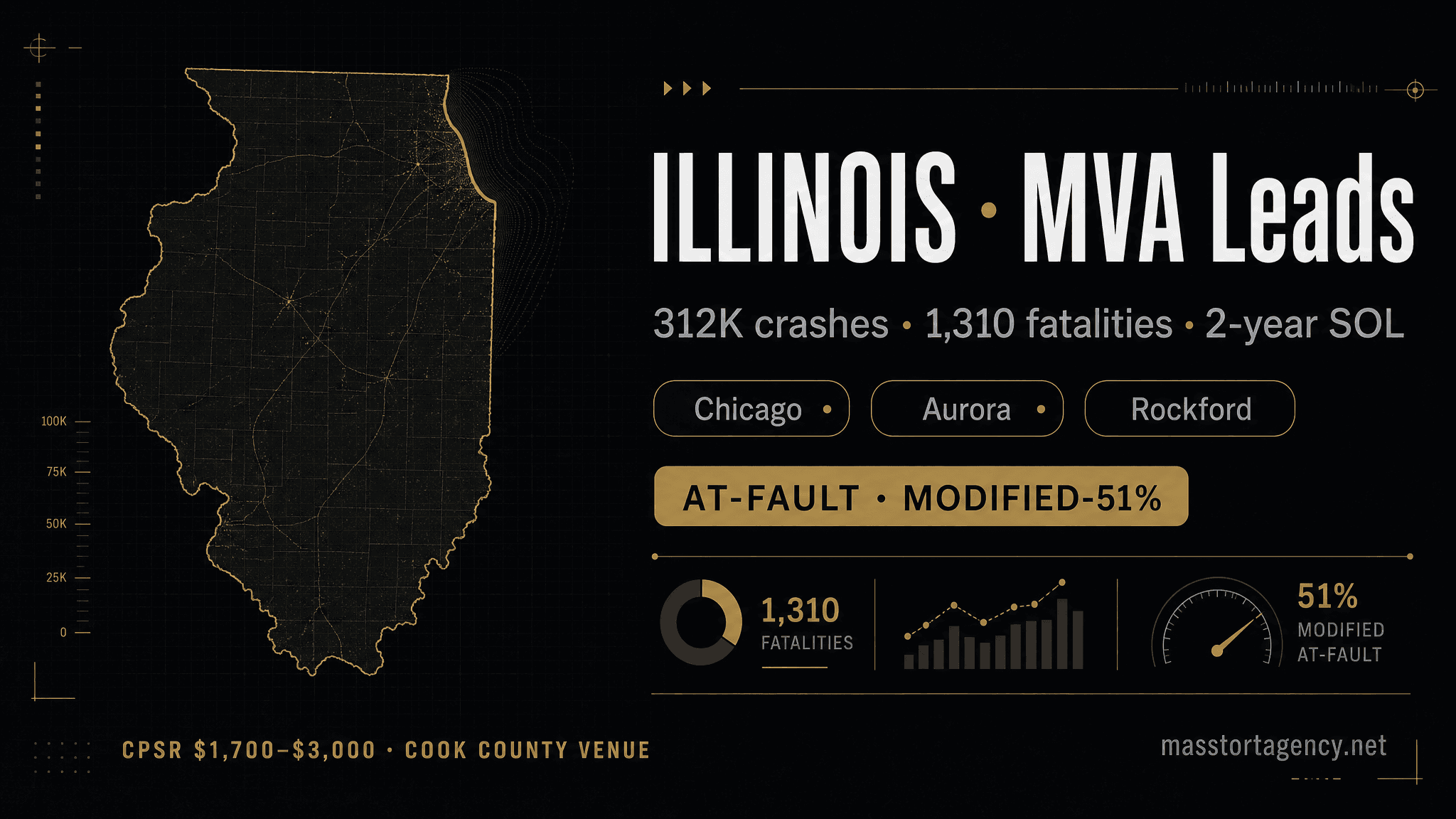
Midwest
Illinois · IL
312,000 crashes/yr
Illinois · Market Size
Source: NHTSA + IL DOT
312,000
Reported crashes / yr
1,310
Annual fatalities
89,700
Injured claimants / yr
12.5M
State population
Illinois · Quick Reference
The 5 facts that drive Illinois MVA lead qualification
Liability
At-fault
Negligence
51% bar
PI SOL
2 years
PIP
Not required
Min. liability
25/50/20
Bottom line · At-fault + 51% bar + Cook County concentration + BIPA + 1-year governmental-entity notice = Illinois is a four-filter market. The case-value math rewards firms that get the Cook County premium correctly priced into media spend, and BIPA quietly disqualifies vendors who skip intake-tooling compliance.
The opportunity in Illinois
Illinois MVA: Cook County concentration, BIPA discipline
Illinois reports 312,000 traffic crashes annually with 1,310 fatalities. Cook County (Chicago and inner suburbs) produces 124,800 of those crashes — roughly 40% of statewide volume — and the case-value share is even more concentrated. Cook County juries have historically returned the highest MVA verdicts in the Midwest, and despite venue-reform discussions, Cook still represents an estimated 75% of statewide MVA case-value pipeline. The remaining volume splits across Aurora, Naperville, Rockford, Joliet, and downstate (Springfield, Peoria, Champaign).
Illinois's at-fault framework with the 51% Proportionate Responsibility bar (735 ILCS 5/2-1116) is a clean convertor when intake captures fault apportionment correctly. Cases at 50/50 fault still recover (reduced by 50%); cases at 50.01% fault don't. That single percentage point is the most-litigated number in Illinois MVA tort practice.
Two Illinois-specific compliance regimes sit on top. The Illinois Tort Immunity Act (745 ILCS 10/) gives 1 year from accident date to file notice against governmental entities — much shorter than the 2-year tort SOL, and a hard kill if missed for CTA, Pace, Metra, or Illinois DOT cases. And the Illinois Biometric Information Privacy Act (BIPA, 740 ILCS 14/) regulates how lead vendors can use voice analysis, facial recognition, and other biometric intake tooling — a compliance floor most national vendors don't engineer for and that Illinois plaintiff firms have aggressively litigated.
Liability framework
How Illinois liability works — and why it matters at intake
Liability system
At-fault
Comparative negligence
Modified comparative — 51% bar
PIP requirement
Not required
PI statute of limitations
2 years
Property damage SOL
5 years
Mandatory liability minimums
25/50/20
(BI per person / per accident / property damage, in thousands)
Illinois is at-fault: the responsible driver's carrier pays. No PIP mandate. Illinois is one of 33 modified-51% states, with Cook County (Chicago) producing the bulk of MVA case volume and the state's highest jury verdicts.
Illinois uses the 51% bar — claimants more than 50% at fault recover nothing. Cook County's plaintiff-friendly jury history has made it one of the highest case-value venues in the Midwest.
Where the volume is
Top Illinois claim markets
Cook County's 124,800 crashes split across Chicago proper (Lake Shore Drive, Dan Ryan, Kennedy, Eisenhower) and inner suburbs (Evanston, Oak Park, Cicero). Aurora, Naperville, and Joliet anchor the collar counties — DuPage, Will, Kane — which carry higher policy limits per claimant (household income drives coverage selection). Rockford is the I-39 / I-90 commercial vehicle corridor; downstate metros (Springfield, Peoria, Champaign) run 18–25% under Cook County CPL with comparable signed-retainer rates for fact patterns that don't depend on Cook County jury value.
Chicago (Cook County)
124,800
Aurora
8,400
Naperville
6,900
Rockford
7,800
Joliet
6,200
Qualified MVA lead criteria
What "qualified" means in Illinois
In Illinois, "qualified" means clearing the 51% bar at intake, capturing governmental-entity notice timing where applicable (1 year under the Tort Immunity Act for CTA / Metra / Pace / IDOT defendants), and operating intake tooling that complies with the Biometric Information Privacy Act. The seven criteria below operationalize all three.
Accident date & SOL margin
Within 60 days of the wreck. Illinois's 2-year personal injury SOL compresses the case-management window — older leads burn the firm's pipeline.
Illinois jurisdiction
Accident occurred in-state with a police report on file. Report number captured at intake.
Fault apportionment
Claimant 50% or less at fault under Illinois's 51% bar.
Coverage profile
Illinois does not mandate PIP. Capture UM/UIM, MedPay, and health insurance status — first-dollar coverage varies widely.
Medical treatment
Active or completed care, with treatment provider documented. Injury severity captures the qualified-lead threshold.
No prior representation
Conflict-check release signed at intake. Lead is the firm's exclusive opportunity.
TCPA consent
Express written consent record on file: IP, timestamp, user agent, consent language all captured.
Illinois · Pricing benchmarks
What Illinois MVA leads actually cost in 2026
Illinois live-transfer CPL runs $285–460, with Cook County zip codes commanding a 15–25% premium over the statewide band — the case-value math supports it. Downstate (Springfield, Peoria, Champaign) runs 18–25% under that band. CPSR $1,700–3,000 reflects Cook County jury value pulling the upper end of the range while collar counties anchor the middle. The numbers below are 2024–2026 Illinois buy cycles, with Cook County weighted appropriately.
Cost per signed retainer · Illinois
$1,700–$3,000
· midpoint $2,350
Typical Illinois CPSR band, inclusive of media + intake + signed-retainer attribution. Variance driven by liability complexity and metro mix, not media cost alone.
CPL by tier
Tier 1 — Live Transfer
$285–$460
CPL · Inbound caller, pre-qualified
Tier 2 — Qualified Form
$115–$215
CPL · Form fill, screened ≤15 min
Tier 3 — Data Lead
$32–$58
CPL · Volume tier, firm-screened
How we operate in Illinois
Channel mix + compliance
Channels that work in Illinois
Chicago metro's media mix is multilingual-first. Spanish-language inbound is structural in Pilsen, Little Village, Cicero, and Aurora. Polish-language coverage matters on the Northwest Side (Avondale, Jefferson Park) and in Lemont and Justice — Chicago has the largest Polish-American population outside Warsaw. Illinois Rule 7.3 restricts in-person and live-telephone solicitation; the Attorney Registration and Disciplinary Commission (ARDC) enforces actively. BIPA compliance affects intake tooling, not just advertising — vendors should run voice-recording and biometric-capture audits before deploying in Illinois.
TCPA + DPPA · federal
Express written consent records on every outbound contact — timestamp, IP, user agent, consent language. DPPA enforced for any driver-record-derived data.
Illinois bar advertising rules
Illinois Rules of Professional Conduct 7.1–7.5. Direct in-person and live-telephone solicitation of MVA victims is restricted — lead vendors must source via opt-in inbound channels only.
Illinois MVA leads · FAQ
Questions Illinois firms ask before buying
What makes Cook County MVA cases more valuable than the rest of Illinois?
Cook County has historically produced larger jury verdicts and settlement values for MVA cases than the surrounding collar counties or downstate Illinois. Even with venue reform discussions, Cook still represents ~75% of statewide MVA case-value pipeline. Qualified Illinois leads sourced from Cook County zip codes typically command a 15–25% premium.
What's the typical CPL for buying MVA leads in Illinois?
Live-transfer MVA leads in Illinois run $285–460 CPL, with Chicago metro at the top of the band. Qualified-form averages $115–215. Downstate metros (Springfield, Peoria, Champaign) run 18–25% below the Chicago-metro range.
Does Illinois's 2-year SOL apply to all MVA cases?
Yes for personal injury — 2 years from accident date. Property damage has a 5-year SOL. Note: for cases against governmental entities (Cook County, CTA, Illinois DOT), notice deadlines are much shorter (1 year for the city, 6 months for Tort Immunity Act claims).
How does the Illinois 51% bar affect MVA lead qualification?
Claimants more than 50% at fault recover nothing. Lead vendors should capture preliminary fault apportionment at intake (police report, witness statements, accident reconstruction notes). Cases at 50/50 fault are still recoverable but get reduced by 50% — meaningful for case-value math.
Are there Illinois-specific compliance issues for MVA lead vendors?
Yes. Illinois has its own Biometric Information Privacy Act (BIPA) that affects certain intake technologies (voice analysis, facial recognition), and Illinois Rule 7.3(b) prohibits in-person or live-telephone solicitation of MVA victims by lawyers. Lead vendors should rely on opt-in inbound channels and document TCPA consent records.
Regional MVA markets