
Motor Vehicle Accident Leads in South Carolina
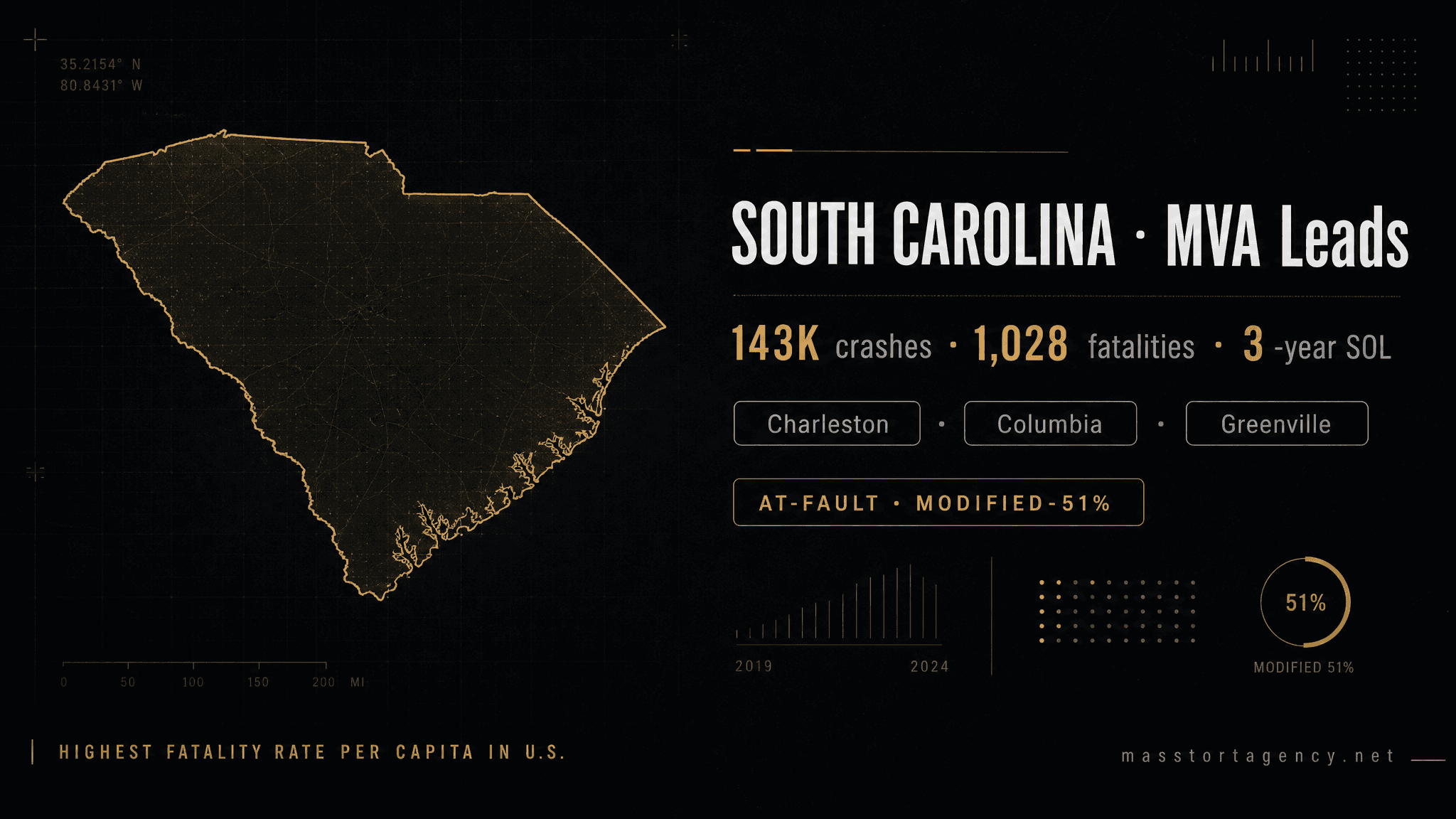
South Carolina has one of the highest per-capita traffic fatality rates in the country (1.8x national average) — and no MVA-specific cap on punitive damages for wantonness. Combine the I-95 commercial-vehicle volume with Charleston's port traffic, and SC's case-value ceiling sits noticeably higher than neighbors.
Southeast
South Carolina · SC
143,000 crashes/yr
South Carolina · Market Size
Source: NHTSA + SC DOT
143,000
Reported crashes / yr
1,028
Annual fatalities
55,700
Injured claimants / yr
5.40M
State population
South Carolina · Quick Reference
The 5 facts that drive South Carolina MVA lead qualification
Liability
At-fault
Negligence
51% bar
PI SOL
3 years
PIP
Not required
Min. liability
25/50/25
Bottom line · At-fault + 51% bar + 3-year SOL + no MVA-specific punitive cap + 1.8x national fatality rate = South Carolina rewards firms that screen for wantonness-supporting evidence at intake. The uncapped MVA punitive exposure is the case-value lever no neighbor offers.
The opportunity in South Carolina
South Carolina MVA: high fatality rate, uncapped MVA punitive exposure
South Carolina reports 145,000 traffic crashes annually with 1,098 fatalities — one of the highest fatality rates per capita in the U.S., approximately 1.8x the national average. The driver mix: heavy I-95 commercial-truck volume, rural two-lane roads with limited shoulders, lower seat-belt-use rates than the national average, and seasonal tourist surge in the Myrtle Beach Grand Strand corridor. Charleston (28,400 crashes/yr), Columbia (16,800), and Greenville–Spartanburg (24,200) anchor the practical urban market.
South Carolina's at-fault framework with 51% modified comparative was adopted in Nelson v. Concrete Supply (1991) — Claimants more than 50% at fault recover nothing. The 3-year SOL under S.C. Code § 15-3-530 is roomier than 2-year neighbors (GA/FL). South Carolina also has no PIP mandate, so UM/UIM and MedPay capture matters at intake. The state's mandatory liability minimum is 25/50/25.
South Carolina's structural advantage for plaintiff firms is the absence of a hard cap on MVA punitive damages. The state's general statutory caps apply to non-economic damages in medical malpractice cases (S.C. Code § 15-32-220 and related sections) — not to punitive damages in standard MVA tort cases. Combined with the high commercial-vehicle volume on I-95 and the Port of Charleston, SC MVA cases involving DUI, distracted driving, or fleet-driver hours-of-service violations carry punitive exposure that materially affects settlement dynamics. Lead vendors who don't screen for wantonness-supporting facts at intake miss the case-value lever unique to SC.
Liability framework
How South Carolina liability works — and why it matters at intake
Liability system
At-fault
Comparative negligence
Modified comparative — 51% bar
PIP requirement
Not required
PI statute of limitations
3 years
Property damage SOL
3 years
Mandatory liability minimums
25/50/25
(BI per person / per accident / property damage, in thousands)
South Carolina is at-fault: the responsible driver's carrier pays. No PIP mandate. SC has one of the highest traffic fatality rates per capita in the country, driven by I-95 commercial vehicle volume and rural-road fatality patterns. Uses the 51% bar.
South Carolina uses the 51% bar (adopted in Nelson v. Concrete Supply, 1991). Claimants more than 50% at fault recover nothing. SC also recognizes punitive damages in cases of recklessness, willfulness, or wantonness with no statutory cap.
Where the volume is
Top South Carolina claim markets
Charleston metro's 28,400 crashes concentrate on I-26/I-526 with port-related commercial-vehicle volume from the Port of Charleston (4th largest container port in the U.S. by TEU volume). Greenville-Spartanburg's 24,200 anchor on I-85/I-26 — the BMW Spartanburg manufacturing plant and Michelin/GE corporate-employee insurance overlay. Columbia carries state-government concentration plus Fort Jackson military-population overlay. Myrtle Beach (8,700 crashes/yr) is the Grand Strand tourist corridor — disproportionate rideshare and rental-vehicle crash mix, with seasonal surge June–August. Hilton Head adds golf-tourism rideshare and golf-cart-on-road MVA volume.
Charleston
28,400
Columbia
26,700
Greenville
24,800
Myrtle Beach
16,200
Spartanburg
11,800
Qualified MVA lead criteria
What "qualified" means in South Carolina
In South Carolina, "qualified" includes wantonness-fact capture at intake — DUI, distracted driving, hours-of-service violations on commercial trucks, fleet-driver record histories. The seven criteria below operationalize the standard 51%-bar fault apportionment plus the punitive-damages screening unique to SC.
Accident date & SOL margin
Within 90 days of the wreck. South Carolina's 3-year personal injury SOL compresses the case-management window — older leads burn the firm's pipeline.
South Carolina jurisdiction
Accident occurred in-state with a police report on file. Report number captured at intake.
Fault apportionment
Claimant 50% or less at fault under South Carolina's 51% bar.
Coverage profile
South Carolina does not mandate PIP. Capture UM/UIM, MedPay, and health insurance status — first-dollar coverage varies widely.
Medical treatment
Active or completed care, with treatment provider documented. Injury severity captures the qualified-lead threshold.
No prior representation
Conflict-check release signed at intake. Lead is the firm's exclusive opportunity.
TCPA consent
Express written consent record on file: IP, timestamp, user agent, consent language all captured.
South Carolina · Pricing benchmarks
What South Carolina MVA leads actually cost in 2026
South Carolina live-transfer CPL runs $260–415 — comparable to Georgia. Charleston, Columbia, and Greenville run at the statewide average; Myrtle Beach commands a 10–15% summer-season premium reflecting tourist-corridor inventory tightening. CPSR $1,600–2,800 reflects clean conversion when the 51% bar is cleared, with upside on wantonness-supported cases that carry uncapped punitive exposure.
Cost per signed retainer · South Carolina
$1,600–$2,800
· midpoint $2,200
Typical South Carolina CPSR band, inclusive of media + intake + signed-retainer attribution. Variance driven by liability complexity and metro mix, not media cost alone.
CPL by tier
Tier 1 — Live Transfer
$265–$425
CPL · Inbound caller, pre-qualified
Tier 2 — Qualified Form
$108–$200
CPL · Form fill, screened ≤15 min
Tier 3 — Data Lead
$31–$55
CPL · Volume tier, firm-screened
How we operate in South Carolina
Channel mix + compliance
Channels that work in South Carolina
Charleston has growing Hispanic and Asian populations on the West Ashley and North Charleston corridors. Columbia carries Fort Jackson Tricare interactions and a meaningful African-American urban media segment. Greenville's BMW manufacturing plant draws international employee population (German, Mexican, Indian engineers). Myrtle Beach's tourist-corridor DOOH placement matches summer-season vacationer claimant demographics. South Carolina Rules of Professional Conduct 7.3 restrict in-person and live-telephone solicitation; the Office of Disciplinary Counsel enforces. SC also requires lawyer-advertising filings with the Commission on Lawyer Conduct under Rule 7.5.
TCPA + DPPA · federal
Express written consent records on every outbound contact — timestamp, IP, user agent, consent language. DPPA enforced for any driver-record-derived data.
South Carolina bar advertising rules
South Carolina Rules of Professional Conduct 7.1–7.5. Direct in-person and live-telephone solicitation of MVA victims is restricted — lead vendors must source via opt-in inbound channels only.
South Carolina MVA leads · FAQ
Questions South Carolina firms ask before buying
Why does South Carolina have such a high traffic fatality rate?
SC consistently ranks in the top 5 U.S. states for fatalities per 100M vehicle miles traveled. The driver mix: high I-95 commercial vehicle traffic, rural two-lane roads with limited shoulders, lower seat-belt use rates than the national average, and high tourist volume in the Myrtle Beach corridor. The fatality rate is roughly 1.8x the national average.
What's the typical CPL for buying MVA leads in South Carolina?
SC live-transfer runs $265–425 CPL, qualified-form $108–200. Charleston, Columbia, and Greenville are roughly comparable in CPL; Myrtle Beach commands a 10–15% premium due to tourist-corridor case mix and out-of-state defendant logistics.
Are out-of-state MVA cases common in South Carolina?
Yes — Myrtle Beach and Charleston have meaningful tourist traffic with out-of-state claimants and out-of-state defendants. SC has long-arm jurisdiction under SC Code § 36-2-803 for non-resident drivers involved in SC accidents. Qualified SC leads from tourist corridors should capture defendant residency at intake for jurisdictional planning.
Does South Carolina cap punitive damages in MVA cases?
Generally no — SC does not have a statutory cap on punitive damages for MVA cases involving recklessness, willfulness, or wantonness. This is meaningfully different from neighboring NC (which has a $250K or 3x compensatory cap) and GA (no cap but treble-damages limit in some cases). Drunk-driving and reckless-driving MVA cases in SC can yield outsized punitive awards.
What MVA case types are most valuable in South Carolina?
Commercial vehicle / trucking cases on I-95 and I-26 (heavy interstate volume), drunk-driving cases (uncapped punitive damages), and motorcycle cases in the Myrtle Beach corridor. Tourist-corridor cases often involve high-policy-limit out-of-state defendants.
Regional MVA markets