
Motor Vehicle Accident Leads in Arizona
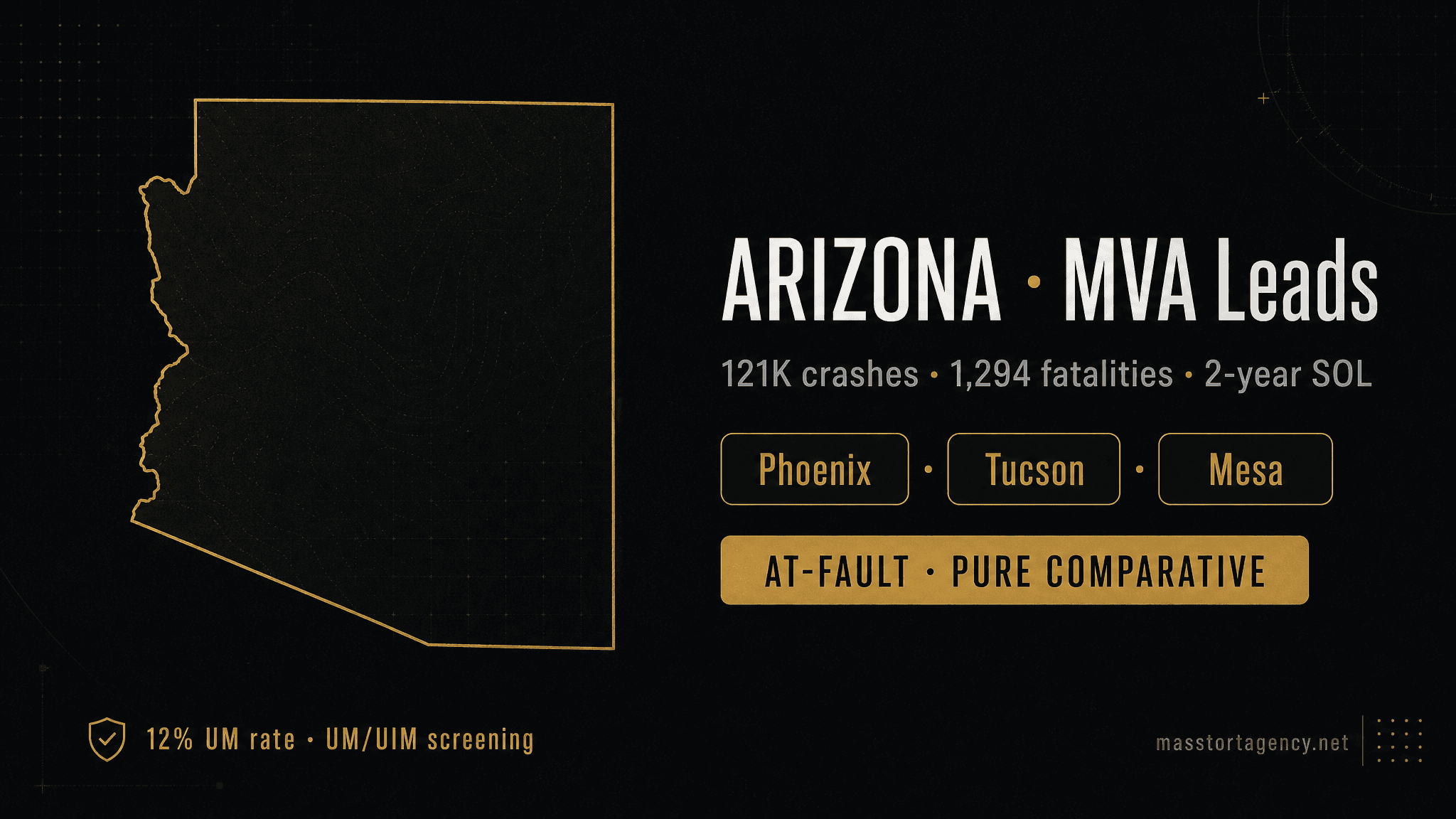
Arizona pairs pure comparative negligence (a structural case-value tailwind) with a 12% uninsured-motorist rate (a structural coverage hole). UM/UIM screening at intake is the single highest-leverage filter in the state — and Phoenix metro produces 65% of statewide volume.
Southwest
Arizona · AZ
121,000 crashes/yr
Arizona · Market Size
Source: NHTSA + AZ DOT
121,000
Reported crashes / yr
1,294
Annual fatalities
41,200
Injured claimants / yr
7.50M
State population
Arizona · Quick Reference
The 5 facts that drive Arizona MVA lead qualification
Liability
At-fault
Negligence
Pure comparative
PI SOL
2 years
PIP
Not required
Min. liability
25/50/15
Bottom line · Pure comparative + 12% uninsured rate + 25/50/15 minimums = Arizona rewards UM/UIM screening above all other intake filters. The pure-comparative advantage is real, but only collects when somebody can actually pay.
The opportunity in Arizona
Arizona MVA: pure comparative meets a 12% uninsured rate
Arizona reports 121,000 traffic crashes annually with 1,294 fatalities. Phoenix metro (Maricopa County) produces 78,400 of those crashes — 65% of statewide volume across the Loop 101 / Loop 202 / I-10 / I-17 interchange complex. Tucson adds 18,600 anchored by I-10 and the University of Arizona corridor. Mesa, Chandler, Scottsdale, and the Valley suburbs round out the practical market. The state's 7.5M residents concentrate heavily in two metros, leaving the rest of Arizona as a thin secondary market.
Arizona's structural advantage is pure comparative negligence under A.R.S. § 12-2505 — one of only 13 pure-comparative states. Claimants recover at any fault percentage, with damages reduced proportionally. A claimant 70% at fault still recovers 30% of damages. Combined with no PIP mandate, no contributory bar, and clean at-fault liability, AZ produces some of the cleanest tort math in the Southwest.
But Arizona pairs that advantage with one of the highest uninsured-motorist rates in the country. The Insurance Research Council estimates approximately 12% of Arizona drivers carry no liability insurance — and Arizona's $25K/$50K/$15K mandatory minimum is among the lower thresholds nationally. The practical effect: a meaningful share of MVA leads involve at-fault drivers without recoverable coverage. Lead vendors who don't capture the claimant's own UM/UIM and MedPay status at intake are quietly selling firms cases that look strong on liability but die on collectability.
Liability framework
How Arizona liability works — and why it matters at intake
Liability system
At-fault
Comparative negligence
Pure comparative negligence
PIP requirement
Not required
PI statute of limitations
2 years
Property damage SOL
2 years
Mandatory liability minimums
25/50/15
(BI per person / per accident / property damage, in thousands)
Arizona is at-fault: the responsible driver's carrier pays. No PIP mandate, and Arizona is one of 13 pure-comparative-negligence states — a meaningful tailwind for case value. Phoenix metro produces the bulk of statewide MVA case volume.
Arizona is a pure comparative negligence state. A claimant 80% at fault still recovers 20% of damages. Combined with the state's high uninsured-motorist rate (~12%), this raises the importance of UM/UIM screening at lead intake.
Where the volume is
Top Arizona claim markets
Phoenix metro's 78,400 crashes split across central Phoenix (downtown, Encanto, Sunnyslope), the East Valley (Mesa, Chandler, Gilbert, Tempe), the West Valley (Glendale, Peoria, Surprise, Goodyear), and the North Valley (Scottsdale, Cave Creek, Anthem). The metro is the country's fastest-growing major MSA — claimant demographics are shifting and tracker data is stale fast. Tucson carries University of Arizona and Davis-Monthan AFB overlay; Yuma sits on the I-8 / Mexico border with cross-jurisdictional complexity; Flagstaff handles I-40 / I-17 commercial vehicle and weather-pattern crashes at altitude.
Phoenix metro
78,400
Tucson
18,600
Mesa
9,800
Chandler
6,400
Scottsdale
5,900
Qualified MVA lead criteria
What "qualified" means in Arizona
In Arizona, "qualified" means clearing two gates: pure-comparative fault percentage (still recoverable at any level, but documented) and UM/UIM/MedPay coverage on the claimant's own policy (essential given the 12% uninsured rate). The seven criteria below operationalize both. Arizona vendors who skip UM/UIM capture are gambling on the at-fault driver actually having coverage — and one in eight times in AZ, they don't.
Accident date & SOL margin
Within 60 days of the wreck. Arizona's 2-year personal injury SOL compresses the case-management window — older leads burn the firm's pipeline.
Arizona jurisdiction
Accident occurred in-state with a police report on file. Report number captured at intake.
Fault apportionment
Claimant fault percentage captured. Arizona pure comparative — recovery preserved at any fault level, reduced proportionally.
Coverage profile
Arizona does not mandate PIP. Capture UM/UIM, MedPay, and health insurance status — first-dollar coverage varies widely.
Medical treatment
Active or completed care, with treatment provider documented. Injury severity captures the qualified-lead threshold.
No prior representation
Conflict-check release signed at intake. Lead is the firm's exclusive opportunity.
TCPA consent
Express written consent record on file: IP, timestamp, user agent, consent language all captured.
Arizona · Pricing benchmarks
What Arizona MVA leads actually cost in 2026
Arizona live-transfer CPL runs $265–425 — among the lowest in the Tier-1 set. Phoenix commands a 15–20% premium over statewide; Tucson and the Valley suburbs run at or below the statewide median. CPSR $1,550–2,750 reflects three structural realities: clean pure-comparative tort math when liability and coverage both exist, but a meaningful slice of cases washing out on UM/UIM coverage gaps. The numbers below reflect 2024–2026 Arizona buy cycles.
Cost per signed retainer · Arizona
$1,550–$2,750
· midpoint $2,150
Typical Arizona CPSR band, inclusive of media + intake + signed-retainer attribution. Variance driven by liability complexity and metro mix, not media cost alone.
CPL by tier
Tier 1 — Live Transfer
$265–$425
CPL · Inbound caller, pre-qualified
Tier 2 — Qualified Form
$108–$195
CPL · Form fill, screened ≤15 min
Tier 3 — Data Lead
$31–$54
CPL · Volume tier, firm-screened
How we operate in Arizona
Channel mix + compliance
Channels that work in Arizona
Phoenix and Tucson media buys are bilingual-Spanish-significant — Maricopa County and Pima County both carry meaningful Spanish-language inbound volume. Bilingual qualified-form CPL runs 8–12% above English-only; signed-retainer rate runs 4–6 points higher because vendor competition is thinner. Arizona Rule 7.3 restricts in-person, live-telephone, and real-time electronic solicitation; the Arizona State Bar enforces actively. UM/UIM claims under the claimant's own auto policy have a 6-year SOL (contract-based) versus the 2-year tort SOL — meaning UM/UIM cases have substantially longer case-management runway than third-party tort claims.
TCPA + DPPA · federal
Express written consent records on every outbound contact — timestamp, IP, user agent, consent language. DPPA enforced for any driver-record-derived data.
Arizona bar advertising rules
Arizona Rules of Professional Conduct 7.1–7.3. Direct in-person and live-telephone solicitation of MVA victims is restricted — lead vendors must source via opt-in inbound channels only.
Arizona MVA leads · FAQ
Questions Arizona firms ask before buying
Why is Arizona's pure comparative negligence advantageous for MVA case value?
Arizona is one of only 13 pure comparative negligence states. Claimants recover even at high fault percentages (e.g., 70% fault still yields 30% of damages), reduced proportionally. Compared to neighbors like Texas (51% bar) and New Mexico (pure comparative as well), AZ offers a more permissive recovery framework that supports more aggressive lead-qualification thresholds.
What is Arizona's uninsured-motorist rate and why does it matter?
Arizona has one of the highest uninsured-motorist rates in the country (~12% of drivers, per IRC data). This means a meaningful share of MVA leads will involve at-fault drivers without liability coverage — making UM/UIM screening at intake essential. Qualified AZ MVA leads should capture the claimant's own UM/UIM limits before delivery.
What's the typical CPL for buying MVA leads in Arizona?
Arizona live-transfer runs $265–425 CPL, qualified-form $108–195. Phoenix metro commands a 15–20% premium over the statewide average; Tucson and the Valley suburbs run at or below the statewide median.
Does Arizona's 2-year SOL apply to UM/UIM claims as well?
Personal injury and property damage SOL is 2 years from accident date for tort claims. UM/UIM claims are governed by contract (the claimant's own auto policy), which under Arizona law gives 6 years to file from the date of breach. The practical effect: a UM claim has a much longer runway than a third-party tort claim.
What MVA case types are most valuable in Arizona?
Commercial vehicle / trucking cases (I-10 and I-40 corridor traffic), serious-injury passenger vehicle cases, and pedestrian cases in Phoenix and Tucson. Catastrophic-injury cases in AZ benefit from the pure comparative negligence framework — case value is preserved even where shared fault is present.
Regional MVA markets