

Updated October 13, 2026
Mass Tort Marketing Compliance: What Agencies Must Get Right
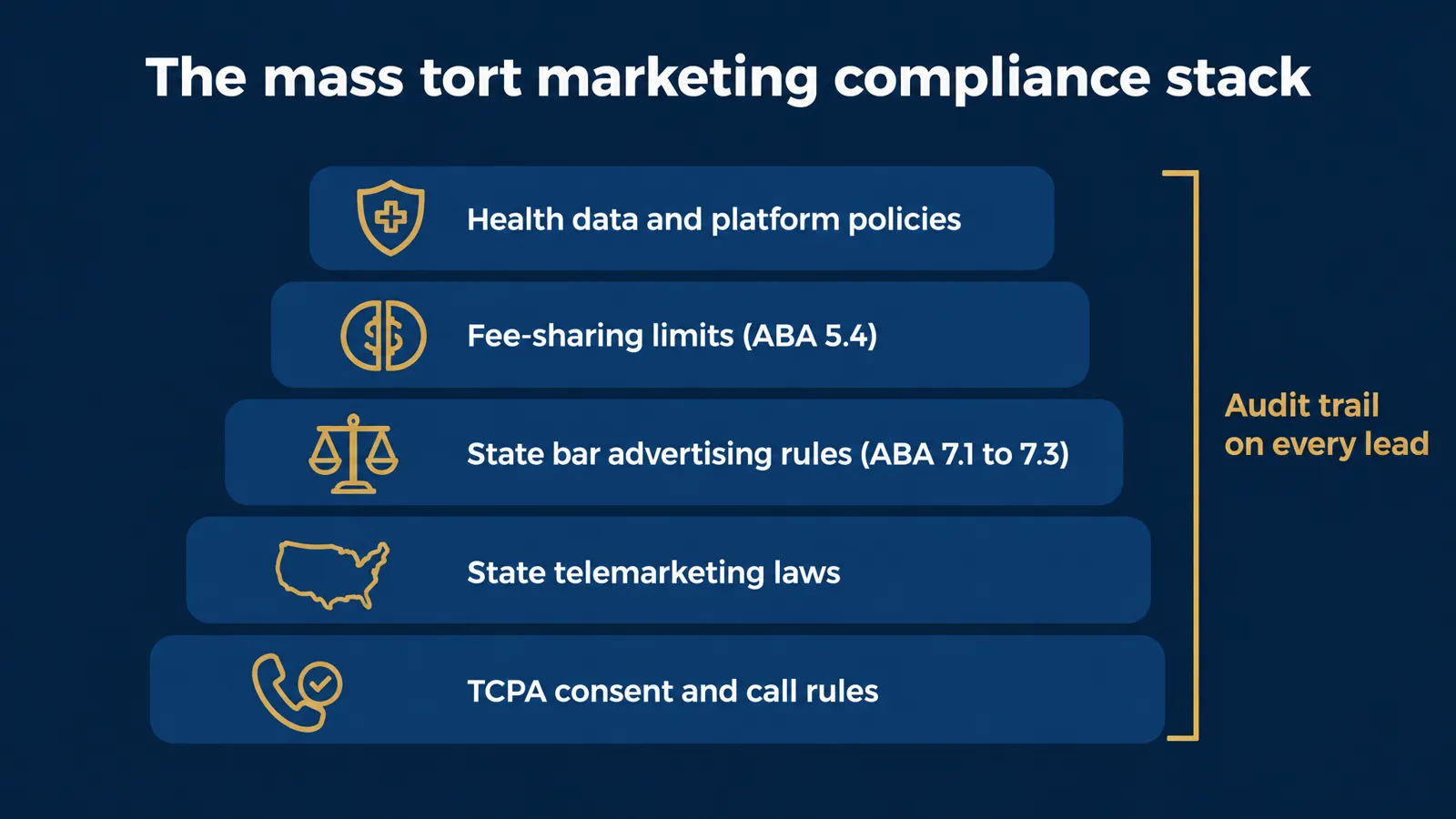
Mass tort marketing agencies have to satisfy six sets of rules at once: TCPA consent and call rules, state telemarketing laws, state bar advertising rules, the ban on sharing legal fees, FTC rules for lead generators, and health data limits. Here is what each one requires and how to check a vendor against it.
The mass tort marketing compliance stack
Each layer applies to a different part of the campaign, from the ad a claimant sees to the fee the firm pays. A single missing consent record can expose the firm to TCPA claims even when every ad was approved by bar counsel.
1. TCPA consent and call rules
The Telephone Consumer Protection Act requires prior express written consent before a marketer calls or texts a mobile phone with an autodialer, an artificial or prerecorded voice, or an AI voice. Violations carry statutory damages of $500 per call or text, and up to $1,500 when the violation is willful or knowing, which is why TCPA class actions follow bad lead lists closely.
The FCC’s “one-to-one consent” rule, which would have required each consent to name a single seller, never took effect: the Eleventh Circuit vacated it in Insurance Marketing Coalition v. FCC in January 2025. Many law firms still require single-firm consent in their contracts, because it is the cleanest proof that a claimant agreed to hear from that firm and no one else.
Consumers can revoke consent by any reasonable means, and callers must honor a revocation within 10 business days. The FCC’s separate “stop one, stop all” requirement, which makes one opt-out cover every message type, has been delayed to January 31, 2027. Calls must also respect the National Do Not Call Registry and calling hours of 8 a.m. to 9 p.m. in the recipient’s time zone.
2. State telemarketing laws (mini-TCPAs)
Several states add their own rules and private rights of action on top of the TCPA. Florida’s Telephone Solicitation Act (2021, amended in 2023) is the most litigated. Oklahoma’s Telephone Solicitation Act took effect in November 2022 and requires written consent for automated calls and texts. Maryland’s Stop the Spam Calls Act took effect in January 2024. Campaigns that cross state lines need to follow the strictest rule that applies to each claimant.
3. State bar advertising rules (ABA Model Rules 7.1 to 7.3)
Every ad, landing page, and intake script that promotes a law firm is attorney advertising. ABA Model Rule 7.1 bars false or misleading communications, which covers implied results, invented urgency, and ads that look like government or medical notices. Rule 7.3 limits live person-to-person solicitation. Each state adopts its own version of these rules, and some, including Florida and Texas, require certain ads to be filed for review.
Paying for lead generation is allowed under Rule 7.2(b)(1), which lets a lawyer “pay the reasonable costs of advertisements or communications.” The rule’s comments add three conditions: the lead generator must not recommend the lawyer, the payment must comply with the fee rules, and the lead generator’s own communications must not be misleading. Florida goes further with Rule 4-7.22, which treats lead generators as “qualifying providers” that must meet registration and reporting requirements before Florida lawyers can accept their referrals.
4. Fee-sharing limits (ABA Model Rule 5.4)
Rule 5.4 bars lawyers from sharing legal fees with non-lawyers, so an agency cannot be paid a percentage of a settlement or attorney fee. Compliant pay-per-case arrangements use a flat marketing fee per signed retainer. Have bar counsel review any per-case pricing, because states differ on how far a per-retainer fee can go before it looks like a referral fee. Fee models are compared in mass tort marketing costs.
5. Health data and ad platform policies
Drug and device torts collect health information on the first form: diagnoses, prescriptions, and treatment dates. HIPAA usually does not apply to marketers, but state health privacy laws can, including Washington’s My Health My Data Act, along with the FTC’s rules on health data. Ad platforms add their own limits: Meta and Google restrict targeting and remarketing based on health conditions, so tort campaigns rely on broad audiences, contextual placement, and qualifying questionnaires rather than health-based targeting. Several states also regulate legal ads about prescription drugs, including requirements that the ad warn viewers not to stop taking a medication without talking to their doctor.
6. FTC rules for lead generators
The FTC’s Telemarketing Sales Rule reaches lead generators that assist or facilitate illegal calls, not just the callers. The agency has acted against “consent farm” websites that collect one consent and sell it to many buyers, including a 2024 order banning Response Tree from telemarketing and a 2025 settlement with MediaAlpha. For a law firm, the practical risk is buying leads from a vendor whose consent came from a site like that.
Not sure your current leads would hold up in a TCPA claim?
Send us a sample of your lead records. In 30 minutes we'll check the consent language, certificates, and opt-out handling, and show where your exposure sits.
No obligation · no contract required · 30 minutes with a senior strategist, not a salesperson.
Compliance checklist for hiring a mass tort marketing agency
Ask any agency or lead vendor to show evidence for each item, not just confirm it.
- Consent language names your firm, and the vendor can show it for every lead
- A TrustedForm or Jornaya certificate is stored with each lead, with the page, timestamp, and IP address
- Opt-outs are honored within 10 business days, across every channel the vendor uses
- Calls and texts are checked against the National Do Not Call Registry and state lists
- Ads, landing pages, and intake scripts are reviewed against your state's bar rules before launch
- Pricing is a flat fee per lead or per signed retainer, never a share of the fee
- Leads are exclusive to your firm and never resold
- Health information is collected only as needed for screening and stored securely
- Your firm owns the consent records and call recordings if the engagement ends
More on vetting vendors: mass tort marketing buyer’s guide, questions to ask a mass tort marketing agency, mass tort lead verification, exclusive mass tort leads, and mass tort intake. For the litigations currently being advertised, see active mass torts.
Mass tort marketing compliance: FAQs
- What compliance standards do mass tort marketing agencies need?
- Mass tort marketing agencies need to comply with the TCPA's consent, revocation, and Do Not Call rules; state telemarketing laws such as Florida's FTSA; state bar advertising rules based on ABA Model Rules 7.1 to 7.3; the fee-sharing ban in ABA Model Rule 5.4; FTC rules on lead generation; and state health privacy laws and ad platform health policies. A compliant agency can show a consent record, such as a TrustedForm or Jornaya certificate, for every lead it delivers.
- Is the FCC one-to-one consent rule in effect?
- No. The FCC's one-to-one consent rule never took effect. The Eleventh Circuit vacated it in Insurance Marketing Coalition v. FCC in January 2025. Prior express written consent is still required for autodialed or prerecorded marketing calls and texts, and many law firms still require consent that names only their firm as a contract term.
- Can a law firm legally pay for mass tort leads?
- Yes, in most states. ABA Model Rule 7.2(b)(1) lets lawyers pay the reasonable costs of advertising, and its comments allow paying lead generators that do not recommend the lawyer, whose communications are not misleading, and whose pay is not a share of legal fees. Some states add their own requirements, such as Florida's qualifying-provider rule, so bar counsel should review any lead agreement.
- Can a mass tort marketing agency be paid a percentage of the settlement?
- Generally no. ABA Model Rule 5.4 bars lawyers from sharing legal fees with non-lawyers, so an agency cannot take a percentage of a settlement or attorney fee. Compliant agencies charge a flat fee per lead, a flat fee per signed retainer, or a management fee.
- What is a TrustedForm or Jornaya certificate?
- TrustedForm (from ActiveProspect) and Jornaya (from Verisk) are third-party services that record how a consumer gave consent on a web form, including the page, the consent language shown, the timestamp, and the IP address. The certificate is the firm's evidence if a TCPA claim is filed, so it should be delivered and stored with every lead.
- How much can a TCPA violation cost a law firm?
- TCPA statutory damages are $500 per call or text, and up to $1,500 per call or text when the violation is willful or knowing. Because damages are per message and claims are often brought as class actions, a single non-compliant lead list can create liability in the millions.
- Does HIPAA apply to mass tort lead generation?
- Usually not directly. HIPAA applies to health care providers, health plans, and their business associates, not to most marketers. But mass tort leads still contain sensitive health information, and state laws such as Washington's My Health My Data Act, FTC health data rules, and ad platform policies on health targeting can apply.
- How quickly must a revoked consent be honored?
- Under current FCC rules, a consumer can revoke consent by any reasonable means, and callers must honor the revocation within 10 business days. The separate rule that one opt-out must stop all message types from a caller has been delayed to January 31, 2027.
This page is general information about marketing regulation, last reviewed October 13, 2026. It is not legal advice. Rules differ by state and change often; have your bar counsel and TCPA counsel review any campaign before launch.
Keep going
Related reading
Exclusive mass tort leads
Single-firm exclusivity, territory locks, and why shared leads collapse your retainer rate.
What mass tort lead generation costs
Cost per lead and cost per signed case by tort, with the budget model we use to forecast campaigns.
Mass tort leads by litigation
Every active tort we run campaigns for, with qualification criteria and current claimant volume.
Class action leads
Claimant acquisition for class actions, with the certification-stage screening that keeps intake clean.
Mass tort marketing buyer's guide
The evaluation framework, diligence questions, and contract terms to insist on before signing an agency.
Want a compliance-first mass tort campaign?
Tell us about your firm, target cases, and intake capacity. A strategist will respond in under 5 minutes during business hours with practical next steps.
Speed-to-lead is the largest single lever in intake conversion: the gap between a 5-minute and a 30-minute callback is measured in retainers lost, not opportunities lost. The same clock is running on the torts you have not claimed yet.
Built for personal injury firms, intake teams, and mass tort dockets