
ChatGPT Ads · Personal Injury · Car, Truck, Rideshare
ChatGPT Ads for Personal Injury Lawyers
Personal injury firms can buy ads in ChatGPT. The harder questions are which case types will actually get an ad shown, how to target only the states you are licensed in, what a click is worth against your cost per signed case, and whether OpenAI's crawler can even reach your landing page.
Quick answer
Yes, personal injury lawyers can run ChatGPT ads in the US, if they are licensed in every jurisdiction where the ad is shown and pass OpenAI's manual legal-category review. A PI campaign that works has four parts: state, DMA, or ZIP targeting limited to licensed states; case types whose conversations clear the sensitive-content filter (car accident insurance disputes and rideshare coverage questions, not catastrophic injury or wrongful death); a landing page OpenAI's OAI-AdsBot can crawl; and intake that answers in under 60 seconds. Judge it on cost per signed case, not on the cheap click. For the policy itself and how it changed in 2026, see ChatGPT ads for lawyers.
Platform details on this page reflect OpenAI's Ad policies and Ads Manager help documentation as of September 2026.

Which PI case types will actually get an ad shown
OpenAI approves the advertiser and the ad, then runs a separate placement check on every conversation. Its policy keeps ads out of personal health conversations, emotionally reliant contexts, and sensitive user journeys. For a personal injury firm, that makes case-type selection the first budgeting decision, before bids or creative.
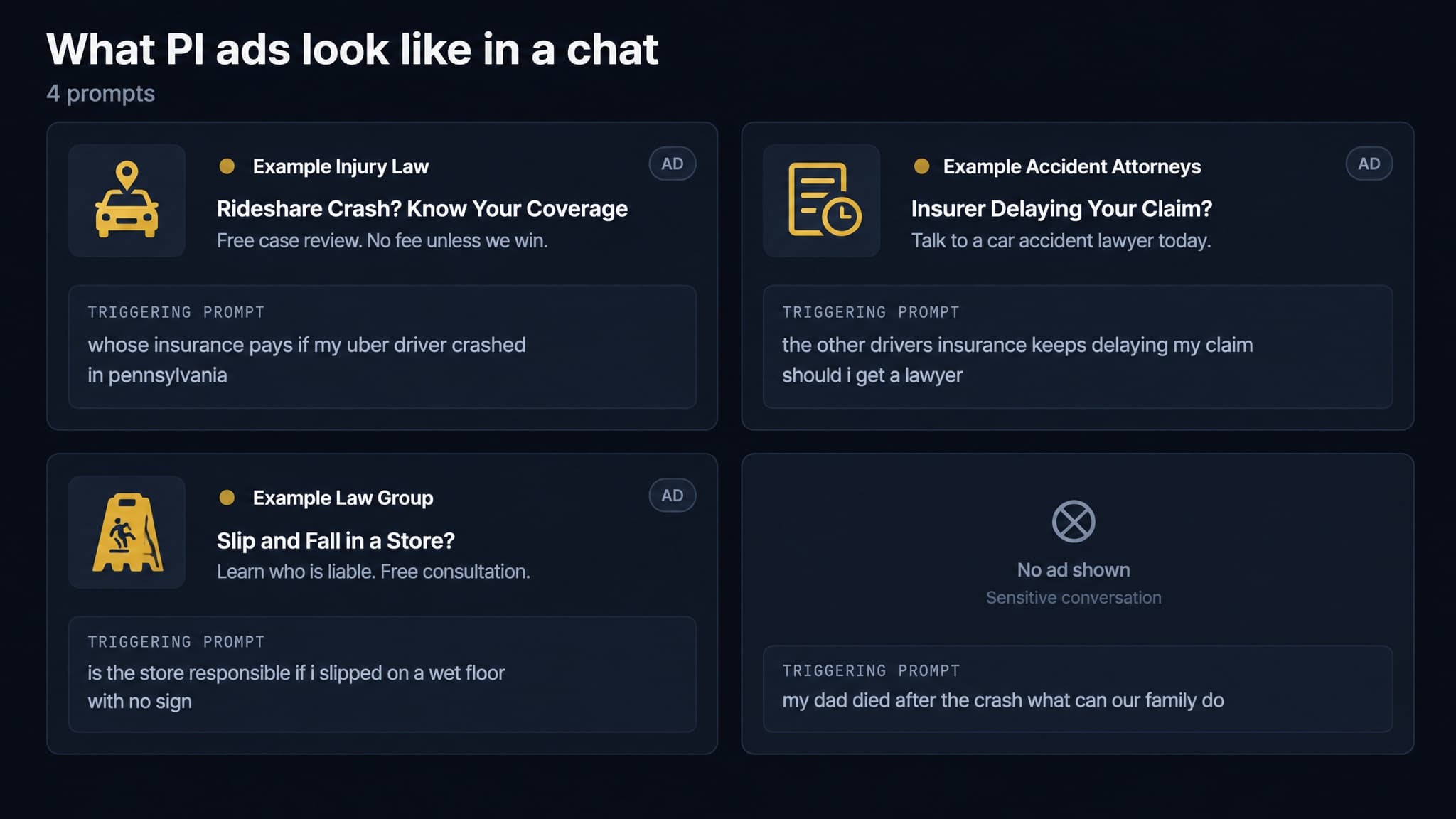
The pattern that follows from the policy: conversations about process (insurance, fault, coverage, deadlines) are plausible placements. Conversations about the injury or a death are not.
| Case type | Typical ChatGPT conversation | Ad placement | Why |
|---|---|---|---|
| Car accident (property damage, early claim) | Insurer delays, repair estimates, whether to talk to the adjuster, how a claim works | Likely | The best-fit lane. Process and insurance questions read as practical, not personal-health. |
| Rideshare accident | Whose insurance applies, Uber or Lyft coverage tiers, who to file against | Likely | Coverage confusion is a procedural conversation, and it is where users most need a lawyer to explain it. |
| Commercial truck accident | Carrier liability, trucking company insurance, evidence preservation | Mixed | Liability questions qualify; the same conversation turns to injury detail quickly on serious crashes. |
| Premises / slip and fall | Property owner responsibility, reporting the fall, store incident reports | Mixed | Liability framing works. Conversations centered on the injury itself lean toward health. |
| Dog bite | Owner liability, homeowner's insurance, state strict-liability rules | Mixed | Legal-rule questions fit; conversations about treatment and scarring do not. |
| Motorcycle accident | Bias against riders in fault disputes, helmet laws and comparative fault | Mixed | Fault-dispute framing fits. Severity is usually higher, so injury-first conversations are common. |
| Traumatic brain injury / catastrophic injury | Diagnosis, prognosis, long-term care, cognitive changes | Unlikely | These are personal health conversations almost by definition. |
| Medical malpractice | A procedure that went wrong, a missed diagnosis, ongoing treatment | Unlikely | Medical subject matter sits squarely in the health exclusion. |
| Wrongful death | A family member's death, grief, what the family can do | Unlikely | Bereavement is a sensitive user journey. Expect little or no delivery, and consider whether you want it. |
This is our reading of OpenAI's placement policy, not an OpenAI classification. OpenAI does not publish how individual conversations are categorized, and the same case type can land on either side depending on how a claimant phrases it. Treat the table as the hypothesis your test is designed to confirm or overturn.
Context hints: describe the decision, not the injury
ChatGPT does not bid on keywords. Each ad group carries context hints, short descriptions of when your ad may be relevant, and OpenAI weighs them alongside the conversation, your ad copy, and your landing page. OpenAI is explicit that hints are not exact-match keywords and do not guarantee delivery.
A Google keyword list pasted into the hint field is the most common mistake. The second is describing injuries, which steers the ad toward exactly the conversations the placement filter excludes. Describe the situation and the decision in front of the claimant instead.
Keyword habit
car accident lawyer
Context hint
people comparing whether to hire a lawyer after a rear-end collision when the other driver's insurer is delaying the claim
Keyword habit
Uber accident
Context hint
passengers or drivers unsure whose insurance covers a rideshare crash in Pennsylvania and who they should file a claim against
Keyword habit
truck accident attorney
Context hint
drivers hit by a commercial truck who need to know what evidence the trucking company must preserve and how carrier liability works
Target only where you are licensed
OpenAI's policy ties legal ads to licensure in the jurisdiction where the ad is shown, not where the firm has its office. In May 2026 OpenAI added state, DMA, and ZIP code targeting for US campaigns, which is what makes compliance practical for a personal injury firm:

Single-state firm
One campaign, state targeting, nothing else. The simplest structure and the one that is easiest to defend.
Metro practice
DMA or ZIP targeting inside the licensed state, matched to where the firm actually takes cases and can meet clients.
Multi-state firm
A separate campaign per licensed state, so budgets, bar-specific disclaimers, and landing pages can differ by jurisdiction.
A border DMA can spill into a neighboring state. If your license stops at the state line, use state or ZIP targeting there rather than the DMA. For how the same licensure logic applies to paid search, see our personal injury PPC guide.
What a ChatGPT click is worth to a PI firm
High-intent personal injury clicks on Google cost $50 to $300 or more, against a cost per signed case that typically lands between $1,500 and $8,000 for general PI (from our PI PPC benchmarks). Reported ChatGPT clicks in legal run a few dollars. Whether that is cheap depends on one number no one has published yet: how many clicks it takes to sign a case.
The break-even formula is simple: maximum CPC = target cost per signed case × click-to-signed-case rate. At a $4,500 target:
| Click to signed case | Equivalent | Break-even max CPC |
|---|---|---|
| 1.0% | 1 signed case per 100 clicks | $45.00 |
| 0.5% | 1 per 200 clicks | $22.50 |
| 0.25% | 1 per 400 clicks | $11.25 |
| 0.1% | 1 per 1,000 clicks | $4.50 |
Illustrative, not a forecast. The table shows that a $4 ChatGPT click pays off only if roughly one in a thousand clicks becomes a signed case. That is a low bar for a well-targeted car accident campaign and a high one for a campaign whose clicks come from people who are still just reading about their options. Your test should be designed to measure that rate, and it should run long enough to see signed cases, not just leads.
For how lead price, sign rate, and cost per signed case fit together across channels, see personal injury lead costs.
The landing page OpenAI has to be able to read
OpenAI reviews every ad's landing page with a crawler called OAI-AdsBot and says advertisers must allow it. Its guidance names what gets in the way: robots.txt rules, firewall and CDN blocks, bot mitigation, CAPTCHAs, JavaScript challenges, login walls, and geo rules. Personal injury sites are unusually likely to have several of these, because they defend their forms against lead scrapers and spam. A page the crawler cannot reach is not reviewed, and an ad that is not reviewed does not run.
- —Allow the crawler everywhere it will land. robots.txt, the WAF, and any bot-challenge layer. Cloudflare lists OAI-AdsBot as a verified bot.
- —Write the ad inside the limits. OpenAI caps the ad title at 50 characters and copy at 100. If your state requires a disclaimer in the ad, draft that version first.
- —One case type per page. OpenAI uses landing page content to judge relevance, so a generic homepage dilutes the signal an ad group is sending.
- —Answer in under 60 seconds. Speed to lead is the strongest predictor of PI conversion, and a ChatGPT click arrives while the claimant is still comparing options. See our intake services.
Solicitation rules were written for letters, not chats
Personal injury is the practice area with the most rules about contacting people soon after they are hurt. ABA Model Rule 7.3 restricts live person-to-person solicitation. Florida bars written solicitation about a personal injury or wrongful death within 30 days of the accident, a rule the Supreme Court upheld in Florida Bar v. Went For It (1995). Federal law bars unsolicited contact with victims and families for 45 days after an air carrier accident.
All of those rules were written for direct contact: letters, calls, visits. A ChatGPT ad is general advertising in form, but it can be placed beside a conversation in which someone has just described their crash, which is closer to the moment those rules were designed to protect. No bar has addressed contextual AI placement. Until one does, we keep creative general, avoid any reference to a specific accident, and recommend a written view from ethics counsel before launch.
How we run a ChatGPT ads test for a PI firm
Licensure-to-geo map
Every state the firm is licensed in becomes a campaign, and nothing outside that list is targeted. Metro firms narrow further with DMA or ZIP targeting. This is the step that keeps a single-state firm from serving ads into a state where it cannot practice.
Case-type triage
We build ad groups only for the case types whose conversations are likely to clear the sensitive-context filter, and write each ad group's context hints around the decision a claimant is making, not the injury they have.
Crawlable, compliant landing pages
One landing page per case type, reachable by OpenAI's OAI-AdsBot through robots.txt, the firewall, and any bot challenge, with the disclaimers your state requires and a form that routes straight to intake.
Intake under 60 seconds
A ChatGPT click arrives mid-research. If intake does not answer while the claimant is still in that conversation, the click is wasted. We check live answer time before the first dollar is spent.
Judge on signed cases
Clicks and form fills are reconciled against intake records and signed retainers. The test ends with a cost per signed case and a recommendation to scale, hold, or stop.
The conversations the placement filter excludes, including catastrophic injury and wrongful death, can still be reached organically. ChatGPT answers those questions even when it will not show an ad beside them. That is the job of AI search optimization, and for most PI firms it should run alongside any paid test.
ChatGPT ads for personal injury lawyers: common questions
Can personal injury lawyers advertise on ChatGPT?
Yes, in the United States. OpenAI's ad policy permits ads for legal services, and names personal injury explicitly, when the advertiser is licensed to practice law in the jurisdiction where the ad is shown. Approval in the legal category is manual and case-by-case, so eligibility under the policy does not guarantee an approved account. The full policy history, including why many pages still say PI ads are banned, is on our ChatGPT ads for lawyers page.
Which personal injury cases are a good fit for ChatGPT ads?
Case types where the claimant's conversation is about process rather than health: car accidents in the insurance and property-damage phase, rideshare coverage disputes, and liability questions on premises and dog bite cases. OpenAI keeps ads out of personal health conversations and sensitive user journeys, so catastrophic injury, medical malpractice, and wrongful death conversations are unlikely to carry ads at all. OpenAI does not publish how it classifies conversations, so treat any case-type map, including ours, as a hypothesis to test.
Can I target ChatGPT ads to my state or city?
Yes. Ads Manager supports campaign-level country targeting and, in the US, state, designated market area (DMA), and ZIP code targeting. For a personal injury firm this is not optional: the ad policy requires licensure in the jurisdiction where the ad is shown, so targeting has to be limited to the states where the firm's lawyers are licensed.
How much should a personal injury firm pay per click on ChatGPT?
Work backward from cost per signed case. Maximum cost per click equals your target cost per signed case multiplied by the share of clicks that become signed cases. At a $4,500 target and 1 signed case per 1,000 clicks, you can pay $4.50 a click and break even; at 1 per 200, you can pay $22.50. Reported ChatGPT clicks in legal have been a few dollars, but nobody has published a click-to-signed-case rate for this channel yet, so the right bid is something a test measures, not something to assume.
What are context hints, and how should a PI firm write them?
Context hints are short descriptions you add to an ad group to tell OpenAI when your ad may be relevant. They are not exact-match keywords and do not guarantee delivery. For a personal injury firm, write them around the decision a claimant is making, for example whether to hire a lawyer when an insurer is delaying a claim, rather than around the injury itself, which pulls toward the conversations where ads are excluded.
Why was my ChatGPT ad rejected or never reviewed?
A common cause is a landing page OpenAI's crawler cannot reach. OpenAI requires advertisers to allow OAI-AdsBot, and its guidance lists robots.txt rules, firewall and CDN blocks, bot mitigation, CAPTCHAs, JavaScript challenges, login walls, and geo rules as things that stop review. Personal injury sites often run aggressive bot protection against lead scrapers, which can block the crawler too. Fix access, then resubmit the ad.
Do solicitation rules apply to ChatGPT ads after an accident?
Nobody knows yet, and that is the honest answer. ABA Model Rule 7.3 restricts live person-to-person solicitation, and several jurisdictions restrict direct written contact after accidents: Florida bars written solicitation about a personal injury or wrongful death within 30 days of the accident, a rule the Supreme Court upheld in Florida Bar v. Went For It, and federal law bars unsolicited contact with victims' families for 45 days after an air carrier accident. Those rules were written for letters and calls, not for an ad placed beside a conversation in which someone has just described their crash. No bar has ruled on it. Get your ethics counsel's view before you launch.
How long can a ChatGPT ad for a personal injury firm be?
OpenAI allows an ad title of up to 50 characters, with 16 to 24 recommended, and ad copy of up to 100 characters, with 32 to 48 recommended. That is less room than a Google search ad, and it matters in states that require a disclaimer or responsible-attorney designation in the advertisement itself. Draft the compliant version first and check that it fits.
Should a personal injury firm move budget from Google Ads to ChatGPT ads?
No. Google PI clicks cost $50 to $300 or more, but that auction has years of conversion history behind it and a known cost per signed case, typically $1,500 to $8,000 for general personal injury. ChatGPT ads are a test to fund from incremental budget once paid search is profitable. Firms whose Google program is not yet profitable should fix that first.
Keep going
Related reading
How much personal injury leads cost
PI lead pricing by lead type and case type — shared vs exclusive, form vs live transfer — and the math from cost per lead to cost per signed case.
Mass tort intake call center
Licensed intake specialists, 24/7 coverage, and the speed-to-lead benchmarks that drive retainer rates.
Marketing for car accident lawyers
The channels that sign auto cases — Local Services Ads, Google Ads, exclusive MVA leads, 24/7 intake — with budgets and an agency checklist.
AFFF lead generation
Firefighting-foam claimant acquisition with exposure and diagnosis screening.
ChatGPT ads for lawyers
What OpenAI's ad policy permits US law firms, the placement rule that blocks claimant conversations, and how paid AI placement compares to earning the citation.
Ready to review your next mass tort campaign?
Tell us about your firm, target cases, and intake capacity. A strategist will respond in under 5 minutes during business hours with practical next steps.
Speed-to-lead is the largest single lever in intake conversion: the gap between a 5-minute and a 30-minute callback is measured in retainers lost, not opportunities lost. The same clock is running on the torts you have not claimed yet.
Built for personal injury firms, intake teams, and mass tort dockets