
Motor Vehicle Accident Leads in California
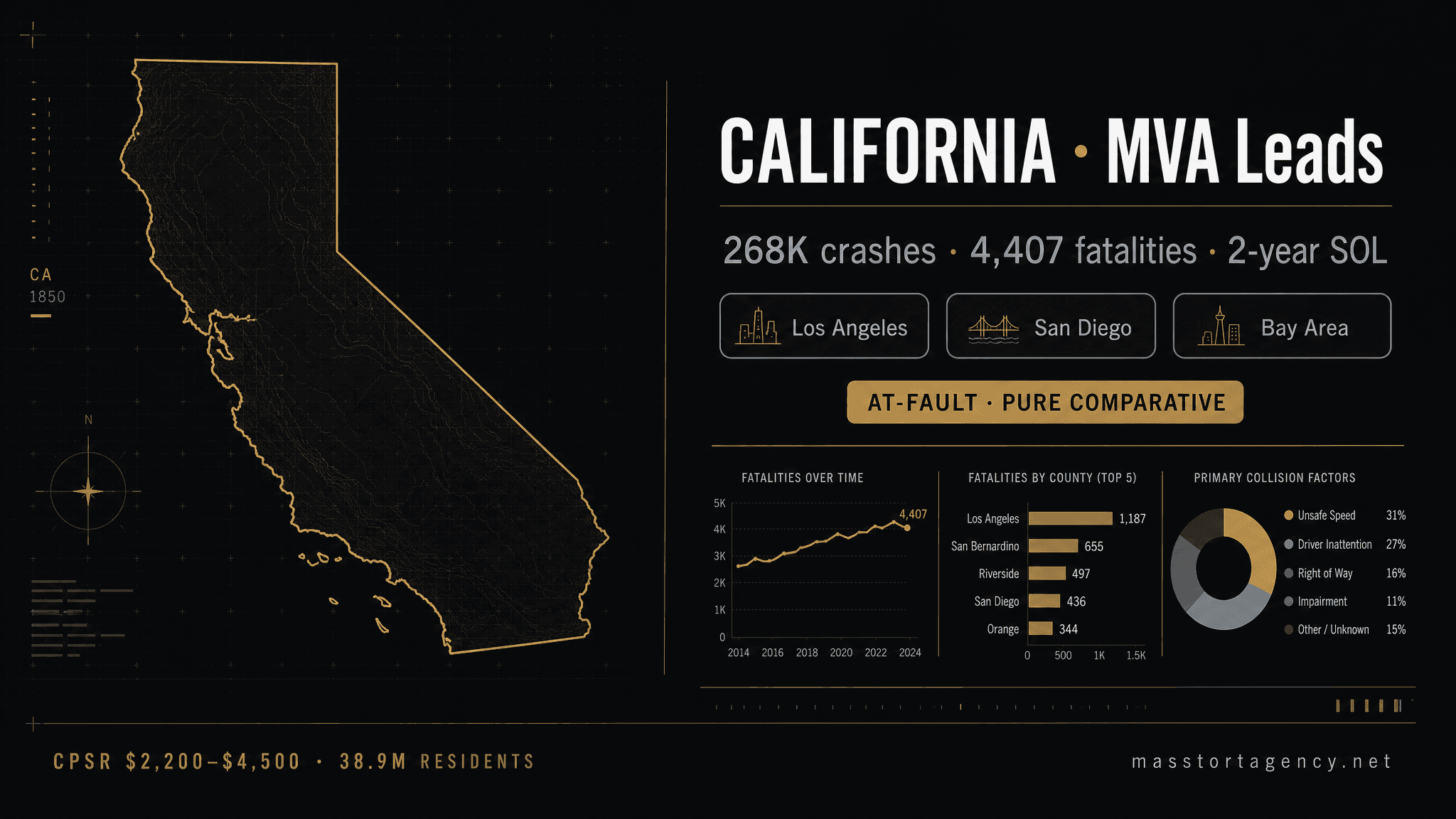
California is the only top-5 MVA market with pure comparative negligence. Claimants 80% at fault still recover 20% — a case-value tailwind no other large state offers. But PROP 213 strips non-economic damages from uninsured drivers, and the 15/30/5 mandatory minimum hides a coverage problem that lives or dies on UM/UIM stacking.
West
California · CA
268,000 crashes/yr
California · Market Size
Source: NHTSA + CA DOT
268,000
Reported crashes / yr
4,407
Annual fatalities
274,000
Injured claimants / yr
38.9M
State population
California · Quick Reference
The 5 facts that drive California MVA lead qualification
Liability
At-fault
Negligence
Pure comparative
PI SOL
2 years
PIP
Not required
Min. liability
15/30/5
Bottom line · Pure comparative + 15/30/5 minimums + PROP 213 = case-value mechanics live on UM/UIM stacking and claimant insurance status, not just liability. California's structural advantages are real — but vendors who don't screen for them sell firms cases that look great until the coverage cliff hits.
The opportunity in California
California MVA: pure comparative meets PROP 213
California reports 268,000 traffic crashes annually — below several at-fault states with smaller populations because California's high-density urban corridors keep average speeds lower. But per-case values run among the highest in the country, making CA a top-5 MVA market by case-value math even if not by raw crash count. Los Angeles County alone produces 56,400 reported crashes per year; the Bay Area (San Francisco, Oakland, San Jose) adds 32,100; Riverside–San Bernardino contributes another 22,300. The state's 38.9 million residents concentrate on the I-5 / I-10 / US-101 corridors.
California's structural advantage for plaintiff recovery is pure comparative negligence. Unlike Texas (51% bar) or post-HB 837 Florida (modified-51%), California claimants recover at any fault percentage — even 80% at fault yields 20% of damages. Combined with LA County's jury patterns and the Bay Area's tech-corridor insurance tower depth, California case values run structurally higher per signed retainer than equivalent fact patterns in any other top-5 state.
Two California-specific rules carve into that advantage. PROP 213 (Cal. Civ. Code § 3333.4) bars uninsured drivers from recovering non-economic damages — even when the at-fault driver is 100% liable. And California's 15/30/5 mandatory liability minimum is among the lowest in the country, so when fault is clear but the at-fault driver carries only policy minimums, UM/UIM stacking becomes the case-value mechanic. Lead vendors who don't capture insurance-status at intake (claimant's own UM/UIM, MedPay, and health coverage) are quietly selling firms cases that hit a coverage cliff at settlement.
Liability framework
How California liability works — and why it matters at intake
Liability system
At-fault
Comparative negligence
Pure comparative negligence
PIP requirement
Not required
PI statute of limitations
2 years
Property damage SOL
3 years
Mandatory liability minimums
15/30/5
(BI per person / per accident / property damage, in thousands)
California is at-fault: the responsible driver's carrier pays. No PIP mandate, but California also uses pure comparative negligence — claimants recover even if 99% at fault, with damages reduced by their fault percentage. That's a meaningful case-value tailwind no other large state offers.
California is one of 13 pure comparative negligence states. A claimant 80% at fault still recovers 20% of damages. Combined with high jury verdicts, this makes California MVA leads structurally more valuable per case.
Where the volume is
Top California claim markets
California MVA volume runs along three coastal axes — Los Angeles, the Bay Area, and San Diego — plus the Inland Empire (Riverside–San Bernardino) and the Sacramento corridor. Each anchor metro carries a distinct claimant profile: Los Angeles is multilingual-first (Spanish, Korean, Vietnamese, Mandarin) with rideshare and entertainment-industry case values; the Bay Area produces high-value tech-corridor cases with deep insurance towers; San Diego carries military-base coverage interactions (Camp Pendleton, MCAS Miramar, Naval Base San Diego); Sacramento is state-government-employee heavy with workers' comp coordination; the Inland Empire produces commercial-trucking case volume on I-10 / I-15.
Los Angeles–Long Beach
56,400
San Diego
18,700
Bay Area (SF / Oakland / SJ)
32,100
Sacramento
12,800
Riverside–San Bernardino
22,300
Qualified MVA lead criteria
What "qualified" means in California
In California, "qualified" means clearing four gates: coverage status (UM/UIM, MedPay, claimant's own insurance), PROP 213 standing (claimant must be insured to recover non-economic damages), fault profile (pure comparative still recovers, but documented), and severity (medical treatment underway within the 2-year SOL). The seven criteria below operationalize all four — including the PROP 213 insurance check that's California-specific.
Accident date & SOL margin
Within 60 days of the wreck. California's 2-year personal injury SOL compresses the case-management window — older leads burn the firm's pipeline.
California jurisdiction
Accident occurred in-state with a police report on file. Report number captured at intake.
Fault apportionment
Claimant fault percentage captured. California pure comparative — recovery preserved at any fault level, reduced proportionally.
Coverage profile
California does not mandate PIP. Capture UM/UIM, MedPay, and health insurance status — first-dollar coverage varies widely.
Medical treatment
Active or completed care, with treatment provider documented. Injury severity captures the qualified-lead threshold.
No prior representation
Conflict-check release signed at intake. Lead is the firm's exclusive opportunity.
TCPA consent
Express written consent record on file: IP, timestamp, user agent, consent language all captured.
California · Pricing benchmarks
What California MVA leads actually cost in 2026
California live-transfer CPL runs 18–25% above Texas and Florida for comparable fact patterns. The premium reflects two structural forces: multilingual intake (English, Spanish, Korean, Vietnamese, Mandarin, Cantonese) that adds 12–18% to intake cost, and case-value math that supports higher media spend (pure comparative + deep insurance towers + LA/Bay Area jury patterns). The $2,200–4,500 CPSR band is the widest in the top-5 — metro mix drives most of the variance.
Cost per signed retainer · California
$2,200–$4,500
· midpoint $3,350
Typical California CPSR band, inclusive of media + intake + signed-retainer attribution. Variance driven by liability complexity and metro mix, not media cost alone.
CPL by tier
Tier 1 — Live Transfer
$350–$600
CPL · Inbound caller, pre-qualified
Tier 2 — Qualified Form
$145–$265
CPL · Form fill, screened ≤15 min
Tier 3 — Data Lead
$40–$75
CPL · Volume tier, firm-screened
How we operate in California
Channel mix + compliance
Channels that work in California
California is the most language-diverse MVA market in the country. Spanish-language intake is the structural baseline for LA, the Inland Empire, and the Central Valley. Korean-language intake is essential in LA Koreatown and Orange County (Garden Grove, Fullerton, Cerritos). Vietnamese covers Westminster, Garden Grove, and East San Jose. Mandarin and Cantonese serve the Bay Area Chinese-American population. California Rule 7.3 bars in-person, live-telephone, and real-time electronic solicitation when "a significant motive is pecuniary gain" — lead vendors must source via opt-in inbound channels only, and the State Bar enforces aggressively.
TCPA + DPPA · federal
Express written consent records on every outbound contact — timestamp, IP, user agent, consent language. DPPA enforced for any driver-record-derived data.
California bar advertising rules
California Rules of Professional Conduct 7.1–7.5 (Communications & Solicitation). Direct in-person and live-telephone solicitation of MVA victims is restricted — lead vendors must source via opt-in inbound channels only.
California MVA leads · FAQ
Questions California firms ask before buying
Why are California MVA leads more expensive than other states?
Two structural reasons. First, California has pure comparative negligence — claimants recover even at high fault percentages, which raises case value and bids up media. Second, the multilingual intake premium (English / Spanish / Korean / Vietnamese / Mandarin) in the LA and Bay Area metros adds 12–18% to intake cost.
What's the typical CPSR (cost per signed retainer) for California MVA cases?
$2,200–4,500 CPSR is the band Mass Tort Marketing Agency sees on California MVA campaigns in 2024–2026. The wide band is driven by metro mix — LA + Bay Area campaigns run at the high end; Sacramento, Fresno, and Bakersfield campaigns run at the low end with similar signed-retainer conversion rates.
Does California's pure comparative negligence change how I should screen leads?
Yes, but in your favor. Unlike modified-50/51 states (TX, FL, GA), California claimants can recover even at 60–80% fault. Pure comparative means the lead-qualification filter on fault percentage is much looser — a 'shared fault' lead in CA is still convertible, while the same fact pattern in Texas would be a hard no.
How does California's $15K/$30K/$5K minimum liability affect case value?
California's mandatory minimums are among the lowest in the country — many at-fault drivers carry only $15K bodily injury coverage. For serious-injury cases, UM/UIM stacking and umbrella coverage become essential. Qualified California MVA leads should always capture UM/UIM status at intake.
What does California Rule 7.3 require for MVA lead-based outreach?
Rule 7.3 prohibits in-person, live-telephone, or real-time electronic solicitation of a prospective client when a significant motive is pecuniary gain — unless the contacted person is a lawyer, has a family/close personal/prior professional relationship, or is a person who routinely uses for business purposes the type of legal services. Lead vendors should source leads via opt-in inbound channels, not outbound cold outreach.
What MVA case types deliver the highest signed-retainer value in California?
Catastrophic injury cases (TBI, spinal, multi-system), commercial vehicle and trucking, and rideshare (Uber/Lyft) cases consistently deliver the highest case value in California due to the deep insurance towers. Standard rear-end + soft-tissue cases are still convertible but at much lower CPSR margin.
California metro markets
MVA leads by California metro
Regional MVA markets