
Motor Vehicle Accident Leads in New York
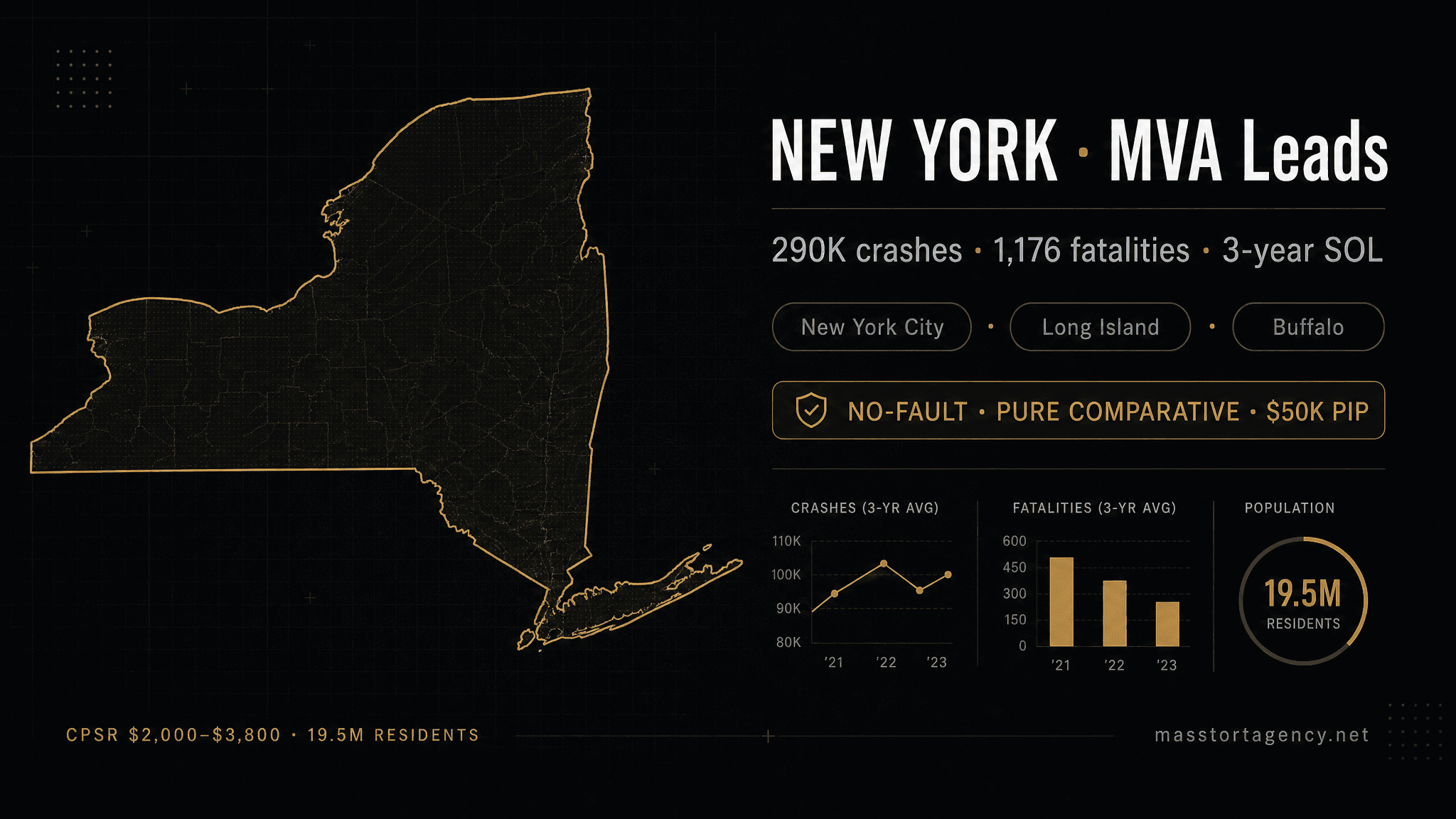
New York carries the highest mandatory PIP in the country — $50,000 — and the strictest serious-injury threshold (Ins. Law § 5102(d)). Combined with pure comparative negligence and a 3-year SOL, the qualified-lead definition in New York looks fundamentally different from anywhere else in the top 5.
Northeast
New York · NY
290,000 crashes/yr
New York · Market Size
Source: NHTSA + NY DOT
290,000
Reported crashes / yr
1,176
Annual fatalities
137,500
Injured claimants / yr
19.5M
State population
New York · Quick Reference
The 5 facts that drive New York MVA lead qualification
Liability
No-fault
Negligence
Pure comparative
PI SOL
3 years
PIP
$50,000 req'd
Min. liability
25/50/10
Bottom line · True no-fault + $50K PIP + § 5102(d) threshold + pure comparative + 3-year SOL = New York is a four-filter market. PIP exhausts later than anywhere else, the threshold is the most-litigated standard in PI law, and pure comparative preserves case value when claims clear. Vendors who treat NY like a generic at-fault state miss the entire qualification framework.
The opportunity in New York
New York MVA: the $50K PIP and § 5102(d) threshold
New York reports 290,000 traffic crashes annually with 1,176 fatalities — a fatality rate below top-5 peers because NYC's pedestrian-density, low-speed urban mix produces more crashes-per-mile but fewer fatalities-per-crash than rural-corridor states like Texas or Georgia. New York City's five boroughs alone produce 86,400 reported crashes per year. Long Island (Nassau plus Suffolk) adds 41,200. Upstate — Buffalo, Rochester, Syracuse, Albany — concentrates a different volume profile along the I-90 / I-87 / Thruway corridor.
New York's no-fault framework is the most generous in the country. Mandatory $50,000 PIP under Insurance Law § 5103 covers first-dollar medical and lost wages without litigation — five times Florida's $10,000 cap. The practical effect: most fender-bender and soft-tissue cases never leave no-fault. Tort recovery against the at-fault driver requires clearing the § 5102(d) serious-injury threshold — death, dismemberment, significant disfigurement, fracture, loss of fetus, permanent loss of use, permanent consequential limitation, significant limitation, or a medically determined non-permanent injury preventing customary daily activities for 90 of the first 180 days post-accident.
Pure comparative negligence layers on top: claimants recover at any fault percentage, with damages reduced proportionally. The 3-year SOL under CPLR § 214(5) is the longest among top-5 states. But pedestrian and cyclist cases dominate NYC volume (highest density among US metros), and the MTA's governmental-entity status triggers a 90-day notice requirement under General Municipal Law § 50-e — qualified MVA leads involving buses, subways, or city/state-owned vehicles run a parallel clock that fires five times faster than the underlying tort SOL.
Liability framework
How New York liability works — and why it matters at intake
Liability system
No-fault
Comparative negligence
Pure comparative negligence
PIP requirement
Required · $50,000 min.
PI statute of limitations
3 years
Property damage SOL
3 years
Mandatory liability minimums
25/50/10
(BI per person / per accident / property damage, in thousands)
New York is a true no-fault state with the most generous mandatory PIP in the country — $50,000 minimum. Claimants must meet the New York 'serious injury' threshold under Insurance Law § 5102(d) before stepping outside no-fault to pursue the at-fault driver's carrier.
New York uses pure comparative negligence — recovery even at high fault percentages, reduced by claimant's own fault. Combined with NYC jury patterns, this makes New York case values among the highest in the U.S.
Where the volume is
Top New York claim markets
New York MVA volume splits into two distinct markets: NYC metro (the five boroughs plus Long Island and the lower Hudson Valley) and upstate (Buffalo, Rochester, Syracuse, Albany). NYC produces the highest pedestrian and cyclist case rates in the country — 86,400 reported crashes per year with a substantially higher proportion of vulnerable-road-user fact patterns than any other US metro. Long Island carries higher policy limits per claimant (Nassau and Suffolk household income drives coverage selection), making case values structurally larger than NYC averages. Upstate metros run 20–25% under NYC CPL with comparable signed-retainer rates — the strongest under-served pricing opportunity in the top 5.
New York City (5 boroughs)
86,400
Long Island (Nassau / Suffolk)
41,200
Buffalo–Niagara
19,800
Rochester
12,500
Albany–Schenectady
9,600
Qualified MVA lead criteria
What "qualified" means in New York
In New York, "qualified" means clearing two layered thresholds: the § 5102(d) serious-injury threshold (or basic economic loss exceeding $50K under § 5104(a)) AND timing under the 3-year SOL (or the 90-day notice clock for governmental-entity claims under GML § 50-e). The seven criteria below operationalize both — with explicit capture of the threshold-qualifying injury documentation that most national vendors skip on intake.
Accident date & SOL margin
Within 90 days of the wreck. New York's 3-year personal injury SOL compresses the case-management window — older leads burn the firm's pipeline.
New York jurisdiction
Accident occurred in-state with a police report on file. Report number captured at intake.
Fault apportionment
Claimant fault percentage captured. New York pure comparative — recovery preserved at any fault level, reduced proportionally.
Coverage profile
PIP confirmed — New York mandates $50,000 minimum. Capture PIP exhaustion status for case-value math.
Medical treatment
Active or completed care, with treatment provider documented. Injury severity captures the qualified-lead threshold.
No prior representation
Conflict-check release signed at intake. Lead is the firm's exclusive opportunity.
TCPA consent
Express written consent record on file: IP, timestamp, user agent, consent language all captured.
New York · Pricing benchmarks
What New York MVA leads actually cost in 2026
New York's pricing structure is bimodal. NYC live-transfer CPL runs at the top of the national range ($325–525) because the five-borough market is the most expensive paid-media zone in the country after LA, and multilingual intake (English, Spanish, Mandarin, Cantonese, Haitian Creole, Russian, Bengali) adds 15–22% to intake cost. Upstate (Buffalo, Rochester, Syracuse, Albany) runs 20–25% under that band with comparable signed-retainer rates — under-served by national vendors who chase NYC volume and ignore Buffalo. CPSR runs $2,000–3,800 with metro mix driving most of the variance.
Cost per signed retainer · New York
$2,000–$3,800
· midpoint $2,900
Typical New York CPSR band, inclusive of media + intake + signed-retainer attribution. Variance driven by liability complexity and metro mix, not media cost alone.
CPL by tier
Tier 1 — Live Transfer
$325–$525
CPL · Inbound caller, pre-qualified
Tier 2 — Qualified Form
$135–$245
CPL · Form fill, screened ≤15 min
Tier 3 — Data Lead
$40–$70
CPL · Volume tier, firm-screened
How we operate in New York
Channel mix + compliance
Channels that work in New York
New York is the most linguistically diverse MVA market in the country after California. Spanish-language intake is the structural baseline across the Bronx, Brooklyn, Queens, and Upper Manhattan. Mandarin and Cantonese cover Flushing and Sunset Park. Haitian Creole covers Flatbush, Crown Heights, and parts of Long Island. Russian covers Brighton Beach and pockets of Queens. Bengali serves Jackson Heights and parts of the Bronx. NY Rules of Professional Conduct 7.3 prohibits in-person, live-telephone, and real-time electronic solicitation by lawyers — leads must originate from opt-in inbound channels. The State Bar Grievance Committees in the First and Second Departments enforce actively.
TCPA + DPPA · federal
Express written consent records on every outbound contact — timestamp, IP, user agent, consent language. DPPA enforced for any driver-record-derived data.
New York bar advertising rules
New York Rules of Professional Conduct 7.1–7.5. Direct in-person and live-telephone solicitation of MVA victims is restricted — lead vendors must source via opt-in inbound channels only.
New York MVA leads · FAQ
Questions New York firms ask before buying
What is the New York 'serious injury' threshold and why does it matter for MVA leads?
Under Insurance Law § 5102(d), a claimant cannot sue the at-fault driver outside no-fault unless their injury qualifies as 'serious' — meaning death, dismemberment, significant disfigurement, fracture, loss of fetus, permanent loss of use of an organ or member, permanent consequential limitation, significant limitation, or a medically determined non-permanent injury preventing customary daily activities for 90 of the first 180 days post-accident. Qualified MVA leads must have initial injury documentation supporting one of these categories.
What's the typical CPL for buying MVA leads in New York?
New York live-transfer MVA leads run $325–525 CPL, qualified-form $135–245. NYC is the most expensive metro nationally for MVA paid media after LA. Upstate (Buffalo, Rochester, Syracuse) runs 20–25% under the statewide band.
How does New York's 3-year SOL compare to other states for lead aging?
New York gives 3 years from accident date for personal injury — one of the longer windows. Older leads (12–24 months post-accident) are still convertible if no prior representation. Florida and Texas have 2-year SOLs that compress the window significantly.
Are Long Island MVA leads priced differently from NYC MVA leads?
Yes — Long Island runs 15–22% under NYC CPL because metro media costs are lower, but signed-retainer rate is comparable. Nassau and Suffolk claimants tend to have higher policy limits, which raises case value.
What does New York's $50K mandatory PIP mean for case strategy?
It means claimants have substantial first-dollar coverage for medical bills and lost wages without litigation — which is why the serious-injury threshold matters so much. A qualified MVA lead in NY has either documented severity that clears § 5102(d) or PIP-exhausted bills exceeding $50K with continued treatment.
What MVA case types are most valuable in New York?
Pedestrian and cyclist cases (NYC has the highest pedestrian crash rate among large metros), commercial vehicle / trucking (federal Hours of Service + state-level rules), and TLC / rideshare cases. NY's labor and traffic regulations create more theories of recovery than most states.
New York metro markets
MVA leads by New York metro
Regional MVA markets