
Motor Vehicle Accident Leads in Colorado
Colorado concentrates roughly three-quarters of statewide MVA volume in the Front Range corridor (Denver → Colorado Springs → Fort Collins) — and the I-70 mountain-pass crashes through Eisenhower Tunnel and Vail Pass run an entirely different fact-pattern playbook. Add Colorado's recreational-marijuana DUI complexity and the case mix has no national parallel.
West
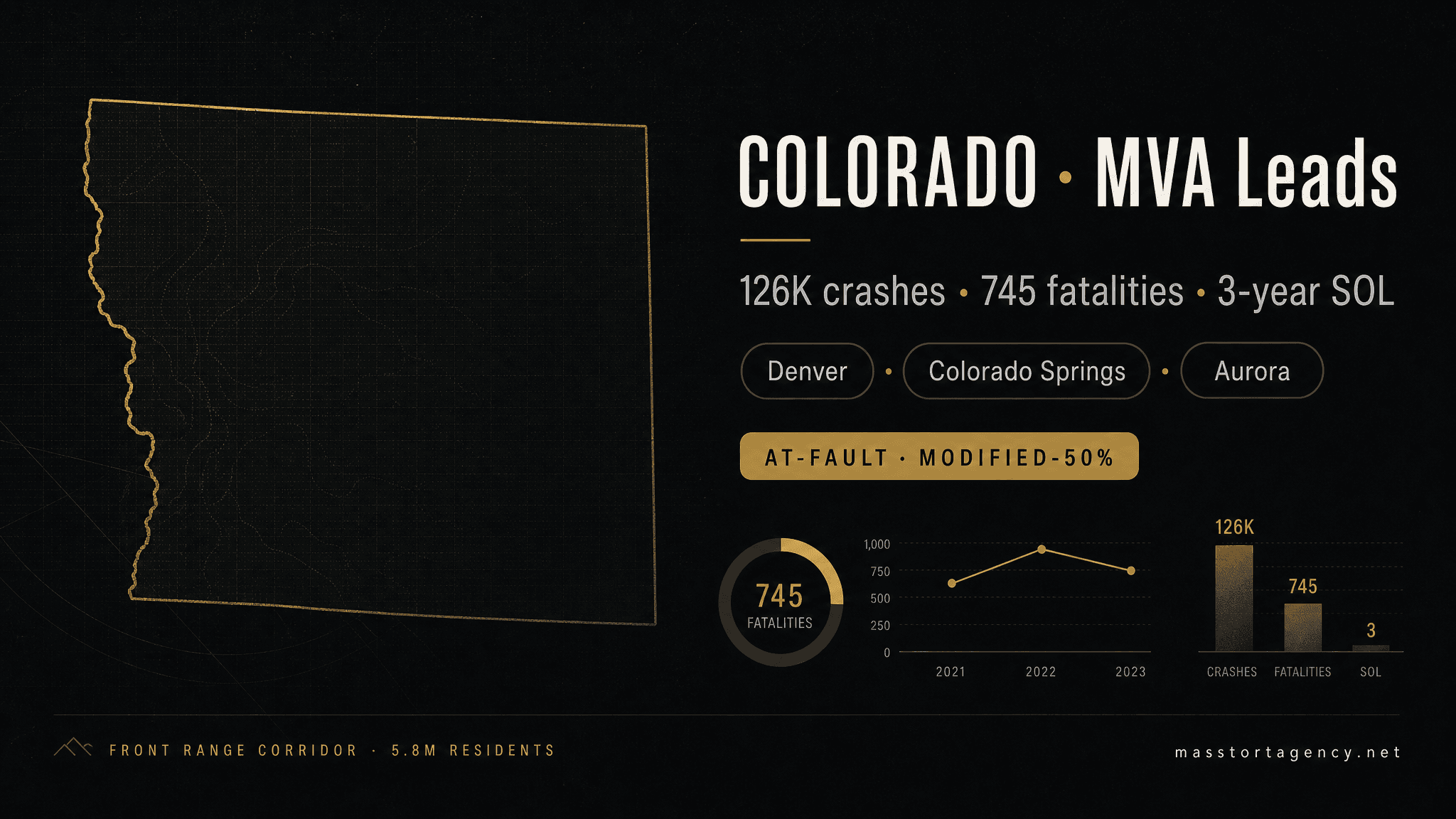
Colorado · CO
126,000 crashes/yr
Colorado · Market Size
Source: NHTSA + CO DOT
126,000
Reported crashes / yr
745
Annual fatalities
31,800
Injured claimants / yr
5.80M
State population
Colorado · Quick Reference
The 5 facts that drive Colorado MVA lead qualification
Liability
At-fault
Negligence
50% bar (strict)
PI SOL
3 years
PIP
Not required
Min. liability
25/50/15
Bottom line · At-fault + strict 50% bar + 3-year SOL + Front Range concentrating ~75% of volume + I-70 mountain corridor + marijuana-DUI evidentiary complexity = Colorado rewards fact-pattern classification at intake. Mountain-pass cases are not Front Range cases — the witnesses, the law-enforcement response, and the fault-apportionment math all differ.
The opportunity in Colorado
Colorado MVA: Front Range concentration + mountain-pass complexity
Colorado reports 126,000 traffic crashes annually with 745 fatalities. Volume concentrates on the Front Range — Denver metro (51,800 crashes/yr), Colorado Springs (17,400), Aurora (11,900), Fort Collins (8,400), and Lakewood (6,200) together produce roughly three-quarters of statewide volume. The I-25 corridor running Fort Collins → Denver → Colorado Springs → Pueblo is the anchor. I-70 through the mountains (Idaho Springs → Eisenhower Tunnel → Vail Pass → Glenwood Springs → Grand Junction) adds a high-severity / low-volume secondary fact pattern.
Colorado uses the strict 50% bar under C.R.S. § 13-21-111 — claimants 50% or more at fault recover nothing. This is different from the 51% bar used by 33 states. The 3-year tort SOL under C.R.S. § 13-80-101 is standard. No PIP mandate since 2003 — Colorado abolished mandatory PIP under HB 03-1188, so first-dollar coverage varies. Mandatory liability minimum is 25/50/15. Combined, Colorado is a clean at-fault state with the discipline of a strict 50% bar.
Colorado's distinctive overlays are recreational marijuana DUI complexity and mountain-pass crash patterns. Marijuana legalization (2014) created blood-THC-level evidentiary issues that don't exist in most states — Colorado law sets a 5 ng/mL active THC threshold under C.R.S. § 42-4-1301(6)(a)(IV), but defense counsel routinely challenges THC blood-level interpretation in court. Mountain-pass crashes on I-70 carry unique fact patterns: ski-resort commercial-vehicle volume, weather-related multi-vehicle pileups, and tourist-driver unfamiliarity with high-altitude road conditions. Lead vendors who don't filter for ski-corridor vs. Front Range fact patterns sell firms cases with materially different conversion economics.
Liability framework
How Colorado liability works — and why it matters at intake
Liability system
At-fault
Comparative negligence
Modified comparative — 50% bar
PIP requirement
Not required
PI statute of limitations
3 years
Property damage SOL
3 years
Mandatory liability minimums
25/50/15
(BI per person / per accident / property damage, in thousands)
Colorado is at-fault: the responsible driver's carrier pays. No PIP mandate (PIP was abolished in 2003). Colorado uses the 50% bar — stricter than the 51% bar used by most states. Combined with the Front Range population concentration along I-25, lead distribution should match metro density.
Colorado uses the strict 50% bar under C.R.S. § 13-21-111. Claimants 50% or more at fault recover nothing. CO is one of 11 states using the strict version, instead of the 51% bar used by 33 states.
Where the volume is
Top Colorado claim markets
Denver metro's 51,800 crashes concentrate on I-25, I-70, I-225, and the C-470 / E-470 outer loops. Denver International Airport (DIA, the country's largest by land area) drives rideshare and rental-vehicle commercial volume. Aurora's 11,900 anchor on I-225 with Buckley Space Force Base military overlay. Colorado Springs's 17,400 sit on I-25 with the Air Force Academy, Fort Carson, NORAD, and Schriever Space Force Base concentrated military population. Fort Collins's 8,400 carry Colorado State University academic overlay. Lakewood operates as a Denver western suburb. The I-70 mountain corridor (Idaho Springs, Vail, Glenwood Springs) operates as a separate secondary market with ski-season surge crash volume December–April.
Denver metro
51,800
Colorado Springs
17,400
Aurora
11,900
Fort Collins
8,400
Lakewood
6,200
Qualified MVA lead criteria
What "qualified" means in Colorado
In Colorado, "qualified" includes fact-pattern classification at intake — Front Range corridor case vs. I-70 mountain-pass case vs. ski-resort commercial-vehicle case. Each carries different fault apportionment, witness availability, and case-value math. The seven criteria below operationalize the standard 50%-bar fault apportionment plus the marijuana-DUI evidentiary capture that's unique to CO.
Accident date & SOL margin
Within 90 days of the wreck. Colorado's 3-year personal injury SOL compresses the case-management window — older leads burn the firm's pipeline.
Colorado jurisdiction
Accident occurred in-state with a police report on file. Report number captured at intake.
Fault apportionment
Claimant less than 50% at fault under Colorado's strict 50% bar.
Coverage profile
Colorado does not mandate PIP. Capture UM/UIM, MedPay, and health insurance status — first-dollar coverage varies widely.
Medical treatment
Active or completed care, with treatment provider documented. Injury severity captures the qualified-lead threshold.
No prior representation
Conflict-check release signed at intake. Lead is the firm's exclusive opportunity.
TCPA consent
Express written consent record on file: IP, timestamp, user agent, consent language all captured.
Colorado · Pricing benchmarks
What Colorado MVA leads actually cost in 2026
Colorado live-transfer CPL runs $285–445. Denver and Colorado Springs anchor the statewide average; Fort Collins runs at the median; mountain-corridor cases command a 15–25% premium reflecting tighter inventory and seasonal volume swings. CPSR $1,700–2,950 reflects clean 50%-bar conversion plus the marijuana-DUI case-value lever where applicable. The numbers below cover 2024–2026 Colorado buy cycles.
Cost per signed retainer · Colorado
$1,700–$3,000
· midpoint $2,350
Typical Colorado CPSR band, inclusive of media + intake + signed-retainer attribution. Variance driven by liability complexity and metro mix, not media cost alone.
CPL by tier
Tier 1 — Live Transfer
$275–$440
CPL · Inbound caller, pre-qualified
Tier 2 — Qualified Form
$115–$210
CPL · Form fill, screened ≤15 min
Tier 3 — Data Lead
$32–$58
CPL · Volume tier, firm-screened
How we operate in Colorado
Channel mix + compliance
Channels that work in Colorado
Denver metro is bilingual-Spanish-significant in Adams and Arapahoe counties (Federal Heights, Commerce City, Aurora's southeast neighborhoods). Colorado Springs has growing Korean and Filipino populations linked to Schriever/Buckley military assignments. Fort Collins and Boulder carry university-population overlays. Colorado Rules of Professional Conduct 7.3 restrict in-person and live-telephone solicitation; the Office of Attorney Regulation Counsel enforces. Colorado's medical-marijuana history dating to 2000 has produced longer-running THC-blood-level case law than any other state — favorable for plaintiff firms challenging defense-counsel impairment arguments.
TCPA + DPPA · federal
Express written consent records on every outbound contact — timestamp, IP, user agent, consent language. DPPA enforced for any driver-record-derived data.
Colorado bar advertising rules
Colorado Rules of Professional Conduct 7.1–7.3. Direct in-person and live-telephone solicitation of MVA victims is restricted — lead vendors must source via opt-in inbound channels only.
Colorado MVA leads · FAQ
Questions Colorado firms ask before buying
How does Colorado's strict 50% bar differ from neighboring states?
Colorado uses C.R.S. § 13-21-111 — claimants 50% or more at fault recover nothing. Arizona (pure comparative), Wyoming (51% bar), Utah (50% bar), and New Mexico (pure comparative) all differ. For lead qualification: a 50/50-fault Colorado case is non-recoverable; a 49/51 case is recoverable but reduced. Lead vendors selling multi-state inventory need state-specific fault filters.
What's the typical CPL for buying MVA leads in Colorado?
Colorado runs $275–440 CPL on live-transfer and $115–210 on qualified-form. Denver metro commands about a 20% premium over statewide; Colorado Springs, Fort Collins, and Boulder run at or slightly below the statewide band.
Why is the Front Range corridor so important for Colorado MVA media?
About 78% of Colorado's statewide MVA case volume originates in the I-25 corridor running from Fort Collins through Denver to Colorado Springs. This 150-mile metro corridor concentrates 4.5M of Colorado's 5.8M residents. MVA media buys should over-index on Front Range geo-targeting.
Does Colorado cap damages in MVA cases?
Compensatory damages: no cap on economic damages, but non-economic damages are capped at $613,760 (as of 2024, inflation-adjusted) under C.R.S. § 13-21-102.5 — one of the few states with such a cap. Punitive damages: limited to the amount of compensatory damages awarded. This caps case value significantly compared to neighboring states.
What MVA case types are most valuable in Colorado?
Commercial vehicle / trucking cases on I-70 and I-25 (cross-state commercial corridors), serious-injury passenger vehicle cases in the Denver metro, and recreational vehicle cases (motorcycles, off-highway vehicles) in the mountain counties. Drunk-driving and reckless-driving cases can pursue punitive damages even with the non-economic cap.
Regional MVA markets