
Motor Vehicle Accident Leads in Michigan
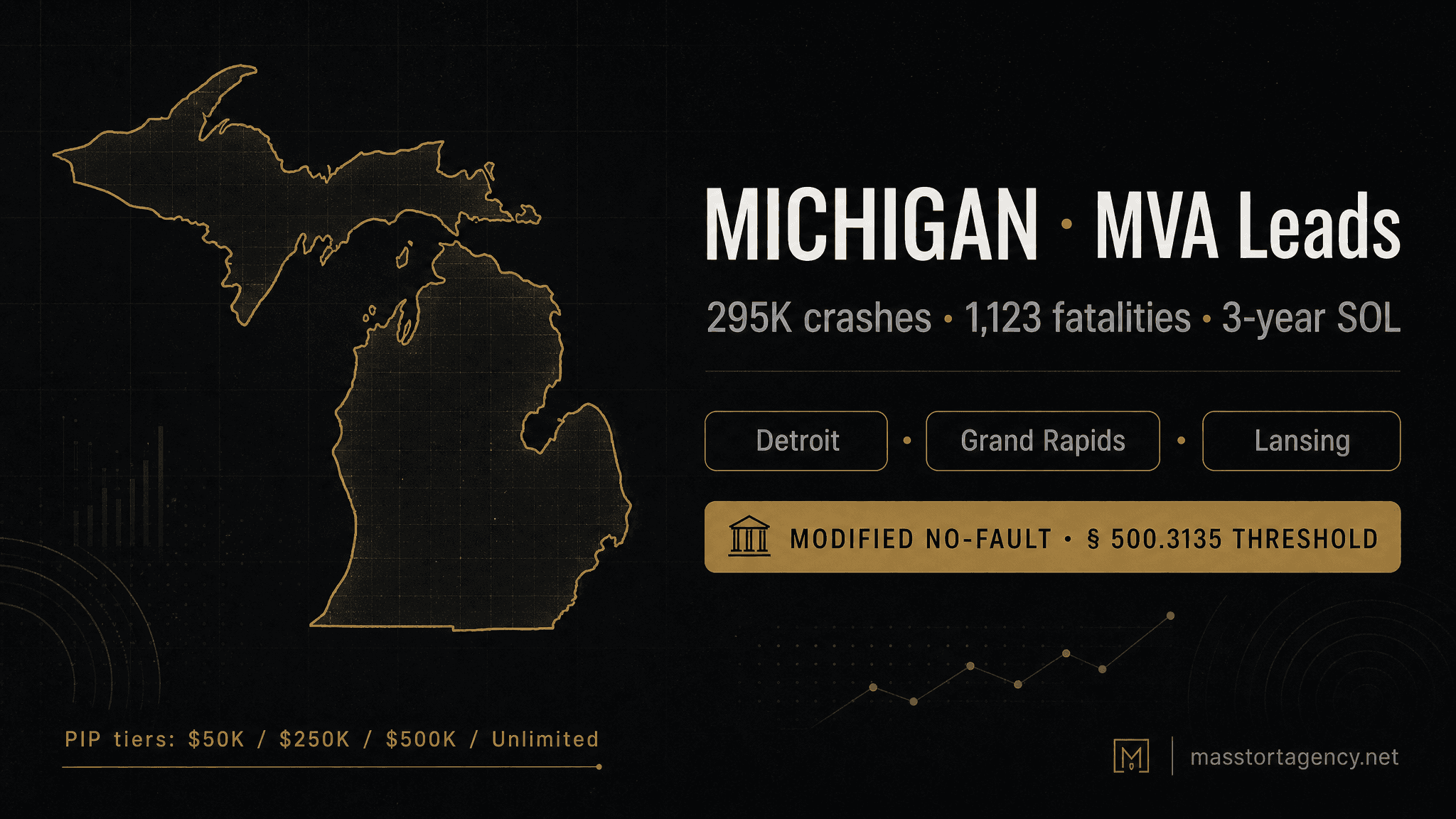
Michigan went from unlimited PIP to a four-tier election ($50K / $250K / $500K / unlimited) after 2019's PA 21. Every Michigan MVA lead requires the PIP level captured at intake — without it, the firm can't model PIP exhaustion or whether the claim will leave no-fault. National vendors who haven't recalibrated since 2019 are still sending pre-reform-style cases.
Midwest
Michigan · MI
295,000 crashes/yr
Michigan · Market Size
Source: NHTSA + MI DOT
295,000
Reported crashes / yr
1,123
Annual fatalities
71,500
Injured claimants / yr
10.0M
State population
Michigan · Quick Reference
The 5 facts that drive Michigan MVA lead qualification
Liability
Modified no-fault
Negligence
51% bar
PI SOL
3 years
PIP
$50,000 req'd
Min. liability
50/100/10
Bottom line · Modified no-fault + four-tier PIP election + § 3135 threshold + 51% bar + 3-year SOL = Michigan is the most complex no-fault qualification framework in the country. Every MI lead requires PIP tier captured at intake — without that data field, the firm cannot model case value.
The opportunity in Michigan
Michigan MVA: post-PA 21 no-fault economics
Michigan reports 295,000 traffic crashes annually with 1,123 fatalities — second among Tier-1 Midwest states behind Illinois. Detroit metro alone produces 102,400 reported crashes per year (about 35% of statewide volume), with Grand Rapids, Lansing, Flint, and Ann Arbor making up the rest of the meaningful market. The state's I-94 / I-96 / I-75 corridor concentrates the bulk of commercial vehicle and commuter crashes.
Michigan's no-fault framework was the country's most generous from 1973 until 2019. Public Act 21 of 2019 broke the unlimited-PIP standard and replaced it with a four-tier election: $50,000 (Medicaid coordination only, available to Medicaid-eligible claimants), $250,000, $500,000, or unlimited. The election applies at policy issuance — and a claimant's elected tier dictates whether their medical bills will exhaust PIP and trigger the need for third-party tort recovery. Without the PIP tier captured at lead intake, the firm cannot model case value, settlement timing, or treatment-financing logistics.
Tort recovery against the at-fault driver requires clearing the "serious impairment of body function" threshold under MCL § 500.3135, as interpreted by McCormick v. Carrier (2010): an objectively manifested impairment, of an important body function, that affects the person's general ability to lead his or her normal life. The 51% modified comparative bar applies to third-party tort claims under MCL § 600.2959. Combined with the 3-year SOL under MCL § 600.5805(2), Michigan is a four-filter market: PIP tier, threshold clearance, fault percentage, and SOL timing.
Liability framework
How Michigan liability works — and why it matters at intake
Liability system
Modified no-fault
Comparative negligence
Modified comparative — 51% bar
PIP requirement
Required · $50,000 min.
PI statute of limitations
3 years
Property damage SOL
3 years
Mandatory liability minimums
50/100/10
(BI per person / per accident / property damage, in thousands)
Michigan was the country's only true 'unlimited' no-fault state until the 2019 reform. Now drivers choose a PIP level: $50K, $250K, $500K, or unlimited. The PIP election dramatically affects what a 'qualified' MVA lead looks like — uncapped PIP claimants can have million-dollar medical bills covered without litigation; $50K PIP claimants exhaust quickly and need third-party tort recovery.
Michigan uses the 51% bar for tort claims (when third-party action is available). Plus the 'serious impairment of body function' threshold under MCL § 500.3135 controls when a claimant can pursue the at-fault driver outside no-fault.
Where the volume is
Top Michigan claim markets
Detroit metro's 102,400 reported crashes span Wayne, Oakland, and Macomb counties. Wayne County (Detroit proper, Dearborn, Hamtramck) carries the historically highest verdicts and largest Arabic-American population in the country (Dearborn / Dearborn Heights). Oakland County (Bloomfield Hills, Birmingham, Troy) carries the highest per-claimant policy limits. Macomb (Warren, Sterling Heights, Clinton Township) anchors the commercial corridor on I-94 / M-59. Grand Rapids drives I-96 west-side commercial vehicle volume; Lansing has state-government-employee claimants with workers' comp coordination; Flint carries persistent I-75 corridor commercial trucking volume; Ann Arbor's University of Michigan medical and academic population creates a distinct claimant profile.
Detroit metro
102,400
Grand Rapids
23,800
Lansing
11,900
Flint
9,800
Ann Arbor
8,400
Qualified MVA lead criteria
What "qualified" means in Michigan
In Michigan, "qualified" requires four data fields captured at intake: PIP tier (under PA 21), serious-impairment documentation (under McCormick v. Carrier), fault percentage (under the 51% bar), and timing (under the 3-year SOL or the 1-year-back rule for no-fault PIP benefits). The seven criteria below operationalize all four — including the PIP tier capture that national vendors routinely skip and that determines whether the case can leave no-fault at all.
Accident date & SOL margin
Within 90 days of the wreck. Michigan's 3-year personal injury SOL compresses the case-management window — older leads burn the firm's pipeline.
Michigan jurisdiction
Accident occurred in-state with a police report on file. Report number captured at intake.
Fault apportionment
Claimant 50% or less at fault under Michigan's 51% bar.
Coverage profile
PIP confirmed — Michigan mandates $50,000 minimum. Capture PIP exhaustion status for case-value math.
Medical treatment
Active or completed care, with treatment provider documented. Injury severity captures the qualified-lead threshold.
No prior representation
Conflict-check release signed at intake. Lead is the firm's exclusive opportunity.
TCPA consent
Express written consent record on file: IP, timestamp, user agent, consent language all captured.
Michigan · Pricing benchmarks
What Michigan MVA leads actually cost in 2026
Michigan live-transfer CPL runs $310–495, higher than Ohio or Illinois because the post-PA 21 intake complexity raises per-lead cost. Detroit metro commands a 20–30% premium over the statewide band; Upper Peninsula and rural Michigan run 30–40% below. CPSR $1,950–3,400 reflects two structural realities: unlimited-PIP-tier claimants drive disproportionate case value (medical bills are recoverable beyond what most other states allow), and $50K-PIP claimants drive disproportionate intake complexity (PIP exhausts fast, threshold must be cleared, third-party tort math has to work). The numbers below cover 2024–2026 Michigan buy cycles.
Cost per signed retainer · Michigan
$1,950–$3,400
· midpoint $2,675
Typical Michigan CPSR band, inclusive of media + intake + signed-retainer attribution. Variance driven by liability complexity and metro mix, not media cost alone.
CPL by tier
Tier 1 — Live Transfer
$310–$495
CPL · Inbound caller, pre-qualified
Tier 2 — Qualified Form
$125–$230
CPL · Form fill, screened ≤15 min
Tier 3 — Data Lead
$36–$62
CPL · Volume tier, firm-screened
How we operate in Michigan
Channel mix + compliance
Channels that work in Michigan
Detroit metro is the most Arabic-language-significant MVA market in the country — Dearborn alone hosts the largest Arab-American population in the US, and Arabic-language intake is structural for the I-94 corridor between Detroit and Dearborn. Spanish-language demand concentrates in Southwest Detroit and Pontiac. Detroit also carries a meaningful African-American urban media segment that over-indexes on AM/FM talk and gospel radio. Michigan Rule 7.3 prohibits in-person, live-telephone, and real-time electronic solicitation; the Attorney Grievance Commission enforces.
TCPA + DPPA · federal
Express written consent records on every outbound contact — timestamp, IP, user agent, consent language. DPPA enforced for any driver-record-derived data.
Michigan bar advertising rules
Michigan Rules of Professional Conduct 7.1–7.3. Direct in-person and live-telephone solicitation of MVA victims is restricted — lead vendors must source via opt-in inbound channels only.
Michigan MVA leads · FAQ
Questions Michigan firms ask before buying
How did the 2019 Michigan no-fault reform change MVA lead qualification?
Before 2019, every Michigan driver had unlimited lifetime medical PIP. After PA 21 of 2019, drivers choose: $50K (Medicaid coordination only), $250K, $500K, or unlimited. Claimants who elected lower PIP tiers exhaust faster and need third-party tort recovery — but they must clear the serious-impairment threshold to step outside no-fault. Lead intake should capture PIP level + injury severity together.
What is the 'serious impairment of body function' threshold in Michigan?
Under MCL § 500.3135 (as interpreted by McCormick v. Carrier, 2010), a 'serious impairment' is (1) an objectively manifested impairment (2) of an important body function (3) that affects the person's general ability to lead his or her normal life. Qualified Michigan MVA leads must have initial documentation supporting all three elements to be tort-eligible.
What's the typical CPL for buying MVA leads in Michigan?
Michigan live-transfer MVA leads run $310–495 CPL, qualified-form $125–230. Detroit metro is the most expensive (40% of statewide volume), Grand Rapids is mid-tier, and the Upper Peninsula runs 30–40% below the statewide band.
Does Michigan's 3-year SOL apply to all MVA claims?
Three years from the accident date for personal injury and property damage. For no-fault PIP benefits, the action against the insurer has a 1-year-back rule (only benefits accrued in the year before suit are recoverable), which is a separate timeline from the underlying tort SOL.
What MVA case types are most valuable in Michigan?
Catastrophic-injury cases where the claimant carries unlimited or $500K PIP (medical bills are recoverable beyond what most other states allow) and commercial vehicle / trucking cases (federal HOS regulations + Michigan's high mandatory liability minimum of 50/100/10). Detroit metro produces ~58% of high-value Michigan MVA cases.
Regional MVA markets