
Motor Vehicle Accident Leads in Indiana
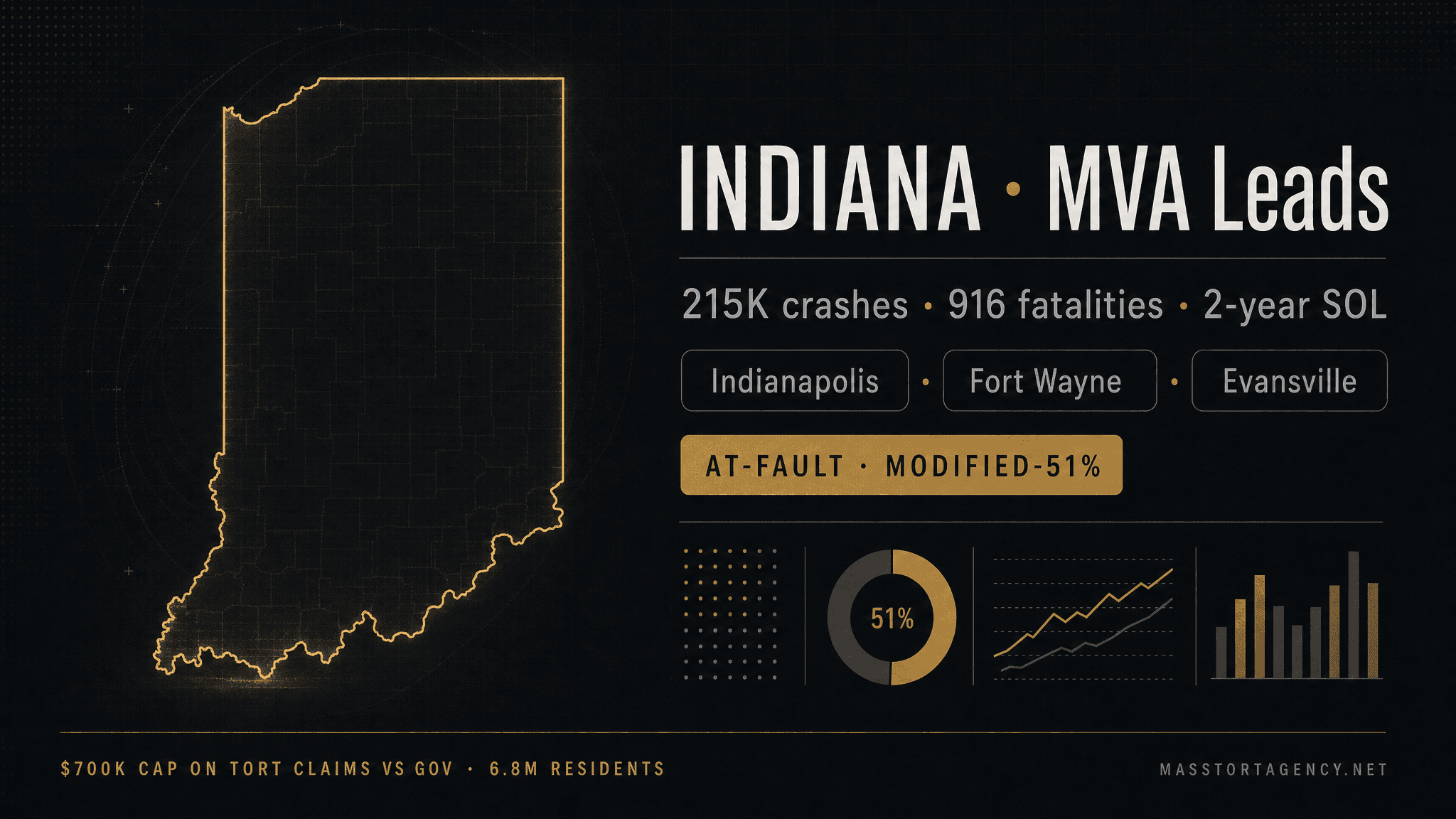
Indianapolis anchors 52,400 of Indiana's 215,000 annual crashes — and the Indiana Tort Claims Act caps governmental-defendant claims at $700,000 (IC 34-13-3-4). Combined with the Chicago DMA spillover into Lake/Porter counties, Indiana has two distinct media-buy structures and a procedural ceiling national vendors routinely miss.
Midwest
Indiana · IN
215,000 crashes/yr
Indiana · Market Size
Source: NHTSA + IN DOT
215,000
Reported crashes / yr
916
Annual fatalities
41,800
Injured claimants / yr
6.80M
State population
Indiana · Quick Reference
The 5 facts that drive Indiana MVA lead qualification
Liability
At-fault
Negligence
51% bar
PI SOL
2 years
PIP
Not required
Min. liability
25/50/25
Bottom line · At-fault + 51% bar + Indianapolis ~24% concentration + Chicago DMA spillover into NW Indiana + $700K ITCA cap = Indiana rewards lead vendors who can flag governmental defendants at intake and price Chicago-DMA Northwest Indiana separately from the rest of the state.
The opportunity in Indiana
Indiana MVA: Indianapolis anchor + the ITCA $700K cap
Indiana reports 215,000 traffic crashes annually with 905 fatalities. Volume concentrates heavily in Indianapolis (52,400 crashes/yr — roughly 24% of statewide) on the I-65/I-70/I-69/I-74 "crossroads of America" interchange complex plus the I-465 Beltway. Fort Wayne (14,800) anchors I-69/I-469 in the northeast; Evansville sits at the I-69/I-64 interchange near Kentucky; Northwest Indiana (Gary, Hammond — 8,600 combined) sits in the Chicago DMA and operates as a Chicago-suburb media market.
Indiana's at-fault framework with the 51% modified-comparative bar under IC 34-51-2-6 converts cleanly when intake captures fault apportionment. The 2-year SOL under IC 34-11-2-4 is the standard tort window. Indiana has no PIP mandate, so first-dollar coverage varies — UM/UIM capture matters at intake.
Indiana's structural ceiling is the Indiana Tort Claims Act under IC 34-13-3-4: when the at-fault driver is a state vehicle, municipal employee, public school bus, or other governmental defendant, damages cap at $700,000 per claimant regardless of injury severity. Catastrophic-injury cases against governmental defendants have case-value math materially different from the same fact pattern against a private driver. Lead vendors who don't flag governmental defendants at intake miss the procedural ceiling that drives case-strategy decisions.
Liability framework
How Indiana liability works — and why it matters at intake
Liability system
At-fault
Comparative negligence
Modified comparative — 51% bar
PIP requirement
Not required
PI statute of limitations
2 years
Property damage SOL
2 years
Mandatory liability minimums
25/50/25
(BI per person / per accident / property damage, in thousands)
Indiana is at-fault: the responsible driver's carrier pays. No PIP mandate. Indiana uses the 51% bar. Notable for Tier 2 procurement: Indiana caps tort claims against governmental entities at $700,000 per claimant, which affects case value for accidents involving government vehicles or public roadways.
Indiana uses the 51% bar under the Comparative Fault Act (IC 34-51-2). The $700K cap on tort claims against state/municipal entities (Indiana Tort Claims Act) is a meaningful case-value ceiling for any MVA involving a public-vehicle or public-roadway defendant.
Where the volume is
Top Indiana claim markets
Indianapolis metro produces 52,400 reported crashes — the I-465 Beltway, downtown, and the I-65/I-70 split through the city core. The metro carries Indianapolis Motor Speedway commercial-vehicle traffic during May (Indy 500), Eli Lilly headquarters claimant population, and the Salesforce / Cummins / Anthem corporate-employee insurance overlay. Fort Wayne anchors I-69 commercial-vehicle volume; Evansville sits at the I-69/I-64 split with Kentucky-border cross-jurisdictional issues; Lake and Porter counties (Gary, Hammond, Merrillville) operate in the Chicago DMA — pricing Northwest Indiana means buying Chicago media.
Indianapolis
52,400
Fort Wayne
14,800
Evansville
9,400
South Bend
8,200
Bloomington
5,900
Qualified MVA lead criteria
What "qualified" means in Indiana
In Indiana, "qualified" includes governmental-defendant flagging at intake (the $700K ITCA cap fundamentally changes case-value modeling for state, municipal, and public-school-bus cases). The seven criteria below operationalize that plus standard 51%-bar fault apportionment.
Accident date & SOL margin
Within 60 days of the wreck. Indiana's 2-year personal injury SOL compresses the case-management window — older leads burn the firm's pipeline.
Indiana jurisdiction
Accident occurred in-state with a police report on file. Report number captured at intake.
Fault apportionment
Claimant 50% or less at fault under Indiana's 51% bar.
Coverage profile
Indiana does not mandate PIP. Capture UM/UIM, MedPay, and health insurance status — first-dollar coverage varies widely.
Medical treatment
Active or completed care, with treatment provider documented. Injury severity captures the qualified-lead threshold.
No prior representation
Conflict-check release signed at intake. Lead is the firm's exclusive opportunity.
TCPA consent
Express written consent record on file: IP, timestamp, user agent, consent language all captured.
Indiana · Pricing benchmarks
What Indiana MVA leads actually cost in 2026
Indiana live-transfer CPL runs $260–410. Indianapolis commands a 15–20% premium over the statewide average; Northwest Indiana (Lake/Porter counties) runs at Chicago DMA pricing — meaningfully more expensive than the rest of the state. CPSR $1,500–2,650 reflects clean at-fault conversion when intake clears the 51% bar and identifies governmental defendants correctly.
Cost per signed retainer · Indiana
$1,500–$2,650
· midpoint $2,075
Typical Indiana CPSR band, inclusive of media + intake + signed-retainer attribution. Variance driven by liability complexity and metro mix, not media cost alone.
CPL by tier
Tier 1 — Live Transfer
$255–$410
CPL · Inbound caller, pre-qualified
Tier 2 — Qualified Form
$105–$195
CPL · Form fill, screened ≤15 min
Tier 3 — Data Lead
$30–$52
CPL · Volume tier, firm-screened
How we operate in Indiana
Channel mix + compliance
Channels that work in Indiana
Northwest Indiana (Lake, Porter, LaPorte counties) sits in the Chicago DMA — buying Indiana from a national TV vendor means understanding the Chicago / Indianapolis DMA split. Indianapolis has a meaningful Mexican-American population in the south side and Latino-immigrant neighborhoods; Fort Wayne has growing Burmese-Karen and Bhutanese-Nepali populations from refugee resettlement. Indiana Rule 7.3 restricts in-person and live-telephone solicitation; the Indiana Supreme Court Disciplinary Commission enforces. The ITCA notice requirement (IC 34-13-3-8) requires written claim within 270 days for state-employee or state-vehicle MVA cases — meaningfully longer than most states.
TCPA + DPPA · federal
Express written consent records on every outbound contact — timestamp, IP, user agent, consent language. DPPA enforced for any driver-record-derived data.
Indiana bar advertising rules
Indiana Rules of Professional Conduct 7.1–7.3. Direct in-person and live-telephone solicitation of MVA victims is restricted — lead vendors must source via opt-in inbound channels only.
Indiana MVA leads · FAQ
Questions Indiana firms ask before buying
Why does the Indiana Tort Claims Act $700K cap matter for MVA leads?
When the at-fault driver is a government entity (state vehicle, municipal employee, public school bus, etc.), damages are capped at $700,000 per claimant under IC 34-13-3-4. This caps case value regardless of injury severity. Lead intake should identify governmental-defendant cases early because the case-value math is materially different.
What's the typical CPL for buying MVA leads in Indiana?
Indiana runs $255–410 CPL on live-transfer and $105–195 on qualified-form — among the lowest CPL bands of any Tier 1 or Tier 2 state because plaintiff bar competition is concentrated in Indianapolis. Fort Wayne, Evansville, and South Bend run 15–20% below the statewide band.
Does Northwest Indiana use Chicago media pricing?
Yes — Lake County and Porter County are in the Chicago DMA, and MVA media costs there reflect Chicago pricing (typically 20–25% higher than the Indianapolis market). About 8% of Indiana's statewide MVA volume comes from Northwest Indiana.
Does Indiana's 2-year SOL apply to UM/UIM claims as well?
For tort claims, 2 years from accident date under IC 34-11-2-4. For UM/UIM claims (which are contract-based), Indiana courts have applied the 10-year contract SOL — significantly longer than the tort runway.
What MVA case types are most valuable in Indiana?
Commercial vehicle / trucking cases on I-65, I-70, and I-80/I-94 (heavy interstate commercial volume), serious-injury passenger vehicle cases in Indianapolis, and rideshare cases in the Indy metro. Governmental-defendant cases are capped at $700K so case-value math differs.
Regional MVA markets