
Motor Vehicle Accident Leads in Massachusetts
Massachusetts has the lowest tort-threshold dollar amount in the country at $2,000 in medical expenses — meaning most cases CAN leave no-fault. But the threshold isn't a recovery floor; it's an admission ticket. PIP filing under M.G.L. c. 90 § 34M is mandatory before tort recovery even on threshold-clearing cases.
Northeast
Massachusetts · MA
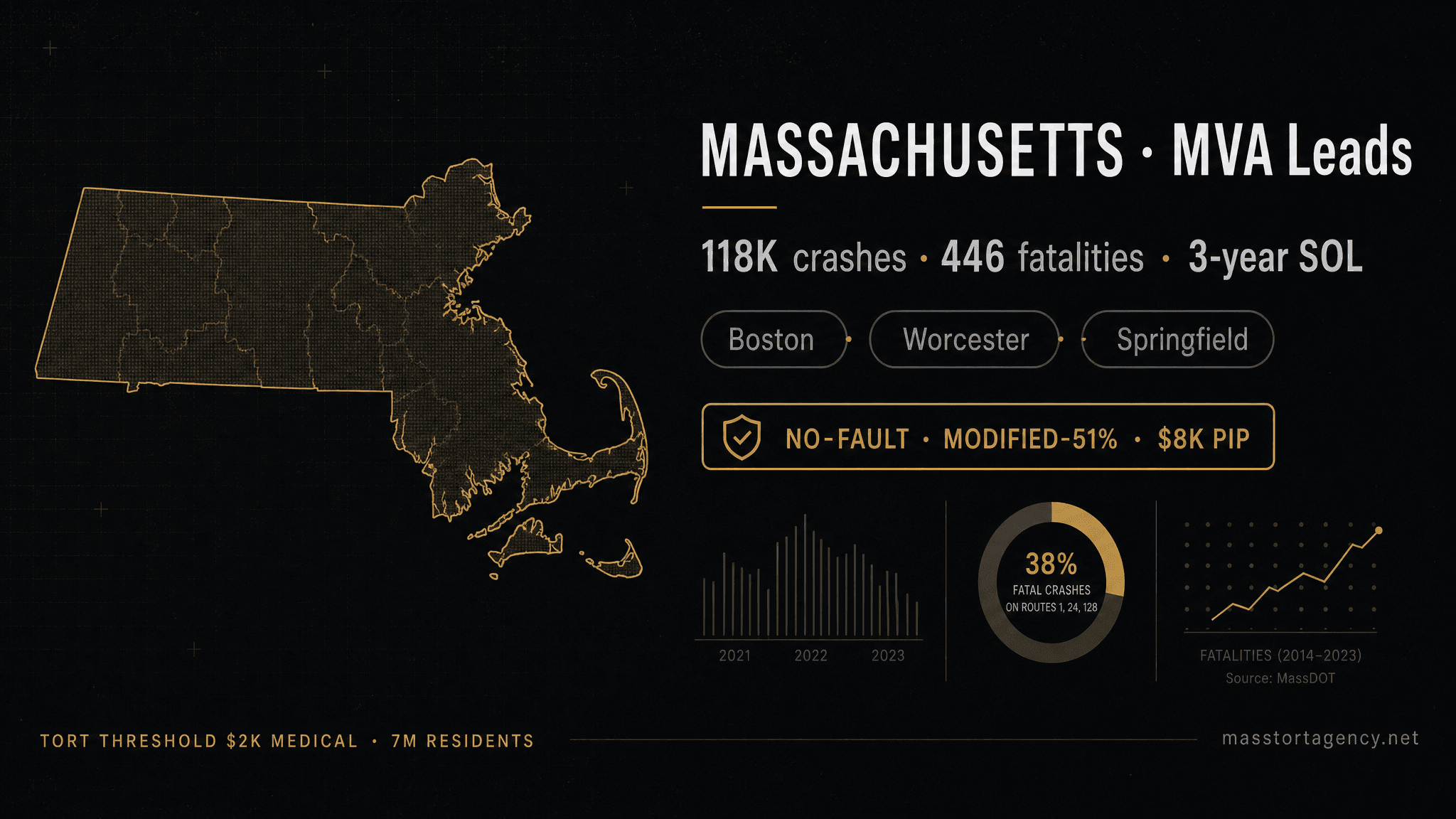
118,000 crashes/yr
Massachusetts · Market Size
Source: NHTSA + MA DOT
118,000
Reported crashes / yr
446
Annual fatalities
39,800
Injured claimants / yr
7.00M
State population
Massachusetts · Quick Reference
The 5 facts that drive Massachusetts MVA lead qualification
Liability
No-fault
Negligence
51% bar
PI SOL
3 years
PIP
$8,000 req'd
Min. liability
20/40/5
Bottom line · No-fault + $2,000 tort threshold (lowest in US) + § 34M PIP-first filing + 51% bar + 3-year SOL = Massachusetts has the most permissive threshold but the strictest procedural compliance. Cases that clear $2,000 medically still die procedurally without proper PIP filing.
The opportunity in Massachusetts
Massachusetts MVA: the $2,000 threshold and PIP-first filing
Massachusetts reports 142,000 traffic crashes annually with 437 fatalities — among the lowest fatality rates per capita in the top 25, driven by MA's mature transit infrastructure, dense pedestrian zones, and lower average speeds. Boston metro produces 47,200 reported crashes per year — about a third of statewide volume — anchored by I-90 (Mass Pike), I-93, and the Big Dig tunnel complex. Worcester, Springfield, Lowell, and Cambridge make up the rest of the meaningful market.
Massachusetts's no-fault framework under the Massachusetts Compulsory Insurance Law (M.G.L. c. 90 § 34A et seq.) requires $8,000 mandatory PIP. The state's tort threshold is the lowest in the country: claimants can step outside no-fault to sue the at-fault driver if they meet ONE of these — $2,000 in reasonable and necessary medical expenses, OR a qualifying injury (death, disfigurement, fracture, loss of a body member, loss of sight or hearing). Most fender-bender and soft-tissue cases clear $2,000 quickly, which means MA's no-fault system gates fewer cases than Florida's or New York's. But unlike those states, MA requires PIP filing first under M.G.L. c. 90 § 34M before tort recovery — failure to comply is a hard procedural defense.
Massachusetts uses the 51% modified comparative bar under M.G.L. c. 231 § 85. The 3-year SOL under M.G.L. c. 260 § 2A is roomier than FL/TX (2 years) but tighter than NY's effective 3-year window with discovery-rule tolling. Boston also carries one of the strictest lawyer-advertising regimes in the country — Sup. Jud. Ct. Rule 3:07 (incorporating the Massachusetts Rules of Professional Conduct) is actively enforced by the Board of Bar Overseers, and the M.G.L. c. 93A consumer-protection statute adds parallel exposure for any deceptive-practice claims.
Liability framework
How Massachusetts liability works — and why it matters at intake
Liability system
No-fault
Comparative negligence
Modified comparative — 51% bar
PIP requirement
Required · $8,000 min.
PI statute of limitations
3 years
Property damage SOL
3 years
Mandatory liability minimums
20/40/5
(BI per person / per accident / property damage, in thousands)
Massachusetts is a no-fault state with mandatory $8,000 PIP. To step outside PIP and pursue the at-fault driver, a claimant must clear the 'tort threshold' — either $2,000 in reasonable and necessary medical expenses OR a qualifying injury (death, disfigurement, fracture, loss of body member, sight, or hearing).
Massachusetts uses the 51% bar. Combined with the tort-threshold filter, MA lead qualification is double-gated: claimants must clear the threshold AND be 50% or less at fault.
Where the volume is
Top Massachusetts claim markets
Boston metro's 47,200 crashes split across the city proper (Allston-Brighton, Roxbury, Dorchester) and the Route 128 / I-95 / I-93 / Mass Pike interchanges. The metro carries disproportionate MBTA / commuter rail interactions — bus, subway, Green Line trolley, and commuter rail (T) accidents trigger Massachusetts Tort Claims Act notice requirements under M.G.L. c. 258 § 4 (presentment within 2 years). Worcester anchors I-90/I-290; Springfield sits at the I-91/I-90 junction with Connecticut commuter traffic; Lowell carries Cambodian-American community concentration; Cambridge anchors MIT and Harvard biomedical/research populations.
Boston metro
47,200
Worcester
12,800
Springfield
11,400
Lowell
6,900
Cambridge
6,200
Qualified MVA lead criteria
What "qualified" means in Massachusetts
In Massachusetts, "qualified" means clearing two gates: tort-threshold qualification (≥$2,000 medical expenses OR statutory injury type) AND PIP-first filing compliance under § 34M. The seven criteria below operationalize both, plus the fault apportionment under the 51% bar. Vendors who skip PIP-filing-status capture sell firms cases that get procedurally dismissed regardless of merit.
Accident date & SOL margin
Within 90 days of the wreck. Massachusetts's 3-year personal injury SOL compresses the case-management window — older leads burn the firm's pipeline.
Massachusetts jurisdiction
Accident occurred in-state with a police report on file. Report number captured at intake.
Fault apportionment
Claimant 50% or less at fault under Massachusetts's 51% bar.
Coverage profile
PIP confirmed — Massachusetts mandates $8,000 minimum. Capture PIP exhaustion status for case-value math.
Medical treatment
Active or completed care, with treatment provider documented. Injury severity captures the qualified-lead threshold.
No prior representation
Conflict-check release signed at intake. Lead is the firm's exclusive opportunity.
TCPA consent
Express written consent record on file: IP, timestamp, user agent, consent language all captured.
Massachusetts · Pricing benchmarks
What Massachusetts MVA leads actually cost in 2026
Massachusetts live-transfer CPL runs $285–445. Boston metro commands a 25–35% premium because it's a top-10 paid-media market and bilingual intake (Spanish in Lawrence/Lowell, Brazilian Portuguese in Framingham/Hudson, Vietnamese in Dorchester) adds 10–15% to intake cost. Worcester, Springfield, and the rest of the state run at or below the statewide median. CPSR $1,800–3,050 holds because the low tort threshold means most cases can leave no-fault — case mix is broader than NY or FL.
Cost per signed retainer · Massachusetts
$1,950–$3,400
· midpoint $2,675
Typical Massachusetts CPSR band, inclusive of media + intake + signed-retainer attribution. Variance driven by liability complexity and metro mix, not media cost alone.
CPL by tier
Tier 1 — Live Transfer
$310–$495
CPL · Inbound caller, pre-qualified
Tier 2 — Qualified Form
$128–$230
CPL · Form fill, screened ≤15 min
Tier 3 — Data Lead
$37–$64
CPL · Volume tier, firm-screened
How we operate in Massachusetts
Channel mix + compliance
Channels that work in Massachusetts
Boston metro is multilingual-significant in distinct micro-markets: Spanish in Lawrence and Lowell (Merrimack Valley); Brazilian Portuguese in Framingham, Hudson, and Marlborough (highest Brazilian-American density in the country); Vietnamese in Dorchester and Quincy; Cape Verdean Portuguese in Brockton; Haitian Creole in Mattapan and Hyde Park. MBTA bus and subway DOOH placement matches the commuter-claimant base. Mass Rules of Professional Conduct 7.3 prohibits in-person, live-telephone, and real-time electronic solicitation; the Board of Bar Overseers enforces. M.G.L. c. 93A (Massachusetts Consumer Protection Act) creates separate exposure for any deceptive-practice claims overlapping with MVA cases.
TCPA + DPPA · federal
Express written consent records on every outbound contact — timestamp, IP, user agent, consent language. DPPA enforced for any driver-record-derived data.
Massachusetts bar advertising rules
Massachusetts Rules of Professional Conduct 7.1–7.3. Direct in-person and live-telephone solicitation of MVA victims is restricted — lead vendors must source via opt-in inbound channels only.
Massachusetts MVA leads · FAQ
Questions Massachusetts firms ask before buying
What is the Massachusetts tort threshold and how does it filter MVA leads?
Under M.G.L. c. 231, § 6D, a claimant cannot recover pain-and-suffering damages from an at-fault driver unless they meet ONE of: (1) $2,000+ in reasonable and necessary medical expenses, OR (2) a qualifying injury — death, dismemberment, fracture (including dental), loss of a body member or function, permanent and serious disfigurement, or loss of sight/hearing. Qualified MA MVA leads should already meet the threshold at intake.
What's the typical CPL for buying MVA leads in Massachusetts?
Massachusetts live-transfer runs $310–495 CPL, qualified-form $128–230. Boston metro commands the highest CPL in the state — among the top 5 most expensive metros nationally for MVA paid media after NYC, LA, and SF.
Does Massachusetts's 3-year SOL apply to all MVA claims?
Three years from the accident date for personal injury and property damage under M.G.L. c. 260, § 2A. Discovery rule applies in limited circumstances. For claims against the Commonwealth (MBTA, state agencies), Mass. Tort Claims Act notice requirements apply with shorter windows.
Why is Massachusetts's MVA market more expensive than its size suggests?
MA has only ~7M residents but Boston is one of the highest CPM markets in the country, and the state's plaintiff bar is well-organized and aggressive. Combined with the $50/$100K mandatory minimum (one of the lower bars) and high cost of medical treatment, MA cases tend to be higher-value than the median per-capita state.
What MVA case types are most valuable in Massachusetts?
Pedestrian/cyclist cases in Boston (Cambridge, Somerville, Brookline) where defendant fault is often clear, commercial vehicle cases on I-90/I-93/I-95, and rideshare cases in the Boston metro. MBTA-involved cases require Mass. Tort Claims Act notice within 2 years (separate from the 3-year SOL).
Regional MVA markets