
Motor Vehicle Accident Leads in Pennsylvania
Roughly 55% of Pennsylvania drivers carry limited tort — meaning they can only sue for pain and suffering after clearing the § 1705 serious-injury threshold. Every Pennsylvania MVA lead requires that data field captured at intake, and 90% of national vendors don't ask for it.
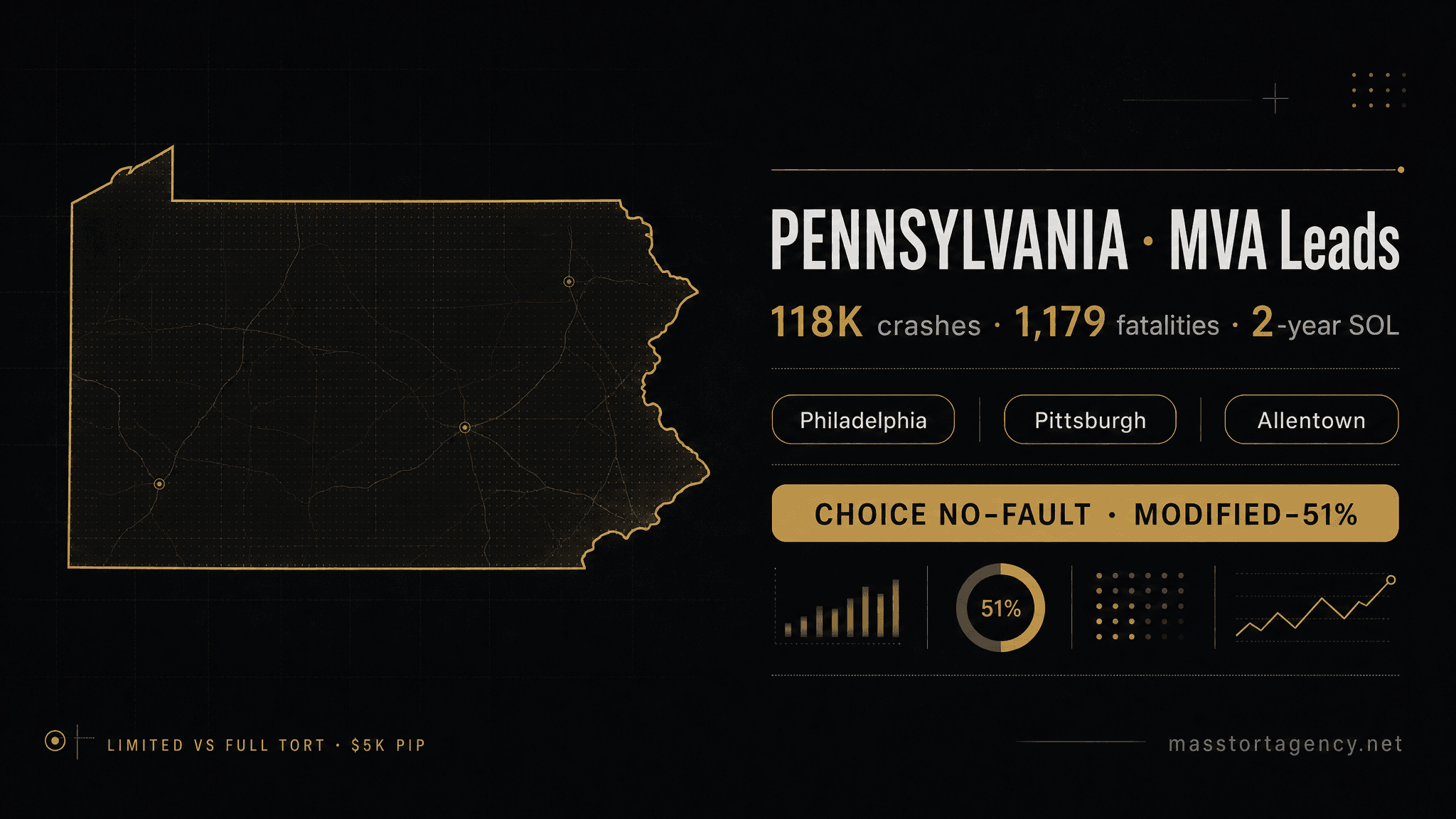
Northeast
Pennsylvania · PA
118,000 crashes/yr
Pennsylvania · Market Size
Source: NHTSA + PA DOT
118,000
Reported crashes / yr
1,179
Annual fatalities
67,400
Injured claimants / yr
13.0M
State population
Pennsylvania · Quick Reference
The 5 facts that drive Pennsylvania MVA lead qualification
Liability
Choice no-fault
Negligence
51% bar
PI SOL
2 years
PIP
$5,000 req'd
Min. liability
15/30/5
Bottom line · Choice no-fault + § 1702 threshold + 55% limited-tort election + 51% bar + bimodal Philly/Pittsburgh media = Pennsylvania is the most layered qualification framework in the top 10. Every PA lead requires the tort-election data field captured at intake — full stop.
The opportunity in Pennsylvania
Pennsylvania MVA: the limited-vs-full-tort election
Pennsylvania reports 118,000 traffic crashes annually with 1,179 fatalities. The volume is bimodal between Philadelphia (32,400 crashes/yr) on the eastern end and Pittsburgh (22,800) on the western end, with smaller markets in Allentown–Bethlehem, Harrisburg, and Erie. The two anchor cities sit in different TV DMAs — Philadelphia and Pittsburgh — and pricing the state correctly requires running both media markets simultaneously.
Pennsylvania's choice-no-fault framework is the single most important MVA qualification filter in the state. Under the Motor Vehicle Financial Responsibility Law (MVFRL § 1705), drivers elect at policy issuance: "limited tort" (lower premium, but the right to sue for pain and suffering is restricted to claimants clearing the § 1702 serious-injury threshold) or "full tort" (higher premium, but full right to sue for any damages including pain and suffering). An estimated 55% of Pennsylvania drivers carry limited tort. Qualified MVA leads must include the claimant's tort election at intake — without it, the firm cannot model case value.
The § 1702 threshold itself defines "serious injury" as death, serious impairment of body function, or permanent serious disfigurement. Pennsylvania's courts have litigated the "serious impairment" standard extensively (Washington v. Baxter, 1998; Cadena v. Latch, 2010), and the qualifying medical documentation must withstand summary-judgment review. Layer on the 51% modified comparative bar under 42 Pa. C.S. § 7102, the mandatory $5,000 First-Party Benefits (PA's PIP equivalent) under MVFRL § 1711, and a 2-year SOL for both PI and property damage — Pennsylvania is the most layered tort-qualification framework in the top 10.
Liability framework
How Pennsylvania liability works — and why it matters at intake
Liability system
Choice no-fault
Comparative negligence
Modified comparative — 51% bar
PIP requirement
Required · $5,000 min.
PI statute of limitations
2 years
Property damage SOL
2 years
Mandatory liability minimums
15/30/5
(BI per person / per accident / property damage, in thousands)
Pennsylvania uses choice no-fault: drivers elect 'limited tort' (cheaper premium, restricted right to sue for pain and suffering unless serious injury) or 'full tort' (full right to sue). The tort election determines what a 'qualified' MVA lead looks like — limited-tort claimants need to clear the serious-injury threshold; full-tort claimants don't.
Pennsylvania uses the 51% bar. Combined with the choice-no-fault structure, claimant tort election + fault percentage are both lead-qualification filters in PA.
Where the volume is
Top Pennsylvania claim markets
Philadelphia produces 32,400 reported crashes per year — Center City, North Philly, Kensington, and the I-95 / I-76 / Schuylkill Expressway corridors. Pittsburgh adds 22,800 across the I-79 / I-376 interchange and the downtown bridges. Allentown–Bethlehem catches the I-78 / I-476 corridor with disproportionately high commercial-trucking volume. Harrisburg sits at the I-81 / I-83 intersection — government-employee claimants overlay state workers' comp interactions. Erie carries the I-90 lake-effect-weather crash pattern.
Philadelphia
32,400
Pittsburgh
22,800
Allentown–Bethlehem
10,600
Harrisburg
7,900
Erie
6,400
Qualified MVA lead criteria
What "qualified" means in Pennsylvania
In Pennsylvania, "qualified" means capturing the tort election (limited vs full) at intake, clearing the § 1702 serious-injury threshold for limited-tort claimants, and confirming fault percentage under the 51% bar. The seven criteria below operationalize all three — with explicit capture of the tort-election data field that national vendors routinely skip.
Accident date & SOL margin
Within 60 days of the wreck. Pennsylvania's 2-year personal injury SOL compresses the case-management window — older leads burn the firm's pipeline.
Pennsylvania jurisdiction
Accident occurred in-state with a police report on file. Report number captured at intake.
Fault apportionment
Claimant 50% or less at fault under Pennsylvania's 51% bar.
Coverage profile
PIP confirmed — Pennsylvania mandates $5,000 minimum. Capture PIP exhaustion status for case-value math.
Medical treatment
Active or completed care, with treatment provider documented. Injury severity captures the qualified-lead threshold.
No prior representation
Conflict-check release signed at intake. Lead is the firm's exclusive opportunity.
TCPA consent
Express written consent record on file: IP, timestamp, user agent, consent language all captured.
Pennsylvania · Pricing benchmarks
What Pennsylvania MVA leads actually cost in 2026
Pennsylvania's bimodal media-market structure produces split pricing. Philadelphia commands a 20–30% premium over the statewide average ($330–530 live-transfer in metro Philly vs $275–440 statewide). Pittsburgh runs at the statewide median; Allentown, Harrisburg, and Erie run 15–20% below. CPSR $1,650–2,900 is held down by the limited-tort filter (55% of claimants need to clear § 1702 before pain-and-suffering damages enter case value). The numbers below reflect 2024–2026 Pennsylvania buy cycles across both DMAs.
Cost per signed retainer · Pennsylvania
$1,650–$2,900
· midpoint $2,275
Typical Pennsylvania CPSR band, inclusive of media + intake + signed-retainer attribution. Variance driven by liability complexity and metro mix, not media cost alone.
CPL by tier
Tier 1 — Live Transfer
$275–$440
CPL · Inbound caller, pre-qualified
Tier 2 — Qualified Form
$115–$210
CPL · Form fill, screened ≤15 min
Tier 3 — Data Lead
$32–$56
CPL · Volume tier, firm-screened
How we operate in Pennsylvania
Channel mix + compliance
Channels that work in Pennsylvania
Philadelphia carries a meaningful Spanish-language inbound segment (North Philly, Kensington) and Caribbean-language demand (Olney, Logan). Pittsburgh has an older average claimant age and more single-vehicle / weather-related crashes than Philadelphia, with a fundamentally different demographic mix. Pennsylvania Rule 7.3 prohibits in-person, live-telephone, and real-time electronic solicitation; the Disciplinary Board of the Supreme Court of Pennsylvania reviews lawyer advertising on complaint.
TCPA + DPPA · federal
Express written consent records on every outbound contact — timestamp, IP, user agent, consent language. DPPA enforced for any driver-record-derived data.
Pennsylvania bar advertising rules
Pennsylvania Rules of Professional Conduct 7.1–7.3. Direct in-person and live-telephone solicitation of MVA victims is restricted — lead vendors must source via opt-in inbound channels only.
Pennsylvania MVA leads · FAQ
Questions Pennsylvania firms ask before buying
What is Pennsylvania's 'limited tort' vs 'full tort' election and why does it matter for MVA leads?
Pennsylvania drivers choose at policy issuance: 'limited tort' (lower premium, can only sue for pain-and-suffering damages if injury qualifies as 'serious' under § 1702 of the MVFRL — death, serious impairment of body function, or permanent serious disfigurement) or 'full tort' (full right to sue for any damages including pain and suffering). About 55% of PA drivers carry limited tort. Qualified MVA leads in PA must include tort election at intake.
Does PA's mandatory $5K PIP mean every MVA claimant has medical coverage?
Yes — every registered PA vehicle carries at least $5,000 of First-Party Benefits (PA's PIP equivalent). For more serious injuries this exhausts quickly, but it covers initial ER and follow-up costs without litigation. Lead qualification can move faster in PA because the medical-bills documentation comes from the PIP record.
What's the typical CPL for buying MVA leads in Pennsylvania?
PA live-transfer runs $275–440 CPL, qualified-form $115–210. Philadelphia commands a 20–30% premium over the statewide average; Pittsburgh runs at the statewide median; Allentown / Erie / Harrisburg are 15–20% below.
Is the Pennsylvania SOL the same as Florida or Texas?
Same in length — 2 years from the accident date for personal injury and for property damage. PA does have a discovery rule that can extend SOL for injuries not reasonably discoverable until later, but for most MVA cases the 2-year clock starts at the wreck.
What's the demographic mix for MVA leads in Philadelphia vs Pittsburgh?
Philadelphia has higher Spanish-language and Caribbean-language demand (North Philly, Kensington) and a younger urban claimant base. Pittsburgh has an older average claimant age and more single-vehicle / weather-related crashes. Channel mix and creative should be city-specific.
Regional MVA markets