
Motor Vehicle Accident Leads in New Jersey
89% of New Jersey drivers carry "limitation on lawsuit" — meaning the verbal threshold under NJSA 39:6A-8(a) determines whether they can sue for pain and suffering at all. Combine that with the state's two-DMA media structure (NYC + Philly) and NJ becomes the most layered qualification framework on the East Coast.
Northeast
New Jersey · NJ
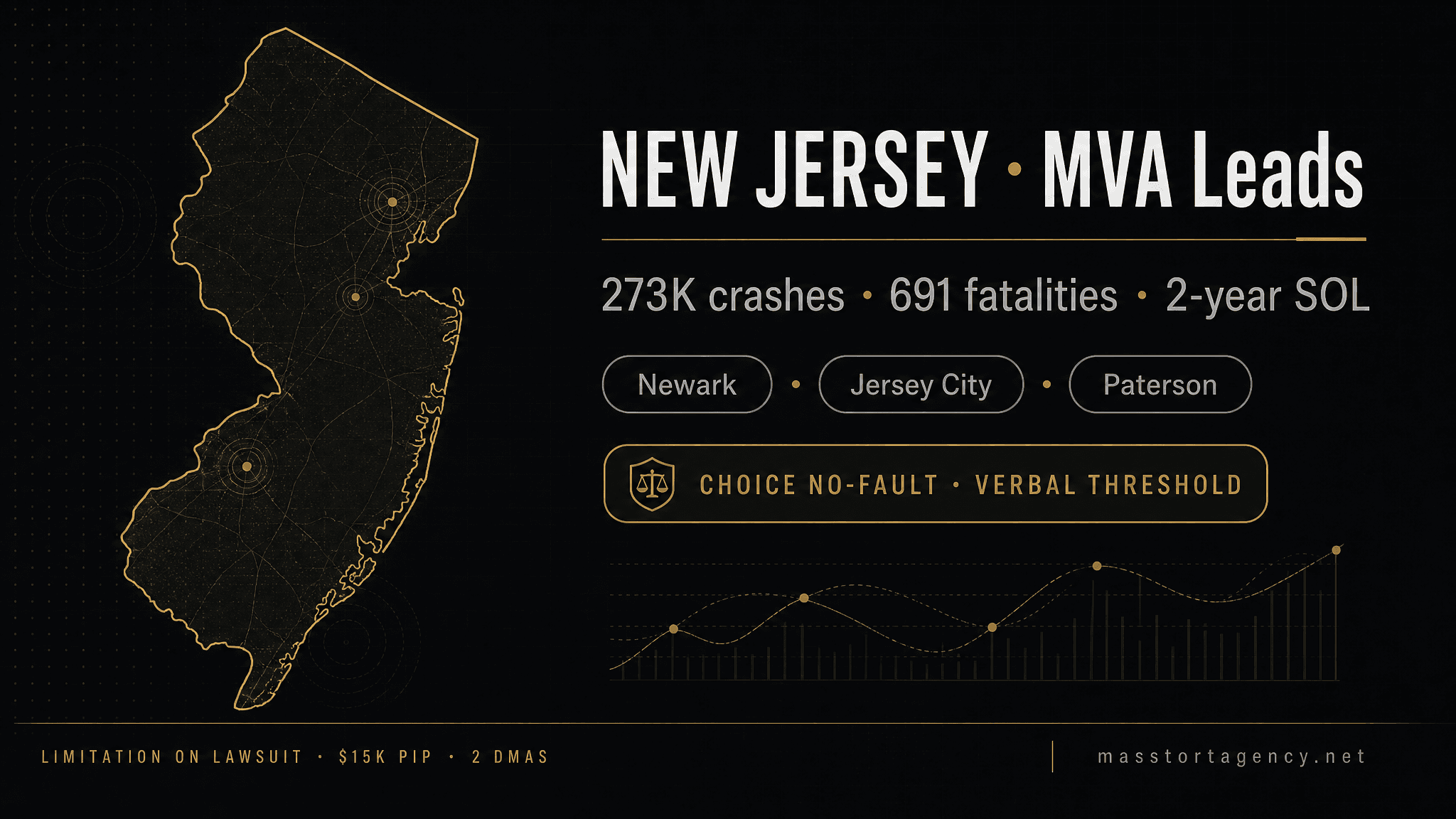
273,000 crashes/yr
New Jersey · Market Size
Source: NHTSA + NJ DOT
273,000
Reported crashes / yr
691
Annual fatalities
51,400
Injured claimants / yr
9.30M
State population
New Jersey · Quick Reference
The 5 facts that drive New Jersey MVA lead qualification
Liability
Choice no-fault
Negligence
51% bar
PI SOL
2 years
PIP
$15,000 req'd
Min. liability
15/30/5
Bottom line · Choice no-fault + verbal threshold + 89% limitation-on-lawsuit + two DMAs + 51% bar = New Jersey requires the tort-election data field captured at intake or the firm cannot model case value. Vendors who skip that field are selling firms cases they can't convert.
The opportunity in New Jersey
New Jersey MVA: the verbal threshold + the two-DMA reality
New Jersey reports 273,000 traffic crashes annually with 691 fatalities — among the lowest fatality rates per capita in the Tier-1 set, driven by NJ's high population density, mature transit infrastructure, and stringent vehicle safety standards. Volume concentrates in the Newark / Jersey City corridor (48,200 crashes/yr) and the I-95 / Turnpike / Parkway spine running north-south through Bergen, Hudson, Essex, Union, and Middlesex counties.
New Jersey's choice-no-fault framework is the state's defining MVA qualification filter. Under NJSA 39:6A-8, drivers elect at policy issuance: "limitation on lawsuit" (cheaper, but pain-and-suffering recovery requires clearing the verbal threshold) or "no limitation" (higher premium, full right to sue). An estimated 89% of NJ drivers carry limitation on lawsuit — the highest percentage of any choice-no-fault state. The verbal threshold under NJSA 39:6A-8(a) requires one of six categories: death, dismemberment, significant disfigurement or scarring, displaced fracture, loss of fetus, or permanent injury within a reasonable degree of medical probability.
New Jersey is also the only state in the country split between two top-3 TV DMAs. North Jersey (Bergen, Hudson, Essex, Passaic, Union) sits in the New York DMA. South Jersey (Camden, Burlington, Gloucester, Atlantic) sits in the Philadelphia DMA. Central Jersey overlaps. Media planning has to run both DMAs simultaneously, and CPL differs meaningfully — North Jersey runs closer to NYC pricing, South Jersey runs closer to Philadelphia pricing. Add the mandatory $15,000 PIP under NJSA 39:6A-4 (with optional higher levels common), 51% modified comparative under NJSA 2A:15-5.1, and a 2-year SOL under NJSA 2A:14-2 — NJ is a five-filter market.
Liability framework
How New Jersey liability works — and why it matters at intake
Liability system
Choice no-fault
Comparative negligence
Modified comparative — 51% bar
PIP requirement
Required · $15,000 min.
PI statute of limitations
2 years
Property damage SOL
6 years
Mandatory liability minimums
15/30/5
(BI per person / per accident / property damage, in thousands)
New Jersey uses choice no-fault: drivers elect 'limitation on lawsuit' (cheaper, restricted right to sue unless injury crosses statutory threshold) or 'no limitation' (full right to sue). Mandatory $15K PIP with optional higher levels. The tort election + PIP level both filter what a qualified MVA lead looks like.
New Jersey uses the 51% bar. Combined with the choice-no-fault tort election and the verbal threshold for limitation-on-lawsuit claimants, NJ has the most layered lead-qualification framework of any Tier 1 state.
Where the volume is
Top New Jersey claim markets
Newark / Jersey City produces 48,200 reported crashes per year — concentrated on the I-78 / I-95 / Turnpike / Pulaski Skyway interchanges and the Lincoln/Holland Tunnel commuter approaches. Paterson and Passaic add 12,800 with a heavy Hispanic and Arabic-American population mix. Trenton (9,600) is government-employee dense with state and federal workers' comp interactions. Camden (8,700) is the South Jersey anchor and sits in the Philadelphia DMA — pricing for Camden tracks Philly, not NYC. Atlantic City carries casino-corridor commercial vehicle volume and tourist-related rideshare crashes.
Newark / Jersey City
48,200
Paterson / Passaic
12,800
Trenton
9,600
Camden
8,700
Atlantic City
6,400
Qualified MVA lead criteria
What "qualified" means in New Jersey
In New Jersey, "qualified" means capturing the tort election (limitation on lawsuit vs no limitation) at intake, clearing the NJSA 39:6A-8(a) verbal threshold for limitation-on-lawsuit claimants, and confirming PIP level (mandatory $15K minimum, but $250K+ common). The seven criteria below operationalize all three — the tort election data field is the one national vendors most often skip, and it's the most consequential for case-value modeling.
Accident date & SOL margin
Within 60 days of the wreck. New Jersey's 2-year personal injury SOL compresses the case-management window — older leads burn the firm's pipeline.
New Jersey jurisdiction
Accident occurred in-state with a police report on file. Report number captured at intake.
Fault apportionment
Claimant 50% or less at fault under New Jersey's 51% bar.
Coverage profile
PIP confirmed — New Jersey mandates $15,000 minimum. Capture PIP exhaustion status for case-value math.
Medical treatment
Active or completed care, with treatment provider documented. Injury severity captures the qualified-lead threshold.
No prior representation
Conflict-check release signed at intake. Lead is the firm's exclusive opportunity.
TCPA consent
Express written consent record on file: IP, timestamp, user agent, consent language all captured.
New Jersey · Pricing benchmarks
What New Jersey MVA leads actually cost in 2026
New Jersey's pricing is bimodal by DMA. North Jersey live-transfer CPL runs $305–485 (close to NYC); South Jersey runs $275–440 (close to Philadelphia). Central Jersey overlaps. CPSR $1,900–3,350 reflects two structural realities: 89% of claimants face the verbal-threshold filter on pain-and-suffering damages, and high-PIP-election claimants ($250K+) drive disproportionate case value when threshold is cleared. The numbers below cover 2024–2026 NJ buy cycles across both DMAs.
Cost per signed retainer · New Jersey
$1,900–$3,350
· midpoint $2,625
Typical New Jersey CPSR band, inclusive of media + intake + signed-retainer attribution. Variance driven by liability complexity and metro mix, not media cost alone.
CPL by tier
Tier 1 — Live Transfer
$305–$485
CPL · Inbound caller, pre-qualified
Tier 2 — Qualified Form
$128–$232
CPL · Form fill, screened ≤15 min
Tier 3 — Data Lead
$38–$65
CPL · Volume tier, firm-screened
How we operate in New Jersey
Channel mix + compliance
Channels that work in New Jersey
Newark / Hudson County is bilingual-Spanish-heavy, with Spanish-language inbound as a structural baseline across Jersey City, Newark, and the Passaic / Paterson corridor. Portuguese covers Newark's Ironbound and parts of Elizabeth. Korean concentrates in Palisades Park, Fort Lee, and Ridgefield. NJ Rule 7.3 prohibits in-person and live-telephone solicitation; the Office of Attorney Ethics enforces under the Supreme Court Disciplinary Review Board. NJ also has Tort Claims Act notice requirements (NJSA 59:1-1) — 90 days for claims against public entities (NJ Transit, NJDOT, municipal vehicles), which is a hard kill if missed.
TCPA + DPPA · federal
Express written consent records on every outbound contact — timestamp, IP, user agent, consent language. DPPA enforced for any driver-record-derived data.
New Jersey bar advertising rules
New Jersey Rules of Professional Conduct 7.1–7.5. Direct in-person and live-telephone solicitation of MVA victims is restricted — lead vendors must source via opt-in inbound channels only.
New Jersey MVA leads · FAQ
Questions New Jersey firms ask before buying
What is the New Jersey 'verbal threshold' and how does it filter MVA leads?
About 89% of NJ drivers carry 'limitation on lawsuit' (the cheaper of the two tort options). Limitation-on-lawsuit claimants can only sue for pain and suffering if their injury falls into one of six statutory categories under NJSA 39:6A-8(a): death, dismemberment, significant disfigurement/scarring, displaced fracture, loss of fetus, or permanent injury within a reasonable degree of medical probability. Qualified NJ leads with limitation-on-lawsuit election must clear this threshold.
Why is New Jersey's MVA lead market influenced by two TV DMAs?
North Jersey is in the New York DMA; South Jersey is in the Philadelphia DMA. This means MVA media planning has to run in two markets simultaneously, and CPL varies — North Jersey runs closer to NYC pricing ($305–485 live-transfer), South Jersey runs closer to Philadelphia pricing ($275–440).
What's the typical CPSR for New Jersey MVA cases?
NJ CPSR runs $1,900–3,350. The variance is driven by tort election (no-limitation claimants convert faster and are worth more), metro mix (Newark/Jersey City > Trenton/Camden), and the layered intake filtering (PIP exhaustion + verbal threshold + fault apportionment).
Does New Jersey's 2-year SOL apply uniformly?
Two years from accident date for personal injury under NJSA 2A:14-2. Property damage has a much longer 6-year SOL. NJ also has the Tort Claims Act (NJSA 59:1-1) for claims against public entities, with a 90-day notice requirement that's a critical issue for MVA cases involving buses, government vehicles, or public roadways.
What MVA case types are most valuable in New Jersey?
Commercial vehicle / trucking cases (NJ's I-95 corridor and Newark port traffic), rideshare cases (Uber/Lyft volume in Newark + Jersey City), and pedestrian/cyclist cases (Hudson County is among the densest US counties). High-PIP-election claimants ($250K+ PIP) with catastrophic injuries deliver the highest case value.
Regional MVA markets