
Motor Vehicle Accident Leads in Washington
Washington pairs pure comparative negligence with the Insurance Fair Conduct Act (IFCA) — the country's most plaintiff-favorable bad-faith statute. PIP is offered but waivable; vendors who don't confirm PIP-waiver status at intake are missing the single most consequential coverage filter in the Pacific Northwest.
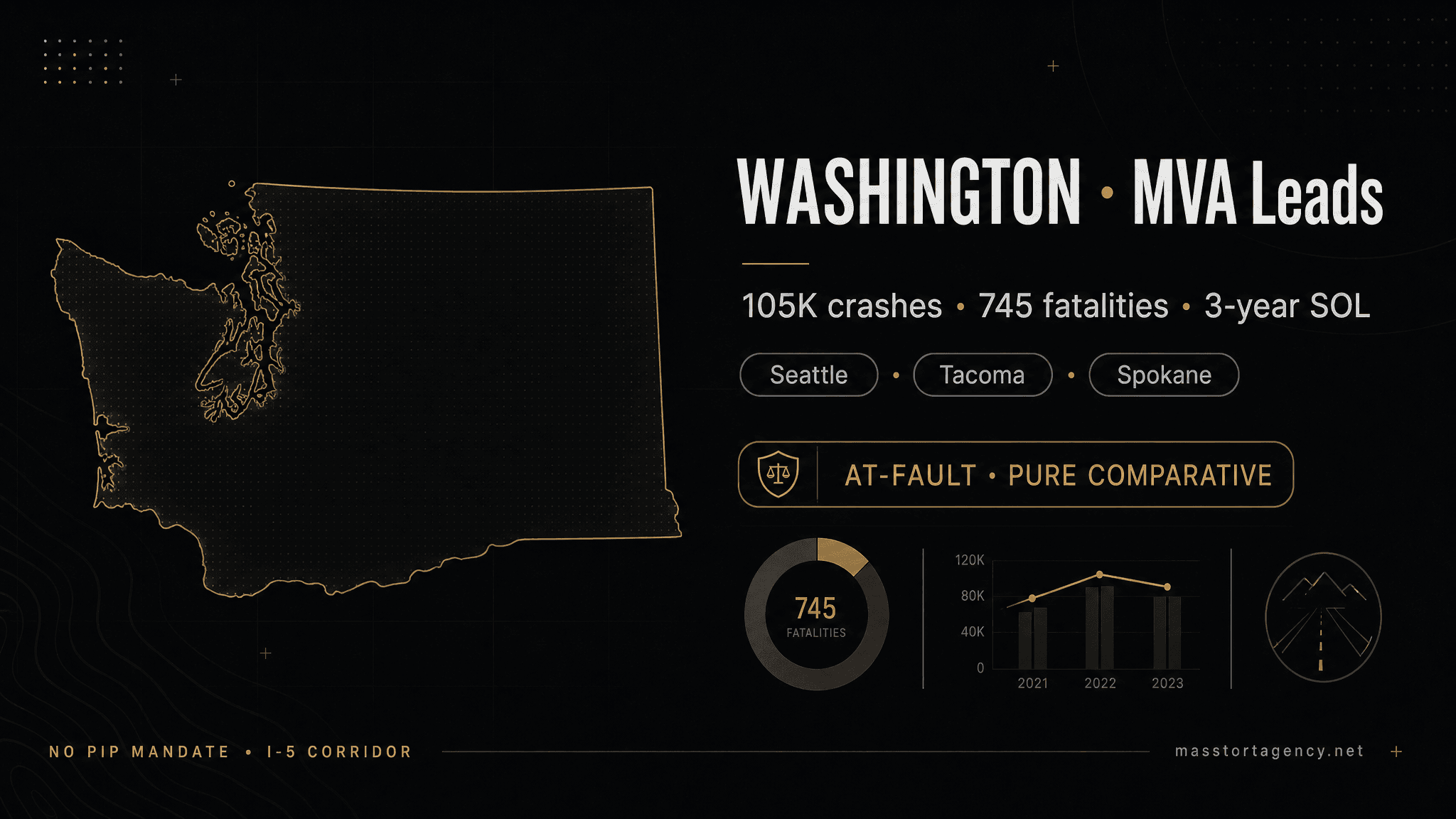
West
Washington · WA
105,000 crashes/yr
Washington · Market Size
Source: NHTSA + WA DOT
105,000
Reported crashes / yr
745
Annual fatalities
47,300
Injured claimants / yr
7.80M
State population
Washington · Quick Reference
The 5 facts that drive Washington MVA lead qualification
Liability
At-fault
Negligence
Pure comparative
PI SOL
3 years
PIP
Not required
Min. liability
25/50/10
Bottom line · Pure comparative + waivable PIP + IFCA bad-faith + 3-year SOL = Washington rewards lead vendors who capture PIP-waiver status and identify IFCA-triggering carrier conduct. The pure-comparative recovery is real; the IFCA leverage is decisive on contested settlements.
The opportunity in Washington
Washington MVA: pure comparative + IFCA bad-faith leverage
Washington reports 108,000 traffic crashes annually with 750 fatalities. Volume concentrates on the I-5 corridor running Bellingham → Everett → Seattle → Tacoma → Olympia → Portland, with Seattle metro producing 38,400 reported crashes per year (Pierce/King/Snohomish counties), Spokane adding 14,200 on the I-90/eastern Washington side, and Tacoma's 11,800 anchoring the JBLM (Joint Base Lewis-McChord) military overlay.
Washington's structural advantage is pure comparative negligence under RCW 4.22.005 — claimants recover at any fault percentage, damages reduced proportionally. Layered on top: the Insurance Fair Conduct Act (RCW 48.30.015) creates one of the country's most plaintiff-favorable bad-faith causes of action. Insurers who unreasonably deny or delay claim payment face treble damages plus attorneys' fees — a leverage point most states don't offer. The combination makes Washington case values structurally larger when liability is clear and the at-fault carrier behaves badly.
Washington PIP under RCW 48.22.085 is mandatory ($10K minimum) BUT waivable in writing. An estimated 18% of Washington drivers waive PIP at policy issuance. Without PIP-waiver capture at intake, the firm can't predict whether the claimant has first-dollar medical coverage. Combined with the 3-year SOL under RCW 4.16.080 and the 51% bar's absence (pure comparative recovers at any fault level), Washington's qualification math depends on coverage capture more than fault apportionment.
Liability framework
How Washington liability works — and why it matters at intake
Liability system
At-fault
Comparative negligence
Pure comparative negligence
PIP requirement
Not required
PI statute of limitations
3 years
Property damage SOL
3 years
Mandatory liability minimums
25/50/10
(BI per person / per accident / property damage, in thousands)
Washington is at-fault: the responsible driver's carrier pays. No PIP mandate, although PIP is offered and must be declined in writing. Washington is one of 13 pure comparative negligence states — a claimant-favorable case-value framework.
Washington uses pure comparative negligence — claimants recover at any fault percentage, with damages reduced proportionally. Combined with strong King County jury verdicts, this raises case values significantly.
Where the volume is
Top Washington claim markets
Seattle metro's 38,400 crashes concentrate on I-5, I-405, I-90, and the SR-520/SR-99 corridors. King County jury patterns are historically plaintiff-favorable for MVA cases. Tacoma's 11,800 anchor on I-5/I-705 with JBLM military-population overlay (Tricare interactions). Spokane's 14,200 on the I-90/US-395 eastern-Washington side carry agricultural and commercial-trucking volume. Bellingham and Olympia operate as secondary markets. King County's First Amendment Coalition has also pushed for transparency rules on insurance settlement amounts — adding case-value benchmarking that doesn't exist in most states.
Seattle–Bellevue
42,400
Tacoma
18,700
Spokane
14,200
Vancouver
9,600
Everett
7,400
Qualified MVA lead criteria
What "qualified" means in Washington
In Washington, "qualified" means capturing PIP-waiver status (waived vs. carried), confirming UM/UIM coverage, and screening for IFCA bad-faith conduct by the at-fault insurer when applicable. The seven criteria below operationalize all three — the PIP-waiver field alone disqualifies 18% of national-vendor leads if not captured correctly.
Accident date & SOL margin
Within 90 days of the wreck. Washington's 3-year personal injury SOL compresses the case-management window — older leads burn the firm's pipeline.
Washington jurisdiction
Accident occurred in-state with a police report on file. Report number captured at intake.
Fault apportionment
Claimant fault percentage captured. Washington pure comparative — recovery preserved at any fault level, reduced proportionally.
Coverage profile
Washington does not mandate PIP. Capture UM/UIM, MedPay, and health insurance status — first-dollar coverage varies widely.
Medical treatment
Active or completed care, with treatment provider documented. Injury severity captures the qualified-lead threshold.
No prior representation
Conflict-check release signed at intake. Lead is the firm's exclusive opportunity.
TCPA consent
Express written consent record on file: IP, timestamp, user agent, consent language all captured.
Washington · Pricing benchmarks
What Washington MVA leads actually cost in 2026
Washington live-transfer CPL runs $295–460. Seattle metro commands a 20–28% premium reflecting the Pacific Northwest paid-media market plus the King County case-value premium. Tacoma and Spokane run at or below the statewide median. CPSR $1,750–3,100 reflects pure-comparative tort math when liability and coverage both check out — plus the IFCA bad-faith leverage on contested claims.
Cost per signed retainer · Washington
$1,850–$3,200
· midpoint $2,525
Typical Washington CPSR band, inclusive of media + intake + signed-retainer attribution. Variance driven by liability complexity and metro mix, not media cost alone.
CPL by tier
Tier 1 — Live Transfer
$295–$470
CPL · Inbound caller, pre-qualified
Tier 2 — Qualified Form
$122–$222
CPL · Form fill, screened ≤15 min
Tier 3 — Data Lead
$34–$60
CPL · Volume tier, firm-screened
How we operate in Washington
Channel mix + compliance
Channels that work in Washington
Seattle metro has growing East African (Somali, Ethiopian) population concentration in Tukwila, SeaTac, and parts of South Seattle; Vietnamese in South King County; Spanish-language in the Yakima Valley (eastern Washington agricultural belt). Washington Rule 7.3 restricts in-person and live-telephone solicitation; the Washington State Bar Association's Office of Disciplinary Counsel enforces. Washington also has a 4-year SOL on IFCA bad-faith claims under RCW 4.16.080 — meaningfully longer than the 3-year tort SOL, creating extended case-management runway on contested claims.
TCPA + DPPA · federal
Express written consent records on every outbound contact — timestamp, IP, user agent, consent language. DPPA enforced for any driver-record-derived data.
Washington bar advertising rules
Washington Rules of Professional Conduct 7.1–7.3. Direct in-person and live-telephone solicitation of MVA victims is restricted — lead vendors must source via opt-in inbound channels only.
Washington MVA leads · FAQ
Questions Washington firms ask before buying
Why is King County such a favorable venue for Washington MVA cases?
King County (Seattle and surrounding) has produced consistently above-average plaintiff verdicts for MVA cases compared to the rest of Washington. Combined with Washington's pure comparative negligence framework, even shared-fault cases retain meaningful value when filed in King County.
What's the typical CPL for buying MVA leads in Washington?
Washington live-transfer runs $295–470 CPL, qualified-form $122–222. Seattle-Bellevue commands a 25–30% premium over statewide. Tacoma, Spokane, and Vancouver run at or slightly below the statewide median.
How does Washington's lack of PIP mandate affect lead quality?
PIP must be offered but the claimant can decline it in writing. Most Washington drivers carry PIP, but lead vendors shouldn't assume — UM/UIM status and PIP status should both be captured at intake. Claimants without PIP rely on health insurance + medical liens for treatment.
Does Washington's 3-year SOL apply uniformly to MVA claims?
Three years from accident date for both personal injury and property damage under RCW 4.16.080. Discovery rule applies in limited circumstances (latent injuries). Claims against state entities have 60-day notice requirements under RCW 4.92.110.
What MVA case types are most valuable in Washington?
Commercial vehicle / trucking cases on I-5 and I-90 (heavy interstate commercial volume), pedestrian/cyclist cases in Seattle/Bellevue (highest pedestrian crash rate in WA), and rideshare cases in the Seattle metro. The I-5 corridor between Seattle and Portland is one of the highest-volume commercial vehicle corridors in the country.
Regional MVA markets