
Motor Vehicle Accident Leads in Wisconsin
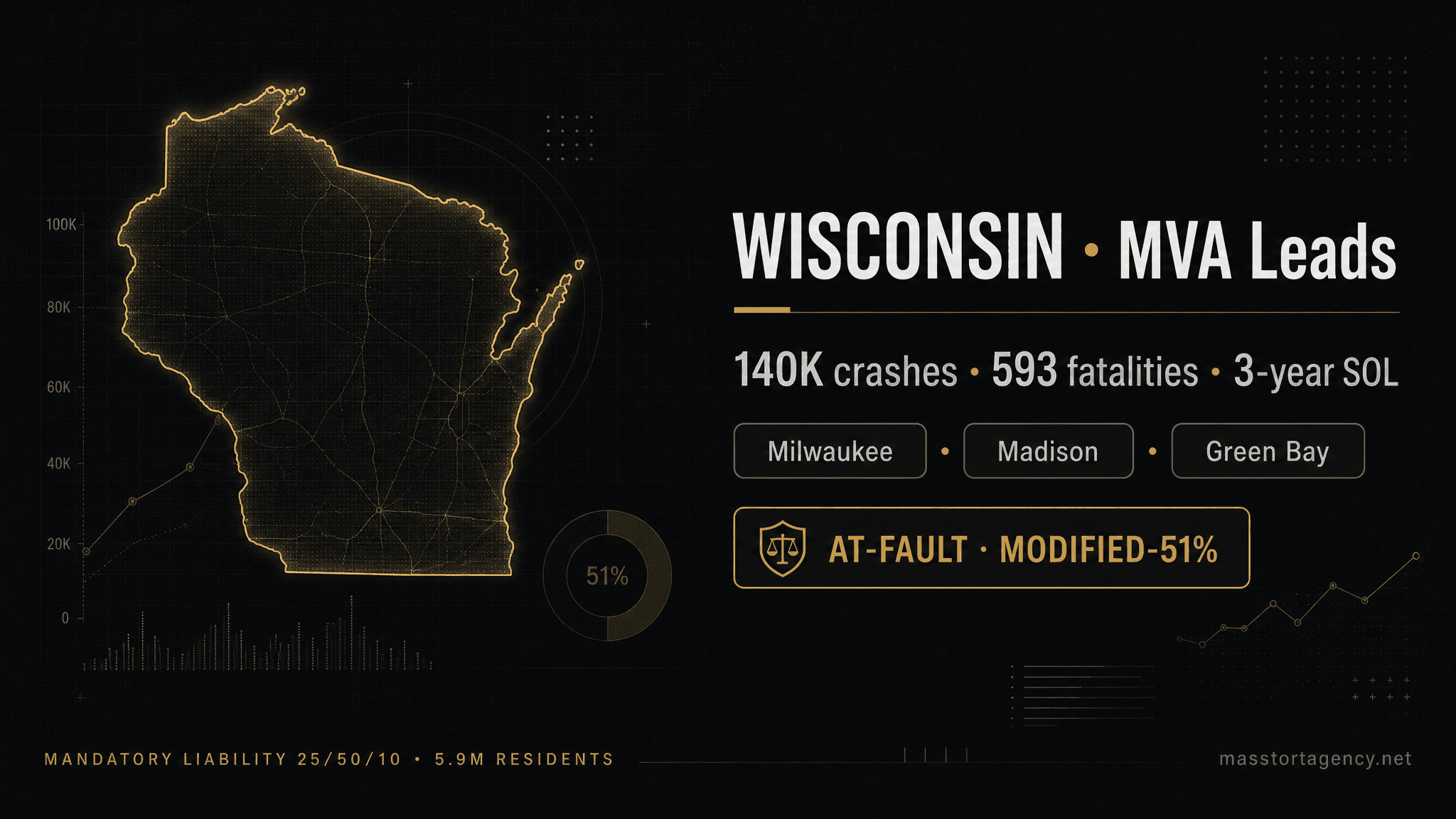
Wisconsin's sponsor-liability statute (Wis. Stat. § 343.15) makes vehicle owners and parental sponsors jointly liable for minor-driver negligence — and the broader Family Purpose Doctrine under Wisconsin case law extends owner exposure on family-use vehicles. Combined with the country's most generous property-damage SOL (6 years) and a clean 51%-bar tort framework, Wisconsin rewards firms that capture vehicle-ownership facts on every passenger-vehicle case.
Midwest
Wisconsin · WI
140,000 crashes/yr
Wisconsin · Market Size
Source: NHTSA + WI DOT
140,000
Reported crashes / yr
593
Annual fatalities
40,200
Injured claimants / yr
5.90M
State population
Wisconsin · Quick Reference
The 5 facts that drive Wisconsin MVA lead qualification
Liability
At-fault
Negligence
51% bar
PI SOL
3 years
PIP
Not required
Min. liability
25/50/10
Bottom line · At-fault + 51% bar + 3-year tort SOL + 6-year property SOL + Family Purpose Doctrine = Wisconsin rewards vehicle-ownership capture at intake. The parent-of-driver policy access under § 343.15 is the case-value lever most national vendors don't even check for.
The opportunity in Wisconsin
Wisconsin MVA: Family Purpose Doctrine + the 6-year property SOL
Wisconsin reports 124,000 traffic crashes annually with 593 fatalities. Volume concentrates in Milwaukee (38,400 crashes/yr) anchored on I-94/I-43/I-894 plus the Hoan Bridge, Madison (14,200) on the I-90/I-94/Beltline corridor, Green Bay (11,800) on I-43 with Packers-game-day surge volume, Kenosha (6,900) on the Illinois border carrying Chicago-spillover commuter volume, and Appleton (5,800) anchoring the Fox Valley.
Wisconsin's at-fault framework with the 51% modified-comparative bar under Wis. Stat. § 895.045 requires the jury to explicitly apportion fault among all parties — a unique procedural quirk where the verdict form must specify percentages. The 3-year tort SOL under Wis. Stat. § 893.54(1m) is standard; the 6-year property-damage SOL is among the most generous in the country.
Wisconsin's structural lever runs on two layers. Wis. Stat. § 343.15 imposes joint and several liability on parents and sponsors of minor drivers — the parent who signs a minor's license application is statutorily liable for the minor's negligent driving. Beyond that, Wisconsin case law applies the broader Family Purpose Doctrine to extend owner liability when a family-use vehicle is involved. The practical effect: when the at-fault driver is a 19-year-old college student on dad's insurance policy, the parents' policy limits are directly on the line — not just through omnibus coverage but through statutory and common-law vicarious liability. Lead vendors who capture vehicle-ownership-vs-driver facts at intake expose case-value math that most don't see.
Liability framework
How Wisconsin liability works — and why it matters at intake
Liability system
At-fault
Comparative negligence
Modified comparative — 51% bar
PIP requirement
Not required
PI statute of limitations
3 years
Property damage SOL
6 years
Mandatory liability minimums
25/50/10
(BI per person / per accident / property damage, in thousands)
Wisconsin is at-fault: the responsible driver's carrier pays. No PIP mandate, although medical-payments coverage is offered. Wisconsin uses the 51% bar under Wis. Stat. § 895.045. Mandatory minimum liability is 25/50/10.
Wisconsin uses the 51% bar — claimants more than 50% at fault recover nothing. Wisconsin is one of the few states where the jury determines fault apportionment with explicit verdict-level allocation (Wis. Stat. § 895.045(1)).
Where the volume is
Top Wisconsin claim markets
Milwaukee's 38,400 crashes concentrate on I-94/I-43/I-894 and the Marquette Interchange. The metro carries Harley-Davidson, Northwestern Mutual, and Northwestern Memorial corporate-employee insurance overlay plus a meaningful African-American urban claimant base on the North Side. Madison's 14,200 anchor on the Beltline (US-12/14/18/151) with University of Wisconsin and state-government concentration. Green Bay's 11,800 carry Packers-game-day surge crash volume (10 home games × 80,000 fans). Kenosha sits in the Chicago DMA spillover; Appleton anchors the Fox River Valley paper-mill / Kimberly-Clark commercial corridor; Eau Claire and La Crosse run as secondary markets.
Milwaukee
38,400
Madison
14,200
Green Bay
11,800
Kenosha
6,900
Appleton
5,800
Qualified MVA lead criteria
What "qualified" means in Wisconsin
In Wisconsin, "qualified" includes vehicle-ownership capture at intake (Family Purpose Doctrine extends owner liability to family-driver use under § 343.15). The seven criteria below operationalize that plus standard 51%-bar fault apportionment under § 895.045, with the jury-percentage-verdict requirement informing pre-suit demand strategy.
Accident date & SOL margin
Within 90 days of the wreck. Wisconsin's 3-year personal injury SOL compresses the case-management window — older leads burn the firm's pipeline.
Wisconsin jurisdiction
Accident occurred in-state with a police report on file. Report number captured at intake.
Fault apportionment
Claimant 50% or less at fault under Wisconsin's 51% bar.
Coverage profile
Wisconsin does not mandate PIP. Capture UM/UIM, MedPay, and health insurance status — first-dollar coverage varies widely.
Medical treatment
Active or completed care, with treatment provider documented. Injury severity captures the qualified-lead threshold.
No prior representation
Conflict-check release signed at intake. Lead is the firm's exclusive opportunity.
TCPA consent
Express written consent record on file: IP, timestamp, user agent, consent language all captured.
Wisconsin · Pricing benchmarks
What Wisconsin MVA leads actually cost in 2026
Wisconsin live-transfer CPL runs $255–410 — among the lowest in the Upper Midwest. Milwaukee and Madison are the most competitive metros; Green Bay, Appleton, and Eau Claire run 15–22% below. CPSR $1,500–2,650 reflects clean 51%-bar conversion plus the case-value lever from Family Purpose Doctrine cases where the parent/spouse policy is directly accessible.
Cost per signed retainer · Wisconsin
$1,500–$2,650
· midpoint $2,075
Typical Wisconsin CPSR band, inclusive of media + intake + signed-retainer attribution. Variance driven by liability complexity and metro mix, not media cost alone.
CPL by tier
Tier 1 — Live Transfer
$255–$410
CPL · Inbound caller, pre-qualified
Tier 2 — Qualified Form
$105–$195
CPL · Form fill, screened ≤15 min
Tier 3 — Data Lead
$30–$52
CPL · Volume tier, firm-screened
How we operate in Wisconsin
Channel mix + compliance
Channels that work in Wisconsin
Milwaukee has a meaningful African-American urban media segment (North Side, Bronzeville) plus significant Hmong-American population in the broader metro and the Fox Valley. Madison has growing East African (Somali, Ethiopian) and Latin American population. Wisconsin's Polish-American heritage in Milwaukee adds Polish-language demand for older claimants. Wisconsin Supreme Court Rules 20:7.1–20:7.3 govern lawyer advertising; the Office of Lawyer Regulation enforces. Wisconsin's Hansen v. A.H. Robins (1983) discovery-rule jurisprudence is broader than most states for non-obvious injury cases.
TCPA + DPPA · federal
Express written consent records on every outbound contact — timestamp, IP, user agent, consent language. DPPA enforced for any driver-record-derived data.
Wisconsin bar advertising rules
Wisconsin Supreme Court Rules 20:7.1–20:7.3. Direct in-person and live-telephone solicitation of MVA victims is restricted — lead vendors must source via opt-in inbound channels only.
Wisconsin MVA leads · FAQ
Questions Wisconsin firms ask before buying
What's the typical CPL for buying MVA leads in Wisconsin?
Wisconsin runs $255–410 CPL on live-transfer and $105–195 on qualified-form — among the lowest CPL bands of any Tier 1 or Tier 2 state due to fragmented plaintiff bar competition. Milwaukee and Madison are the most competitive metros; Green Bay, Appleton, and Eau Claire run 15–22% below the statewide band.
Does Wisconsin's 3-year SOL apply uniformly?
Three years from the accident date for personal injury under Wis. Stat. § 893.54(1m), six years for property damage. Discovery rule applies for non-obvious injuries (Hansen v. A.H. Robins, 1983). Claims against governmental entities have shorter notice requirements under Wis. Stat. § 893.80.
How does Wisconsin's jury fault apportionment work?
Under Wis. Stat. § 895.045(1), juries are required to allocate fault among all responsible parties (including the claimant and any non-party tortfeasors). If the claimant's share exceeds 50%, recovery is barred. If 50% or less, damages are reduced by the claimant's percentage. This explicit allocation makes the 51% bar enforceable at the verdict level.
Why does Kenosha County use Chicago media pricing?
Kenosha and parts of Racine County are in the Chicago DMA — media costs reflect Chicago pricing. About 6% of Wisconsin's statewide MVA volume comes from this corridor, with CPLs 18–25% higher than Milwaukee.
What MVA case types are most valuable in Wisconsin?
Commercial vehicle / trucking cases on I-94 (cross-state Chicago–Twin Cities corridor) and I-90 (Madison–La Crosse corridor), motorcycle cases (Wisconsin's motorcycle fatality rate is significantly above the national average), and snowmobile/recreational vehicle cases in the northern counties. Winter-weather single-vehicle crashes are common but often low-fault-allocation against the claimant.
Regional MVA markets