

Pretrial Order 22 in the Depo-Provera MDL names 23 distinct meningioma diagnoses that satisfy the threshold injury requirement — and excludes arachnoid cyst by name.
Source: PTO No. 22, In re Depo-Provera, No. 3:25-md-3140 (N.D. Fla. May 6, 2025), Doc. 281 n.5
Key takeaways
- →23 qualifying diagnoses are named in the Depo-Provera MDL — with arachnoid cyst expressly excluded even though arachnoid tumor qualifies. (PTO 22 n.5)
- →13 product names satisfy proof of use, including DMPA, Greenstone MPA and Prasco MPA — so a claimant who says “the shot” or names a generic is describing a Requisite Product. (PTO 22 n.3)
- →6 document types are accepted as proof of use, from a pharmacy record to a photograph of the syringe. An unsworn statement from anyone is not one of them. (PTO 22, Ex. A)
- →1 year is the maximum gap permitted between the diagnosis date on the record and the date the claimant states from memory. (PTO 22 at 3)
- →Pre-June 2005 use now qualifies for a Deficiency Exception when records cannot be obtained — a rule entered September 11, 2025 that appears in no secondary summary we located. (PTO 22A)
- →30 days is the Camp Lejeune statutory exposure minimum. The statute does not say “non-consecutive”, despite widespread assertions that it does. (Pub. L. 117-168 § 804(b))
- →0 court orders set threshold qualification criteria in the NEC preterm formula litigation. The screening rules in circulation are practice, not mandate.
Every active mass tort has a set of criteria that decides whether a claimant is a case or a rejection. For most litigations those criteria are public — they sit in a pretrial order or a statute. They are also, almost without exception, unindexed, uncompared, and frequently restated wrong by the pages that claimants and intake teams actually read.
This is a comparison of six active litigations against the document that governs each one. Where we could retrieve and read the controlling order, we quote it. Where we could not, we say so.
1The Depo-Provera MDL names 23 qualifying diagnoses — and one disqualifying near-miss
Pretrial Order 22 defines the threshold injury as one of 23 named meningioma diagnoses. Footnote 5 lists “Arachnoid tumor” as qualifying, then parenthesises “but not arachnoid cyst”.
That parenthetical is the entire difference between a signed retainer and a wasted intake call, and it exists nowhere except in a footnote of a court order. The full list runs from the generic (Meningioma, Brain meningioma, Meninges tumor) through anatomical subtypes (Convexity, Falcine, Parasagittal, Intraventricular, Skull base, Sphenoid wing, Olfactory groove, Posterior fossa/petrous, Suprasellar, Foramen magnum) to histological ones (Meningothelial, Fibrous, Psammomatous, Angiomatous, Secretory). It also includes Recurrent meningioma, and tolerates the common misspelling “Intercranial”.
| Requirement | What the order says | Source |
|---|---|---|
| Qualifying injuries | 23 named diagnoses | PTO 22 n.5 |
| Named exclusion | Arachnoid cyst | PTO 22 n.5 |
| Qualifying products | 13 named identifiers | PTO 22 n.3 |
| Duration of use threshold | None stated | PTO 22; PTO 22A |
| Diagnosis date tolerance | Within 1 year of claimed date | PTO 22 at 3 |
| Pages per document set | 5 maximum, bookmarked PDF | PTO 22 at 3 |
The product list matters as much as the diagnosis list. Proof of use is satisfied by any of thirteen identifiers — Depo Provera, Depo-Provera, DPCI, Depo Provera IM, DMPA, Depot medroxyprogesterone acetate, Medroxyprogesterone Acetate, MPA, IM MPA, Depo-SubQ Provera 104, Greenstone Medroxyprogesterone, Greenstone MPA, Prasco Medroxyprogesterone and Prasco MPA. An intake specialist who screens only for the brand name will disqualify claimants whose pharmacy records show the generic, which is a large share of them. Anyone building a Depo-Provera meningioma docket should be screening against all thirteen.
2Six documents prove use — and four of them must be contemporaneous
Exhibit A to PTO 22 accepts six categories of proof of use. Four of them must have been created at or near the time of the events they record, which removes the most common workaround intake teams reach for.
| Accepted document | Contemporaneous required? | Source |
|---|---|---|
| Prescription record | Yes | PTO 22, Ex. A |
| Medical record (incl. patient history) | Yes | PTO 22, Ex. A |
| Insurance record | Yes | PTO 22, Ex. A |
| Pharmacy record | Yes | PTO 22, Ex. A |
| Sworn provider/pharmacist declaration | No — after-the-fact permitted | PTO 22 n.4 |
| Photograph of product box or syringe | No — must show product + claimant name | PTO 22, Ex. A |
A medical record reciting that the patient reported receiving the product is sufficient at the threshold stage — the court expressly reserved whether a patient history will ultimately constitute adequate proof at trial. The declaration route must be sworn under 28 U.S.C. § 1746 or notarised; an unsworn statement from any person is not accepted. This is precisely the kind of detail that separates a functioning intake operation from one generating rejections, and it is worth reading alongside our guide to running mass tort intake.
is the hard cap per product and per diagnosis. Submissions must be PDFs with the relied-upon pages bookmarked, and no photographs or screenshots may be submitted unless first converted to PDF. A sixty-page records dump is a deficiency, not diligence.
PTO No. 22 at 3 (N.D. Fla. May 6, 2025)
There is also a signature rule that catches firms out. The product user must sign the questionnaire electronically under penalty of perjury. A lawyer may not sign for her even while holding a power of attorney. Only where the user is deceased, legally incapacitated or a minor may a legally authorised representative sign — and that representative must be registered as such in the portal.
And there is a clock. Pretrial Order 17 makes the questionnaire due 120 days after a case is filed in or transferred to the MDL, extendable only by the court for good cause or by agreement with leave of court. Answers are made under penalty of perjury and are treated as interrogatory responses under Federal Rule of Civil Procedure 33 — so an intake error that reaches the questionnaire is a discovery problem, not a paperwork one.
3PTO 22A opened a records exception for pre-2005 use
On September 11, 2025 the court created a Deficiency Exception for claimants whose alleged use is old enough that records no longer exist. It is the newest qualification rule in the litigation and we found it in no secondary summary.
PTO 22 had flagged the problem and deferred it: some claimants, despite diligent effort, cannot obtain proof for a product that has been on the market for decades. PTO 22A resolved it. A claimant qualifies for the exception by filing a declaration under penalty of perjury that affirms her sole alleged use was before June 2005, identifies every provider, pharmacy or entity that administered the product, affirms she requested records from each, and affirms that each responded that no records exist for the period claimed.
For a firm screening this tort, that converts a category of claimants previously treated as unworkable into viable cases — which changes the economics of the tort materially, and is the kind of shift that should feed straight into how you model cost per signed retainer for the docket.
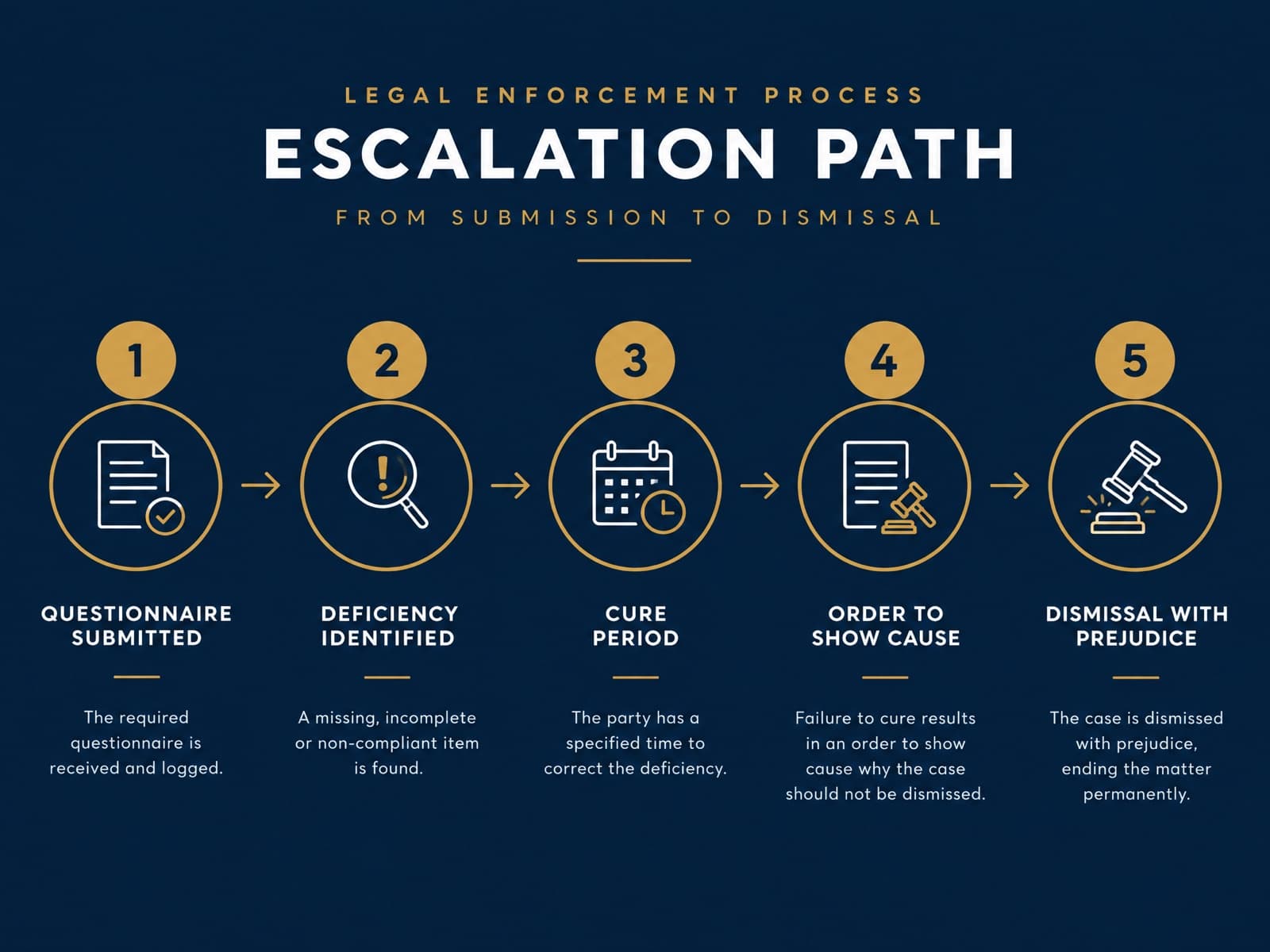
The consequence of not curing a deficiency is equally concrete. BrownGreer reviews submissions, identifies deficiencies, and allows a cure period. Failure to cure is reported to the court, which issues an Order to Show Cause on the individual docket. If the claimant still fails to comply, the action may be dismissed with prejudice.
4Camp Lejeune's criteria are statutory — and widely misquoted
Section 804(b) of Public Law 117-168 requires exposure “for not less than 30 days” between August 1, 1953 and December 31, 1987. The words “consecutive” and “non-consecutive” do not appear anywhere in the statute.
A large number of firm pages assert the non-consecutive reading as though it were statutory language. It may well be the correct legal interpretation — but it is an interpretation, and presenting it as text is the sort of thing that erodes trust with a sophisticated claimant. The statute is otherwise unusually generous in scope: it covers anyone who “resided, worked, or was otherwise exposed”, and expressly includes in utero exposure.
| Criterion | Statutory text | Source |
|---|---|---|
| Minimum exposure | “not less than 30 days” | § 804(b) |
| Exposure window | Aug 1, 1953 – Dec 31, 1987 | § 804(b) |
| Eligible claimants | Resided, worked, or otherwise exposed — in utero included | § 804(b) |
| Causation standard | Causal relationship “at least as likely as not” | § 804(c)(2) |
| Venue | E.D.N.C., exclusive | § 804(d) |
The causation standard is the underrated provision. “At least as likely as not” is a materially lower bar than ordinary tort causation, and it widens the qualifying population well beyond what a conventional medical-causation screen would return. Firms building a Camp Lejeune docket who screen to a stricter standard than the statute imposes are rejecting claimants Congress intended to admit.
5Where the criteria come from matters as much as what they are
Across the six litigations examined, qualification criteria come from three different kinds of authority — and only two of them bind anyone.
| Litigation | Qualifying criteria | Authority |
|---|---|---|
| Depo-Provera (MDL 3140) | 23 named diagnoses; 13 product names; contemporaneous records | Court order (retrieved) |
| Camp Lejeune (CLJA) | 30 days, 1953–87; in utero included | Statute (retrieved) |
| AFFF (MDL 2873) | 6 Listed Claims: kidney, testicular, liver and thyroid cancer; thyroid disease; ulcerative colitis. 3 exposure pathways | Court order (retrieved) |
| Hair relaxer (MDL 3060) | Not limited to cancer; fibroid and endometriosis claims proceed. Court set refiling rules only for undiagnosed cancer claims | Litigation practice; refiling set by court |
| Suboxone (MDL 3092) | Film formulation only + dental injury + Rx and dental records | Litigation practice |
| NEC formula (MDL 3026) | Under 32 weeks gestation; formula before NEC onset | Litigation practice — no order located |
That last column is the one nobody publishes, and it is the most operationally useful thing on this page. The Suboxone film restriction and the gestational-age cut-off used to screen NEC baby formula claims are both sensible — but neither is imposed by an order we could locate. Court-mandated criteria are non-negotiable: a claimant outside them cannot be worked, whatever the firm would prefer. Practice criteria are the firm's own policy, inherited from a vendor or a competitor, and they can be revisited. Confusing the two means either working cases that will be dismissed, or rejecting claimants nobody actually requires you to reject.
The AFFF list is the clearest case of criteria that are genuinely narrow and genuinely binding. Case Management Order 35 defines six “Listed Claims” — kidney cancer, testicular cancer, ulcerative colitis, thyroid disease, liver cancer and thyroid cancer — and recognises three exposure pathways: direct use or handling of AFFF, PFAS-contaminated drinking water, and turnout gear. Firms running AFFF firefighting foam campaigns against a broader PFAS symptom list are generating volume that the docket will not accept.
| AFFF proof requirement | What must be produced | Source |
|---|---|---|
| Diagnosis | Record establishing the diagnosis and the earliest diagnosis date | CMO 35 § I.B.1 |
| Fact sheet | Amended PI Plaintiff Fact Sheet via the EAG portal | CMO 35 § I.B.2 |
| Water contamination | Evidence of PFAS in the water; public water system ID (PWSID) or name | CMO 35 § I.B.3 |
| Residence | Credit report, lease, deed or utility bills proving residence before diagnosis | CMO 35 § I.B.4 |
| Direct exposure | Military, employment or tax records covering the whole exposure period, pre-diagnosis | CMO 35 § I.B.5 |
| Turnout gear only | Separate Turnout Gear Plaintiff Fact Sheet | CMO 35 § I.B.6 |
The order also opened a 21-day Filing Facilitation Window during which complaints could bundle up to 150 unrelated plaintiffs and use a short form complaint. For a firm sitting on unfiled AFFF claimants, the residence and employment-records requirements are the ones that decide viability — and both can be screened at intake.
Hair relaxer is widely misdescribed. Many summaries of hair relaxer claims treat uterine, ovarian and endometrial cancer as the litigation's qualifying diagnoses. The November 13, 2024 order they cite does something narrower. It dealt only with plaintiffs who had filed a cancer claim without a cancer diagnosis: those who filed on or before September 14, 2023 were dismissed without prejudice and may refile within six months of a later diagnosis of one of those three cancers, serving a complete fact sheet within ten business days; those who filed after that date were dismissed with prejudice. The court said in terms that “the case is clearly not limited to the three identified cancers” — fibroid and endometriosis claims continue.
6Two criteria the industry repeats that no order contains
Reading the primary documents surfaced two widely circulated requirements with no basis in the governing text.
| Claim in circulation | What the primary document says | Status |
|---|---|---|
| Camp Lejeune: “30 non-consecutive days” | Statute says only “not less than 30 days” | Interpretation, not text |
| Depo-Provera: “one year of use required” | No duration threshold in PTO 22 or 22A | Firm screening heuristic |
| “60–70% of mass tort leads are disqualified” | No source discloses sample size or method | Commonly claimed; unverified |
The Depo-Provera duration claim is the more consequential of the two. If a firm screens out claimants with under a year of use because it believes the court requires it, it is discarding qualified claimants on the basis of a rule that does not exist. That is a direct, measurable cost — and it shows up in lead-to-retainer conversion as vendor quality failure when the actual failure is internal screening policy — and it quietly inflates the cost of every signed retainer the campaign does produce.
duration-of-use or injection-count thresholds appear in either Depo-Provera pretrial order. The “year or longer” figure is a screening heuristic that has been restated often enough to read as law.
Pretrial Orders 22 and 22A, In re Depo-Provera (N.D. Fla. 2025)
Screen against the order, not the folklore
We build intake criteria for each tort from the governing court documents, and screen claimants against your case criteria before they reach your intake team.
See how our intake works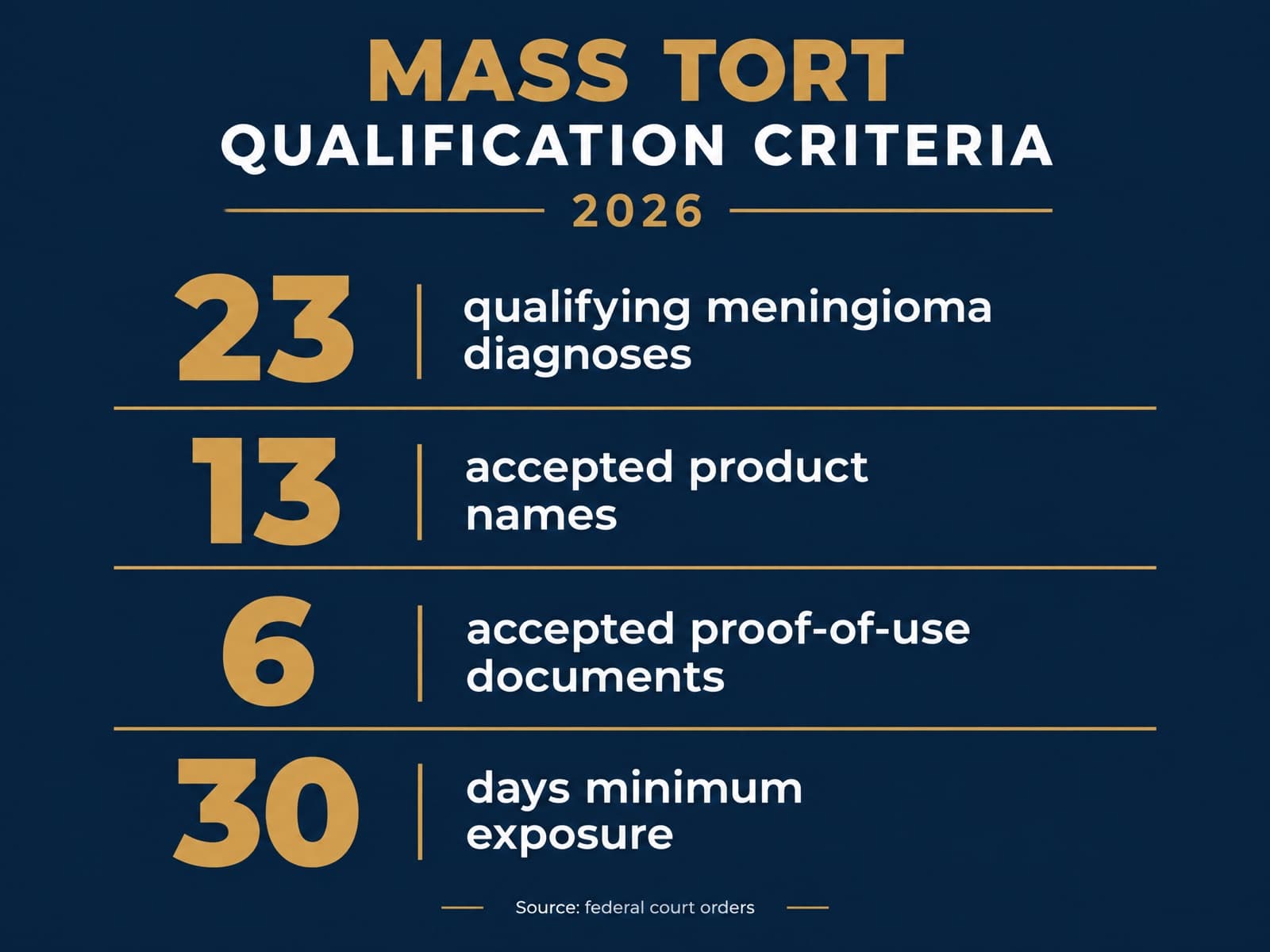
7Methodology
Research conducted September 20, 2026; court documents re-verified September 23, 2026. Eighteen sources consulted; the eight listed below are all primary government or court sources. Every court document cited was downloaded and read in full: Pretrial Orders 17, 22 and 22A in the Depo-Provera MDL, Case Management Order 35 in the AFFF MDL, the November 13, 2024 memorandum opinion in the hair relaxer MDL, and the text of Public Law 117-168 § 804. Court filings were obtained from the court's own site or from the free RECAP archive of PACER documents.
Reading the hair relaxer opinion in full changed our description of that litigation: secondary sources present its three cancers as qualifying criteria, but the order governs only refiling of undiagnosed cancer claims and states that the case is not limited to those cancers. Suboxone criteria are cross-verified across multiple 2026 sources but are not traceable to a threshold order. For the NEC preterm formula litigation, no court-ordered threshold criteria were located at all.
Coverage limitation. This covers six litigations, not the full active docket. We are expanding it one tort at a time as primary documents are retrieved, and each addition will be dated. Publishing thin, uncited rows to reach a rounder number would defeat the purpose of the exercise.
Three excluded claims are listed in section 6 rather than silently dropped, because knowing which widely repeated criteria are unsupported is as useful as knowing which are real. Next scheduled update: December 2026, or sooner if a threshold order issues in any covered litigation.
Frequently asked questions
Pretrial Order 22 accepts six document types: a prescription record, a medical record (including a patient-history recitation that the product was administered), an insurance record, a pharmacy record, a sworn declaration from a healthcare provider or pharmacist under 28 U.S.C. § 1746, or a photograph of the product box or syringe showing both the product name and the claimant's name. An unsworn statement from any person is not accepted. The first four categories must have been created at or near the time of the events they record.
Pretrial Order 22A, entered September 11, 2025, created a Deficiency Exception. A claimant whose sole alleged use was before June 2005 may instead file a declaration under penalty of perjury that identifies every provider, pharmacy or entity that administered the product, affirms that records were requested from each, and affirms that each responded that no records exist for the period claimed. BrownGreer makes the initial determination and tracks how many claimants qualify.
No. Pretrial Order 22 lists 23 qualifying diagnoses, including 'arachnoid tumor' — but the order expressly parenthesises 'but not arachnoid cyst'. This is the kind of single-word distinction that decides whether a claimant is a case or a rejection, and it exists nowhere except in footnote 5 of the order.
The statute does not say. Section 804(b) of Public Law 117-168 requires exposure 'for not less than 30 days' between August 1, 1953 and December 31, 1987. The words 'consecutive' and 'non-consecutive' do not appear in the statutory text, despite a large number of law firm pages asserting the non-consecutive reading as though it were statutory language.
Not under any court order located. Pretrial Orders 22 and 22A impose no duration-of-use or injection-count threshold. The widely repeated 'one year or longer' figure appears to be a firm-level screening heuristic that has been restated so often it now reads as a court requirement. Firms are free to screen on it — but they should know they are applying their own policy, not the court's rule.
In the Depo-Provera MDL, no. Exhibit A to Pretrial Order 22 requires the product user to sign electronically under penalty of perjury, and states that a lawyer may not sign for the claimant even while holding a power of attorney. Only a person with legal authority may sign, and only where the user is deceased, legally incapacitated, or a minor.
Most rejections trace to one of four causes: the diagnosis is not on the litigation's named qualifying list, the use or exposure window does not match, the supporting document was created after the fact where the order requires contemporaneous records, or the claimant's recalled dates fall outside the tolerance the order allows. Three of those four are knowable before a claimant ever reaches an intake specialist.
It varies by litigation, and the distinction matters. Depo-Provera and Camp Lejeune criteria are fixed by a court order and a statute respectively. In the NEC preterm formula litigation, no court-ordered threshold qualification criteria were located at all — the screening rules in circulation reflect litigation practice rather than a court mandate. Court-mandated criteria are non-negotiable; practice criteria are a firm's own policy and can be revisited.
Sources
- 1. Pretrial Order No. 22 (Identification of Deficiencies in Threshold Proof of Use and Injury Requirements), In re Depo-Provera (Depot Medroxyprogesterone Acetate) Prods. Liab. Litig., No. 3:25-md-3140-MCR-HTC (N.D. Fla. May 6, 2025), Doc. 281 & Doc. 281-1. flnd.uscourts.gov. Accessed September 20, 2026.
- 2. Pretrial Order No. 17 (Threshold Proof of Use and Injury Requirements), In re Depo-Provera, No. 3:25-md-3140 (N.D. Fla. Mar. 14, 2025), Doc. 178. RECAP archive (PDF). Accessed September 23, 2026.
- 3. Pretrial Order No. 22A (Amendment Regarding Identification of Deficiencies in Threshold Proof of Use and Injury Requirements), In re Depo-Provera, No. 3:25-md-3140 (N.D. Fla. Sept. 11, 2025), Doc. 423. Accessed September 20, 2026.
- 4. Camp Lejeune Justice Act of 2022, Pub. L. No. 117-168 § 804, 136 Stat. 1802. congress.gov. Accessed September 20, 2026.
- 5. Case Management Order No. 35, In re Aqueous Film-Forming Foams Prods. Liab. Litig., MDL No. 2873 (D.S.C. Aug. 15, 2025), ECF 7823 and Exhibit A (Short Form Complaint). RECAP archive (PDF). Accessed September 23, 2026.
- 6. Memorandum Opinion, In re Hair Relaxer Mktg., Sales Practices & Prods. Liab. Litig., No. 1:23-cv-00818 (N.D. Ill. Nov. 13, 2024), Doc. 946. RECAP archive (PDF). Accessed September 23, 2026.
- 7. Congressional Research Service, Preterm Infant Formula and Necrotizing Enterocolitis Litigation, IN12591. congress.gov.
- 8. Judicial Panel on Multidistrict Litigation, Pending MDLs. jpml.uscourts.gov. Accessed September 20, 2026.
Last updated September 20, 2026. This page describes qualification criteria used in litigation intake and is not legal advice.