

Quick answer. Search engine optimization for lawyers is the work of helping Google and AI search tools understand a law firm's site so that people searching for legal help can find it and decide to visit, which tracks Google's own definition of SEO. In practice it means practice-area and city pages built around real searches, an accurate Google Business Profile, steady reviews, sound technical setup and earned links. Judge it by signed cases, plan in months, and walk away from anyone who guarantees a #1 ranking.
Key takeaways
- No one can buy or be promised a top ranking. Google says advertising has no effect on organic results and that "No one can guarantee a #1 ranking on Google," per its page on whether you need an SEO.
- E-E-A-T is a lens, not a lever. Google says E-E-A-T "itself isn't a specific ranking factor," but its helpful content guidance gives trust extra weight on topics that can harm people's finances or safety, and legal pages qualify.
- The map pack runs on relevance, distance and prominence, and Google says there is no way to pay for a better local ranking.
- Clicks thin out where AI Overviews appear. Ahrefs measured a 58% lower top-result CTR on AI Overview keywords in December 2025 data, and Pew saw clicks on 8% of visits with an AI summary versus 15% without.
- Use current schema. schema.org deprecated
Attorneyin favor ofLegalService, and Google stopped showing FAQ rich results on May 7, 2026. - Measure signed cases, not traffic. For context, WordStream's 2026 benchmarks put the median Google Ads CPC for attorneys and legal services at $9.87.
- Bar rules apply to SEO copy. ABA Model Rule 7.1 bars misleading communications, and its Comment 3 covers results presented to create unjustified expectations.
If you run a firm or its marketing, you have probably heard three different answers to every SEO question. The numbers people quote often come from different studies, different years or nowhere at all. This guide sorts the claims you can rely on from the ones you can't, then lays out what to do first.
It runs in the order a firm should think: what law firm SEO is and the evidence for it, the trust signals Google looks for, a strategy and practice-area scorecard, keyword research and practice playbooks, content and on-page work, technical SEO and schema, local SEO, links, AI search, measurement and intake, cost and ROI, hiring, attorney advertising rules, a 90-day plan, then a FAQ. Facts were checked on primary sources as of October 2026, and the legal sections are general information, not legal advice.
Mass Tort Marketing Agency is a plaintiff-side agency focused on personal injury and mass tort case acquisition, so this guide measures SEO the way those firms do, by signed cases rather than traffic, the same yardstick we use for personal injury lawyer marketing. The examples lean toward plaintiff practices, but criminal defense, family, estate planning, immigration and employment firms get their own guidance too.
What SEO for lawyers means in 2026
SEO for lawyers, also called law firm SEO or attorney SEO, is the practice of improving a firm's website, Google Business Profile and wider web presence so search engines can find, understand and trust them, and so the firm appears in organic results, the map pack and AI answers for the legal help it offers.
A working definition of law firm SEO
Google's SEO Starter Guide puts it this way: "SEO—short for search engine optimization—is about helping search engines understand your content, and helping users find your site and make a decision about whether they should visit your site through a search engine."
That sentence gives a firm's site three jobs. First, be found: Google has to crawl and index the pages. Second, be understood: each page should clearly answer one kind of search, such as a truck accident page for a specific county. Third, be chosen: the title, snippet, reviews and visible proof have to persuade a stressed person to click and then call.
None of this is bought. Google says advertising with it "won't have any effect on your site's presence in our search results" and that it "costs nothing to appear in our organic search results," according to its guidance on hiring an SEO. "Legal SEO" and "lawyer SEO" are simply other names for the same work.
Lawyer, attorney and law firm searches
People type "lawyer," "attorney" and "law firm" more or less interchangeably, and this guide treats "SEO for lawyers," "attorney SEO" and "law firm SEO" as one topic. The practical question is which wording your own market uses for each practice. Your Search Console query report shows the exact phrases that already bring impressions, and the keyword research section later in this guide explains how to read it.
Use both terms naturally on a page. What you should not do is build a "lawyer" page and an "attorney" page for the same service and city. Google's AI optimization guide says creating separate content "for every possible variation of how people might search" primarily to manipulate rankings or AI responses violates its scaled content abuse policy, and its spam policies treat near-duplicate city and region pages as doorway abuse. One strong page per intent beats two thin ones.
The working parts of law firm SEO
Law firm SEO has eight working parts, and each has its own section in this guide:
- Strategy and keyword research: which practices, places and searches to target (strategy below, keyword research next).
- Practice-area, location and supporting content: the pages that answer each search (the pages and content sections).
- On-page elements: titles, headings, internal links and conversion elements (the on-page section).
- Technical health and schema: crawling, indexing, speed and structured data (the technical section).
- Local SEO: Business Profile, reviews and citations (the local SEO section).
- Links and mentions: earned references from other sites (the link building section).
- AI search visibility: AI Overviews, AI Mode and assistants such as ChatGPT (the AI search section).
- Measurement and intake: tracking from query to signed case (the tracking section).
Google's own list of services an SEO may provide now ends with "Optimizing for generative AI," alongside keyword research, content development and technical advice, per Google's guidance on hiring an SEO. That is why AI search sits inside SEO in this guide rather than beside it.
What Google says an SEO can and cannot promise
Google is unusually direct about what nobody can sell you. Its page Do you need an SEO? says "No one can guarantee a #1 ranking on Google" and warns against SEOs that "allege a 'special relationship' with Google, or advertise a 'priority submit' to Google." It also says Google never accepts money to include or rank sites in organic results.
The same page gives practical hiring rules. Give an auditor read access to Search Console only ("don't grant them write access"), and "If they guarantee you that their changes will give you first place in search results, find someone else." It says "You should never have to link to an SEO." And it adds: "Ultimately, you are responsible for the actions of any companies you hire."
Tools get the same caution. Google says third-party SEO tools "don't have access to Google's internal ranking data" and to "Be wary of tools that claim to be 'acceptable' or 'approved' by Google Search." Its June 5, 2026 page on third-party SEO services and tools adds that "Google doesn't evaluate third-party services," that "using a service or tool doesn't guarantee ranking success," and names AEO and GEO tools among those to judge critically, with Search Console as the first-party starting point.
Responsibility for vendors has a bar-rule echo: ABA Model Rule 5.3 requires reasonable efforts so that nonlawyer assistants act compatibly with a lawyer's obligations, and the hiring section of this guide covers vendor supervision.
SEO terms attorneys hear most
Most SEO reports and sales calls lean on the same dozen terms. Here they are in plain language.
| Term | Plain meaning | Why it matters to a firm |
|---|---|---|
| SERP | The search engine results page | Where clients first see your firm |
| Organic result | An unpaid listing ranked by Google | Cannot be bought; earned through SEO |
| Map pack (local pack) | The map with three local listings | Drives calls for local practices |
| Google Business Profile | Your free listing on Maps and Search | Feeds the map pack and reviews |
| Local Services Ads | Google's pay-per-lead ads for lawyers | Sits above organic results for many practices |
| AI Overview | Google's AI summary above results | Launched to everyone in the US May 2024 |
| AI Mode | Google's conversational AI search tab | A new place to be cited |
| E-E-A-T | Experience, expertise, authoritativeness, trust | A quality lens, not a ranking factor |
| YMYL | Topics that can affect money, health or safety | Legal pages face higher trust standards |
| Core Web Vitals | Google's page experience speed metrics | Affects usability on mobile |
| Structured data (schema) | Code labeling your firm and attorneys | Helps Google read facts about you |
| Backlink | A link from another site to yours | Signals that others vouch for you |
| Search Console | Google's free site performance tool | Shows queries, clicks and indexing |
| GEO and AEO | Optimizing for generative or answer engines | Google says this is still SEO |
Google announced it was bringing AI Overviews to everyone in the U.S. on May 14, 2024, and Google's AI optimization guide defines AEO as "answer engine optimization" and GEO as "generative engine optimization," adding that optimizing for generative AI search "is optimizing for the search experience, and thus still SEO."
Why SEO matters for law firms: the evidence
SEO matters because most US searches still run through Google, where organic and map-pack positions can't be bought. The payoff now depends on earning a click or citation on a results page crowded with ads and AI answers, and the evidence on clicks is mixed, so firms should plan around their own data rather than industry averages.
How people look for lawyers now
Google still dominates US search. StatCounter's US figures for September 2026 put Google at 85.19% and Bing at 9.89%. That Bing share is why Bing Webmaster Tools is worth setting up too (see the free tools list in the technical section).
AI is now part of how people research legal problems. Clio's 2025 Legal Trends Report press release reports three findings worth quoting exactly: "More than half of consumers have used or would consider using AI to answer a legal question." "Of those who used AI, 28% were directed to contact a lawyer." "A growing majority of consumers say they would look for their next lawyer online." The 28% applies only to consumers who used AI.
Competition is also large. The ABA's 2025 Profile of the Legal Profession counted 1,374,720 lawyers in the United States in 2025, up from 1,355,963 in 2024.
What is not known matters as much. Many statistics about how many legal clients use search engines, or how fast "near me" legal searches have grown, circulate widely in legal marketing content. I could not trace them to current primary sources, so this guide does not repeat them.
The zones of a legal search results page
A legal results page is a stack of zones, and only some of them reward SEO. Knowing which zone a query shows tells you which channel can actually win it.
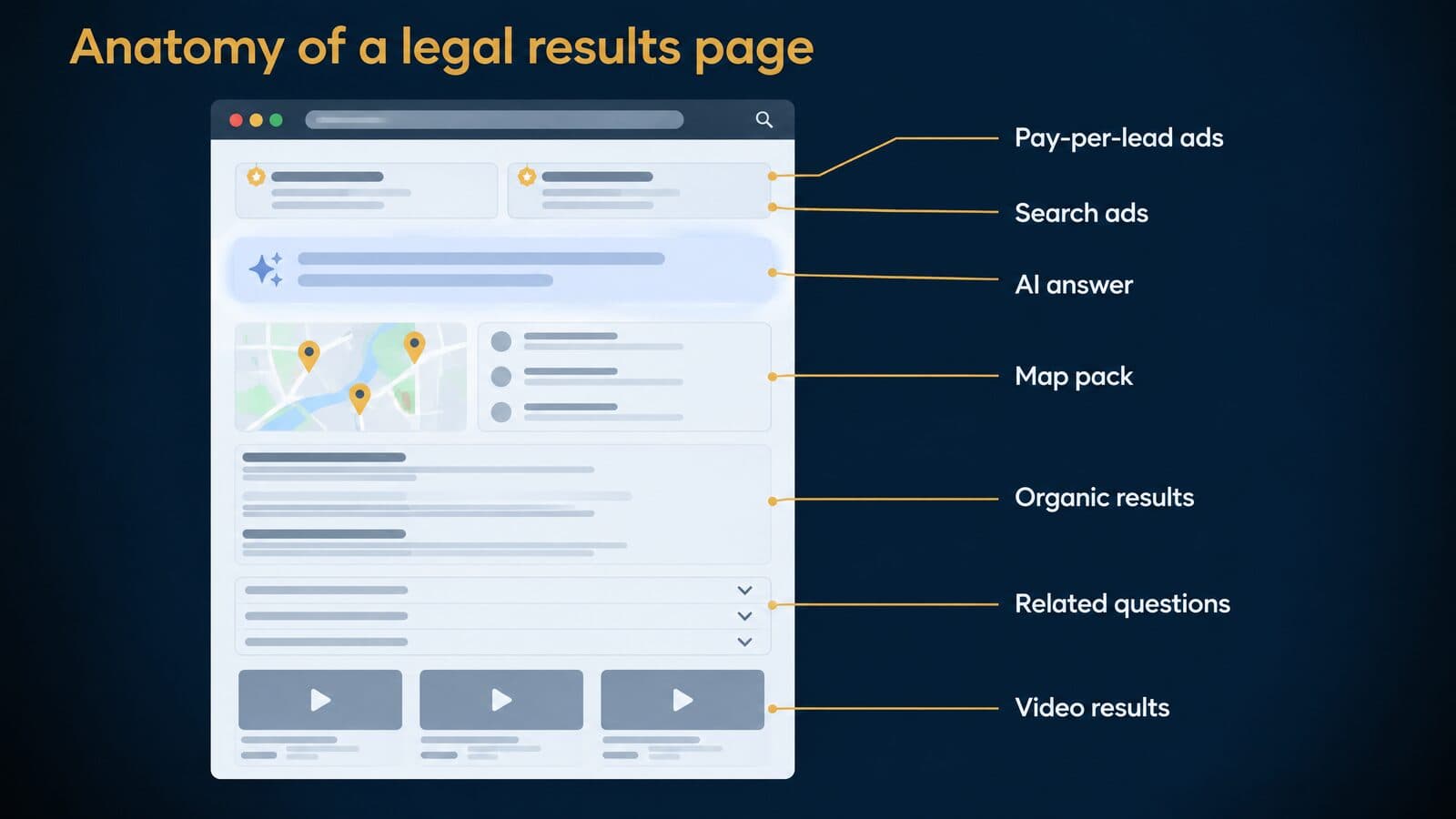
For many legal categories, Local Services Ads sit at the very top. Google's pitch is "Pay only for leads," and its help pages list legal categories that include personal injury, criminal, DUI, family, immigration, estate, bankruptcy and malpractice. Since October 2025 those ads carry a single Google Verified badge, which replaced Google Screened and Google Guaranteed.
Below or among the ads, an AI Overview or AI Mode answer may appear, though Google says AI Overviews "are only shown when our systems determine that it is additive to classic Search, and as such, often don't trigger," per its AI features documentation. Then comes the map pack, ranked on relevance, distance and prominence. Organic results follow, often shared with directories such as Avvo, Justia and FindLaw.
| Zone | Paid or organic | What earns a place | Covered in |
|---|---|---|---|
| Local Services Ads | Paid per lead | Verification, reviews, responsiveness | Local SEO H2 |
| Search ads | Paid per click | Bids, ad quality, landing page | Cost and ROI H2 |
| AI Overview or AI Mode | Organic | Clear, trusted, indexable content | AI search H2 |
| Map pack | Organic | Relevance, distance, prominence | Local SEO H2 |
| Organic results | Organic | Relevant pages, links, trust | On-page and technical H2s |
| People Also Ask | Organic | Direct answers to common questions | Pages and content H2s |
| Video results | Organic | Useful videos with clear titles | Blogging and video H2 |
The layout varies by query, location and device. Check your own target queries before assuming which zones you compete in.
Clicks after AI Overviews: what studies show
The click figures people quote disagree because they come from different datasets, years and methods. A 2019 study of millions of results cannot describe a 2026 page with an AI summary on top, and a sample of one agency's clients is not the same as a panel of US adults. Read each number with its source, date and method attached.
| Study | Data period | Sample | Finding |
|---|---|---|---|
| Backlinko CTR study | 2019 dataset | 4 million Google results | #1 result 27.6% average CTR; top 3 get 54.4% of clicks |
| Ahrefs, April 2025 | 2025 analysis | 300,000 keywords | AI Overview linked to 34.5% lower top-result CTR |
| Ahrefs, February 2026 | Dec 2023 vs Dec 2025 | Desktop Search Console data | 58% lower; position-1 CTR 0.073 to 0.016 |
| Seer Interactive, November 2025 | June 2024 to Sept 2025 | 3,119 queries, 42 organizations | AIO organic CTR 1.76% to 0.61%; non-AIO down 41% |
| Pew Research Center, July 2025 | March 2025 | 900 US adults' browsing | Clicks on 8% of visits with summary vs 15% without; 18% had one |
Backlinko's dataset was published in August 2019, before AI Overviews existed, so its 27.6% is a historical baseline and not a 2026 benchmark; the same page also shows a separate figure from a different dataset, and the two should never be combined. Seer measured a 61% decline on AI Overview queries in its client sample and says it "cannot definitively prove" the AI Overview caused it.
Three things hold across the studies. Top positions still take most of the clicks that happen. Clicks on informational queries fall sharply when an AI Overview appears, and even queries without one lost clicks over the same period. And Ahrefs found that 99.2% of keywords triggering AI Overviews were informational in intent, so commercial searches such as "hire a truck accident lawyer" are likely less exposed than "what is comparative negligence," though no study has measured legal queries specifically.
Google says clicks from results pages with AI Overviews "are higher quality (meaning, users are more likely to spend more time on the site)." That is Google's own claim, made in its AI features documentation, and no independent study cited here confirms it. For a longer look at why marketing numbers conflict, see why law firm marketing benchmarks disagree.
When SEO is the wrong first investment
SEO is slow, and some firms should start elsewhere or run something faster beside it. Google's starter guide says some changes "might take effect in a few hours, others could take several months," and that you likely want "to wait a few weeks" before judging. A firm that needs signed cases this quarter cannot wait on that.
Other cases where SEO should wait or share the budget:
- A referral-saturated practice with no spare capacity gains little from more inquiries.
- A budget too small to outbuild entrenched firms in a major metro, with no niche or neighborhood to own, will struggle for years.
- Intake that cannot answer calls at night and on weekends wastes the leads SEO produces (the intake section covers this).
- A short-lived mass tort litigation window may close before new pages mature (see the mass tort playbook).
The faster alternatives are Google Ads, Local Services Ads, referral building and buying leads from a vendor such as a personal injury lead generation provider. Each has its own cost structure and compliance questions, and the cost and ROI section compares them with SEO side by side. In my view, most firms that can afford it should run one paid channel while their SEO matures, then shift budget as organic cases start to show up in intake records.
The 80/20 rule applied to law firm SEO
The 80/20 rule, or Pareto principle, is a heuristic rather than a law: a small share of causes usually produces most of the effect. In law firm SEO, a small share of pages and practice areas usually produces most of the signed cases, while dozens of blog posts bring traffic that never calls.
To find those pages, join Search Console's landing-page data with your intake records by landing page, which the tracking section explains step by step. Once you can see which pages produce consultations and retainers, protect them first: keep them accurate, fast and well linked, then build related pages around them.
E-E-A-T and YMYL for law firm websites
Google says E-E-A-T "itself isn't a specific ranking factor," yet its systems give more weight to strong E-E-A-T on topics that can affect people's finances, health or safety. Legal pages fall into that group through Google's harm test, so trust signals matter more for law firms than for most sites. Some legal marketing guides call E-E-A-T the top ranking factor; Google's documentation says otherwise.
What Google says about E-E-A-T
Google's guidance on creating helpful content states: "While E-E-A-T itself isn't a specific ranking factor, using a mix of factors that can identify content with good E-E-A-T is useful." The letters stand for experience, expertise, authoritativeness and trustworthiness, and Google adds: "Of these aspects, trust is most important."
The same page offers a "Who, How, and Why" self-check and calls "Why" "perhaps the most important question." Apply it to a practice page. Who wrote it: a named attorney admitted in the state, not "Admin." How was it produced: written or reviewed by that attorney, with statutes and court rules cited. Why does it exist: to help a person decide whether they have a case and what to do next, not to fill a keyword slot. A page that answers all three plainly is doing what Google describes.
Why legal pages fall under YMYL
Google says its "systems give even more weight to content that aligns with strong E-E-A-T for topics that could significantly impact the health, financial stability, or safety of people, or the welfare or well-being of society. We call these 'Your Money or Your Life' topics, or YMYL for short."
The Search Quality Rater Guidelines, dated September 11, 2025 and running to 182 pages, define YMYL in section 2.3 through four harm types: "YMYL Health or Safety," "YMYL Financial Security," "YMYL Government, Civics & Society" and "YMYL Other." That section does not name legal services as a category. Legal content qualifies through the harm test itself, mainly financial security and safety.
An example makes the point. A page that misstates a filing deadline could lead a reader to miss it and lose the claim entirely. That is the kind of harm the definition describes.
Quality raters do not set your rankings
Google is explicit that "Search raters have no control over how pages rank. Rater data is not used directly in our ranking algorithms." Its guidance on generative AI content repeats that rater "ratings don't directly influence ranking."
Raters help Google evaluate its systems; they do not review your site and lower it. Treat the guidelines as a detailed quality checklist written by the company that builds the ranking systems, which makes them useful for auditing your pages, but don't read them as a ranking manual.
Trust signals to build into every page
Trust signals are the visible facts that let a reader, and Google's systems, see who stands behind a page. Build these into every practice, location and article page:
- Named attorney author with bar admissions and jurisdictions, because Google "strongly encourage[s] adding accurate authorship information, such as bylines."
- A "reviewed by" line with a date, used only when a real review happened.
- A visible last-updated date that changes only when the content changes.
- The firm name and contact details of a responsible lawyer, which ABA Model Rule 7.2(d) requires on lawyer advertising.
- Citations to statutes, court rules and official agency pages, so readers can check claims.
- Case results with context and disclaimers, since Rule 7.1 Comment 3 warns about creating unjustified expectations (see the attorney advertising section).
- Real photos of the attorneys and offices, not stock images of strangers in suits.
- The same firm name, address and phone number everywhere (see NAP consistency under local SEO).
- Reviews you are allowed to show, displayed within Google's and the bar's rules (see the reviews section).
None of these is a ranking trick. States vary in what they require on attorney advertising, so check your own bar's rules before finalizing the template.
Fake authors and credentials backfire
Google calls "Fabricating creator profiles (such as by using AI-generated headshots, made-up names, or false credentials to make content appear as if it was written by human experts)" a form of deception and "a signal of a low-quality page." For a law firm the risk doubles, because misleading credentials can also raise issues under Rule 7.1's bar on false or misleading communications. My recommendation: don't attribute copy written by a marketing team to a lawyer who neither wrote nor reviewed it. Have the attorney review it, then sign it honestly, using the attorney review workflow described in the content section.
Build a law firm SEO strategy before tactics
A law firm SEO strategy is a written decision about which practice areas, places and case types the site must win, for which clients, with what intake capacity and budget. Tactics such as blog posts, links and schema come after it and should trace back to it.
Strategy versus tactics
"Publish two blog posts a month" is a tactic. "Win truck-accident searches in the two counties where we have offices and can staff Spanish-language intake" is a strategy. The second names an outcome, a market and the capacity to serve it, and tells you which posts are worth writing.
In my view, firms that skip strategy tend to end up with traffic that doesn't match the cases they want: visitors researching small claims for a firm that only takes catastrophic injuries, or out-of-state readers for a firm licensed in one state. The fix is to decide the target first and let every page, link and profile update serve it. For a broader view of how SEO fits with other channels, see these personal injury law firm marketing strategies.
The one-page SEO strategy template
The one-page strategy fits on a single sheet and answers ten questions. Fill in each field before commissioning any SEO work:
- Practice areas, ranked by priority: list them in the order you want cases, not the order they appear on your site.
- Target geographies: offices, service areas, statewide coverage or national reach for each practice.
- Ideal client and case types, plus disqualifiers: who you want, and who you will turn away.
- Average fee or case value range: the firm's own numbers, kept internal and never published.
- Intake capacity: hours covered, languages spoken and how many calls a day the team can answer and qualify.
- Search competitors: the rival firms, directories, lead-gen sites and national brands that hold page one today.
- Baseline: current Search Console clicks, Business Profile calls and signed cases by source.
- Twelve-month goals stated in signed cases by practice, not in traffic or rankings.
- Budget and who does the work: in-house staff, an agency, freelancers or a mix.
- Compliance owner: the person who checks content against your state's advertising rules before it goes live.
Review it each quarter with the people who run intake and marketing. Every tactic in your SEO plan should trace to a line on this sheet; if a proposed task can't, ask why it is there. When you are ready to turn it into a fuller document with channels and budgets, use a full personal injury marketing plan as a model.
Score practice areas by case value and winnability
Score each practice area on two sides, how much a case is worth and how winnable its searches are, then build the top-right quadrant first. The priority scorecard below turns that into numbers you can compare across practices and offices.
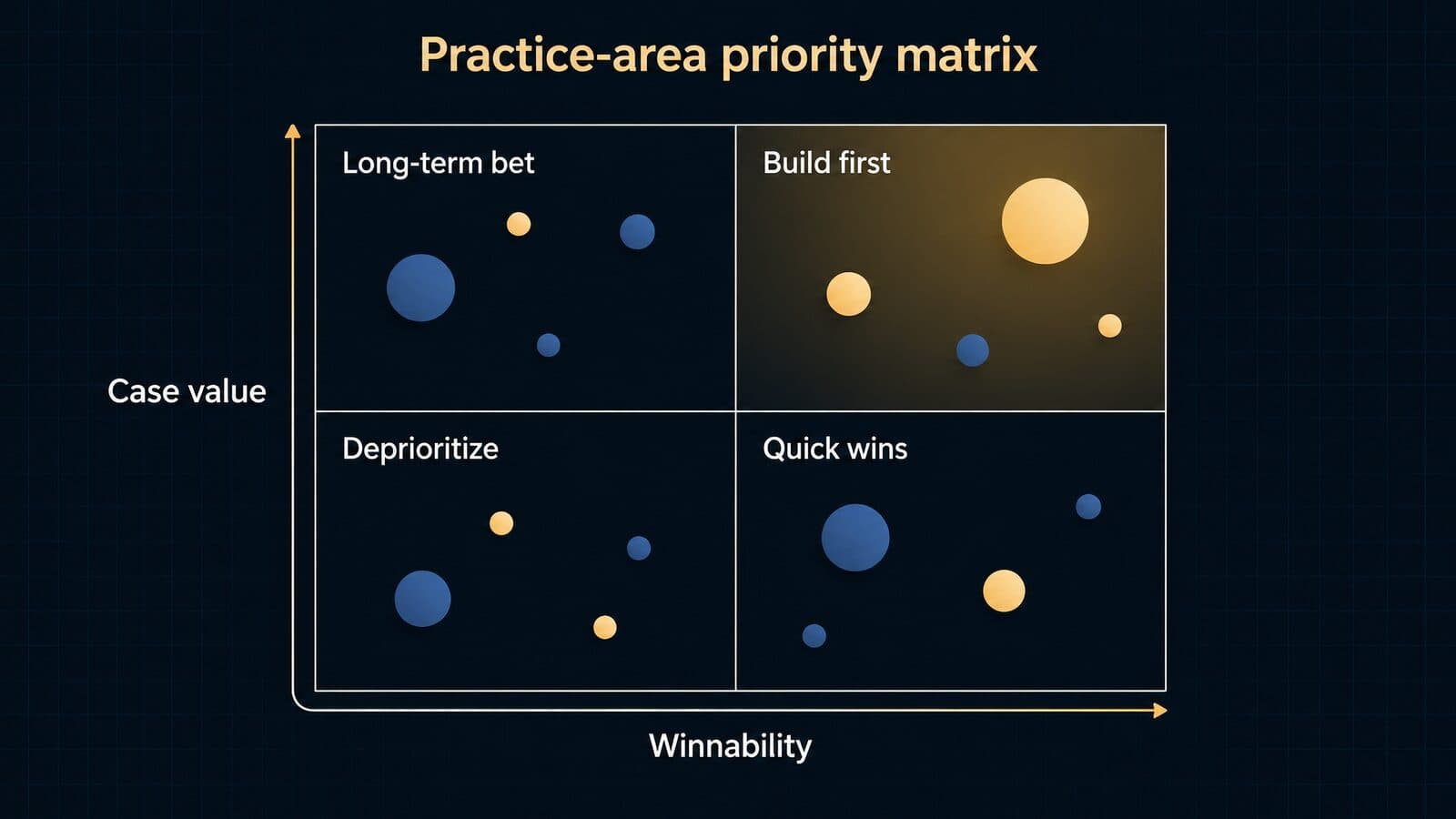
| Factor | Side | What to look at | Score 1 to 5 |
|---|---|---|---|
| Average fee per signed case | Value | Firm's own fee data by practice | Higher fee, higher score |
| Paid-click value | Value | Keyword Planner suggested bids as a proxy | Higher bids, higher score |
| Search demand | Value | Keyword Planner trends, Search Console impressions | More demand, higher score |
| Page-one competition | Winnability | National firms, directories, lead-gen sites holding each zone | Weaker rivals, higher score |
| Current footing | Winnability | Existing rankings, pages and reviews | Stronger footing, higher score |
| Intake fit | Winnability | Can you answer and qualify these calls | Better fit, higher score |
| YMYL and compliance load | Winnability | Rules, disclaimers and review burden | Higher load, lower score |
Google's Keyword Planner gives insight into how often people search and how that has changed over time, plus "suggested bid estimates for each keyword," which is a useful proxy for what other firms will pay for a click. WordStream's 2026 median CPC for attorneys and legal services is $9.87, but bids for individual practice keywords vary widely, so use your own Keyword Planner data and note the date and market next to every figure.
To score, average the three Value rows and the four Winnability rows, then plot each practice on the matrix. High value and high winnability means Build first. High value and low winnability is a Long-term bet. Lower value with high winnability is a Quick win. Low on both means Deprioritize, at least for SEO.
Here is a hypothetical example. A two-office injury firm scores truck accidents high on value but low on winnability, because national firms and lead-gen sites hold page one, so trucking becomes a long-term bet. Rideshare accidents score high on both, with solid fees and weaker local competition, so they go in Build first. Dog bites score lower on value but high on winnability, making them a quick win that adds reviews and local relevance while the bigger pages mature.
Solo, multi-location and national firms
Solo and small firms usually have one office, one Business Profile, a handful of practice pages and an owner who writes or reviews the content. That is a manageable scope. Google itself says that "If you run a small local business, you can probably do much of the work yourself," and that a redesign or new-site launch is "a great time to hire" an SEO, per its guidance on hiring an SEO.
Multi-location firms need one Business Profile per real, staffed office. Google's Business Profile guidelines say a virtual office "isn't eligible," and the local SEO section covers the rest of the rules. Each location page must carry unique substance about that office and its community, which the doorway test in the pages section helps you check.
National and mass tort firms face a different search landscape. Many of their queries, such as a product name plus "lawsuit," show no local pack at all, so topical depth, freshness and brand recognition matter more than proximity. The mass tort playbook later in this guide covers how that works across the life of a litigation.
With the strategy and scorecard in hand, the next step is finding the exact searches behind each priority.
Keyword research for lawyers, step by step
Keyword research for lawyers means finding the searches potential clients use for each priority practice and place, judging the intent and case value behind them, and assigning each group of searches to one page. Start from the practices that scored highest on the priority scorecard earlier in this guide, not from a tool's list of popular terms.
That order matters because a keyword tool will happily hand you thousands of phrases, most of them irrelevant to the cases you want. A firm that signs truck and commercial vehicle cases in two counties needs perhaps a few hundred searches mapped well, not ten thousand mapped loosely. The work below runs in five passes: gather data, label intent, add local and long-tail variations, check who already holds each result, and then map every cluster to a single URL.
Tools for legal keyword research
Start with first-party data before you pay for anything. Google Search Console shows "which queries bring users to your site" along with impressions, clicks and average position, which tells you where you already have a foothold. Google itself points site owners to Search Console as the first-party tool and warns that "using a service or tool doesn't guarantee ranking success". Export early and often, because Search Console keeps data for the last 16 months. Google Keyword Planner adds how often terms are searched, how that has changed over time, and "suggested bid estimates", a rough signal of commercial value. Do not skip Bing: it held 9.89% of US search in September 2026, and Bing Webmaster Tools offers "free reports, tools and resources".
| Tool | Entry price (monthly, as of October 2026) | Useful for |
|---|---|---|
| Google Search Console | Sign in with a Google account | Your own queries, clicks and positions |
| Google Keyword Planner | Inside a Google Ads account | Search trends and bid estimates |
| Bing Webmaster Tools | Free reports | Bing queries and site diagnostics |
| Ahrefs | Starter $29; Lite $129 | Competitor keywords and links |
| Semrush | SEO plan $139; Starter with AI Search $199 | Keyword gaps and rank tracking |
| Moz Pro | Entry-level $49; Standard $99 | Keyword lists and site audits |
The paid prices come from Ahrefs' pricing page, Semrush's pricing page and Moz Pro's pricing page as of October 2026; plans change often, so confirm with each vendor before you budget. Semrush is now owned by Adobe, which completed its acquisition of Semrush on April 28, 2026. Treat every third-party volume and difficulty score as an estimate. Google says plainly that these tools "don't have access to Google's internal ranking data", so use them to compare terms against each other, not to forecast traffic.
Search intent types with legal examples
Intent is the job the searcher wants done. Matching the page type to that job matters more than matching the exact words, because Google ranks the page that best answers the request.
| Intent | Example legal search | Page that should rank | Goal |
|---|---|---|---|
| Informational | how long to file a car accident claim in [state] | Guide or FAQ | Email or call later |
| Commercial investigation | best divorce lawyer [city]; do I need a lawyer for a minor accident | Practice page with reviews and results | Consultation |
| Local or transactional | truck accident lawyer near me | Practice page plus Business Profile | Call |
| Urgent | arrested for DUI what to do | Practice page built for phones | Immediate call |
| Navigational | [firm name] reviews | Home, reviews or contact page | Call |
The split has a practical consequence in 2026. Ahrefs found that "99.2% of keywords that trigger AI Overviews are informational in intent", so your guides and FAQ answers now compete to be cited inside an AI answer, while your practice pages still fight for the map pack and the classic organic links. Plan both: guides written so a clear, sourced answer can be lifted, and practice pages built to win the click and the call. The AI search section of this guide covers how to measure AI visibility.
Local modifiers, near me and long-tail queries
Google resolves "near me" searches by itself. Local results rest on relevance, distance and prominence, and the searcher's location supplies the distance. Writing "car accident lawyer near me" ten times into a page does not move you closer to anyone. Worse, pasting a list of suburbs into a footer or sidebar matches one of the examples in Google's keyword-stuffing policy: "Blocks of text that list cities and regions that a web page is trying to rank for".
The long tail is where smaller firms win. Three patterns produce most of the useful phrases:
- Case type by injury by place: "rear-end collision back injury lawyer [city]" or "dog bite lawyer for a child [county]".
- Procedural questions: "what happens at a DUI arraignment in [county]" or "how long does probate take in [state]".
- Comparison questions: "settle or sue after a slip and fall", "mediation vs court divorce [state]".
Harvest them from three places. In Search Console, filter queries containing "how", "what", "can" or "do I" and sort by impressions. In the results page, record the People Also Ask questions for each money term. And ask intake staff to log the exact first question callers ask; those words are often the searches no tool reports. Spanish-language queries deserve their own pages rather than a translated paragraph, covered in the multilingual section below.
Find your real search competitors
Your search competitors are whoever holds each zone of the results page for your money queries, and many of them are not law firms. National directories such as Avvo, Justia, FindLaw, Martindale-Hubbell and Super Lawyers rank on many local practice terms. Lead-generation sites, national plaintiff brands, news outlets and government pages take other positions. A firm that only benchmarks the rival across the street will misread the market.
Use this method:
- Pick 20 to 30 priority queries from your scorecard practices, mixing practice, case-type and question searches.
- Check them from inside your market with a location-accurate rank tracker or a search set to the city, never from your office browser history.
- Record who holds the map pack, the organic top five and any AI answer, query by query.
- Note which page types win: directory listings, firm practice pages, long guides, videos or news.
- Decide for each query whether to compete head-on or target a narrower search you can realistically own, such as a case type or a county.
The output is a short list of the domains that actually stand between you and the client. For the full workflow on mining their rankings, see our guide to competitor keyword research.
Map every keyword cluster to one page
Every cluster of searches that share the same intent gets exactly one URL, and every page has one primary cluster. That single rule prevents most of the structural problems law firm sites develop as they grow, because it forces a decision before anything is written.
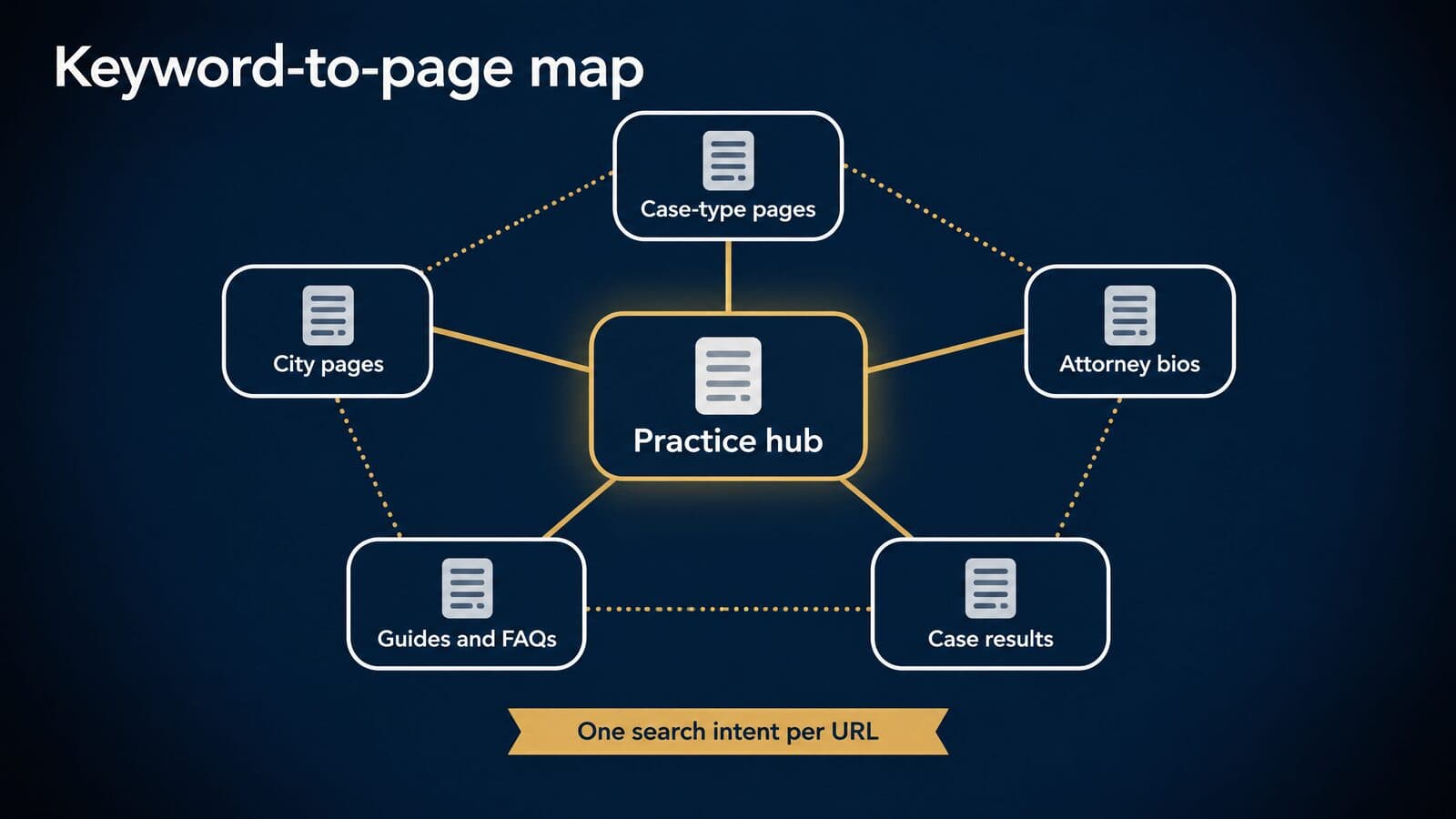
The keyword-to-page map is a spreadsheet with one row per cluster. The rows below are illustrative, for a hypothetical truck accident practice:
| Cluster | Primary search | Page type | Target URL |
|---|---|---|---|
| Truck accident lawyer (hypothetical) | truck accident lawyer [city] | Practice page | /truck-accident-lawyer/ |
| Filing deadline (hypothetical) | how long to file a truck accident claim in [state] | Guide | /guides/truck-accident-deadline/ |
| Semi crash attorney (hypothetical) | [city] semi-truck crash attorney | Same practice page as row 1 | /truck-accident-lawyer/ |
| Second city (hypothetical) | truck accident lawyer [second city] | Location page, only if it passes the doorway test | /truck-accident-lawyer/[second-city]/ |
Row three shows the most common judgment call: "semi-truck crash attorney" means the same thing as "truck accident lawyer", so it is folded into the existing page as a secondary search rather than given a near-duplicate page. When two pages split one cluster, that is cannibalization. You can spot it in Search Console by opening a query and checking the Pages tab: if two URLs trade places for the same search over the weeks, neither is getting full credit. The fix is either to merge the weaker page into the stronger and 301-redirect it, or to sharpen the intent so the two pages truly answer different questions.
Arrange the map as hub and spoke. Each practice hub links down to its case-type pages, location pages, the attorneys who handle the work, related guides and case results, and each of those links back up to the hub. That structure gives visitors and crawlers a clear, browseable hierarchy. Google's spam policies name the opposite pattern as doorway abuse: "Creating substantially similar pages that are closer to search results than a clearly defined, browseable hierarchy".
SEO playbooks by practice area
Practice areas differ in search geography, urgency, case value and the layout of the results page, so one SEO plan does not fit personal injury, criminal defense and mass torts. Choose your first battles by where your clients search and which part of the page they click.
The table below is an editorial assessment of how these practices typically behave in search, not measured data. Use it as a starting hypothesis and confirm it against your own competitor check above.
| Practice | Search geography | Urgency | Zones to win first | Content priority |
|---|---|---|---|---|
| Personal injury | Metro and city | High | Map pack, LSAs, organic | Case-type and city pages, reviews |
| Mass tort | National | Rises with news | Organic, AI answers, video | Litigation status and eligibility pages |
| Criminal and DUI | County court | Very high | Map pack, LSAs, mobile organic | Charge and court pages |
| Family | County | Medium | Map pack, organic | Process guides, local court info |
| Estate planning | Metro | Low | Organic, map pack | Plain-language guides |
| Immigration | Metro and national | Medium to high | Organic, map pack | Process guides, other languages |
| Employment and workers' comp | State | Medium | Organic, map pack | State-law guides |
| Medical malpractice | State | Medium | Organic | Deep case-type pages, credentials |
Read across a row and the plan writes itself. Urgency tells you how much weight to give phones and calls, geography tells you whether location pages make sense at all, and the zones column tells you whether the map pack or the organic list deserves the first dollar.
Personal injury: map pack, city pages and reviews
Personal injury is the most local and most crowded practice in legal search. Google sells personal injury leads directly through Local Services Ads, where firms "Pay only for leads" and personal injury is one of the listed legal categories. That puts paid listings above both the map pack and the organic results on many accident searches, and it means the organic page has to work harder for the click it does get.
The map pack decides a large share of first calls in this practice, and the local SEO section covers the Business Profile factors that shape it. On the website side, the playbook has five parts. First, build case-type pages for the injuries you actually take: car, truck, motorcycle, pedestrian, premises, dog bite, wrongful death. Second, add case-type by city pages only where the doorway test below passes, usually where you have an office or regularly appear in the local courthouse. Third, earn reviews steadily and answer them, because prominence is one of the three local pillars. Fourth, publish Spanish-language pages where your market calls for them and your intake team can answer in Spanish. Fifth, staff intake after hours, since crashes do not happen during business hours.
Expect national plaintiff brands and lead-generation sites on page one for most accident terms. A local firm beats them with specific local substance: the roads, the hospitals, the courthouse and the attorneys clients will actually meet. For a deeper treatment of the practice, see our page on SEO for personal injury law firms and the case-type example in car accident lawyer marketing.
Mass tort: national queries and the litigation lifecycle
Mass tort searches usually pair a product with an injury and the word "lawsuit", and they come from anywhere in the country. Proximity and the map pack therefore matter little; this is national organic SEO, competing with news sites, lead-generation sites and national firms. That is an observation about how these queries work rather than a measured statistic, but it changes almost every tactic.
Search demand follows the litigation lifecycle. Interest usually starts with a recall, an FDA warning or a published study. It rises again with the first filings, again when federal cases are consolidated (often into a multidistrict litigation, or MDL), again around bellwether trials, and again when settlement talks become public. Each stage changes what searchers want: early on they ask whether a product causes an injury; later they ask whether they qualify, what the deadlines are and what a settlement might mean.
Content therefore has to track docket status, carry a visible date and be refreshed at least monthly while a case is active. A page that still describes a pending motion after the judge has ruled loses trust with readers and with search engines. These pages also make medical claims, which puts them squarely in Google's YMYL category of topics that can affect a person's health, financial stability or safety. Attorney review and citations to court orders and agency records are non-negotiable.
Solicitation rules shift too. New York eliminated its 30-day solicitation window for personal injury, wrongful death and mass tort matters effective June 1, 2026, though federal limits after air and rail disasters remain; the attorney advertising section covers the details. National mass tort search is the core of Mass Tort Marketing Agency's work, and our mass tort SEO services page describes that approach; for the long version of this playbook, read our mass tort law firm SEO guide.
Criminal defense and other urgent practices
Arrests and DUI stops create same-day, phone-first searches, often made by a family member at night. Local Services Ads list criminal, DUI and traffic categories, and Google notes that unanswered calls can affect ad ranking, a reminder that responsiveness is part of winning these searches, paid or organic.
Content should be specific to the charge and the courthouse: separate pages for DUI, drug possession, domestic violence and theft charges; process pages for each county court you appear in (arraignment, bail, next dates); and what-to-do-now guides written for a scared reader on a phone. Put click-to-call at the top of every page, not only in the footer.
Family law, estate planning and immigration
Family law is county-based and emotional. Searchers worry about privacy and about the other party seeing their search, so pages should use calm language, explain confidentiality and give real local court process: filing locations, mediation requirements, typical sequences. Estate planning runs the other way. It is low urgency with long research cycles, so evergreen, plain-language guides on wills, trusts, powers of attorney and probate earn visits over months.
Immigration combines federal law with local offices and multilingual audiences. Visitors are vulnerable to fraud, so trust signals and clear credentials, discussed in the E-E-A-T section, carry extra weight, as do pages in the languages your clients speak. All three practices appear as legal categories in Local Services Ads, so expect paid listings above the organic results here too.
Employment, workers' comp and medical malpractice
State law drives all three practices: filing deadlines, damage caps, agency procedures and notice rules differ by state, so state-specific guides need the attorney review workflow described below and a dated refresh. Medical malpractice combines high case values with strict screening, so pages should explain merit criteria honestly, including the cases the firm cannot take. That honesty filters calls and builds trust. Local Services Ads list labor, disability and malpractice categories as well. For a worked example of this practice, see medical malpractice lawyer marketing.
The pages every law firm website needs
Every firm needs a short list of core pages, each built for one job: home, practice hubs, case-type pages, location pages, attorney bios, case results, reviews, guides and FAQ, and contact. Most ranking and converting happens on the practice and location pages, so they get the most care.
A small firm can launch with a dozen well-built pages and add more as the keyword-to-page map grows. What matters is that each page has a defined job and a defined set of searches, so nothing overlaps and nothing important is missing.
Core page inventory
| Page | Job | Must include |
|---|---|---|
| Home | Route visitors and state who you serve | Practices, places, phone, proof |
| Practice-area hub | Rank for the broad practice term | Case types, process, attorneys |
| Case-type page | Rank for one case type and convert | Eligibility, deadlines, results |
| Location page | Serve one real office or court area | Local courts, address, directions |
| Attorney bio | Prove who does the work | Admissions, focus, photo, articles |
| Case results | Show relevant outcomes in context | Facts, disclaimers, dates |
| Reviews | Show client feedback | Real reviews, response policy |
| Guides and FAQ | Answer informational questions | Sources, reviewer, date |
| Contact | Turn intent into a call or form | Phone, hours, form, languages |
Experts surveyed by Whitespark for its 2026 study ranked "Dedicated Page for Each Service" as the top local organic factor. That is expert opinion, not Google's published weighting, but it matches the logic of intent matching: one page per practice and case type answers a searcher better than a single "Practice Areas" page that lists twenty services in bullet points.
Anatomy of a practice-area page
A strong practice or case-type page answers the visitor's questions in the order they ask them. Here is a reliable sequence:
- An H1 naming the case type and the place.
- A two- to three-sentence answer to "can you help me?"
- Who the page is for and which cases qualify.
- How the process works in your state, step by step.
- Deadlines, with a link to the statute and a last-checked date.
- Fees and how contingency works where applicable, checking your state's rules on fee statements.
- Relevant results with context and the disclaimers your state requires (see the advertising rules section).
- The attorney who handles these cases, linked to a full bio.
- Questions clients actually ask, drawn from intake notes and People Also Ask.
- A call, text or form block, repeated where it helps on mobile.
On length, Google is direct: "There's no ideal page length". Cover the client's questions fully and stop. The same Google guide contrasts commodity content with non-commodity content, using "7 Tips for First-Time Homebuyers" against "Why We Waived the Inspection & Saved Money: A Look Inside the Sewer Line", and advises "unique, expert-led content that provides value beyond common knowledge". For a law firm, the commodity version is "What to do after a car accident". The non-commodity version explains how claims against a particular city's buses work, which notice deadline applies, and what your attorneys have seen go wrong in that process. Local, case-specific detail is the part no directory can copy.
City pages that are not doorway pages
City pages are where law firm SEO most often crosses Google's spam lines. The spam policies give two doorway examples that describe the classic template: "Having multiple domain names or pages targeted at specific regions or cities that funnel users to one page" and "Creating substantially similar pages that are closer to search results than a clearly defined, browseable hierarchy". The keyword-stuffing policy adds "Blocks of text that list cities and regions that a web page is trying to rank for". Fifty pages that differ only by the city name in the H1 fit those examples closely.
Run every proposed city page through the doorway test:
- Does the firm have an office, a regular courthouse presence or real clients in this place?
- Does the page carry local substance (courts, venues, local procedure, local data you can source) that the other city pages don't?
- Would the page still be useful if the city name were removed? If yes, the content is generic.
- Does it sit in a clear hierarchy, practice hub then location, rather than funneling every visitor to one page?
- Would you keep it if search engines didn't exist?
My recommendation is simple: a page that fails two or more questions should be merged into the practice hub or dropped. Passing pages tend to be fewer and stronger, often one per office plus a handful for courthouses the firm appears in every week. Experts surveyed by Whitespark rank "Geographic keyword relevance of content" second among local organic factors, which rewards pages with real local substance, not swapped city names.
Attorney bios, case results and reviews pages
Bios carry more weight in legal search than in most industries, because the reader is hiring a person. A good bio lists bar admissions and jurisdictions, education, practice focus, publications, speaking, languages spoken, a real photograph and links to the articles that attorney has written or reviewed. The schema section covers the Person markup that connects bios to those articles.
Watch the specialist wording. Under ABA Model Rule 7.2 Comment [9], a lawyer is "generally permitted to state that the lawyer 'concentrates in' or is a 'specialist,' practices a 'specialty,' or 'specializes in' particular fields", subject to Rule 7.1. Calling someone "certified" is different: Rule 7.2(c) requires certification by an approved or accredited organization that is "clearly identified".
Case results pages need context. [Rule 7.1 Comment [3]](https://www.americanbar.org/groups/professional_responsibility/publications/model_rules_of_professional_conduct/rule_7_1_communication_concerning_a_lawyer_s_services/comment_on_rule_7_1/) explains that past results can create unjustified expectations and discusses the role of disclaimers; state rules vary and some are stricter. On reviews pages, show real reviews, but don't expect stars in search: Google treats pages as ineligible for star review features when the business marks up reviews about itself, including an "embedded third-party widget (for example, Google Business reviews or Facebook reviews widget)". Our page on advertising rules for case results and reviews goes further. This is general information, not legal advice; check your state bar's rules.
Blogging, video and AI-assisted legal content
Blogs, videos and AI drafts help a law firm only when they answer real client questions with attorney-level accuracy. Google judges the content, not the tool: its scaled content abuse policy applies to pages made to manipulate rankings "no matter how it's created".
That framing removes most of the debate. The question for every post, video or AI-assisted draft is the same one asked of a practice page: does it serve a real person with a real legal problem better than what already ranks?
When a law firm blog earns its keep
A blog pays off when it publishes what clients actually need. The best sources of topics are the questions intake hears every week, state-law explainers (deadlines, fault rules, caps), process guides for what happens after a crash, an arrest or a filing, local guides tied to specific courts and agencies, and news only when it changes a client's options, such as litigation updates for an active mass tort.
Google requires no posting cadence. In my view, consistency and accuracy matter far more than volume: one reviewed guide a month that answers a real question beats four thin posts written for keywords. Each guide should link to the practice page it supports, and each practice page should link back.
A blog is not worth it for every firm. A referral-only practice running at full capacity gains little, and a firm that cannot get attorneys to review posts should not publish legal explanations at all. Confidentiality also applies: ABA Formal Opinion 480 (March 6, 2018) addresses "Confidentiality Obligations for Lawyer Blogging and Other Public Commentary", so never publish client details, even disguised ones, without informed consent. For models worth studying, see these examples of strong law firm blogs.
Video and YouTube for law firms
Video results appear on many legal searches, especially process and how-to questions, so a short video library can win space a text page cannot. Keep each video to one question: "What happens at a DUI arraignment?", "How does a contingency fee work?". An attorney explaining it on camera also builds the trust a bio page only describes.
Host videos on YouTube, embed each on the page that answers the same question, and add a transcript or written summary so the page stands on its own for readers and search engines. Every claim in a video is attorney advertising too, so keep it within Rule 7.1 and your state's rules.
Spanish and multilingual pages
Give each language its own URL with fully translated main content. Google's localized versions documentation says localized pages are only considered duplicates "if the main content of the page remains untranslated", so a Spanish page with an English body and a translated menu is a duplicate, not a second page.
Connect the versions with hreflang, which Google describes as the way "to tell Google about the variations of your content"; each language version "must list itself as well as all other language versions". Google does not use hreflang to detect language; it detects language algorithmically from the content. Translation must be fluent and attorney-reviewed, since legal terms do not map word for word. Most important, intake must answer in that language, or the page wastes the traffic it earns.
Using AI drafts within Google's rules
Google's guidance on creating helpful content is clear: "If you use automation, including AI-generation, to produce content for the primary purpose of manipulating search rankings, that's a violation of our spam policies." It also says AI disclosures are useful "for content where someone might think 'How was this created?'". The scaled content abuse policy names "Using generative AI tools or other similar tools to generate many pages without adding value for users" as an example. And Google's AI optimization guide adds that making separate content for every variation or "fan-out" query, primarily to manipulate rankings or generative AI responses, violates the same policy.
Google's guidance on generative AI content warns that "generative models don't retrieve facts" and that "It is critical to manually factcheck and review all AI-generated content for accuracy and trustworthiness before publishing", including meta descriptions, structured data and image alt text. Never invent an AI author or headshot; Google calls fabricated creator profiles "a form of deception". The bar adds its own layer: ABA Formal Opinion 512 (July 29, 2024) applies competence and confidentiality duties to generative AI, so client facts stay out of tools not cleared for them. In my view, AI is useful for outlines, summaries of public sources and first drafts that an attorney then rewrites.
The attorney review and refresh workflow
Legal content is only as good as its last review. The review workflow below makes accuracy a process rather than a hope:
- Build a brief from a real client question and the keyword-to-page map.
- Draft the piece, by a human writer or with AI assistance.
- Fact-check every statute, deadline, number and quote against its source, and link it.
- Get attorney review, recording the reviewer's name and the date.
- Check compliance against Rule 7.1 and your state's advertising rules (see the advertising rules section).
- Publish with a byline, a reviewer line and the date.
- Schedule the refresh: monthly for active mass torts, at least yearly for statutes, caps and deadlines, and immediately when a law changes.
- Log what changed, and update the visible "last updated" date only when the content actually changes.
Keep the log in the same spreadsheet as the keyword-to-page map, so every URL carries its owner, reviewer and next review date. Patience is rewarded sooner than many firms expect: Google says smaller core updates "are not announced", so improvements can lift a site without waiting for a named update.
Once the pages exist, each one has to say clearly what it covers in its title, headings, URL and links.
On-page SEO for law firm pages, with examples
On-page SEO makes each page's title, snippet, headings, URL, images and links say plainly which case type and which place the page serves. Google treats titles and descriptions as inputs it may rewrite, so write them for the searcher first and for the algorithm second.
The quickest way to see the difference is side by side. The examples below use placeholders, not any real firm, and each "stronger" version does one job: it tells a person scanning results on a phone exactly what the page is about.
| Element | Weaker version | Stronger version |
|---|---|---|
| Title | Personal Injury Lawyer, Car Accident Lawyer, Truck Lawyer [City] | Truck Accident Lawyer in [City] / [Firm] |
| Meta description | We are the best lawyers. Call now! | Hurt in a truck crash in [City]? We handle truck accident claims in [County]. Free consultation; call or text 24/7. |
| H1 | Welcome | [City] Truck Accident Lawyers |
| URL | /page?id=123 | /truck-accident-lawyer/ |
| Image alt | IMG_0045 | Attorney [Name] outside the [County] courthouse |
| Link anchor | click here | truck accident claims in [County] |
A note on the meta description example: phrases such as "free consultation" are advertising claims, and whether you may use them, and with what qualifiers, depends on your state's rules. The compliance section later in this guide covers that.
Title tags that earn the click
Google's title link documentation says "there's no limit on how long a [title] element can be". The title link "is truncated in Google Search results as needed, typically to fit the device width", and Google "uses a number of different sources to automatically determine the title link." So your title element is a strong suggestion, not a guarantee.
Many practitioners aim for roughly 50 to 60 characters so the important words survive truncation. Treat that as a display heuristic, not a Google rule. A formula that works for most practice pages:
- Case type + "lawyer" or "attorney" + place + firm name.
- One page, one primary search. A truck accident page targets truck accident searches, not every vehicle type.
- A differentiator only if it is true and compliant, such as "Spanish-speaking" or "24/7 intake".
Avoid stacking case types or cities into one title. That pattern reads like a keyword list, and Google often rewrites it anyway. And skip the meta keywords tag entirely: the SEO Starter Guide states plainly that "Google Search doesn't use the keywords meta tag." If a vendor's audit flags missing meta keywords, that tells you something about the audit.
Meta descriptions and snippets
Google's snippet documentation says "There's no limit on how long a meta description can be, but the snippet is truncated in Google Search results as needed, typically to fit the device width." Google may also pull text from the page instead of your description when it judges the page text a better match for the query.
Write one or two sentences that match the search and give a reason to act: the case types, the place, consultation terms you are allowed to advertise, and how to reach the firm. The nosnippet and max-snippet controls exist, but they limit what Google can show, including in its AI features (covered in the AI search section). If an AI tool drafts your descriptions, Google's guidance on generative AI content says to check meta descriptions, structured data and alt text for accuracy before publishing.
Headings, URLs and image alt text
Give each page one H1 that matches its job: "[City] Truck Accident Lawyers", not "Welcome" or the firm's slogan. Use H2s that mirror the questions clients actually ask: how long a claim takes, who pays medical bills, what happens if the trucking company calls. FAQ rich results no longer appear in Google (see the schema section below), so write those questions for readers, not for a search feature.
Keep URLs short and readable. Leave dates out of evergreen practice pages so you never have to change the URL when you update the content. Google's Starter Guide says keywords in a domain or URL path "alone have hardly any effect beyond appearing in breadcrumbs," so never buy an exact-match domain for SEO reasons. Choose a URL a client can read aloud.
Alt text describes the image for someone using a screen reader. "Attorney [Name] outside the [County] courthouse" helps that person and gives Google context. A string of keywords helps neither.
Internal links and anchor text
Link the practice hub to each case-type page and each case-type page back to the hub, following the topic map described in the keyword section. Use descriptive anchors ("truck accident claims in [County]") rather than "learn more". Your highest-traffic guides should link to the matching practice page, because that is where readers become callers.
Avoid sitewide footer blocks listing every city you serve. Google's spam policies cite lists of cities and regions a page is trying to rank for as an example of keyword stuffing, and a footer of 40 town names comes uncomfortably close. Experts surveyed by Whitespark rank "Internal linking across the site" among the top local organic factors (more on that survey below). Breadcrumbs help users find their way back up the hierarchy, although Google's changelog notes breadcrumb rich results now show on desktop only.
Conversion elements above the fold
Many people searching for a lawyer after an accident do it on a phone, and the first screen of a practice page has to work as an intake desk. A checklist for that first screen:
- A tap-to-call button that stays visible as the visitor scrolls.
- A short form: name, phone, case type and one sentence about what happened.
- A text option for people who can't talk where they are.
- Hours and after-hours coverage, stated plainly.
- Languages spoken by intake staff and attorneys.
- A real attorney photo and the office location.
- Review proof that complies with Google, FTC and bar rules (see the reviews section).
Don't count on Google to carry the conversation. Per Google's Business Profile help, "As of July 31, 2024, the chat and call history features are no longer available in your Business Profile"; eligible accounts can offer text messages or WhatsApp instead. Put messaging on your own site. Collecting phone numbers for follow-up calls and texts raises consent questions, which the compliance section addresses. If your current pages bury the phone number under a slider, start with conversion-built landing pages before you buy more traffic.
Technical SEO and schema for law firm sites
Technical SEO makes sure Google can crawl, render and index the right URLs quickly on a phone; schema then tells search systems who the firm is, where it practices and who its lawyers are. Most law firm sites need a cleanup audit far more than they need new technology.
Crawling, indexing and site architecture
Run this audit once a quarter and after every redesign:
- XML sitemap listing canonical URLs only, within Google's sitemap limits of 50MB uncompressed or 50,000 URLs per file.
- Honest lastmod values; Google uses them only if they are "consistently and verifiably" accurate and ignores priority and changefreq.
- robots.txt that blocks no important sections, such as practice pages or attorney bios.
- One canonical URL per page, with no competing parameter or trailing-slash versions.
noindexonly where intended, and never in the original HTML of a page you may want indexed.- No conflicting robots tags; Google's robots meta documentation says "the more restrictive tag applies".
- No redirect chains; each old URL points straight to its final destination.
- HTTPS on every URL, including images and scripts.
- No broken internal links, especially from navigation and footers.
- The same canonical tag in the HTML and in any JavaScript that modifies the page.
- Key pages checked with Search Console's URL Inspection tool.
- IndexNow set up for Bing and other participating engines.
Two notes on those bullets. Google's Search Central changelog records that "Google Search has been rendering JavaScript for multiple years now," and its December 2025 guidance warns against putting noindex in the original page code if you might want the page indexed, and says to keep the canonical URL in JavaScript the same as in the original HTML or leave it out of the HTML. Defaults of index, follow don't need to be specified. The Search Console URL Inspection tool "provides detailed crawl, index, and serving information about your pages, directly from the Google index." IndexNow participants include Bing, Yandex, Naver, Seznam.cz, Amazon and Yep; Google is not one, so IndexNow never replaces Google's own sitemap and inspection tools.
For architecture, a simple hierarchy serves most firms: practice hub, then case type, then location. My rule of thumb, not a Google rule, is that every money page should be reachable in a few clicks from the home page. Orphaned city pages that only a sitemap links to rarely perform. For the mechanics of discovery and indexing in more depth, see our guide to how Google indexing works.
Core Web Vitals and mobile-first indexing
Google says it "uses the mobile version of a site's content, crawled with the smartphone agent, for indexing and ranking. This is called mobile-first indexing." It also publishes three Core Web Vitals targets that describe a good page experience.
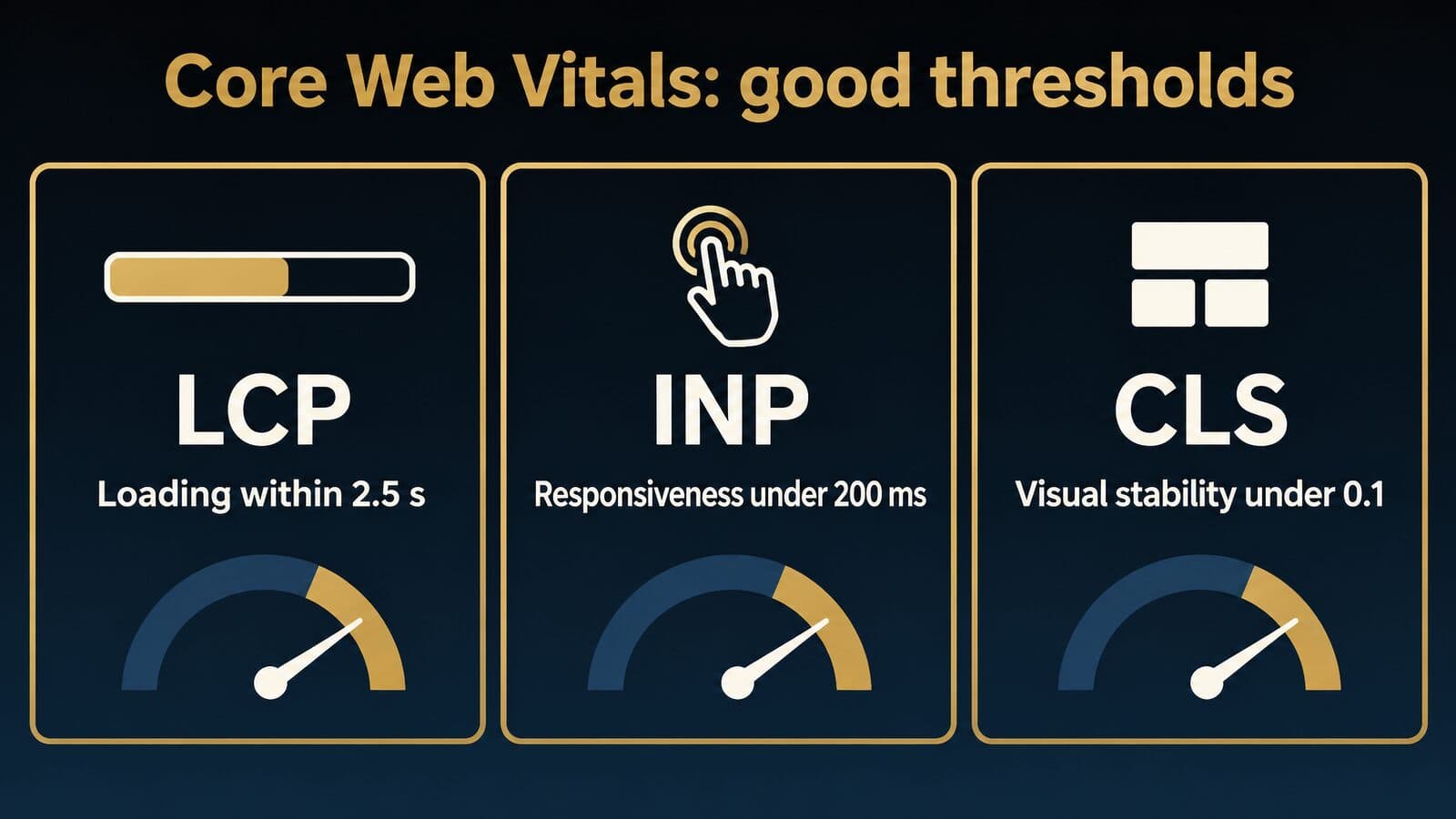
Per Google's Core Web Vitals documentation, a good Largest Contentful Paint happens "within the first 2.5 seconds" of the page starting to load; a good Interaction to Next Paint is "less than 200 milliseconds"; and a good Cumulative Layout Shift is "less than 0.1". INP replaced First Input Delay in March 2024; Google's INP announcement carries a March 12, 2024 update reading "INP is now a Core Web Vital".
Mobile-first means anything missing from your mobile layout is effectively missing from Google's view. Hidden attorney bios, collapsed practice descriptions that never load, and desktop-only content all count. On law firm sites, these are the common suspects worth testing first, not proven causes on any given site:
- Autoplay hero videos that delay the main content.
- Chat widgets and call-tracking scripts loading before the page is usable.
- Third-party review widgets that shift the layout as they appear.
- Large, uncompressed attorney photos.
- Pop-ups that cover the call button on a phone.
Fix one at a time and recheck, so you know which change moved the numbers.
Schema markup for law firms, done right
Much of the schema advice circulating for law firms is out of date. schema.org marks the Attorney type as deprecated: "This type is deprecated - LegalService is more inclusive and less ambiguous." And Google's changelog says FAQ rich results "will no longer appear in Google Search starting May 7, 2026"; the documentation was removed on June 15, 2026, and since September 2023 the feature had already been limited to "well-known, authoritative government and health websites". Popular law firm SEO checklists still recommend both. Here is the current picture:
| Schema type | Use it for | Status, October 2026 |
|---|---|---|
LegalService | The firm and each office | Current; a LocalBusiness subtype |
Organization | Brand-level details and logo | Current |
Person | Each attorney's bio and bylines | Current |
Attorney | Nothing new | Deprecated by schema.org |
FAQPage | Optional, for readers | No Google rich result since May 7, 2026 |
BreadcrumbList | Site hierarchy | Rich result on desktop only |
Article or BlogPosting | Guides and posts | Current |
Review or AggregateRating about your own firm | Avoid | Ineligible for stars |
schema.org defines a LegalService as "a business that provides legally-oriented services, advice and representation, e.g. law firms," sitting under Organization and LocalBusiness. Google's LocalBusiness documentation requires address and name, says to "Use the most specific LocalBusiness sub-type possible", and to list multiple types as an array because "additionalType isn't supported".
The rules that matter most: markup must match the visible text on the page, per Google's AI features guidance, which also says "There's also no special schema.org structured data that you need to add" for AI features. Google's review snippet documentation makes self-serving review stars ineligible on LocalBusiness or Organization pages when the business controls the reviews, including embedded Google Business or Facebook review widgets, and since July 2026 says "Don't include fake or undisclosed incentivized reviews on your page or in your structured data markup." Google's changelog also notes that it uses both schema.org markup and the og:image meta tag when choosing image thumbnails.
A minimal office block, described in words: set @type to LegalService; add name, url and telephone; give address as a PostalAddress matching the Business Profile exactly; add geo coordinates and openingHoursSpecification; list areaServed; and use sameAs to point to the Business Profile, state bar listing and directory profiles. Then reference each attorney through employee or member, pointing to a Person entry with jobTitle, alumniOf and knowsAbout. If an AI tool generates this markup, check every value against the page before publishing.
Platform ownership, redesigns and migrations
Before any redesign or agency change, confirm the firm owns what it depends on:
- The domain registrar account, in the firm's name.
- Hosting and CMS administrator access.
- Search Console and GA4, with the firm as owner rather than only the agency.
- Primary ownership of every Business Profile.
- Call-tracking numbers, and whether they can be ported if you leave.
- Licenses for site content and photos.
In my opinion, proprietary legal-marketing platforms can make leaving expensive, because content, numbers or the site itself may stay behind. Ask before you sign; the hiring section covers contract terms.
For migrations, benchmark rankings, traffic and calls first so you can tell whether anything dropped. Build a URL-by-URL redirect map from every old page to its closest new equivalent, not to the home page. Google's site move guidance says "Keep the redirects for as long as possible, generally at least 1 year", and for users, "consider keeping redirects indefinitely". Since June 17, 2026, Google advises using the Change of Address tool for all subdomain variants, both www and non-www.
Export your analytics history before any platform change. Google's Analytics help records that Universal Analytics stopped processing hits on July 1, 2023, and that from the week of July 1, 2024 there was no access to any UA data; firms that never exported lost it. If you are planning a rebuild, our law firm website design page explains how we approach migrations.
Free tools to check your fixes
You can verify most technical work without paying for software:
- Rich Results Test and Schema Markup Validator: Google's structured data introduction points to the Rich Results Test and Search Console's rich result reports, and schema.org runs the Schema Markup Validator.
- PageSpeed Insights: field and lab speed data for any URL.
- Search Console: URL Inspection and the Core Web Vitals report; Google's Search Console help notes it "keeps data for the last 16 months," so export what you want to keep longer.
- Bing Webmaster Tools: free reports, tools and resources for Bing, including IndexNow submission.
- Microsoft Clarity: a free user behavior analytics tool with session replays and heatmaps. Mask form fields on intake pages so you never record what visitors type about their cases; the privacy section covers why.
- GA4: the replacement for Universal Analytics, for traffic and conversion events.
A technically clean site still has to win the map pack, and the map pack runs on different signals.
Local SEO for law firms and Google Business Profile
Local SEO decides whether a firm shows in the map pack and in local organic results. Google says local ranking is "mainly based on relevance, distance, and popularity" and that "There's no way to request or pay for a better local ranking on Google." For most firms the levers are an accurate Business Profile, real offices, reviews, consistent listings and location-relevant pages.
How Google ranks local results
Google's local ranking help page names three factors. Relevance is how well a profile matches the search. Distance is how far the business is from the searcher or the location in the query. Prominence is "based on info like how many websites link to your business and how many reviews you have," and Google adds that "More reviews and positive ratings can help your business's local ranking."
Google does not publish weights. The most cited outside view is Whitespark's Local Search Ranking Factors 2026, published by Darren Shaw on November 6, 2025: 47 experts scored 187 factors from 0 to 5. Whitespark is candid that "None of the experts have special access to the internal workings of Google's local search algorithm." Read it as informed opinion. Here is how the experts rank the top local pack factors:
| Rank | Local pack factor (Whitespark 2026 expert survey) | Score | Note |
|---|---|---|---|
| 1 | Primary GBP Category | 227 | Pick the one that says what the firm is |
| 2 | Proximity of address to the point of search | 225 | You can't change it; open real offices |
| 3 | Keywords in GBP Business Title | 223 | Against Google's name rules |
| 4 | Physical address in city of search | 213 | Real staffed office |
| 5 | Business open at time of search | 189 | Post accurate hours |
| 6 | High numerical Google ratings | 181 | Earned, not bought |
| 7 | Address showing on GBP (not SAB) | 176 | Service-area profiles hide it |
| 8 | Additional GBP categories | 173 | Few and accurate |
Factor 3 needs a warning. Google's Business Profile guidelines say "Including unnecessary information in your business name isn't permitted, and could result in the suspension of your Business Profile." Whitespark's own survey lists keyword stuffing in the business name as a suspension risk. Adding "Car Accident Lawyer" to a firm name that doesn't contain those words may help for a while and then cost you the profile. Don't do it.
Set up your Business Profile correctly
Google's Business Profile guidelines set the ground rules. Use the firm's real-world name, exactly as it appears on signage and letterhead. Choose a primary category that states what the business is; Google says to "Use as few categories as possible", "Do not use categories solely as keywords", and describe what "This business IS". A personal injury firm should pick the category that describes it, not every category a client might search.
Post accurate hours, including whether intake answers after hours. Point the website link to the matching location page, not the home page; experts surveyed by Whitespark rank keywords in the GBP landing page title tag fourth among local organic factors, behind dedicated pages for each service, geographic relevance and link quality. Write services and the description within ABA Model Rule 7.1, which bars false or misleading communications about a lawyer's services; state versions vary. Upload real photos of the office and attorneys. In my opinion, posts are worth it only if someone will keep them current. Business Profile chat ended July 31, 2024, so offer text or WhatsApp where your account is eligible.
Business Profile rules that trip up law firms
Google's guidelines treat lawyers as individual practitioners and set strict address rules, and these are the rules law firms most need to get right.
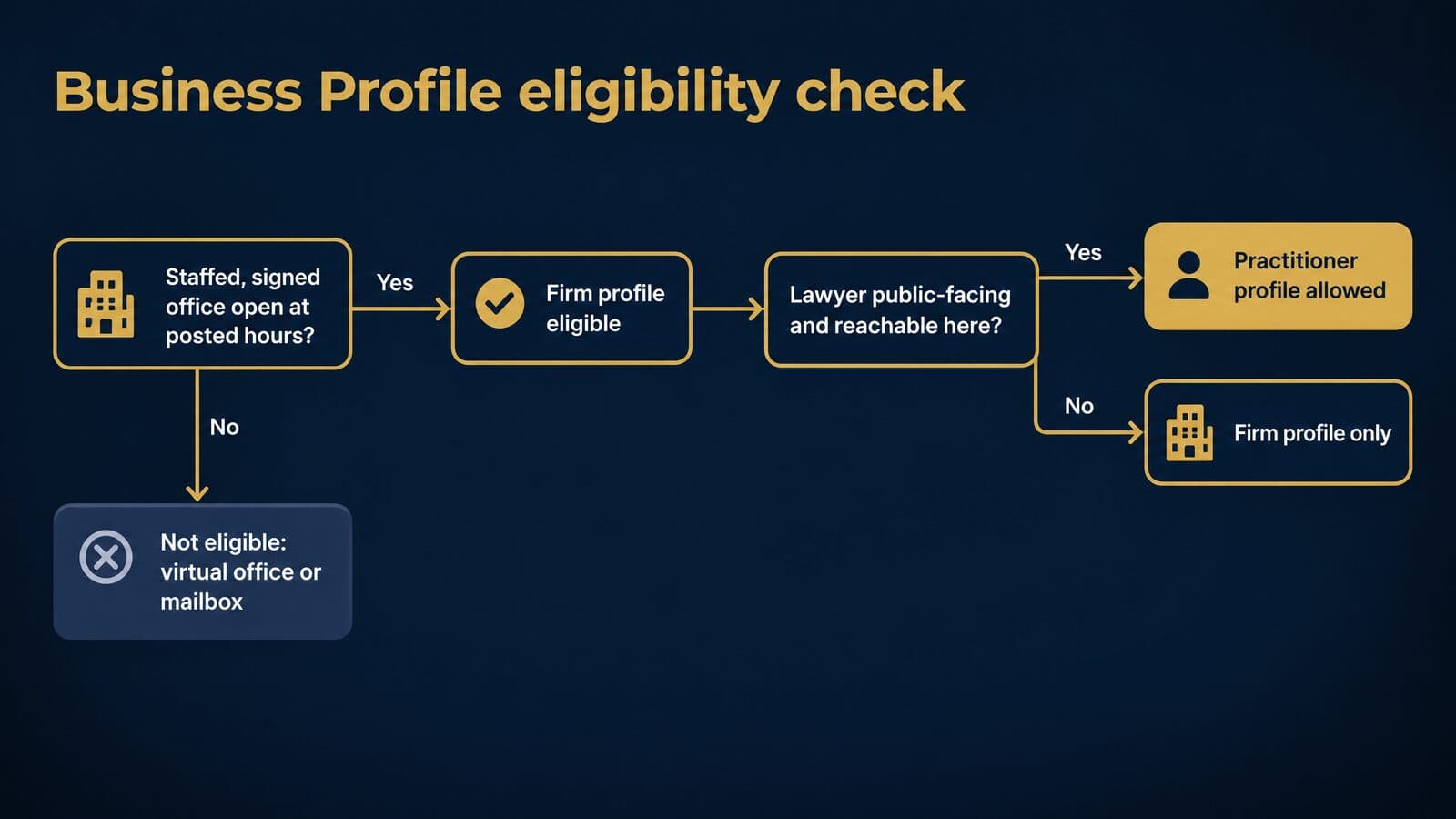
The guidelines say "Doctors, dentists, lawyers, financial planners, and insurance or real estate agents are all individual practitioners." Practitioner profiles "may include title or degree certification (for example Dr., MD, JD, Esq., CFA)." A lawyer qualifies for a practitioner profile if public-facing and if the lawyer "can be contacted directly at the verified location during stated hours." Two limits matter for firms: "A practitioner shouldn't have multiple Business Profiles to cover all of their specializations," and "lead generation agents for corporations aren't individual practitioners and aren't eligible for a Business Profile."
Where several practitioners work at one location, the firm gets its own profile, separate from each practitioner's, and a practitioner's title "should include only the name of the practitioner". A sole practitioner at a branded location shares one profile named "[brand/company]: [practitioner name]".
Address rules are stricter still. A virtual office "isn't eligible for a Business Profile." A coworking office qualifies only if the business "maintains clear signage, receives customers at the location during business hours, and is staffed during business hours by your business staff." "P.O. boxes or mailboxes located at remote locations aren't acceptable," and service-area businesses use "one profile for the central office."
Whitespark's experts agree on the risks. They rank "Address is a PO Box, UPS Mail Store, Virtual Office, or Other False Address" as the top suspension risk, with reports of review gating, reports of fake reviews and keyword stuffing in the business name further down the list. Among negative ranking factors, they put "Business Marked as Permanently Closed" first and "Incorrect Primary Category" second. A firm that rents a virtual suite in a second city to get a map pin is taking the single biggest risk the survey names.
NAP consistency and legal directories
NAP means name, address and phone number. Keep them identical everywhere a firm is listed: the website, the Google Business Profile, Bing Places, Apple Business Connect, the state bar listing, and legal directories such as Avvo, Justia, FindLaw, Martindale-Hubbell and Super Lawyers. "Suite 200" on one listing and "Ste. 200" on another is minor; an old address or a retired phone number is not.
Paying for directory listings is generally permitted. [ABA Model Rule 7.2 Comment [3]](https://www.americanbar.org/groups/professional_responsibility/publications/model_rules_of_professional_conduct/rule_7_2_advertising/comment_on_rule_7_2/) lets lawyers pay for "on-line directory listings… domain-name registrations, sponsorship fees, Internet-based advertisements", and Comment [2] says "Directory listings and group advertisements that list lawyers by practice area, without more, do not constitute impermissible 'recommendations.'" States adopt their own versions, so check yours; this is general information, not legal advice. Whether directory links help rankings is a separate question, covered in the link building section.
If you use call tracking, keep the firm's main number consistent across listings and follow your provider's and Google's current guidance on how tracking numbers should appear.
Reviews: volume, recency and the rules
Reviews matter for two reasons. Google says "More reviews and positive ratings can help your business's local ranking," and experts surveyed by Whitespark rank high numerical ratings (6th), quantity of native Google reviews with text (9th) and recency of reviews (11th) among the top local pack factors. Reviews also sway the person reading them. The harder part is collecting them within four sets of rules. This is general information, not legal advice, and state rules vary.
Google. The Google Maps contribution policy bans "Reviews or ratings that have been paid for, directly or in kind", incentives for posting or removing reviews, merchants who "Discourage or prohibit negative reviews, or selectively solicit positive reviews from customers", and conflict-of-interest reviews, including from "current or former employment". It allows businesses to "Solicit or encourage the posting of content that does represent a genuine experience, without offering incentives".
The FTC. The FTC's Consumer Reviews and Testimonials Rule (16 CFR Part 465), in effect since October 21, 2024, bans fake reviews and testimonials, including AI-generated ones; buying reviews conditioned on sentiment; undisclosed insider reviews; company-controlled review sites presented as independent; and suppressing reviews through threats or false accusations. In December 2025 the FTC warned 10 companies that violations can bring "civil penalties of up to $53,088 per violation"; that figure is inflation-adjusted, so recheck it each January. On review gating, the FTC's staff Q&A says the rule "does not contain a specific prohibition" on asking only satisfied customers, but "this practice could violate the FTC Act". Google's policy prohibits it outright.
Bar rules. ABA Model Rule 7.2(b) says "A lawyer shall not compensate, give or promise anything of value to a person for recommending the lawyer's services," with narrow exceptions such as "nominal gifts". Treat review incentives as off limits. Testimonials are also communications about the lawyer's services under Rule 7.1, so they can't be misleading. Your state's version controls.
Responding. The ABA addressed replies in Formal Opinion 496 (January 13, 2021), "Responding to Online Criticism". According to the ABA Litigation Section's summary of Opinion 496, a negative review is not a proceeding that lets a lawyer reveal confidential information in a reply. Options include asking the host to remove the post, not responding, inviting the poster to talk offline, or, where the poster was never a client, saying so.
A workflow that fits all four sets of rules:
- Ask every client at the same natural point, such as when the case resolves or reaches a set milestone.
- Send one message with a direct link to your Google review form.
- Offer no incentives, and don't screen for happy clients before asking.
- Respond to reviews without revealing anything a client told you in confidence.
- Log every request so you can show the process is the same for everyone.
Local Services Ads beside the map pack
Local Services Ads are ads, not SEO, but they sit above the map pack for many legal searches and reward some of the same work. Google's LSA help lists US legal categories including bankruptcy, business, contract, criminal, disability, DUI, estate, family, immigration, IP, labor, litigation, malpractice, personal injury and traffic "lawyer services", plus "Real estate lawyer".
The model differs from search ads: you "Pay only for leads", which arrive as calls and messages. Responsiveness counts: "If you regularly fail to answer calls or respond to messages, your ad ranking may be affected," and ads still in onboarding sit "below providers who've completed all onboarding requirements". Badges changed in 2025. Google announced Google Verified on August 20, 2025, and in October 2025 it replaced "Google Guaranteed, Google Screened, License Verified by Google and the Money Back Guarantee". Any guide telling you to "get Google Screened" is out of date.
Experts surveyed by Whitespark rank budget and bidding first among LSA factors, followed by reviews, service selection, response times and "Being Verified / Google Guaranteed". In short: answer the phone, collect reviews properly, and pick only services you actually handle. The channel comparison in the next section puts LSAs beside SEO and search ads.
Multi-location and service-area firms
Create one Business Profile for each real, staffed office that meets Google's rules: signage, customers received during business hours, and your own staff on site. Never create a profile per practice area or per lawyer specialization; Google says a practitioner shouldn't have multiple profiles to cover specializations. If the firm serves clients at their homes or in hospitals rather than at an office, a service-area setup uses one profile for the central office.
Each office then gets its own location page with the office's address, hours, attorneys, directions, and the case types handled there. That page must pass the doorway test from the content section: unique, useful information for people in that place, not a template with the city name swapped. Name every office consistently, "[Firm] [City]" or simply "[Firm]", on the profile, the location page and every directory listing.
Prominence also comes from links, and how a firm earns them decides whether they help or hurt.
Link building for law firms without spam risk
Links still matter for law firms. Google's local ranking guidance says prominence draws on information such as how many websites link to your business, and experts surveyed by Whitespark rank link quality and links from industry-relevant domains among the top local organic factors. But Google's link-spam policy and ABA Rule 7.2(b) close most of the shortcuts that firms are still sold.
In the Whitespark survey, "Quality/authority of inbound links" sits at #3 and "Quantity of links from industry-relevant domains" at #5. That is expert opinion, not Google's weights. A handful of links from sources a client would recognize does more than a pile from sites nobody visits.
What Google treats as link spam
Google's spam policies list the link schemes it treats as manipulation. The ones law firms meet most often are:
- "Exchanging money for links, or posts that contain links"
- "Exchanging goods or services for links"
- "Excessive link exchanges"
- "Low-quality directory or bookmark site links"
- "Widely distributed links in the footers or templates of various sites"
- Optimized-anchor links in "articles, guest posts, or press releases distributed on other sites"
Paying for a placement is not banned in itself. Google says paid links are fine "as long as they are qualified with a rel="nofollow" or rel="sponsored" attribute value". Its guide to qualifying outbound links prefers rel="sponsored" for "advertisements or paid placements", says nofollow "is still an acceptable way to flag them", reserves rel="ugc" for user-generated content, and uses rel="nofollow" "when other values don't apply".
Two newer policies matter too. Expired domain abuse covers a domain "purchased and repurposed primarily to manipulate search rankings by hosting content that provides little to no value to users". Site reputation abuse covers third-party content placed on a host "mainly because of that host's already-established ranking signals", and Google names "freelancers, white-label services" as separate entities. Google added both policies, with scaled content abuse, on March 5, 2024. On April 14, 2026 it said it "may use spam report submissions to take manual action", and on May 15, 2026 that spam policies "also apply to generative AI responses in Google Search".
In law-firm form, the risky patterns are private blog networks, paid guest posts with exact-match anchors such as "best car accident lawyer Houston", sitewide footer credits from web designers, and "legal directory" link packages sold by the dozen.
Paying for links and ABA Rule 7.2
ABA Model Rule 7.2(b) bars a lawyer from giving anything of value to a person for recommending the lawyer's services. The exceptions are "the reasonable costs of advertisements or communications permitted by this Rule", legal service plans and qualified referral services, the purchase of a law practice, non-exclusive reciprocal referral agreements with client notice, and "nominal gifts".
The comments to Rule 7.2 draw the line. Comment [2] says a communication is a recommendation when it "endorses or vouches for a lawyer's credentials, abilities, competence, character, or other professional qualities". Comment [3] allows paying for directory listings, sponsorship fees and internet ads, and paying marketing vendors such as "website designers".
Read with Google's rules: paying for an ad, sponsorship or directory listing is generally allowed, but the link should carry rel="sponsored". A paid article that calls your firm the best in town starts to look like a paid recommendation under Comment [2] and is a paid link under Google's policy. Label paid placements and keep them factual.
This is general information, not legal advice. States adopt their own versions of Rule 7.2, so check your state bar's rule and opinions before signing any paid-placement deal.
Link sources that work for law firms
The links worth having come from organizations that would mention a firm anyway: its community, its profession and the press. Seven sources produce most of them:
- Local sponsorships and community events. Youth leagues, charity runs and school programs often list sponsors with a link. Ask for
rel="sponsored"on paid sponsorships so the link stays within Google's rules. - Bar associations, CLE talks and legal organizations. Speaker bios and committee pages link to members.
- Expert commentary for journalists. Reporters covering a crash, a recall or a new law need a lawyer to explain it. Expert-quote platforms change often: according to industry reports, Connectively, HARO's rebrand under Cision, shut down on December 9, 2024, and Cision sold HARO to Featured.com in April 2025. Check what is operating before you pay for any service.
- Original local data. A firm's analysis of public crash reports, court filings or verdict records, with the method shown, gives journalists something to cite.
- Law school, alumni and clinic pages. Alumni profiles and clinic partner pages are natural links.
- Legal publications and guest columns. Write for the readers of a state bar journal or a trade publication, with a byline link at most. A column stuffed with keyword anchors is the pattern the spam policy names.
- Unlinked mentions. When a story mentions the firm without a link, ask for one.
One ethics point applies to every PR and commentary link. ABA Formal Opinion 480 (March 6, 2018) addresses confidentiality in lawyer blogging and public commentary. A quote that helps a reporter must not reveal client information, even when the lawyer thinks the facts are already public.
What directory links are worth
Directories sit on both sides of the line. Google lists "Low-quality directory or bookmark site links" as link spam, so mass-submission services that place a firm on hundreds of thin directories add risk and nothing else.
Reputable legal directories are different. In my view their value is less the link than the consistent name, address and phone citation, referral visits and a profile searchers read before they call. Rule 7.2 Comment [3] allows paying for directory listings, so a paid profile is generally fine under the Model Rules, subject to your state's version.
My priority order, offered as opinion: the state bar's lawyer listing first, then the major legal directories where clients in your practice area look, then local chamber and bar groups. Skip any service that promises a number of directory links. If a paid listing links out, it is a paid placement, and Google's rules on qualifying it still apply.
SEO for AI Overviews, ChatGPT and AI search
Google says optimizing for generative AI search "is optimizing for the search experience, and thus still SEO". The extra work for a law firm is letting the right AI crawlers in, keeping the firm's facts consistent across the web, and measuring citations and AI referrals, because Google says no special file or markup is required.
The same guide treats AEO and GEO as names for this work, not a separate discipline, so the earlier sections of this guide are also the AI-search plan.
AI Overviews, AI Mode and how people use them
Google announced on May 14, 2024 that it was bringing AI Overviews to everyone in the US. Google's own usage figures are large, and they come from Google, so read them as Google's claims: it says AI Overviews has over 2.5 billion monthly active users and AI Mode has surpassed one billion monthly users, and at Google I/O 2026 it said AI Mode queries were "more than doubling every quarter since launch".
AI answers do not appear on every search. Google's documentation says AI Overviews "often don't trigger". Outside Google, OpenAI says ChatGPT web search "is available on ChatGPT Free, Go, Plus, Pro, Business, Enterprise, and Edu", and that people who are not signed in can use it too.
No public dataset shows how often AI answers appear on legal queries specifically. The reliable number for your firm is in your own Search Console generative AI report, which shows how often your pages appear in those features.
How AI tools choose which firms to cite
Google says there are "no additional requirements to appear in AI Overviews or AI Mode, nor other special optimizations necessary". To be a supporting link, "a page must be indexed and eligible to be shown in Google Search with a snippet". Google also says AI Overviews and AI Mode may use a query fan-out technique, running several related searches across subtopics and data sources to build one answer.
My inference: a page that answers a client's follow-up questions (deadlines, fault rules, what happens after the consultation) covers more of those related searches than one that answers only the head term.
Seer Interactive found in November 2025 that when brands were cited in an AI Overview, they got "35% more organic clicks and 91% more paid clicks" than when they were not cited. Seer says it "cannot definitively prove" causation.
What a firm controls:
- Answer-first writing. Short, direct answers under clear headings, written for readers. Google lists "chunking" content for machines among the things you can ignore.
- Expert content. Google asks for "unique, expert-led content that provides value beyond common knowledge". A partner's explanation of how your county's courts handle a claim beats a rewritten national article.
- Consistent facts. The same firm name, address, attorneys and practice list on the site, the Business Profile, bar profiles and directories.
- Genuine corroboration. Reviews, press coverage, bar records and court records that confirm what the site says. Google lists "Seeking inauthentic 'mentions'" among the tactics to ignore.
- No fan-out page farms. Google says content made to manipulate rankings or AI responses through fan-out queries violates the scaled content abuse policy.
For a deeper practice-specific walkthrough, see answer engine optimization for personal injury lawyers.
AI crawlers and controls: what to allow
Each AI system has its own crawler and its own controls, and blocking the wrong one can remove a firm from search features it wants. The table below maps each crawler or setting to what it governs.
| Crawler or control | Operator | What it governs | If you block or exclude it |
|---|---|---|---|
| Googlebot via robots.txt | Crawling for Search, including AI features | Google can't crawl those pages | |
| Search generative AI setting | AI Overviews, AI Mode, Discover AI features | No AI-feature visibility; no ranking effect elsewhere | |
Google-Extended | Gemini training and grounding | No effect on Search | |
OAI-SearchBot | OpenAI | ChatGPT search | Not shown in ChatGPT search answers |
GPTBot | OpenAI | Model training | Content not used for training |
ChatGPT-User | OpenAI | User-initiated visits | robots.txt "may not apply" |
Claude-SearchBot and ClaudeBot | Anthropic | Search quality and training | Honored per subdomain |
PerplexityBot | Perplexity | Perplexity search | Not crawled for Perplexity search |
Perplexity-User | Perplexity | User-initiated fetches | "Generally ignores robots.txt" |
Sources for the rows: Google's AI features documentation says "robots.txt directives for Googlebot is the control" for crawling; the Search generative AI setting offers Include (the default), Exclude or Inherit, removes links and content (including grounding) from AI Overviews, AI Mode and generative AI in Discover when excluded, "isn't used as a ranking or inclusion signal affecting other parts of Search", and "doesn't affect AI training"; Google's crawler documentation says Google-Extended "does not impact a site's inclusion in Google Search nor is it used as a ranking signal"; and the OpenAI, Anthropic and Perplexity bot pages describe their own agents.
My recommendation, as opinion: most firms that want AI visibility should allow the search crawlers (OAI-SearchBot, Claude-SearchBot, PerplexityBot) and treat the training crawlers (GPTBot, ClaudeBot, Google-Extended) as a business decision about whether your content may train models. Blocking GPTBot does not hide you from ChatGPT search, and blocking Google-Extended does not remove you from AI Overviews. To block a training crawler, the robots.txt group is User-agent: GPTBot followed by Disallow: /. OpenAI says robots.txt changes take about 24 hours to take effect, and Perplexity says up to 24 hours.
Two Google details close the loop. Google's AI optimization guide says a site "must be included in Search generative AI features in Search Console to be eligible for display in generative AI features on Google Search", and the nosnippet and noindex rules that limit snippets also limit what Google's AI features can show.
What to ignore: llms.txt, chunking and AI schema
Google's AI optimization guide has a list of things "you can ignore for Google Search". Three matter most for firms: "LLMS.txt files and other 'special' markup", because "Google Search itself doesn't use them"; "'Chunking' content"; and "Rewriting content just for AI systems". The same list includes "Overfocusing on structured data".
The llms.txt proposal is "A proposal to standardise on using an /llms.txt file", published by Jeremy Howard on September 3, 2024. Google said on June 15, 2026 that such files "aren't needed for Google Search (and won't negatively or positively impact your visibility or rankings)". Other services may read the file, so adding one is harmless, but it is not a Google ranking lever. Google also says no special schema is needed for AI features.
Google's "Do you need an SEO?" page adds a buyer's warning: be wary of tools that claim to be "acceptable" or "approved" by Google, and ask whether AEO or GEO advice "is aligned with Google Search's official guidance on optimizing for generative AI features". Google also lists "Optimizing for generative AI" among legitimate SEO services, so the question to ask a vendor is about method, not label.
Measuring AI visibility and AI referrals
Google's Search generative AI performance reports, announced June 3, 2026 and rolled out to all sites worldwide as of August 31, 2026, show impressions, pages, countries, devices and dates for appearances in AI features, in Search and Discover views. The same data still counts in the overall Performance report. Google's changelog notes that AI Mode data counts in Performance totals and that AI Overviews report within the "Web" search type.
Bing Webmaster Tools AI Performance, in public preview since February 10, 2026, shows how often content "is cited in generative answers" across Microsoft Copilot, Bing AI summaries and select partners. Its metrics are Total Citations, Average Cited Pages and Grounding queries, and a "Topics Portfolio (Beta)" view was added on October 13, 2026.
For visits, filter GA4's referral reports by hostnames such as chatgpt.com, perplexity.ai, copilot.microsoft.com and gemini.google.com. Check which hostnames actually appear in your own data rather than assuming the assistants add UTM tags. Then add one question to intake: "Did you use ChatGPT or another AI tool to find us?" If you want this set up and tracked for you, see AI search optimization for law firms.
Tracking law firm SEO: KPIs, attribution and intake
Track SEO the way a firm tracks its docket: signed cases and fees by landing page and query come first, and rankings and traffic are leading indicators. Without call tracking and an intake CRM that records the source, a firm can't tell whether SEO is working.
The KPIs that matter, in order
The list runs from the business result down to leading indicators.
| KPI | What it shows | Where to get it | Review |
|---|---|---|---|
| Signed cases from organic, by practice | Whether SEO produces clients | Intake CRM | Monthly |
| Cost per signed case from SEO | What each organic client costs | Finance plus CRM | Quarterly |
| Qualified calls and forms from organic and Business Profile | Lead volume after screening | Call tracking, CRM | Monthly |
| Non-branded organic clicks | Demand you win from strangers | Search Console | Monthly |
| Share of branded search | Growth in brand demand | Search Console | Quarterly |
| Target keyword positions | Progress on chosen terms | Rank tracker | Monthly |
| Total search visibility | Breadth of rankings | SEO tool estimates | Quarterly |
| Organic click growth rate | Month-over-month trend | Search Console, GA4 | Monthly |
| Business Profile calls, directions, website clicks | Local pack demand | Business Profile performance | Monthly |
| AI citations and AI referrals | Presence in AI answers | Search Console AI report, Bing AI Performance | Monthly |
Search Console lets you "See which queries bring users to your site" and analyze "impressions, clicks, and position on Google Search", which makes it the source for most of the middle rows.
Share of branded search is branded clicks (the firm's name, its attorneys' names, misspellings) divided by all organic clicks. A rising share signals growing brand demand; read it next to the non-branded row.
Read the growth rate against seasonality: compare a month with the same month last year as well as the month before.
Two metrics do not belong on this list. Domain Authority is a Moz metric, not a Google ranking factor, and time on page is not a Google ranking factor or a core KPI. Neither tells you whether a case was signed.
The free measurement stack
Most of the measurement stack is free:
- Google Search Console. Queries, impressions, clicks, position and the URL Inspection tool. Google says it keeps 16 months of data, so export the Performance report monthly if you want longer history.
- Google Analytics 4. Universal Analytics is gone and GA4 replaces it.
- Bing Webmaster Tools. Microsoft says you can "Get access to free reports, tools and resources", including the AI Performance report.
- PageSpeed Insights. Speed data for key templates.
- Microsoft Clarity. Clarity is "a free user behavior analytics tool" with session replays and heatmaps, and the page says "Free forever." Mask form fields on intake pages so replays never record what a prospective client typed.
- Business Profile performance. Calls, direction requests and website clicks from the profile.
Call tracking and an intake CRM are usually paid tools; choose vendors that can pass the landing page and source into the CRM.
Build attribution from query to retainer
The search-to-signed-case chain runs from query to landing page, call or form, an answered and screened inquiry, a consultation, a signed case and finally a fee. Attribution links each signed case back to the query and page that produced it, so SEO can be judged on cases and cost per case.
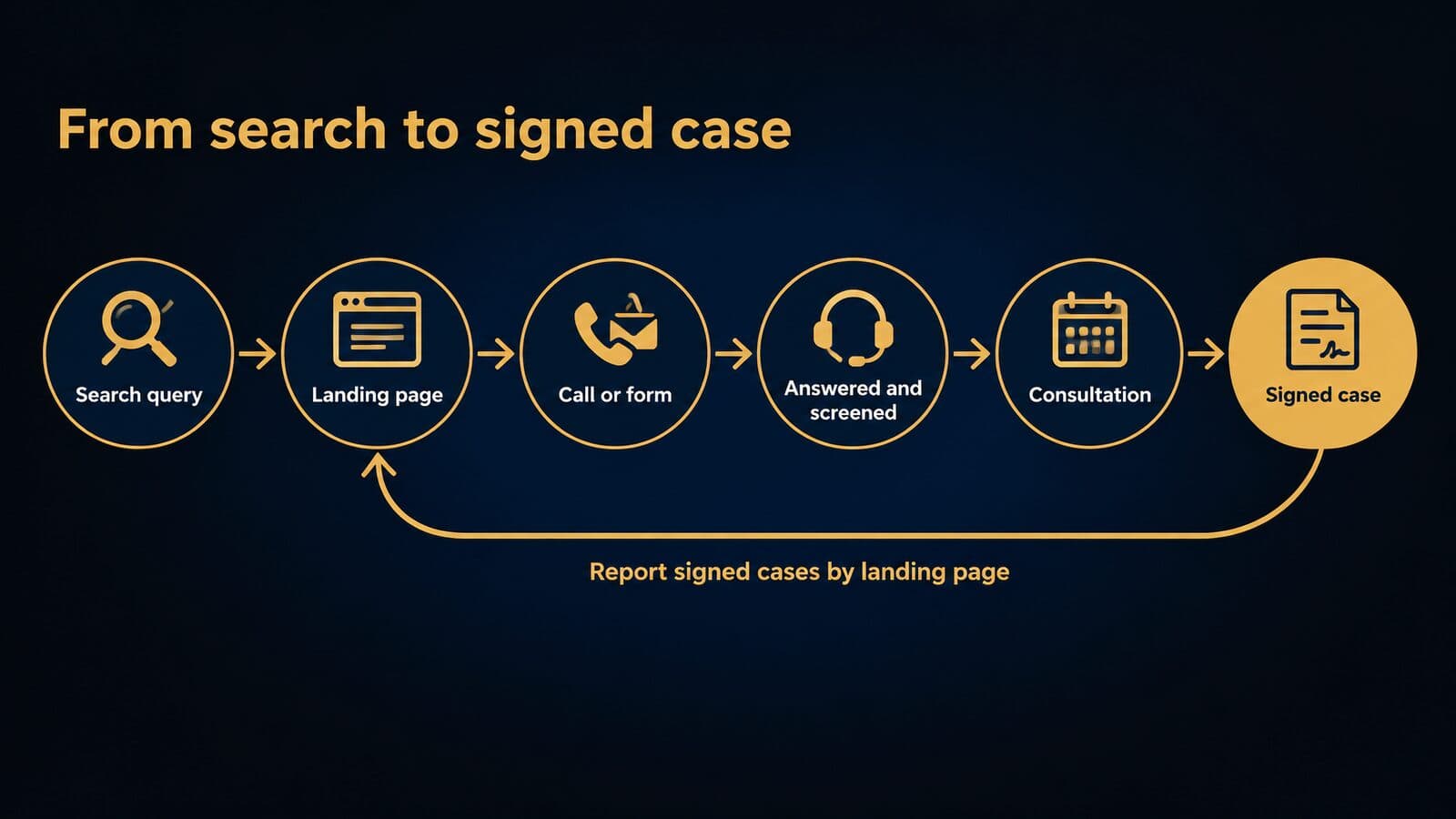
The plumbing takes seven steps:
- Put dynamic call-tracking numbers on the website so each organic visit gets a trackable number, while the main number stays the same in your Business Profile and directory listings, as the local section of this guide explains.
- Add hidden form fields that capture the landing page, the referrer and any UTM values on every form submission.
- Tag the Business Profile website link with UTM parameters, for example
utm_source=google&utm_medium=organic&utm_campaign=gbp, to separate map-pack visits. - Create intake CRM fields for source, landing page, practice area, status, consultation date, signed date and fee.
- Ask "How did you hear about us?" on every call and record the answer as a cross-check on the tracking data.
- Once a month, join CRM outcomes with Search Console landing-page data so each page shows clicks, leads and signed cases side by side.
- Report signed cases and cost per signed case by landing page, then by practice area.
Expect gaps; the goal is a record good enough to compare pages and channels. For why spend alone is a poor predictor, see why ad spend doesn't predict signed retainers.
Intake: where rankings turn into cases
Rankings only pay when someone answers. Organic calls that hit voicemail or an untrained screener sign nothing, so speed and answer rate decide how many organic callers become clients.
Measure intake with the same discipline as SEO:
- Answer rate for calls during and after business hours.
- Time to first response for web forms and chat.
- After-hours coverage, because injury calls do not keep office hours.
- Languages offered, matched to the languages of your pages.
- Qualification criteria written down per practice area.
- Disposition codes for every inquiry: signed, declined, referred out, no answer, duplicate.
Google itself connects responsiveness to visibility in one product. Its Local Services Ads help says LSAs "Pay only for leads" and that unanswered calls and messages can hurt ad ranking. Organic rankings do not work that way, but the lesson for a firm is the same: an unanswered call is a lost case. If intake is the weak link, legal intake services can cover nights, weekends and overflow.
Reporting cadence and red flags in SEO reports
A monthly report should show the KPI table above, the work done that month and the plan for the next. A quarterly review should test results against the one-page strategy from earlier in this guide and decide what to keep, cut or expand.
Red flags in an SEO report:
- Traffic rising while signed cases stay flat for several months.
- Rankings reported only for vanity terms nobody searches or that bring no cases.
- Impressions and clicks from states the firm can't serve.
- No read access to your own Search Console. Google's "Do you need an SEO?" guidance describes giving auditors read-only access, which means the property should be yours.
- Domain Authority as the headline metric.
- A list of links built that the agency won't show you.
- Any request to link to the agency from your site. Google says "You should never have to link to an SEO."
Law firm SEO cost, timeline and ROI vs paid ads
There is no neutral published dataset of law firm SEO prices, and Google gives no SEO timeline beyond saying changes can take "a few hours" to "several months". The honest way to decide is to price the work, set a realistic ramp and run a break-even model on your own fees and cost per signed case.
What law firm SEO costs and how it is priced
Law firm SEO is sold in five common shapes:
- Monthly retainer covering an agreed scope of content, technical work, links and reporting.
- Project fees for an audit, a site build, a migration or a content sprint.
- Hourly consulting for strategy, training or reviewing an in-house team's work.
- In-house salary plus tools when the firm hires its own marketer.
- Hybrids, such as an in-house writer with an agency for technical work and links.
What moves the price:
- Market size and competition in the metros you target.
- Practice area, since PI and mass tort terms draw the heaviest competition.
- Number of offices and location pages.
- Content volume and the attorney-review time each page needs.
- Link and PR work.
- Technical debt from old sites, migrations or plugins.
- Intake and tracking setup, if it doesn't exist yet.
Published agency price ranges conflict with one another, and the price lines that appear in AI Overviews cite no source, so I won't repeat any of them. Tool costs are verifiable: Ahrefs from $29, Semrush from $139 and Moz from $49 a month as of October 2026, per the tools table in the keyword section of this guide. Confirm current pricing with each vendor.
One contract point matters for lawyers. Payment tied to fees or to signed cases raises questions under ABA Model Rule 5.4(a), which says "A lawyer or law firm shall not share legal fees with a nonlawyer", and under Rule 7.2. The compliance section later in this guide covers both. For a channel-wide view of fees, see what a personal injury marketing agency costs.
How long law firm SEO takes
Google's SEO Starter Guide says "Some changes might take effect in a few hours, others could take several months" and advises waiting "a few weeks" to assess. The current "Do you need an SEO?" page, simplified in June 2026, gives no time-to-results figure at all. Google's core updates documentation also says it makes smaller core updates that "are not announced", so gains can show up without a named update.
What follows is my opinion as a practitioner, not a Google figure. Technical fixes and Business Profile corrections can show within weeks. New practice and location pages in moderate markets often take months. Competitive personal injury terms in large metros commonly take a year or more.
What speeds or slows it:
- Starting authority
- Competition from firms already ranking
- Migration history
- Content gaps
- Review velocity
- Intake quality
SEO vs Google Ads, LSAs, ChatGPT ads and bought leads
SEO is one of six ways a firm buys or earns cases, and they differ most in what you keep when you stop paying.
| Channel | How you pay | Speed to first leads | What you keep | Main risk |
|---|---|---|---|---|
| SEO | Retainer, project or in-house | Months | Pages, links, reviews | Slow start, updates |
| Google Search Ads | Per click, $9.87 median for legal | Days | Account data | Leads stop with spend |
| Local Services Ads | Per lead | Short after onboarding | Profile reviews | Unanswered calls lower ranking |
| ChatGPT ads | Set by OpenAI | Days | Little | New channel, changing policies |
| Bought leads or signed cases | Per lead or case | Immediate | Nothing | Rule 7.2 and 5.4 limits, quality |
| Referrals | Relationship time | Varies | Relationships | Hard to scale |
The Google Ads figure is the median CPC for Attorneys & Legal Services in WordStream and LocaliQ's 2026 benchmarks, drawn from 13,474 US campaigns between April 1, 2025 and March 31, 2026; WordStream notes its "'Averages' are technically median figures." For ChatGPT ads, OpenAI's OAI-AdsBot checks landing pages submitted as ads and is not used for training. For bought leads, [Rule 7.2 Comment [5]](https://www.americanbar.org/groups/professional_responsibility/publications/model_rules_of_professional_conduct/rule_7_2_advertising/comment_on_rule_7_2/) allows paying lead generators only if the generator "does not recommend the lawyer" and payment is consistent with Rules 1.5(e) and 5.4.
Google says advertising with Google "won't have any effect on your site's presence in our search results", per its "Do you need an SEO?" page. So paid and organic channels don't help each other's rankings, only each other's data: ad search-term reports show which queries convert, and that tells you which pages to build. In my view the sensible sequence is to run paid search while SEO ramps, then shift budget as organic signed cases rise.
A disclosure belongs here. Mass Tort Marketing Agency sells personal injury and mass tort leads and intake as well as marketing, so weigh this comparison knowing that we earn money from several of these channels. The break-even model below is there so you can check the math with your own numbers. For the paid side in more depth, see personal injury PPC and ChatGPT ads for lawyers.
A break-even model for SEO spend
The break-even model asks how many organic signed cases SEO must produce each month to pay for itself. Six steps:
- Monthly SEO cost (C). Everything: retainer or salary, tools, content, attorney review time and tracking.
- Average fee per signed case (F). From the firm's own books for the practice area.
- Organic signed cases per month after the ramp (S). From the attribution built in the tracking section above.
- Cost per signed case from SEO = C ÷ S.
- Break-even cases per month = C ÷ F.
- Compare cost per signed case across channels, and remember that contingency fees arrive months or years after the spend, so cash flow matters as much as the ratio.
A worked example; every input is hypothetical:
| Input (hypothetical) | Value | How it is calculated |
|---|---|---|
| Monthly SEO cost (C) | $10,000 | Hypothetical all-in cost |
| Average fee per signed case (F) | $12,000 | Hypothetical firm average |
| Organic signed cases per month after ramp (S) | 3 | Hypothetical, from attribution |
| Cost per signed case from SEO | $3,333 | C ÷ S |
| Break-even cases per month | 0.83 | C ÷ F |
| Paid search cost per signed case at the median CPL | $1,316 | $131.63 median CPL ÷ hypothetical 10% lead-to-signed rate |
The last row uses one real input: WordStream and LocaliQ's 2026 median cost per lead of $131.63 for Attorneys & Legal Services. The 10% lead-to-signed rate is hypothetical. None of these figures is a price quote or a benchmark for your firm.
In this hypothetical, paid search looks cheaper per signed case at the median, which is a real possibility for some practices. In my view, the case for SEO rests on what the table doesn't show: cost per case tends to fall as pages keep producing after the build, and the firm keeps the pages, links and reviews when spending stops.
Rerun the model quarterly with real numbers. If organic cost per signed case isn't falling after a reasonable ramp, the tracking above should show whether the problem is strategy, pages or intake. For category-level comparisons, see cost per signed retainer benchmarks.
The same model also answers the next question: whether to do the work in-house or hire someone to do it.
DIY, in-house or agency: choosing SEO help
Google says that if you run a small local business, you "can probably do much of the work yourself". Firms in competitive personal injury markets, multi-office firms and national practices usually need specialist help, and the way a firm vets that help matters more than any agency's pitch.
What a firm can do itself
These tasks are realistic for a lawyer or office manager with a few hours a week:
- Set up and maintain the Google Business Profile: hours, categories, photos, office details.
- Ask every client for a review, the same way, at the same point in the matter.
- Write or dictate practice pages and FAQs from real client questions, then edit them.
- Set up Search Console, Bing Webmaster Tools and GA4, and keep owner access.
- Track intake by source and send a monthly signed-case report to the partners.
- Run the compliance check on every new page before it goes live.
Other tasks usually need specialists: site migrations, schema and technical debt, analytics and call-tracking plumbing, and PR or link earning at scale. Google calls a redesign or new-site launch "a great time to hire" an SEO: "the earlier, the better."
DIY, in-house, agency and hybrid compared
Most firms end up in one of four models, each with its own fit and failure mode.
| Model | Best fit | Strengths | Watch-outs |
|---|---|---|---|
| DIY | Solo or small local firm | Low cost; real legal expertise in the content | Time; technical gaps |
| In-house marketer | Multi-office or high-volume firm | Control; close to intake | Hiring, tools, one point of failure |
| Agency | Competitive PI, national or multi-practice firms | Specialists and scale | Lock-in, conflicts, vague reporting |
| Hybrid | Firm with a marketing lead | Firm owns strategy and content; agency does technical work and links | Needs a clear written task split |
Whichever model you pick, budget for tools. As of October 2026, Ahrefs starts at $29 a month, Semrush at $139 a month and Moz Pro's entry-level plan at $49 a month; confirm current plans with each vendor.
How to vet a law firm SEO agency
Buying lawyer SEO services is a hiring decision: start with the questions Google suggests, then add law-firm ones. Google's page on whether you need an SEO suggests asking: "Can you show me examples of your previous work and share some success stories?", "Do you follow the Google Search Essentials (previously known as Webmaster Guidelines)?", "What kind of results do you expect to see, and in what timeframe? How do you measure your success?" and "What's your experience in my industry?"
Then ask six law-firm questions:
- Which practice areas and markets do you work in, and do you serve competing firms in my market?
- Show me Search Console data, with dates, for a comparable firm, plus a reference I can call.
- How will you report signed cases and cost per signed case, not only traffic and rankings?
- Who writes and who reviews content, and how do you keep it within Rule 7.1 and my state's rules?
- Which links will you build, and will you show me every one?
- What is your plan for AI search, and does it follow Google's guidance? Google lists "Optimizing for generative AI" as an SEO service, and warns that tools claiming to be "acceptable" or "approved" by Google deserve suspicion.
Google says it "doesn't evaluate third-party services", and using a service or tool doesn't guarantee ranking success. Badges such as "top 1% of agencies" can't be verified, so ask for evidence. And the firm stays responsible for its vendors: ABA Model Rule 5.3 requires reasonable efforts to keep a nonlawyer's conduct compatible with the lawyer's obligations, and Google adds: "Ultimately, you are responsible for the actions of any companies you hire."
Mass Tort Marketing Agency is itself an agency, so put every one of these questions to us too. For more depth, see how to choose a personal injury marketing agency, law firm SEO companies compared and the questions to ask an agency before you sign.
Red flags in SEO proposals
Each sign traces to a Google policy or an ownership risk:
- A ranking guarantee. Google says "No one can guarantee a #1 ranking on Google" and that if someone guarantees first place, "find someone else."
- A claimed "special relationship" with Google or a "priority submit" service.
- Tools described as "approved" or "acceptable" to Google.
- A requirement that your site link to the agency. Google: "You should never have to link to an SEO."
- A refusal to list the links they build, or paid links without
rel="sponsored"orrel="nofollow", which Google's spam policies treat as link spam. - City-page packages that swap one template across dozens of towns, which risks doorway abuse and keyword stuffing.
- AI-generated pages at scale; scaled content abuse applies "no matter how it's created."
- A site or tracking setup you can't take with you.
- Reports with no signed-case data.
Contract terms to put in writing
Put these terms in writing before you sign:
- Term, renewal and notice period.
- Who owns the domain, website, content, photos, Business Profile, Search Console and GA4 properties, and call-tracking numbers. The firm should be the owner of every account.
- Deliverables, reporting cadence and the metrics in each report, including signed cases.
- Market exclusivity for your practice areas, if promised.
- Who reviews content for compliance. The firm stays responsible under Rule 5.3.
- Payment that is not a share of legal fees. Rule 5.4(a) says "A lawyer or law firm shall not share legal fees with a nonlawyer."
- What happens on exit: transfer of access, files and redirects. Google advises keeping redirects in place "generally at least 1 year" after a move.
This is general information, not legal advice; check your state's rules and have the contract reviewed.
Attorney advertising rules that apply to SEO
A firm's website, Business Profile, reviews and blog are communications about a lawyer's services, so the ABA Model Rules on advertising (7.1 to 7.3) apply as each state has adopted them, along with Google's and the FTC's review rules. This is general information, not legal advice; your state's version of the rules controls.
A title tag that says "best," a results page with no context and a review request that offers a gift card all touch these rules. For more, see our guide to attorney advertising compliance.
ABA Model Rules 7.1 to 7.3 in plain terms
The ABA's advertising rules are short, and each one maps to specific SEO work. State versions differ, so treat this as orientation.
| Rule | What it says | Where it touches SEO |
|---|---|---|
| 7.1 | No false or misleading communications | Page copy, titles, Business Profile text |
| [7.1 cmt [3]](https://www.americanbar.org/groups/professional_responsibility/publications/model_rules_of_professional_conduct/rule_7_1_communication_concerning_a_lawyer_s_services/comment_on_rule_7_1/) | Past results can mislead; disclaimers may help | Results pages, review excerpts |
| 7.1 cmt [5] | Domains and trade names must not mislead | Domains, firm names |
| 7.2(a) | Any media allowed | Every channel |
| 7.2(b) | Nothing of value for recommending | Review incentives, paid links, vendors |
| 7.2(c) | Specialist certification only if certifier named | Bios, titles, schema |
| 7.2(d) | Name and contact of a responsible lawyer | Every page and landing page |
| [7.2 cmt [5]](https://www.americanbar.org/groups/professional_responsibility/publications/model_rules_of_professional_conduct/rule_7_2_advertising/comment_on_rule_7_2/) | Lead generators allowed with conditions | Bought leads |
| 7.3 | Limits live solicitation of specific people | Outreach to people you identify |
| 5.3 and 5.4 | Supervise vendors; no fee sharing | Your agency's work and pay |
Comment [5] to Rule 7.1 notes that a firm may use "a distinctive website address, social media username or comparable professional designation that is not misleading," and that a trade name with a place name, such as "Springfield Legal Clinic," may need "an express statement explaining that it is not a public legal aid organization." Comment [5] to Rule 7.2 lets lawyers pay lead generators only if the generator doesn't recommend the lawyer and the payment is consistent with Rules 1.5(e) and 5.4.
Rules 7.4 and 7.5 are listed as "(Deleted)" after the ABA's 2018 amendments, so older guides citing them are out of date. The ABA has issued formal opinions that touch marketing: 480 (blogging, 2018), 496 (responding to online criticism, 2021), 501 (solicitation, 2022), 506 (nonlawyer assistants, 2023) and 512 (generative AI, 2024).
Results, testimonials and specialist claims
Case results, reviews and credentials are the three places where SEO copy most often crosses a line. Comment [3] to Rule 7.1 says past results "may be misleading if presented so as to lead a reasonable person to form an unjustified expectation that the same results could be obtained for other clients," and that unsubstantiated comparisons can mislead. It adds that "an appropriate disclaimer or qualifying language may preclude a finding" of unjustified expectations. Present each result with context (case type, year, what the amount represents) and the disclaimer your state requires.
Reviews have two overlapping rule sets. The FTC's Consumer Reviews and Testimonials Rule, in effect since October 21, 2024, bans fake reviews (including AI-generated ones), purchased reviews conditioned on sentiment, undisclosed insider reviews and review suppression. Google's Maps content policy bans incentivized reviews and selectively soliciting positive ones, and treats reviews from employees as a conflict of interest.
For credentials, Comment [9] to Rule 7.2 says "specializes in" and similar wording is "generally permitted," subject to Rule 7.1. Rule 7.2(c) allows a claim of certification as a specialist only if the certifier is approved or ABA-accredited "and the name of the certifying organization is clearly identified." Avoid "expert" or "best" claims you can't substantiate.
State rules and the New York overhaul
State rules control, and they change. New York's amended advertising rules took effect June 1, 2026 and, according to Marjorie E. Gross's NYSBA analysis, "essentially adopt" the ABA's 2018 Rules 7.1 and 7.3. New York dropped the "Attorney Advertising" label requirement, the mandatory "Prior results do not guarantee a similar outcome" statement, Rule 7.3 filing and three-year recordkeeping, and the ban on soliciting in personal injury, wrongful death and mass tort matters within 30 days of the incident. Specialization moved to Rule 7.1(c).
Federal air and rail limits (49 U.S.C. 1136 and 1139) and N.Y. Judiciary Law § 480 still apply, and Rule 7.2 is unchanged (amended rule text).
Many other states keep their own filing, review or disclaimer rules (for example Florida and Texas). Check your bar's current rules before publishing a new page, landing page or ad. This is general information, not legal advice.
Privacy, tracking and consent on firm websites
Intake forms collect sensitive facts, so tracking on those pages deserves care. Microsoft Clarity, for example, records session replays and heatmaps. In my view, firms should limit pixels and session recording on intake pages, mask form fields, and publish a privacy notice that matches what the site collects.
The FCC's one-to-one consent rule was vacated: in Insurance Marketing Coalition Ltd. v. FCC, the Eleventh Circuit "vacated and remanded part III.D" of the FCC order, and the FCC conformed its rules in Order DA 25-621 on July 14, 2025. Do not describe that rule as current. Consent for follow-up calls and texts still matters under the TCPA and state laws, so get advice for your setup.
When AI tools touch client information, the ABA's Formal Opinion 512 points to Model Rules 1.1, 1.6, 1.4 and 1.5. This is general information, not legal advice, and state privacy laws vary.
A 90-day law firm SEO plan and audit checklist
Most firms can sequence the first 90 days as audit and fix, then build the priority pages, then reviews, links and measurement. The schedule is a work plan, not a ranking promise: Google says no one can guarantee a #1 ranking, and its SEO Starter Guide says changes can take anywhere from "a few hours" to "several months" to show, so wait "a few weeks" before judging.
The 90-day plan at a glance
The plan runs in three 30-day phases: protect what you have and set a baseline, build the pages most likely to produce signed cases, then add reviews, links and reporting.
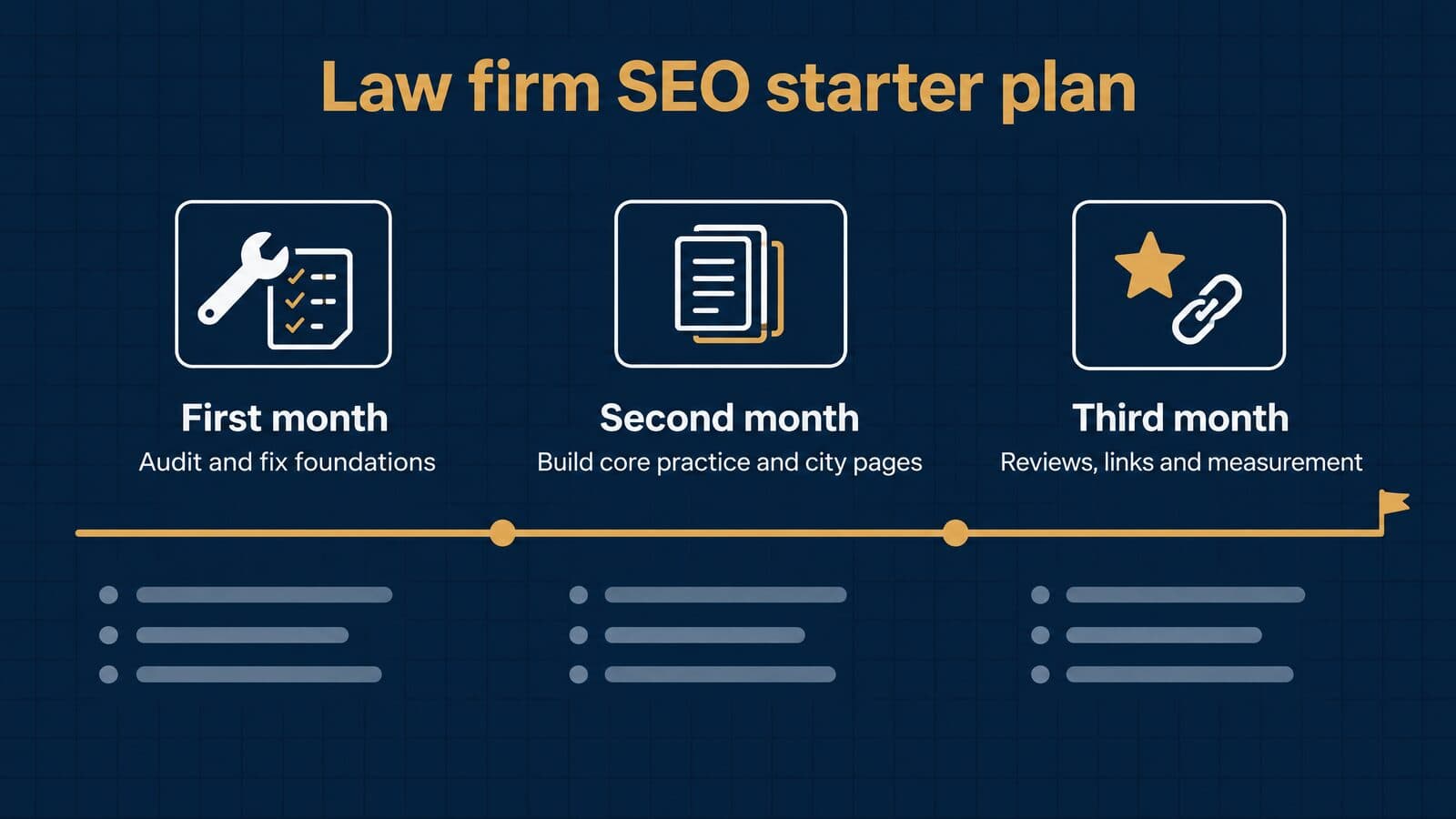
- Days 1 to 30: Collect owner access to the domain, site, Search Console, GA4, Business Profile and call tracking, then record the baseline: clicks, calls and signed cases by source.
- Days 1 to 30: Run the technical audit and fix indexing, redirect and Core Web Vitals problems.
- Days 1 to 30: Correct the Business Profile (name, category, hours, address) and set up attribution from landing page to signed case.
- Days 31 to 60: Fill in the one-page strategy and the priority scorecard.
- Days 31 to 60: Build or rebuild the top three practice or case-type pages and the bios of the attorneys who handle those cases.
- Days 31 to 60: Add
LegalServiceandPersonschema and validate it. - Days 61 to 90: Start the review workflow so every client is asked the same way.
- Days 61 to 90: Launch one or two link projects, such as a local sponsorship, bar activity or a page of original local data.
- Days 61 to 90: Deliver the first signed-case report and set the content refresh calendar.
After day 90, repeat the build cycle on the next scorecard quadrant and review quarterly.
The law firm SEO audit checklist
Run this pass-or-fail checklist at the start of any engagement and each quarter.
- Access: the firm, not a vendor, owns the domain, site, analytics and every profile.
- Indexing: key pages are indexed in Search Console.
- Indexing: the sitemap lists only live, canonical pages; no stray
noindextags. - Speed: Core Web Vitals pass on mobile for the main templates.
- Pages: one page per priority practice area and case type.
- Pages: every city page passes the doorway test.
- On-page: unique titles and H1s on every page; no meta keywords.
- Schema:
LegalServicefor the firm andPersonfor attorneys; noAttorney, which schema.org marks deprecated. - Schema: no self-serving review stars, which Google's review snippet rules make ineligible.
- Local: a real, staffed office address on every profile and no virtual office, per Google's Business Profile guidelines.
- Local: a business name with no added keywords and only the categories that fit.
- Reviews: every client is asked, with no incentives and no gating.
- Links: no paid links without
rel="sponsored". - AI: search crawlers such as
OAI-SearchBotare allowed, per OpenAI's bot documentation. - AI: the Search Console generative AI setting is set as the firm intends.
- Compliance: results carry context and disclaimers, a responsible lawyer is named, specialist claims are checked.
- Measurement: signed cases are tracked by landing page and source.
Core and spam updates since 2024
Google confirmed these updates on its Search Status Dashboard; compare the dates with your Search Console data before reacting to a traffic change.
| Year | Confirmed core updates | Confirmed spam updates |
|---|---|---|
| 2024 | March, August, November, December | March, June, December |
| 2025 | March, June, December | August |
| 2026 (to October 22) | March, May | March, June, August, September |
The helpful content system now runs inside the core ranking systems, and Google also ships smaller core updates that "are not announced". To stay current, follow the Search Status Dashboard and the Search Central documentation changelog.
Common law firm SEO mistakes
Each of these is fixed in an earlier section of this guide:
- Template city pages with the town name swapped (see the pages section).
- Unsourced statistics and invented testimonials (see the content and advertising rules sections).
- Expecting FAQ or
Attorneyschema to win rich results (see technical SEO). - A Business Profile at a virtual office (see local SEO).
- Review gating (see local SEO and the advertising rules).
- Paid links without disclosure (see link building).
- A website the firm can't take with it (see the contract terms above).
- Reporting traffic instead of signed cases (see measurement).
Sources and methodology
Research started with a keyword-gap export comparing this site with rankings.io, dated October 22, 2026. Google US desktop results for four law-firm SEO queries were pulled the same day. The leading pages were read in full: the rankings.io SEO guide and its law firm SEO service page, a sponsored post on dcbar.org, Coalition Technologies' law firm SEO service page and LawPay's SEO guide. Every figure in this guide was then checked on its primary source in late October 2026. Three ABA Model Rule pages (7.2, 7.3 and 5.3) blocked automated access, so they were read from the Internet Archive's captures of the ABA's own pages, with capture dates recorded.
Click studies are reported with method, sample and date, and datasets are never mixed. Google's usage and click-quality statements are attributed to Google. Whitespark rankings are the opinion of surveyed experts, not Google's ranking weights. Prices are as of October 2026; confirm them with the vendor. Hypothetical figures are labelled. Widely repeated statistics with no traceable primary source were left out.
This is general information for US law firms, not legal advice; bar rules vary by state. It was written by Tarun, founder of Mass Tort Marketing Agency.
Primary sources consulted:
- Google Search Central: SEO Starter Guide, spam policies, structured data, AI features, AI optimization guide and the Search Status Dashboard.
- Google help (Search Console, Business Profile) and schema.org (Attorney, LegalService).
- ABA: Model Rules 5.3, 5.4, 7.1, 7.2 and 7.3 and the Formal Opinions index; ABA Profile of the Legal Profession 2025.
- NYSBA commentary on New York's 2026 amendments; FTC Consumer Reviews and Testimonials Rule; FCC Order DA 25-621.
- Studies: Backlinko, Ahrefs (2025 and 2026), Seer Interactive, Pew Research Center.
- Industry data: Whitespark Local Search Ranking Factors 2026, WordStream 2026 Google Ads benchmarks, StatCounter, Clio's 2025 Legal Trends press release.
- Crawler documentation from OpenAI, Anthropic and Perplexity; Bing AI Performance; Ahrefs, Semrush and Moz pricing.