

Quick answer. The best SEO services for attorneys come from an agency whose proof, contract terms and ownership you can check yourself. Each of the five agency-published "best law firm SEO company" lists I checked ranks its own publisher first, so this guide ranks no one. It profiles 19 agencies from their own published pages, dated October 2026, and gives you a scorecard, an RFP, a contract checklist and a cost-per-case model. Start from Google's own rule: no one can guarantee a #1 ranking.
Key takeaways
- All five "best law firm SEO" lists checked on October 22, 2026 rank their own publisher first: Rankings.io, Consultwebs, LawRank, Juris Digital and Grow Law.
- Google says to give an auditing SEO only read access to Search Console and to walk away from anyone who guarantees first place.
- Of 19 agencies checked, only Hennessey Digital ($2,000 to $60,000 a month in three tiers) and WebFX (from $2,900 a month) publish SEO prices, as of October 2026.
- Ownership changes incentives: Hennessey was acquired by PE-backed Herringbone Digital on June 11, 2025, and Rankings.io discloses that its CEO holds an ownership stake in an Arizona personal injury firm.
- Put ownership of the domain, site, content, Business Profile, analytics and call-tracking numbers in the contract before you sign.
- Pay for the work, not per case: ABA Model Rule 5.4(a) bars sharing legal fees with nonlawyers and Rule 7.2(b) bars paying for recommendations; state rules vary.
- Judge SEO on cost per signed case. LocaliQ's 2026 benchmarks put the average legal search-ad lead at $131.63, a useful number to compare against.
If you are reading this, you probably have three to five agency pitches on your desk, and each one links to a "best law firm SEO companies" list where that agency sits at number one. The lists look independent. Most of them are written by the agencies they rank. That leaves a managing partner comparing sales pages that are dressed up as research, with no easy way to tell a good fit from a good pitch.
This guide is written first for owners and marketing leads at personal injury, mass tort and other plaintiff firms, though any firm buying SEO can use it. I run Mass Tort Marketing Agency, which sells personal injury and mass tort lead generation, intake and SEO, so the next section explains why it isn't on this list. The page covers SEO companies only. If you want firms that run paid search, TV, social and SEO together, see our guide to personal injury marketing agencies across every channel.
Every fact about an agency below was checked on that agency's own pages, or on the primary source for a rule or statistic, as of October 2026. The route through the page: how the guide was built, two comparison tables, what SEO includes, the 19 profiles, fit by firm type, ownership and ethics, the scorecard and RFP, contracts and red flags, costs and channel economics, AI search, measurement, switching agencies, and an FAQ.
How this guide was built, and why it isn't ranked
This guide is unranked. It profiles agencies alphabetically within three groups, using only their own published pages captured on October 22, 2026, because each of the five self-published "best" lists I checked puts its publisher at number one, and the ratings tables in those lists carry no dates or sources.
The rest of this section shows the evidence for that decision and the method that replaces a ranking. If you only read one part of the methodology, read the table in the second subsection: it takes about thirty seconds and changes how you read every agency pitch that cites a "top 10" list.
Our conflict of interest, stated up front
Mass Tort Marketing Agency sells personal injury SEO, mass tort SEO, lead generation and intake support to plaintiff firms. That makes us a competitor to several agencies on this page, and it is the reason MTMA has no profile here. A publisher can't judge itself, and a firm comparing SEO companies deserves a list without a thumb on the scale.
The bias that remains is one of viewpoint, and I'd rather name it. This guide leans toward cost-per-signed-case thinking and toward checking intake before blaming SEO, because that is how a plaintiff acquisition agency sees the problem. That is my opinion, and you may weigh it differently.
The controls are simple. Every agency gets the same fact block. Order is alphabetical inside each group. Only published facts appear, each with a capture date. Where a fact wasn't on the agency's pages, the cell says "not found" instead of a guess. No star ratings, scores or awards appear anywhere. If an agency spots an error, it can send a source link, and the entry and its capture date will be updated.
Why most best-of lists rank their own publisher first
Five agencies publish a list of the best law firm SEO companies that ranks well enough to show up when a firm owner searches. The table below records where each agency appears on each of those five lists. Read it row by row, then look at the cells where the row agency and the column publisher are the same.
| Agency | Rankings.io list | Consultwebs list | LawRank list | Juris Digital list | Grow Law list |
|---|---|---|---|---|---|
| Rankings.io | 1 | 2 | 3 | 2 | 3 |
| LawRank | 2 | 11 | 1 | – | 2 |
| Consultwebs | 10 | 1 | – | 4 | 4 |
| Juris Digital | 12 | 9 | – | 1 | – |
| Grow Law | 9 | 15 | 8 | – | 1 |
| Hennessey Digital | 3 | 12 | 5 | 5 | – |
| AttorneySync | 5 | 8 | – | 3 | – |
| BluShark Digital | 4 | 14 | 10 | – | – |
| The Search Engine Guys | 11 | 3 | 4 | – | – |
| iLawyerMarketing | 13 | – | 2 | 6 | – |
| Nifty Marketing | 14 | 16 | 9 | – | – |
| Mockingbird Marketing | 6 | 4 | – | – | – |
| On The Map Marketing | 18 | 17 | – | – | – |
| Stellar SEO | – | 13 | 7 | – | – |
Lists checked October 22, 2026: Rankings.io, Consultwebs, LawRank, Juris Digital, Grow Law. Agencies on only one list are omitted from this table.
The diagonal of 1s is the finding: every publisher is first on its own list. Positions for everyone else move a lot. Consultwebs is 1st on its own list and 10th on Rankings.io's. LawRank is 1st on its own list and 11th on Consultwebs'. Grow Law is 1st on its own list and 15th on Consultwebs'. None of these lists is lying about its author's opinion; each simply ranks from a seat that isn't neutral.
A list that ranks its own author isn't worthless. Grow Law's list, bylined by co-founder Sasha Berson, publishes the seven criteria it weighed and says it shows no star ratings "because there's no reliable way to verify them." Consultwebs states that it works "with a limited number of law firms in each market." Rankings.io's two lists, one updated September 16, 2026 and a generic one dated October 19, 2026, both place Rankings.io first and carry no conflict disclosure on the page.
How to use these lists: as a long list of names your peers will recognize, never as a ranking. Check every fact on the agency's own site. My opinion on why the pattern exists is plain commercial logic: a "best X" page reaches buyers at the moment they are choosing, so any agency that can rank one will put itself on top.
What the ratings tables do and don't tell you
Several of these lists add a ratings table that looks like independent proof. Rankings.io's law firm list, for example, shows Google, Clutch, Trustpilot and Inc. 5000 columns for each agency, with no links to the source profiles and no capture dates.
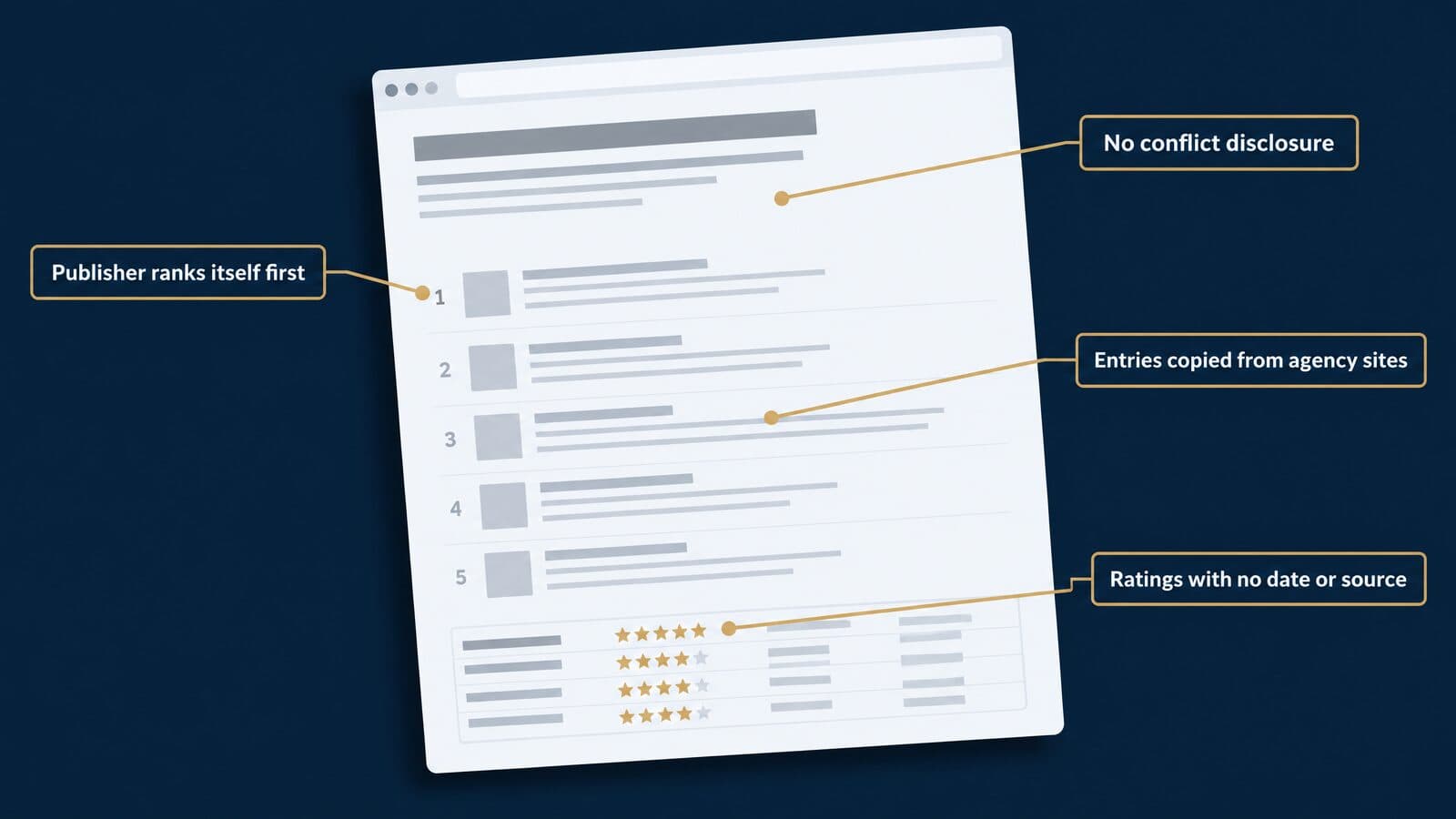
The numbers don't hold still even on one site. Rankings.io's table lists its own Clutch rating as 4.9 from 108 reviews, the body text of the same page says "4.8-star," and its about page says "A 4.9 average across 95+ client reviews." Ratings change daily, so an undated number tells you little.
The platforms behind the columns measure different things. Clutch's methodology page says companies "can pay a fee for higher placement in specific directories," that sponsorship affects "default directory sort position only, not Clutch Rank," and that its audience is B2B buyers with engagements "typically $10K–$500K+." The Inc. 5000 ranks the agency's own "percentage revenue growth from 2022 to 2025," as reproduced in a 2026 honoree announcement. Revenue growth says nothing about client outcomes.
So this page shows no ratings at all. The directories section later explains how to use those platforms well. For the wider problem of numbers that conflict across sources, see why law firm marketing benchmarks disagree.
The eight things we checked for every agency
Each agency was checked against the same eight fields, using only what it publishes:
- Legal focus, as the agency states it, because a firm that sells to every industry staffs and prices differently.
- Founding year and base, because tenure and location tell you which markets the team knows.
- Named founder or leader, and any published ownership disclosure, because owners set incentives.
- Published SEO pricing, because a published number lets you budget before the first call.
- Published contract terms, because the exit clause matters more than the onboarding deck.
- Published asset-ownership terms, because your domain, content and profiles must survive a breakup.
- Market limits or conflict commitments, because your agency may also serve the firm across the street.
- The proof the agency publishes, and whether it is self-reported, because unaudited results are marketing.
What this guide did not do matters as much. There were no client interviews, no test campaigns, no paid inclusion, no star ratings and no "best for" awards. Nothing here claims first-hand results with any agency. Those limits keep the page checkable: every claim points to a page you can open yourself.
These eight fields become the fact block in each agency profile, and they feed the scorecard later in the guide, so you can score your own shortlist the same way.
Law firm SEO companies compared at a glance
Across 19 agencies checked on October 22, 2026, only Hennessey Digital and WebFX publish SEO prices. Only AttorneySync, Hennessey Digital and Coalition Technologies publish contract-length terms, only AttorneySync publishes an asset-ownership promise, and only Consultwebs publishes a per-market client limit.
The two tables below put those findings side by side. The first covers who each agency is; the second covers what it publicly commits to. Most cells in the second table say "not found," and that pattern is the most useful thing on this page for a buyer, as the third subsection explains.
Published facts: founding, base, focus and ownership
The first table lists each agency's founding year, base, stated legal focus, named leader and any ownership note, exactly as each agency publishes them.
| Agency | Founded | Base | Legal focus (as published) | Founder or leader named | Ownership note |
|---|---|---|---|---|---|
| AttorneySync | 2008 | Not found | Law firms only | Gyi Tsakalakis, Jeff Berman | Not stated |
| BluShark Digital | Not found | Washington, DC | Lawyers; founder is an attorney | Seth Price | Not stated |
| Consultwebs | 1999 | Raleigh, NC | Legal digital marketing | Dale Tincher | Not stated |
| Empirical360 | 2019 | Not found | Family law | Elliot Alicea | Not stated |
| Esquire Digital | Not found | Not found | Attorneys and legal organizations only | Brad Wetherall (COO) | Not stated |
| Grow Law | 2008 | Not found | Law firms only | Sasha Berson (co-founder) | Not stated |
| Hennessey Digital | 2015 | North Hollywood, CA; remote team | Legal SEO | Jason Hennessey | Acquired by Herringbone Digital, June 11, 2025 |
| iLawyerMarketing | 2005 | California | Law firm digital marketing | Not found | Not stated |
| Juris Digital | Not found | Not found | Law firm SEO | Casey Meraz | Legal name: Ethical SEO Consulting LLC |
| LawRank | Not on about page | Not found | Law firm SEO | Mariano Rodriguez (co-founder) | Not stated |
| Mockingbird Marketing | 2013 | Not found | Legal industry only | Conrad Saam | Not stated |
| On The Map Marketing | Not found | Miami, FL | Not stated on about page | Not found | Not stated |
| Rankings.io | 2013 | Marion, IL | PI-only from 2018, now expanding | Chris Dreyer | Published disclosure: CEO's Arizona ABS stake |
| The Search Engine Guys | 2008 | Austin, TX | Legal (15+ years, per site) | Joe Devine (co-founder) | Not stated |
| WEBRIS | Not found (10+ years, per site) | Not found | Law firms | Ryan Stewart (Managing Partner) | Not stated |
| Scorpion | Not found (two decades, per site) | Not found | Local businesses, many industries | Rustin Kretz | Acquirer: bought Coalmarch Marketing, Oct 19, 2026 |
| WebFX | 1996 | Not found | Many industries | Not found | Not stated |
| Coalition Technologies | Not found | Not found | Many industries; has a lawyer SEO page | Not found | Not stated |
| CAMG | Not found | Not found | Mass tort, PI and sex abuse campaigns | Not found | Not stated |
Sources: each agency's own about, home or pricing page, captured October 22, 2026; links are in each profile below. The first 15 rows are legal-focused agencies, and the last 4 sell to many industries or run multi-channel legal campaigns.
A few patterns stand out. Founding dates run from 1996 (WebFX) and 1999 (Consultwebs) to 2019 (Empirical360), so "years in business" varies more than the lists suggest. Specialization varies too: Empirical360 states a family law focus, Rankings.io states a personal injury history, and CAMG describes mass tort, PI and sex abuse campaigns. A PI firm and a family law firm should not read the same row the same way.
Ownership is the thinnest column. Only two agencies publish anything about who owns them or what their leaders own: Hennessey Digital's acquisition and Rankings.io's disclosure of its CEO's stake in an Arizona law firm. "Not stated" means the agency's pages say nothing either way, so ownership is a question for every other agency on the list.
Published terms: pricing, contracts and asset ownership
The second table records what each agency publicly commits to on price, contract length, ownership of your assets and conflicts with other clients.
| Agency | Published SEO pricing | Contract terms | Asset ownership terms | Market limits or conflict terms |
|---|---|---|---|---|
| AttorneySync | Not found | Month-to-month | Domain, accounts, content and data stay the firm's | Not found |
| BluShark Digital | Not found | Not found | Not found | Not found |
| Consultwebs | Not found | Not found | Not found | Limits firms per market |
| Empirical360 | Not found | Not found | Not found | Not found |
| Esquire Digital | Not found | Not found | Not found | Not found |
| Grow Law | Not found | Not found | Advises written ownership (on its list) | Not found |
| Hennessey Digital | Three tiers, $2,000 to $60,000 a month | No long-term contracts | Not found | Not found |
| iLawyerMarketing | Not found | Not found | Not found | Not found |
| Juris Digital | Not found | Not found | Not found | Not found |
| LawRank | Not found | Not found | Not found | Not found |
| Mockingbird Marketing | Not found | Not found | Not found | Not found |
| On The Map Marketing | Not found | Not found | Not found | Not found |
| Rankings.io | Custom, "premium pricing tier" | Not found | Not found | Law Bear stays out of client markets (disclosure) |
| The Search Engine Guys | "Custom quotes available" | Not found | Not found | Not found |
| WEBRIS | Not found | Not found | Not found | Not found |
| Scorpion | Not found | Not found | Not found | Not found |
| WebFX | From $2,900 a month | Not found | Not found | Not found |
| Coalition Technologies | Not found (offers a free SEO plan) | "No commitments or lengthy contracts" | Not found | Not found |
| CAMG | Not found | Not found | Not found | Not found |
Prices as of October 2026; confirm with the agency. Sources: each agency's own about, home or pricing page, captured October 22, 2026; links are in each profile below.
The two published price points sit in different worlds. Hennessey's three monthly tiers, $2,000 to $6,000, $6,000 to $12,000 and $12,000 to $60,000, are scoped by practice area and market, and the same page says "We operate without long-term contracts." WebFX's "SEO Services Starting at $2,900/month" is the entry price for its general SEO service across industries. Neither number is a "typical" law firm price, and no verified public figure for one exists.
Hennessey's page also shows how a single site can carry two ranges: its SEO-versus-PPC table lists SEO at "$2,500-$10,000+ depending on the scope," which differs from its own tier table. That is why this page records prices as published, with the page and date, and doesn't average them. The cost section later in the guide covers pricing models, what drives a quote up or down, and how to compare a retainer with cost per signed case.
How to read the "not found" cells
"Not found" means the item wasn't located on the pages listed in each profile's sources on October 22, 2026. It does not mean the agency lacks the policy or refuses to share it. Many agencies give pricing, contract terms and ownership language on request, during a sales call or in the proposal itself.
There are fair reasons an agency quotes custom prices. In my opinion, the main ones are that scope changes a lot by market, practice area and the condition of the firm's site: a solo family law practice in a small city and a multi-state PI firm in Los Angeles are different jobs. Grow Law's own list gives the useful counter-move: request "an itemized proposal" and get ownership "in writing for your website, content, data, and Google Business Profile."
Use the blanks as a to-do list. Turn every "not found" cell into a written question in your RFP, then into a contract clause. The RFP template and clause checklist later in this guide follow the same column order as the table, so you can copy the gaps across directly.
A blank cell is not a negative signal by itself. My view is that a refusal to answer in writing is. Recheck these tables before relying on them: agencies update their pages, and this guide is reviewed quarterly.
What SEO services for attorneys include
SEO services for attorneys are the paid work of getting a law firm's website and Google Business Profile found and chosen in unpaid search results for the cases the firm wants. Google's own list of what SEOs provide covers site and content review, technical advice, content, keyword research, training, local and market expertise, and optimizing for generative AI.
That definition matters when proposals arrive, because agencies bundle these services under different names and prices. The subsections below break the bundle into line items, set out what Google itself says an SEO can and can't promise, and explain where SEO earns its keep for a plaintiff firm and where it can't help in time.
The service menu, line by line
Google's list is the neutral baseline: review of site content or structure, technical advice such as hosting, redirects, error pages and JavaScript, content development, management of online business development campaigns, keyword research, SEO training, expertise in specific markets and geographies, and optimizing for generative AI. Here is how that list translates into a law firm proposal.
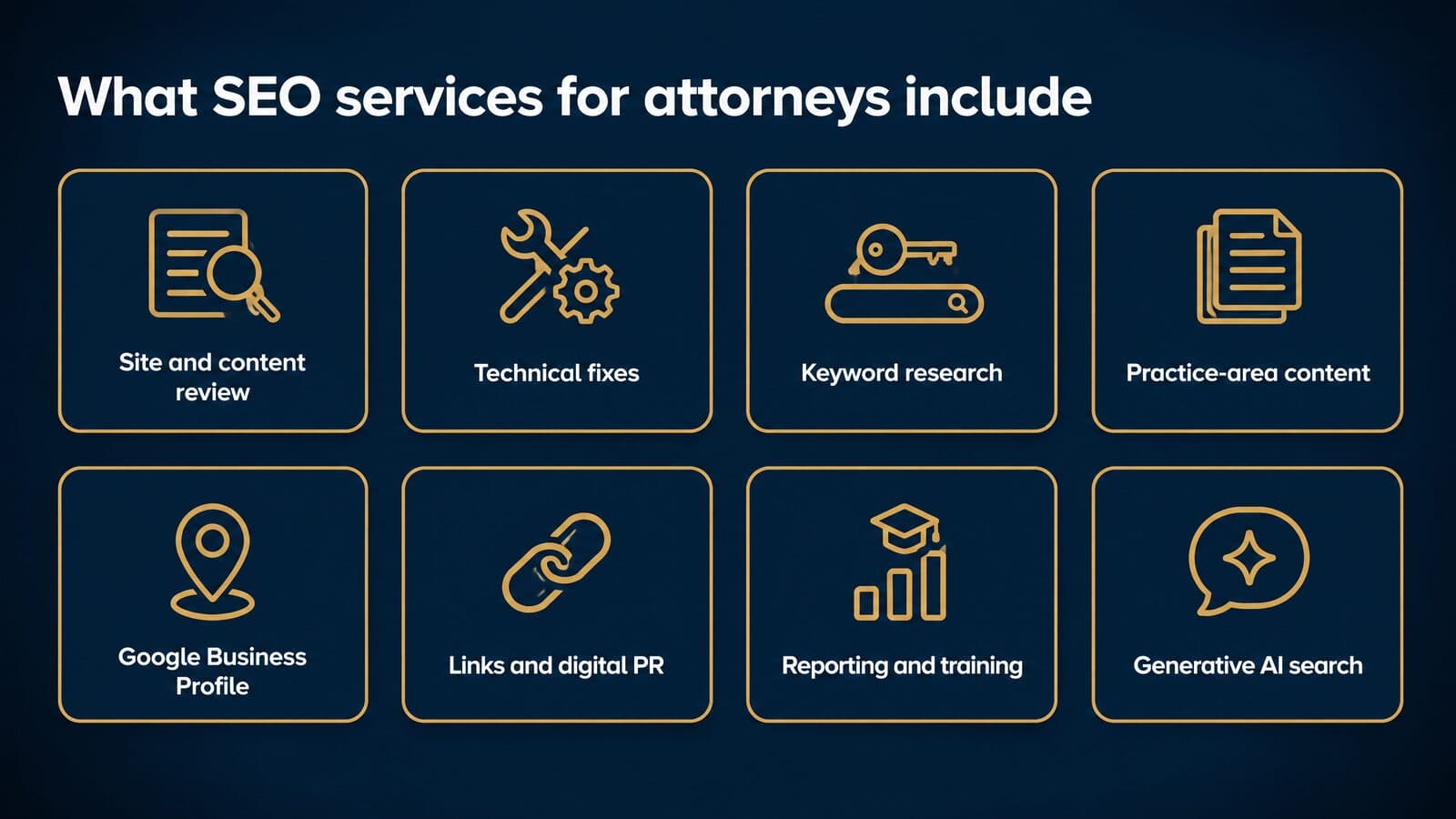
| Service | What it covers for a law firm | What to ask the agency |
|---|---|---|
| Site and content review | Practice-area and location pages, thin or duplicate pages | Can I see a written audit with priorities? |
| Technical fixes | Hosting, redirects, error pages, JavaScript | Who implements fixes, and on which platform? |
| Keyword research | Case types, locations, Spanish terms | How do you separate case-intent searches from research searches? |
| Practice-area content | Pages, FAQs, attorney-reviewed articles | Who writes, and which lawyer reviews? |
| Google Business Profile | Categories, practitioner profiles, reviews | Who owns the profile login? |
| Links and digital PR | Earned mentions, local sponsorships, legal publications | Will you list every link you build? |
| Reporting and training | Dashboards, calls, signed cases | What does the monthly report contain? |
| Generative AI search | Visibility in AI Overviews and AI Mode | What do you change beyond normal SEO? |
Not every firm needs all eight at once. A firm with a sound site may need content and local work more than technical fixes, while a firm on an old platform may need the reverse. The AI search line is covered in its own section later. The mechanics of each service are covered in how law firm SEO works, step by step; this page stays on choosing who does them.
What Google says an SEO can and can't do
Google publishes a short page on hiring an SEO, and it was last updated on June 5, 2026 with guidance on evaluating an SEO's recommendations and tools. Its core points are blunt.
Paying Google doesn't help rankings: "Advertising with Google won't have any effect on your site's presence in our search results. Google never accepts money to include or rank sites." At the audit stage, Google says to "only grant read access to Search Console (at this stage, don't grant them write access)," and adds: "If they guarantee you that their changes will give you first place in search results, find someone else." Elsewhere on the page: "No one can guarantee a #1 ranking on Google." It even notes that "If you run a small local business, you can probably do much of the work yourself."
Responsibility stays with the firm. Google says "you are responsible for the actions of any companies you hire," and that if an SEO creates deceptive content, "your site could be removed entirely from Google's index." Google's guidance on third-party SEO advice adds that "Third-party tools don't have access to our internal ranking data. They can't guarantee performance," and that good advice "either qualifies their claims as opinion based on data or experience, or backs up their claims by citing official Google Search guidance."
The practical point: Google's hiring page is short and free, and it is the best baseline a firm can hold an agency to. Print it, and ask each finalist which of its claims are opinion and which cite Google.
How legal SEO differs from SEO for other businesses
Legal SEO works on the same ranking systems as any other site, but the stakes and rules around it differ. Google's Search Quality Rater Guidelines, dated September 11, 2025, define "Your Money or Your Life" topics by the harm they could do to people's "health, financial stability, or safety." Legal topics can fall under that definition when they affect someone's money or safety, but the guidelines don't name "legal" as a category of its own. The same document says "Trust is the most important member of the E-E-A-T family."
Keep the guidelines in proportion. Google says they "are not a guide to ranking first in Google" and that raters' "ratings don't directly influence ranking," per its guidance on generative AI content. An agency that sells "YMYL compliance" as a ranking lever is overstating them.
Two more differences are specific to lawyers. A law firm's website is a lawyer communication, so state advertising rules apply to it; the ethics section later covers the rules. And Google treats lawyers as individual practitioners with their own Business Profile rules, covered in the local SEO discussion.
Then there is cost. LocaliQ's 2026 data puts the average cost per click for attorneys and legal services at $9.87, against $5.42 across all industries. In my opinion, that gap is the main reason organic visibility is worth more to a law firm than to most businesses: every click you earn organically is one you didn't buy at legal prices.
How people look for a lawyer
The best verified public data on how consumers find lawyers is from 2019, and it shows search and referrals working side by side. The Clio 2019 Legal Trends Report surveyed 2,000 consumers: 59% sought a referral, 57% searched on their own, and 16% did both. Among self-directed methods, an online search engine and a lawyer's website tied at 17% as the top choices. Asked what they did first, 39% searched on their own and 45% first sought a referral.
Those numbers are seven years old, and search has changed since. I use them because nothing newer and equally well documented is public, not because they describe 2026 behavior exactly.
You may have seen bigger figures on agency pages, such as "90%+ of legal consumers use search engines" or "one in three people turn to the internet" when starting a lawyer search. This page doesn't repeat them. On Rankings.io's list, the first is sourced to a LinkedIn Pulse post with no study, sample or date, and the second to a Clio blog page that returned an error when checked and that conflicts with Clio's own 2019 report figures above.
Competition is the other half of the picture. The U.S. had 1,374,720 lawyers in 2025, up from 1,355,963 in 2024, per the ABA's 2025 Profile, as reported by the State Bar of Arizona's 2Civility. Many of them want the same searches you do.
What SEO does well for a plaintiff firm
SEO earns its place for a plaintiff firm in five ways, each of which compounds over time rather than stopping when a budget pauses.
Visibility. Organic results and the local pack are where people land when they search a case type plus a city, such as "truck accident lawyer" with a town name. Ranking for those terms puts the firm in front of people at the moment they are choosing, without paying per click.
Site experience. Speed and stability affect whether a visitor stays long enough to call. Google's Core Web Vitals set "good" at the 75th percentile of page loads: Largest Contentful Paint within 2.5 seconds, Interaction to Next Paint of 200 milliseconds or less, and Cumulative Layout Shift of 0.1 or less. SEO work that hits those thresholds helps paid traffic too.
Trust. Attorney bios with real credentials, genuine client reviews and sourced practice-area content give a nervous injured person reasons to call. Google's rater guidelines put Trust at the center of E-E-A-T, and the same signals help a prospect decide between two firms on the same results page.
Cost over time. A well-built practice-area page is an owned asset that keeps bringing in searches after spend pauses, unlike clicks that stop the day the budget does. Whether that beats paid channels on cost per signed case depends on your market; the cost section works through the numbers.
Competition. A firm that doesn't rank for its own practice areas cedes those searches to whoever does. In a market where competitors invest in SEO, standing still is a decision to lose share of the people who search before they ask for a referral.
What SEO can't do on a deadline
SEO is slow and uncertain on any fixed timeline. Google used to say results typically take "four months to a year," but that sentence appears only in the March 2025 archived version of its hiring page and is gone from the current one. Google now says core updates happen "Several times a year" and that "there's no guarantee that changes you make to your website will result in noticeable impact," per its core updates documentation.
Agencies fill the gap with their own estimates. Hennessey's law firm SEO page, for example, claims SEO takes 3 to 12 months to show results. Treat any such range as the agency's claim, not Google's.
So SEO can't rescue a quarter with a case-volume gap, a new office opening next month or a mass tort with a short claim window. Those situations call for paid search, Local Services Ads or signed-case acquisition, which the channel economics section compares. SEO belongs in the plan as the long-term base, with faster channels covering the gap while it builds.
With the scope clear, the next sections profile the agencies one by one, using the same eight fields.
Legal SEO agency profiles: AttorneySync to iLawyerMarketing
These are the first eight of the 15 legal-focused agencies in this guide, in alphabetical order. Each profile is built only from the agency's own published pages as captured on October 22, 2026, and a profile's position in this list says nothing about its quality.
How each profile is built
Every profile in this part uses the same template, so you can compare agencies field by field instead of reading 19 different sales pitches. Each one starts with a single neutral sentence drawn from how the agency describes itself, then a seven-item fact block, then a short paragraph of fit notes and questions.
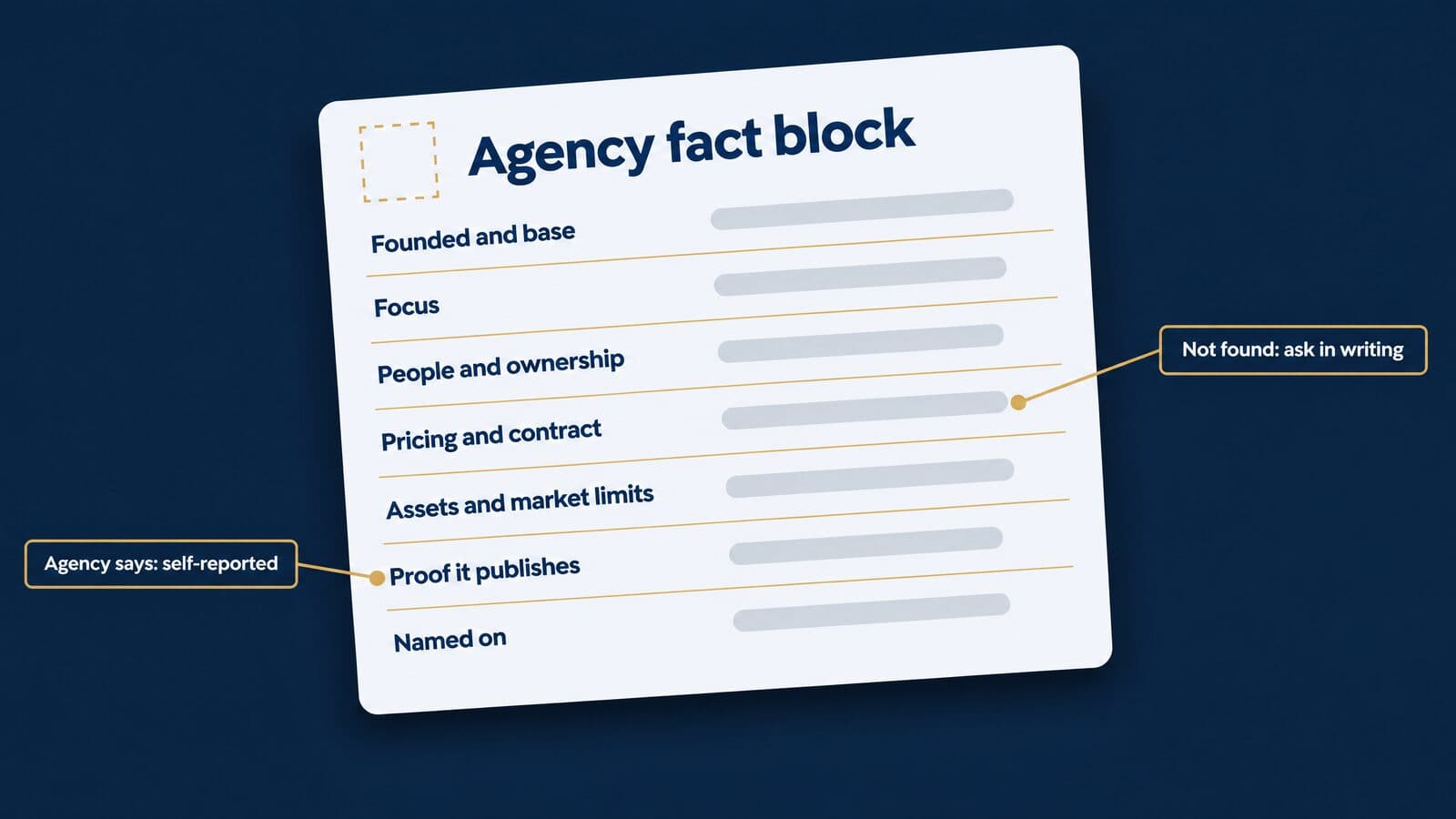
The seven fields work like this. Founded and base gives the founding year and city the agency publishes. Focus records the practice areas or industries it says it serves. People and ownership names founders and any ownership change the agency or its acquirer has announced. Pricing and contract reports published prices and contract terms. Assets and market limits covers who owns the website, content and accounts, and whether the agency limits how many firms it takes per market. Proof it publishes lists the claims the agency makes about itself. Named on shows where the agency appears on the five self-published "best" lists compared in Part 1, as captured October 22, 2026.
Two phrases carry weight. "The agency says" marks a self-reported claim that no one has audited. "Not found" means we did not find the fact on the pages linked in the profile on October 22, 2026; it does not mean the agency refuses to share it. "Named on" is included to show which peers list an agency, not to suggest merit, because every one of those lists ranks its own publisher first.
The Fit and questions paragraph is my opinion, grounded in the agency's stated focus, followed by two questions aimed at its "Not found" fields. Order is alphabetical inside three groups (legal-focused A to I, legal-focused J to W, then multi-industry), so Rankings.io, the publisher of the lists this page competes with, appears 13th by alphabet.
AttorneySync
AttorneySync describes itself as a digital marketing agency that works only with law firms.
- Founded and base: Co-founded in 2008 by Gyi Tsakalakis and Jeff Berman, according to its about page. City not found on that page.
- Focus: Law firms only, per the agency.
- People and ownership: Gyi Tsakalakis is a non-practicing attorney, the agency says. No ownership change found.
- Pricing and contract: No price published. The agency states "Month-to-month, no long-term contracts."
- Assets and market limits: The agency states: "Your domain, accounts, content, and data are yours. Always." Market limits not found.
- Proof it publishes: Not found beyond the founding story and its stated terms.
- Named on: Rankings.io #5, Consultwebs #8, Juris Digital #3.
Fit and questions. AttorneySync is the only agency in this guide whose own pages publish both month-to-month terms and an explicit asset-ownership promise. In my view, that makes it a natural shortlist candidate for firms that want written exit and ownership terms from the first day, especially firms that have been burned by a vendor that kept the domain or the analytics account. Two questions to send in writing: what does a typical engagement cost per month for your practice area and market, and who does the work, meaning which tasks are done by AttorneySync staff and which, if any, go to contractors or partners.
BluShark Digital
BluShark Digital presents itself as a legal marketing agency founded by a practicing attorney.
- Founded and base: Washington, DC, per its about page. Founding year not found on that page.
- Focus: Law firms, with local SEO prominent in its materials.
- People and ownership: Founded by Seth Price, whom the agency calls "an accomplished attorney." The agency says he "scaled a 2-person law firm to 50 lawyers in less than a decade." No ownership change found.
- Pricing and contract: Not found.
- Assets and market limits: Not found.
- Proof it publishes: The founder's firm-growth story above (the agency says; not independently checked) and a free book, "Local SEO for Lawyers - AI Edition."
- Named on: Rankings.io #4, Consultwebs #14, LawRank #10.
Fit and questions. Based on its stated focus and the book it gives away, BluShark is a natural candidate for firms whose growth plan leans on local search: Google Business Profile, map-pack visibility and city-level practice pages. Three gaps matter: ask for a written price for your scope, the minimum contract length and notice period, and a clause stating that the firm owns the website, content, Business Profile and analytics accounts if the engagement ends.
Consultwebs
Consultwebs describes itself as a law firm marketing agency that has worked with attorneys since the late 1990s.
- Founded and base: "Dale Tincher founded Consultwebs in 1999 in Raleigh, North Carolina," per its about page.
- Focus: Law firms.
- People and ownership: Founder Dale Tincher. No ownership change found.
- Pricing and contract: Not found.
- Assets and market limits: Its own list of law firm SEO companies says: "We work with a limited number of law firms in each market to maximize results and avoid conflicts of interest." Asset ownership terms not found.
- Proof it publishes: The same page says "No ethical provider can promise specific rankings or results." Its list ranks Consultwebs first, followed by 17 other agencies.
- Named on: Rankings.io #10, Consultwebs #1, Juris Digital #4, Grow Law #4.
Fit and questions. Consultwebs is one of the few agencies here that publishes any per-market limit, so in my view it fits firms whose first concern is not sharing an agency with the competitor down the street. A published limit is only as useful as its definition, though. Ask how Consultwebs defines a "market": a city, a metro area, a radius in miles or a practice area within a geography. Then ask what happens if it signs a firm across the street that practices in a different area, and whether that answer goes into the contract.
Empirical360
Empirical360 calls itself "the family law growth company powered by ScaleIQ, our AI software."
- Founded and base: Founded in 2019 by Elliot Alicea, per its homepage. City not found.
- Focus: Family law firms, by its own description.
- People and ownership: Founder Elliot Alicea. No ownership change found.
- Pricing and contract: Not found.
- Assets and market limits: Not found, including who owns data collected through its software.
- Proof it publishes: Its positioning as a family law specialist with proprietary AI software, ScaleIQ.
- Named on: Rankings.io #7.
Fit and questions. Based on its own description, Empirical360 is a natural candidate for family law firms, and probably only for them. Its software is part of the offer, which adds a question most SEO retainers don't raise: what happens to the data that runs through it. Ask who owns the leads, call records and analytics that ScaleIQ collects, and whether the firm can export all of it in a usable format when the engagement ends. Then ask whether the agency serves other practice areas, which matters if your firm also handles estate planning or criminal defense.
Esquire Digital
Esquire Digital says it works "exclusively with attorneys and legal organizations across the United States."
- Founded and base: Founding year and city not found on its about page.
- Focus: Attorneys and legal organizations only, per the agency.
- People and ownership: The agency describes its COO, Brad Wetherall, as a "former Director of Operations at Google" who "spent more than a decade managing the Google Business Profile platform" (agency claim). No ownership change found.
- Pricing and contract: Not found.
- Assets and market limits: Not found.
- Proof it publishes: The COO's background above, as the agency states it.
- Named on: Rankings.io #16.
Fit and questions. Based on its stated focus and the background it highlights, Esquire Digital will interest firms that care most about Google Business Profile work. One neutral point is worth knowing: Google's guidance on hiring an SEO warns against SEOs that "allege a 'special relationship' with Google." Esquire Digital makes no such claim on the page reviewed; a former employee's experience is a different thing. Ask for pricing and contract terms in writing, and ask how it handles Business Profiles for firms with several attorneys or offices (Part 3 covers Google's rules on that).
Grow Law
Grow Law describes itself as a marketing agency that has served law firms since 2008.
- Founded and base: Its about page says "Since 2008, we've helped hundreds of law firms grow" and shows "2008 Year Founded." City not found.
- Focus: "100% Law Firms Only," per the about page.
- People and ownership: The about page shows "95+ Marketing Experts" (agency figure). Sasha Berson signs its list as "Co-Founder & CGO, Grow Law." No ownership change found.
- Pricing and contract: Not found.
- Assets and market limits: Its list advises getting ownership "in writing for your website, content, data, and Google Business Profile." Its own ownership terms and market limits not found.
- Proof it publishes: Its list, "9 Best SEO Companies for Lawyers in 2026 (Manually Reviewed)," ranks Grow Law first, publishes seven criteria under a "Full Disclosure" heading and says it shows no star ratings "because there's no reliable way to verify them."
- Named on: Rankings.io #9, Consultwebs #15 (as "Grow Law Firm"), LawRank #8, Grow Law #1.
Fit and questions. Grow Law ranks itself first like every other list publisher, but it is the only one of the five that publishes its selection criteria and explains why it omits ratings. In my view, that makes it a natural candidate for firms that want a law-only agency willing to show how it judges vendors. Its list also tells buyers to request "an itemized proposal." Take that advice back to Grow Law: ask it to score itself against its own seven criteria in writing, with evidence for each, and to confirm that its contract gives you the ownership terms its list recommends.
Hennessey Digital
Hennessey Digital describes itself as a law firm marketing agency, now part of a private equity-backed platform.
- Founded and base: "Founded in 2015 by Jason Hennessey," per the acquisition press release, which calls it "California-based" with "a fully remote team of 125 professionals." Its about page lists an office in North Hollywood, CA.
- Focus: Law firms.
- People and ownership: On June 11, 2025, "Trinity Hunt Partners-backed Herringbone Digital" announced it had acquired Hennessey Digital, its "first investment in the legal marketing vertical." Herringbone was "Founded in 2024" and serves dental, legal, home services and healthcare businesses. Trinity Hunt is "a growth-oriented private equity firm with over $2 billion of assets under management." The release says Hennessey keeps its brand and its executive team continues.
- Pricing and contract: Its law firm SEO page publishes three monthly tiers: $2,000 to $6,000 for one practice area in one market with basic SEO; $6,000 to $12,000 to dominate one market in one practice area; $12,000 to $60,000 for one or more practice areas across one or more markets (as of October 2026; confirm with the agency). It says "We operate without long-term contracts."
- Assets and market limits: Not found.
- Proof it publishes: The agency calls itself "a 6x Inc. 5000 company," names Jason Hennessey as author of "Law Firm SEO" (published by Lioncrest) and claims "over $1 billion in revenue and verdicts" (self-reported, unaudited).
- Named on: Rankings.io #3, Consultwebs #12, LawRank #5, Juris Digital #5.
One detail is worth noting neutrally. The same SEO page carries an SEO vs PPC table that gives SEO a monthly cost of "$2,500-$10,000+ depending on the scope" and "3-12 months" to results. That range doesn't match the page's own tiers, which run from $2,000 to $60,000. Neither figure is wrong in itself; they describe different things. It is a good reason to get a written scope before comparing quotes.
Fit and questions. Hennessey is one of only two agencies in this guide with published price figures, so in my view it suits firms that want to budget against stated tiers before the first call. Ask what changed for clients after the acquisition, in staffing, tools or reporting (Part 3 explains why that question matters). Then ask whether Herringbone's other verticals, such as dental or home services, share account managers, writers or link-building staff with legal clients.
iLawyerMarketing
iLawyerMarketing describes itself as "a California-based law firm digital marketing company."
- Founded and base: "Since 2005, iLawyer Marketing has grown from a one-man shop to a team of over 40 employees," per its about page. California-based, per the page's meta description; city not found.
- Focus: Law firms.
- People and ownership: Team of over 40 employees (agency figure). Founder names and ownership not found on that page.
- Pricing and contract: Not found.
- Assets and market limits: Not found.
- Proof it publishes: Its founding story and team size, as stated.
- Named on: Rankings.io #13, LawRank #2, Juris Digital #6.
Fit and questions. Based on its stated focus and size, iLawyerMarketing is a candidate for firms that want a law-only agency with a long operating history and a team of moderate size. It appears on three of the five lists, more than most, though that reflects peer listing, not performance. If you are weighing it against other options, our page on iLawyerMarketing alternatives sets out the comparison. Three gaps to close in writing: a price for your scope and market, the contract length and cancellation terms, and confirmation that the firm owns its site, content and accounts on exit.
Legal SEO agency profiles: Juris Digital to WEBRIS
These are the remaining seven legal-focused agencies, profiled with the same seven-field template and the same October 22, 2026 capture date. As before, alphabetical order carries no judgment.
Juris Digital
Juris Digital presents itself as a legal marketing agency built around ethical SEO.
- Founded and base: Founded by Casey Meraz. Its structured data gives the legal name "Ethical SEO Consulting LLC." Founding year and city not found on the pages reviewed.
- Focus: Law firms.
- People and ownership: Founder Casey Meraz. No ownership change found.
- Pricing and contract: Not found.
- Assets and market limits: Not found.
- Proof it publishes: Its list, "7 Best Law Firm SEO Companies," ranks Juris Digital first, then Rankings.io, AttorneySync, Consultwebs, Hennessey Digital, iLawyer Marketing and Sterling Sky.
- Named on: Rankings.io #12, Consultwebs #9, Juris Digital #1.
Fit and questions. Juris Digital's list is the shortest of the five and the only one that names Sterling Sky, an agency absent from the other four. Based on its stated focus, it is a candidate for any firm building a shortlist of legal specialists. Because the pages reviewed publish no commercial terms, the useful questions are basic ones. Ask for a written price for your practice area and market, the contract length and notice period, and a clause confirming the firm owns its website, content, Business Profile and tracking accounts.
LawRank
LawRank describes itself as a law firm SEO agency with a law-trained co-founder.
- Founded and base: Founding year and city not found on its about page.
- Focus: Law firms.
- People and ownership: "Our co-founder and SEO expert is Mariano Rodriguez, a graduate of UCLA School of Law," per the about page.
- Pricing and contract: Not found.
- Assets and market limits: Not found.
- Proof it publishes: Its list of best law firm SEO companies ranks LawRank first, then iLawyer Marketing, Rankings.io, TSEG, Hennessey Digital, Elite Legal Marketing, Stellar SEO, Grow Law, Nifty Marketing and BluShark Digital.
- Named on: Rankings.io #2, Consultwebs #11, LawRank #1, Grow Law #2.
The "How to Choose" headings on LawRank's list match Rankings.io's wording. In my opinion, that says more about how commoditized these roundups have become than about either agency.
Fit and questions. Based on its stated focus and a co-founder with a law degree, LawRank is a candidate for firms that want an SEO lead who understands legal content from the inside. Its about page leaves the commercial basics unpublished. Ask for a price for your scope in writing, the minimum term and exit terms, and who does the work: which tasks the co-founder handles, which go to staff and which, if any, go to contractors.
Mockingbird Marketing
"Founded in 2013 by Conrad Saam, Mockingbird is a full-service marketing agency focused solely on the legal industry," according to its about page.
- Founded and base: Founded in 2013, per its about page. City not found.
- Focus: The legal industry only, as a full-service agency.
- People and ownership: Founder Conrad Saam. Before Mockingbird, "Conrad spent six years as Director of Marketing for Avvo," per the agency. No ownership change found.
- Pricing and contract: Not found.
- Assets and market limits: Not found.
- Proof it publishes: The founder's background above.
- Named on: Rankings.io #6, Consultwebs #4.
Fit and questions. Because Mockingbird describes itself as full-service, in my view it fits firms that want SEO run alongside other marketing under one roof rather than a pure SEO retainer. Full-service retainers make line items harder to see. Ask for a price with SEO separated from other services, the contract term and notice period, and written confirmation that the firm owns its website, content and accounts.
On The Map Marketing
On The Map Marketing describes itself as a digital marketing agency "located in beautiful downtown Miami."
- Founded and base: Downtown Miami, per its about page. Founding year not found.
- Focus: Not stated on the about page beyond digital marketing.
- People and ownership: "Over 50 people," per the agency. Founders and ownership not found.
- Pricing and contract: Not found.
- Assets and market limits: Not found.
- Proof it publishes: Little beyond location and team size on the page reviewed.
- Named on: Rankings.io #18, Consultwebs #17.
Fit and questions. The about page gives less to work with than most in this guide, so any fit statement is thin. Based on its location, it may suit Florida firms that want an agency nearby, though most SEO work is remote. Start with scope: ask whether legal is its only vertical or one of several, and what share of its clients are law firms. Then ask for a written price for your market, the contract length and exit terms, and confirmation that the firm owns its site, content and accounts.
Rankings.io
Rankings.io describes itself as a legal marketing agency that served personal injury firms exclusively from 2018 and is now widening its practice areas.
- Founded and base: "Founded in 2013," per its about page. Its generic SEO companies list gives "Location: Marion, IL."
- Focus: In 2018 it "niched down to serve PI firms exclusively," and it "is expanding to serve a broader set of high-value practices," the about page says.
- People and ownership: CEO and founder Chris Dreyer. Its Ownership & Operational Disclosure (May 2026) says Dreyer holds "an approved non-attorney ownership interest in Law Bear, a personal injury law firm operating exclusively in Arizona," approved under "Administrative Order No. 2026-49 (May 5, 2026)."
- Pricing and contract: The generic list says Rankings.io "offers custom pricing" in "the premium pricing tier," and its FAQ says competitive industries "like legal" typically require "$5,000 to $15,000 or more per month" (Rankings.io's claim, as of October 2026; confirm with the agency). Contract length not found.
- Assets and market limits: The disclosure commits that Law Bear "will not compete for clients in markets served by Rankings.io clients" and that Rankings.io "has exited all PI firms with primary headquarters in Arizona." Asset ownership terms not found.
- Proof it publishes: Self-reported on its about page: "Nine consecutive years on the Inc. 5000 (2018–2026)," "A 4.9 average across 95+ client reviews," "160+ full-time employees," "95% of our work is done in-house" and "No white label."
- Named on: Rankings.io #1, Consultwebs #2, LawRank #3, Juris Digital #2, Grow Law #3.
The disclosure adds two more commitments: Rankings.io "is compensated solely through marketing service fees" and "does not and will not participate in legal fees," and playbooks validated at Law Bear "are released to Rankings.io clients." Part 3 explains what an agency owner's stake in a law firm means for buyers. Both of Rankings.io's "best" lists rank Rankings.io first, and neither carries a conflict disclosure on the page. Dreyer's book is "Niching Up: The Narrower The Market, The Bigger The Prize"; Rankings.io describes him as a "WSJ bestselling author" (self-description). For a side-by-side view, see Rankings.io compared with an acquisition-led model.
Fit and questions. By its own positioning, Rankings.io is built for personal injury firms in competitive markets, and it is the only agency here that appears on all five lists. Its published disclosure answers questions most agencies never address. It also raises two specific ones. Ask how playbooks tested at Law Bear are shared with clients, and on what schedule. Then ask how client data, including search terms, call recordings and intake figures, is kept separate from Law Bear, and whether that separation is written into the client contract.
The Search Engine Guys
The Search Engine Guys (TSEG) describes itself as an SEO agency with long experience serving law firms.
- Founded and base: Its homepage structured data gives a founding date of 2008 and a base in Austin, TX.
- Focus: Law firms; the site cites "15+ years of experience" in legal.
- People and ownership: Co-founder Joe Devine. No ownership change found.
- Pricing and contract: Its structured data lists the price range as "custom quotes available." Contract terms not found.
- Assets and market limits: Not found.
- Proof it publishes: Its years of legal experience, as stated.
- Named on: Rankings.io #11, Consultwebs #3, LawRank #4.
Fit and questions. Based on its stated focus and history, TSEG is a candidate for firms that want an SEO-led agency with a long record in legal. Ask for a quote that lists monthly fee, deliverables and staff hours. Then ask about contract terms (minimum term, notice period, cancellation fees), asset ownership on exit, and whether TSEG limits how many firms it takes in one market and practice area.
WEBRIS
WEBRIS's homepage is titled "WEBRIS: Law Firm Marketing Agency."
- Founded and base: Its about page says "10+ Years Of Helping Law Firms Get More Clients." Founding year and city not found.
- Focus: Law firms, across several channels.
- People and ownership: Ryan Stewart is Managing Partner, per the about page. No ownership change found.
- Pricing and contract: Not found.
- Assets and market limits: Not found.
- Proof it publishes: Its homepage presents "The Growth Grid™ Framework" with four parts: Organic Search, Paid Search, Paid Social and Organic Social.
- Named on: Rankings.io #8.
Fit and questions. The four-part framework shows WEBRIS sells more than SEO, so in my view it fits firms that want one agency to run search and social together. That model needs clear accounting. Ask what share of a retainer goes to SEO versus paid search, paid social and organic social, and how each channel is reported. Then ask for a written price for your scope and confirmation that the firm owns its site, content, ad accounts and analytics.
Multi-industry agencies and other names on the lists
Four firms named on these lists serve many industries or run multi-channel legal advertising rather than SEO-only retainers. In my view, they belong on a shortlist only if your firm wants that model. After them comes a paragraph naming the agencies other lists include that this guide did not profile.
Scorpion
Scorpion describes itself as a marketing company serving local businesses, not a legal-only agency.
- Founded and base: Its about page describes "two decades of experience." Founding year and city not found on that page.
- Focus: Local businesses in many industries, legal among them.
- People and ownership: Rustin Kretz is listed as "Founder & Chief Executive Officer." Ownership not found.
- Pricing and contract: Not found.
- Assets and market limits: Not found.
- Proof it publishes: Its news feed shows "Oct 19, 2026: Scorpion deepens its investment in pest control and lawn care, acquires Coalmarch Marketing."
- Named on: Rankings.io #17.
Fit and questions. The Coalmarch acquisition is a neutral sign that Scorpion serves many verticals, so it suits firms comfortable with a platform agency rather than a legal specialist. Ask how legal accounts are staffed and whether account managers also handle other industries. Then ask who owns the website, and whether it can move off Scorpion's platform on exit. For mass tort comparisons, see Scorpion alternatives for mass tort firms.
WebFX
WebFX describes itself as a full-service digital marketing agency serving businesses in many industries.
- Founded and base: Its SEO pricing page structured data gives a founding date of 1996. City not found on that page.
- Focus: Many industries; legal is one of them.
- People and ownership: Not found on the page reviewed.
- Pricing and contract: "SEO Services Starting at $2,900/month." The same page says retainers average "$1,000 to $5,000 per month" and "Most businesses spend $2,500 per month," which are WebFX's all-industry estimates (as of October 2026; confirm with WebFX).
- Assets and market limits: Not found.
- Proof it publishes: Its published entry price and market averages.
- Named on: Grow Law #5.
Rankings.io's generic list says WebFX packages "start as low as $1,000/month" and gives 1995 as its founding year. WebFX's own page shows $2,900 and 1996.
Fit and questions. WebFX suits firms that want a large generalist with a published entry price. Ask who on the account team has legal experience, and how bar advertising rules are handled when its writers draft content for a law firm.
Coalition Technologies
Coalition Technologies runs an "SEO for lawyers" page as part of a multi-industry agency offer.
- Founded and base: Not found on the page reviewed.
- Focus: Many industries; its SEO for lawyers page targets visibility in "ChatGPT, Google AI Overviews, and other LLMs."
- People and ownership: Not found.
- Pricing and contract: No price published. The page says: "No commitments or lengthy contracts, just a real conversation."
- Assets and market limits: Not found.
- Proof it publishes: A free SEO plan offer, plus three percentage statistics about legal search with no cited source.
- Named on: None of the five.
Fit and questions. For firms that want a free plan before committing, the offer is a low-cost way to see how a generalist approaches legal search. Ask for pricing and contract terms in writing, written asset ownership, and the source for any statistic it quotes.
CAMG (Consumer Attorney Marketing Group)
CAMG's site markets national mass tort campaigns and local personal injury and sex abuse campaigns.
- Founded and base: Not found.
- Focus: Legal advertising campaigns, per its homepage.
- People and ownership: Not found.
- Pricing and contract: Not found.
- Assets and market limits: Not found.
- Proof it publishes: Listed services: creative, digital, infomercials, out-of-home and print, radio, television and a "Visionary AI Suite."
- Named on: Rankings.io #15 (as "Consumer Attorney Marketing Group").
Fit and questions. CAMG is a multi-channel advertising firm, not an SEO-first agency. It fits firms buying campaigns across media. Ask who owns it, how it prices campaigns, and see how CAMG compares for mass tort dockets.
Other agencies named on published lists
The five lists name more agencies than this guide profiles. Nifty Marketing appears on Rankings.io's list (#14), Consultwebs' (#16) and LawRank's (#9), but its site returned a 403 error to our checks on October 22, 2026, so it is not profiled. LawRank also names Elite Legal Marketing (#6) and Stellar SEO (#7), which Consultwebs lists at #13. Juris Digital names Sterling Sky (#7). Consultwebs adds Everest Legal Marketing (#5), SLS Consulting (#6), Drive Law Firm Marketing (#7), Legal Guardian (#10) and SEO.co (#18). Grow Law includes four generalists: SEOProfy (#6), OuterBox (#7), Victorious (#8) and Inoriseo (#9). Before shortlisting any of these names, check what directories and badges can and can't tell you.
Review directories, awards and generalist SEO firms
Searches for "best SEO providers" or "best search engine optimization company" return agency directories and large generalist firms, not legal pages. Directories help you find names and read verified reviews, but their sort order, sponsored slots and badges measure different things than results in a legal market.
What Clutch rankings and sponsored listings measure
Clutch is the directory most agencies cite, so its rules are worth reading directly. According to Clutch's methodology page, every review "is checked by a human editor before it's published," and "In 2025, we rejected 10% of submitted reviews for signs of falsified information."
The same page is equally clear about money. "Companies can pay a fee for higher placement in specific directories," and sponsored listings appear above organic ones. Clutch says sponsorship affects "default directory sort position only, not Clutch Rank," and does not affect certification or awards. So the top of a directory page can be paid, while the underlying score is not. Clutch also describes its audience as B2B services buyers, with engagements "typically $10K–$500K+," which is a wider and more corporate market than a three-lawyer practice.
Other directories also rank SEO companies for generic searches, including Semrush Agencies, G2, DesignRush, GoodFirms and The Manifest. Their methods were not verified for this guide, so read each one's methodology page before relying on its order.
What an Inc. 5000 badge does and doesn't prove
The Inc. 5000 ranks companies by their own revenue growth. According to the 2026 criteria as reproduced in an honoree announcement from TA Associates, companies are "ranked according to percentage revenue growth from 2022 to 2025," must have been "founded and generating revenue by March 31, 2022," must be "U.S.-based, privately held, for-profit, and independent – not subsidiaries or divisions of other companies," and "the minimum required revenue for 2025 is $2 million."
Nothing in those criteria touches client outcomes. Two agencies profiled in this guide cite the list: Rankings.io says it has "Nine consecutive years on the Inc. 5000 (2018–2026)" on its about page, and Hennessey says it is "a 6x Inc. 5000 company" on its law firm SEO page. Both are the agencies' own statements. In my view, fast growth can reflect strong client demand or heavy sales investment, so the badge tells you nothing about results in your market by itself.
Legal directories and who owns them
Legal directories are a separate category from agency directories, and their ownership has consolidated. Thomson Reuters closed the sale of FindLaw to Internet Brands on December 2, 2024, and the release states that "Internet Brands is a portfolio company of KKR and Warburg Pincus." Martindale-Avvo's about page lists services from "Martindale-Hubbell, Avvo, Nolo, Ngage Live Chat, Lawyers.com, and Captorra," claims "over 25 million monthly consumers" (its own figure), and its footer reads "MH Sub I, LLC dba Internet Brands."
Internet Brands' legal page calls the unit "The US's Biggest and Best Legal Marketing Network" and lists intake and lead-matching capabilities, including AI chat, a "fully agentic phone," and "Dynamic scoring for auction execution while consumer is still in intake process."
Paying for a listing is generally permitted. Under [ABA Model Rule 7.2 Comment [2] and [3]](https://www.americanbar.org/groups/professional_responsibility/publications/model_rules_of_professional_conduct/rule_7_2_advertising/comment_on_rule_7_2/), directory listings by practice area are not, "without more," recommendations, and lawyers may pay for "on-line directory listings" and "Internet-based advertisements." My opinion: when one parent owns directories, lead matching and marketing services, ask any vendor in that family what data it shares across products.
When a generalist SEO company makes sense
Rankings.io's generic list of SEO companies publishes nine non-legal segment picks after itself: Siege Media, Venveo, WebFX, Orainti, Ardent Growth, SimpleTiger, Straight North, Authority Hacker and One Firefly.
In my view a generalist can fit a firm that needs heavy technical work, such as a large site migration, a multi-site build or complex JavaScript rendering, or a firm that wants a published entry price. WebFX, for example, shows "SEO Services Starting at $2,900/month" on its pricing page, as of October 2026 (confirm with the agency). Coalition Technologies publishes a lawyer-specific page while serving many industries.
A generalist fits less well when content needs lawyer review under bar rules, when intake and signed-case attribution matter more than traffic, and when the agency has no current legal clients to show. Google's own test works here. Among its suggested interview questions on its page about hiring an SEO is "What's your experience in my industry?" Ask it, and ask for the legal client you can call.
Firms outside the United States
Rankings.io's generic list also includes a section on international SEO agencies for law firms. This guide covers US rules only: the ABA Model Rules, state bar filing duties and the FTC review rule. Legal advertising outside the US is set by each country's own regulator, and the differences can be large.
If you practice elsewhere, use Google's interview wording: "What's your experience in my industry? In my country/city? Developing international sites?" Ask for examples in your jurisdiction and language, and have local counsel confirm what lawyer advertising rules allow before an agency publishes anything.
Best-fit SEO companies by firm type
The right SEO company depends on how your firm gets cases, how far its market reaches and how fast it needs volume. Start from the agency's stated focus, then test fit with your own questions. If SEO is one piece of a wider plan, build a full law firm marketing plan first and hire to it.
Solo and small firms
Google says plainly on its hiring page that "If you run a small local business, you can probably do much of the work yourself." For a solo or small firm, most early gains come from the Google Business Profile, reviews and a handful of strong practice pages.
Google's Business Profile guidelines shape that work. A sole practitioner at a branded location shares one profile named "[brand/company]: [practitioner name]," and a "virtual office" "isn't eligible." My opinion: a small firm may get more from a freelancer or a light retainer focused on those three things than from a full-service agency.
Personal injury firms in competitive metros
Personal injury is the most contested legal search market. LocaliQ's 2026 search advertising benchmarks put Attorneys and Legal Services at an average cost per click of $9.87 and a cost per lead of $131.63, which is why PI firms fight for organic and local-pack visibility they don't pay for per click. Personal injury is also a Local Services Ads category, so the top of the page is crowded.
Agencies whose stated focus is PI include Rankings.io, which says it "niched down to serve PI firms exclusively" in 2018 on its about page. Before signing in a big metro, ask who else the agency serves in your market and case types. The exclusivity section below explains how to frame that question.
Multi-state and multi-location firms
Multi-location firms run into Google's Business Profile rules more than anyone. The guidelines require real offices: P.O. boxes are not acceptable, co-working spaces need signage, staffed hours and on-site staff, and service areas "shouldn't extend farther than about 2 hours of driving time." Names must match the real-world name, and adding keywords can lead to suspension. Individual practitioner profiles exist only for lawyers who are public-facing and directly contactable at the verified location during stated hours.
Location pages raise a second risk. Thin city pages that differ only by place name can fall under "doorway abuse," a named item in Google's spam policies. Ask to see location pages with unique substance.
Family, criminal, immigration and estate firms
Family, criminal, immigration and estate law are all Local Services Ads categories too, alongside bankruptcy, DUI, disability and traffic. In my view local organic competition in these practices is often lighter than in PI, which lets a focused site and a strong Business Profile do more of the work.
Some agencies specialize by practice. Empirical360, for example, describes itself on its homepage as "the family law growth company." Ask any agency for proof in your practice area.
Mass tort firms
Mass tort is the market Mass Tort Marketing Agency works in every day, and SEO behaves differently there. Demand is national and tied to litigation news, filing deadlines and MDL milestones, so the work is litigation pages and timely content rather than a local pack.
Much mass tort content touches health and safety. The search quality rater guidelines describe YMYL topics as those that "could significantly impact the health, financial stability, or safety of people," and Google says on its AI-generated content guidance that "It is critical to manually factcheck and review all AI-generated content for accuracy and trustworthiness before publishing." Firms also compete with national advertisers and lead networks, such as Internet Brands' legal network and CAMG, which markets national mass tort campaigns.
SEO helps on long-running dockets. It is too slow for a new tort with a short claim window, a point the channel comparison later returns to. For depth, see our mass tort law firm SEO guide and mass tort SEO built around litigation pages.
Spanish-language and multilingual markets
Google lists "expertise in specific markets and geographies" among the services an SEO can offer. For a Spanish-language practice, ask who writes the Spanish content, whether a Spanish-speaking lawyer reviews it before publishing, and how Spanish keywords are researched rather than translated from English.
Starting points by firm type
Use this table as a first filter. It names agency types, not agencies, and each row ends with the question I'd press hardest in a first call.
| Firm type | What to prioritize | Agency type to shortlist | Question to press |
|---|---|---|---|
| Solo or small firm | Business Profile, reviews, a few practice pages | Freelancer, light retainer or DIY | "What will you do in month one that I can't?" |
| PI firm in a competitive metro | Local pack, case-type pages, intake speed | Legal-only agency with PI proof | "Who else do you serve in my metro?" |
| Multi-state or multi-location firm | Location pages, GBP compliance, reporting by office | Legal agency with multi-location proof | "Show me location pages you built that rank" |
| Family, criminal, immigration or estate | Local pages, reviews, practice depth | Legal agency with that practice's proof | "Show me results in my practice area" |
| Mass tort firm | Litigation pages, national content, speed | Agency with mass tort content experience, plus paid channels | "How do you handle a tort with a short claim window?" |
| Spanish-language market | Spanish pages, lawyer review | Agency with native Spanish writers | "Who reviews Spanish content?" |
Who owns the agency: private equity and conflicts
Ownership shapes incentives, so ask who owns the agency, who else it serves in your market and whether its owners have any stake in a law firm. Among the agencies in this guide, two published ownership facts matter most: Hennessey's 2025 acquisition by a PE-backed platform and Rankings.io's disclosure of its CEO's Arizona law firm stake.
Founder-led, private equity and platform owners
Agency ownership falls into three broad models. A founder-owned agency is controlled by the people who started it. A PE-backed agency has a private equity investor holding a stake, usually with a plan to grow and later sell. A platform or roll-up buys agencies across several industries and runs them under a holding company, often keeping the acquired brands.
Hennessey Digital is the clearest published example of the third model in this guide. Per the June 11, 2025 press release, "Trinity Hunt Partners-backed Herringbone Digital" acquired Hennessey Digital, its "first investment in the legal marketing vertical." It describes Herringbone as a platform "Founded in 2024" serving dental, legal, home services and healthcare businesses, and Trinity Hunt as "a growth-oriented private equity firm with over $2 billion of assets under management."
Scorpion appears in this guide as an acquirer: the news feed on its about page lists an October 19, 2026 acquisition of Coalmarch Marketing, a pest control and lawn care agency. For most other agencies profiled here, ownership was not found on their pages. Ask.
What can change after an acquisition
Rankings.io's law firm list includes a section on what changes when an agency is PE-backed, and it cites an A&O Shearman article. That article, "Antitrust focus on private equity funds and serial acquisitions" (July 8, 2024), covers antitrust enforcement against PE roll-ups, such as the FTC case involving U.S. Anesthesia Partners and Welsh Carson. It is about competition law in healthcare, not about the service quality of marketing agencies, so it isn't evidence either way.
Ask concrete questions instead of assuming:
- Will pricing or contract terms change at renewal, and is the current rate locked for a set period?
- Will my named account team stay, and what notice do I get if it changes?
- Will the platform cross-sell services from sister agencies, and can I decline without affecting service?
- Is client data, including keyword research and intake numbers, shared across portfolio companies?
- Does the contract allow assignment to a buyer without my consent?
The last question is the one to settle in writing; the contracting section includes a change-of-control clause for it. For balance: Hennessey's release says the agency keeps its brand and its executive team continues in their roles.
Agency owners with law firm stakes
A newer conflict is an agency owner who also owns part of a law firm. Arizona permits licensed alternative business structure (ABS) entities with nonlawyer owners. According to the State Bar of Arizona's 2Civility summary, the entity type was defined in an August 27, 2020 Arizona Supreme Court order, the Court approved the first applications in March and April 2021, and Rule 31.1 defines an ABS as "An entity that includes nonlawyers who have an economic interest or decision-making authority" in the firm.
Rankings.io's Ownership & Operational Disclosure states that CEO and founder Chris Dreyer "holds an approved non-attorney ownership interest in Law Bear, a personal injury law firm operating exclusively in Arizona." It lists commitments: Law Bear "will not compete for clients in markets served by Rankings.io clients and will not solicit personal injury cases outside Arizona"; Rankings.io "is compensated solely through marketing service fees" and "does not and will not participate in legal fees"; it "has exited all PI firms with primary headquarters in Arizona"; and playbooks validated at Law Bear "are released to Rankings.io clients" first.
Why buyers care, in my opinion: an agency sees client keyword data, intake numbers and playbooks. When its owner also owns a firm, ask how that data is separated and what happens if the owned firm expands into new markets. The disclosure is a published document most agencies don't offer, which deserves credit. It is not mentioned on Rankings.io's self-ranked list pages, so buyers who arrive through a list won't see it unless they look. A question to ask every agency: "Does anyone with an ownership stake in your agency own or invest in a law firm, a lead generator or a referral service?"
Market exclusivity and agencies that serve your competitors
Most legal SEO agencies publish no policy on serving competing firms in one market. One agency in this guide does publish a limit: Consultwebs says on its list of law firm SEO companies, "We work with a limited number of law firms in each market to maximize results and avoid conflicts of interest."
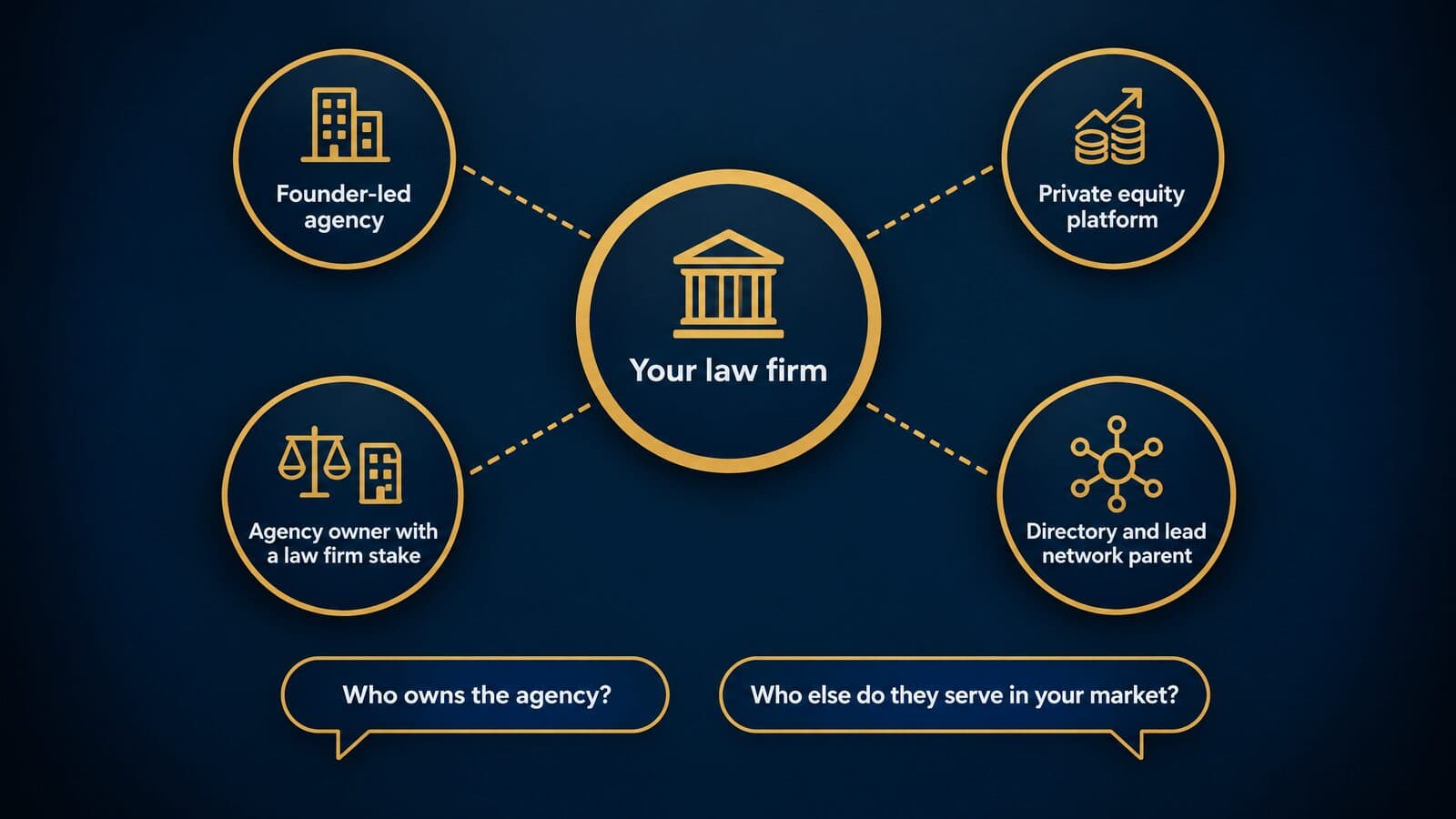
Exclusivity can mean different things, and the definition decides whether it protects you. It can cover a city, a metro area, a radius around your office, a practice area or a specific case type. A promise not to serve "another firm in Dallas" may still allow a firm in Fort Worth targeting the same Dallas searches.
What to ask:
- Who else do you serve within my market and practice area today?
- What do you do when a competitor in my market approaches you?
- Does the restriction survive the end of our contract, and for how long?
- Does it cover sister agencies under the same owner?
Put the answers in writing. The contracting section has an exclusivity clause to adapt.
Bar rules and ethics that limit SEO deals
State advertising rules apply to everything an SEO agency publishes for a firm, and the lawyer, not the agency, answers for it. The ABA Model Rules are the template most states adapt, so check your own state's version (see bar advertising and TCPA compliance for legal marketing). This is general information, not legal advice.
Rule 7.1 and the content an agency writes for you
ABA Model Rule 7.1 says: "A lawyer shall not make a false or misleading communication about the lawyer or the lawyer's services." [Comment [1]](https://www.americanbar.org/groups/professional_responsibility/publications/model_rules_of_professional_conduct/rule_7_1_communication_concerning_a_lawyer_s_services/comment_on_rule_7_1/) says the rule "governs all communications about a lawyer's services, including advertising." Every blog post, practice page, title tag and meta description an agency writes falls under it.
Responsibility does not pass to the vendor. Rule 5.3 requires lawyers with managerial authority to make reasonable efforts to ensure a nonlawyer "employed or retained by or associated with a lawyer" acts compatibly with the lawyer's obligations. Google says the same thing in search terms: "you are responsible for the actions of any companies you hire."
Comment [5] adds that a lawyer may use "a distinctive website address, social media username or comparable professional designation that is not misleading," so a keyword-stuffed domain still has to pass the misleading test. The practical rule: a lawyer reviews every page before it goes live, and the contract says so.
Paying an agency: lead generators and fee sharing
Rule 7.2(a) allows advertising through "any media." Rule 7.2(b) bars compensating anyone "for recommending the lawyer's services," with exceptions that include paying "reasonable costs of advertisements." Comment [3] says lawyers may compensate vendors "such as... website designers," which covers an ordinary SEO retainer.
Lead generators get their own comment. Comment [5] says: "A lawyer may pay others for generating client leads, such as Internet-based client leads, as long as the lead generator does not recommend the lawyer, any payment to the lead generator is consistent with Rules 1.5(e) (division of fees) and 5.4 (professional independence of the lawyer), and the lead generator's communications are consistent with Rule 7.1." A lawyer must not pay a lead generator that implies it recommends the lawyer or "has analyzed a person's legal problems."
Rule 5.4(a) says "A lawyer or law firm shall not share legal fees with a nonlawyer," with narrow exceptions, and 5.4(c) bars letting someone who "recommends, employs, or pays the lawyer" direct the lawyer's judgment. For agencies that call or text prospects, Rule 7.3(b) bars live person-to-person solicitation when a significant motive is pecuniary gain, with exceptions.
The practical line: a flat or monthly fee for SEO work is the ordinary structure. Any offer to be paid per signed case or as a share of fees needs your state bar's rules checked first, and this guide does not say such deals are allowed. The economics of per-case lead buying are compared later.
Results, testimonials and specialist claims
Comment [3] to Rule 7.1 says truthful past results "may be misleading if presented so as to lead a reasonable person to form an unjustified expectation," that unsubstantiated comparisons can mislead, and that a disclaimer "may preclude" that finding. Rule 7.2(c) bars implying certification as a specialist unless the lawyer is certified by an approved or ABA-accredited body that is clearly identified, though Comment [9] says lawyers may generally state that they "concentrate in" or "specialize in" a field, subject to Rule 7.1. Rule 7.2(d) requires every communication to "include the name and contact information of at least one lawyer or law firm responsible for its content," and Comment [12] says contact information "includes a website address."
Three SEO examples that deserve a second look (illustrative, not cases): a "best car accident lawyer in [city]" title tag; a case results page with dollar figures and no context; a practice page calling a lawyer a "specialist" without certification.
Reviews: Google's policy and the FTC rule
Reviews are where SEO and consumer protection law meet, and two rule sets apply at once: Google's policies for its own products and the FTC's rule for everyone. The table summarizes how each treats common review tactics.
| Practice | Google's policy | FTC rule (16 CFR Part 465) |
|---|---|---|
| Paying or rewarding clients for reviews | Barred: no incentives | Barred when conditioned on sentiment (465.4) |
| Asking only happy clients | Barred as selective solicitation | No section names it; hiding negative reviews is barred (465.7) |
| Staff or owner reviews | Barred as conflict of interest | Need clear disclosure (465.5) |
| Hiding negative reviews on your site | Self-hosted review stars ineligible | Barred as suppression (465.7) |
| Fake reviews | Barred | Barred (465.2) |
Sources for the Google column: the Maps user-contributed content policy bars incentives, bars businesses that "Discourage or prohibit negative reviews, or selectively solicit positive reviews from customers," and bars conflict-of-interest reviews from current or former employees. The review snippet documentation makes LocalBusiness and Organization pages "ineligible for star review feature" when the business controls its own reviews, and bars "fake or undisclosed incentivized reviews," a guideline Google's changelog records adding on July 24, 2026.
For the FTC column, see 16 CFR Part 465 on eCFR. Section 465.4 bars compensation "conditioned expressly or by implication on, the writing or creation of consumer reviews expressing a particular sentiment," and 465.7(b) bars implying displayed reviews "represent most or all the reviews submitted" when negative ones are suppressed; withholding on equal criteria, such as defamatory content, is not suppression. Part 465 took effect October 21, 2024. The penalty cap for knowing violations is $53,088 per violation as of the January 17, 2025 adjustment, the latest shown in eCFR on October 22, 2026.
State filing rules, with Texas as the example
In Texas, per the Texas Center for Legal Ethics' filing guide, Rule 7.04(a) requires filing with the State Bar of Texas Advertising Review Committee "no later than ten (10) days after dissemination," with an application and fee. Rule 7.05(b) exempts "information and links posted on a law firm website, except the contents of the website homepage," though Comment 2 says the whole site must still comply with Rules 7.01 and 7.02. TCLE's July 2025 ethics question puts it simply: "Only the homepage of the website must be filed." Rule 7.04(c) allows voluntary pre-approval, and 7.04(b) requires prompt substantiation of statements on request.
Florida has its own filing and review regime; check the current Florida Bar rules. Whatever your state, ask any agency how it tracks filing duties when it changes a homepage.
How to choose a law firm SEO company: the scorecard
Choose a law firm SEO company on proof tied to signed cases, written ownership and exit terms, reporting you can audit, transparent scope and price, legal and practice fit, a compliance process, disclosed conflicts, who does the work, and an AI-search approach grounded in Google's guidance. The weighted scorecard below turns those nine criteria into a number.
For multi-channel hires, see the 10-criteria framework for choosing a PI marketing agency which covers paid media and intake too.
Judge signed cases, not vanity metrics
Rankings, traffic and impressions are inputs. Third-party rank trackers lack Google's data; Google notes on its page about third-party SEO tools that such tools "can't guarantee performance." Qualified calls, signed cases and cost per signed case are outputs, and outputs are what pay the firm. The KPI definitions later in this guide set out which numbers belong at the top of a report.
Ask for proof you can check
Google suggests asking any SEO: "Can you show me examples of your previous work and share some success stories?" and "How do you measure your success?" A credible legal case study answers both. It names the market and practice area, gives a baseline and a dated time window, explains what the agency changed, describes how leads were attributed, and has the client's permission to be named.
Self-reported figures without those elements are marketing. In my opinion you should ask for two references you can call, and, where a reference client agrees, read-only Search Console access to one property so you can see the trend yourself. Google itself suggests read-only Search Console access when an SEO audits your site, so the request is not unusual.
Check the services and who does the work
The service menu table earlier in this guide lists what an SEO engagement can include. The scorecard question is narrower: which of those items are in your proposal, at what frequency, and who performs them. The answer might be in-house staff, US or offshore contractors, or a white-label reseller that buys the work from another firm.
White-label work is not banned, but you should know about it. Google's spam policies name "white-label services" among the third-party content creators in its site reputation abuse policy, which shows how common the model is. Rankings.io publishes "No white label" on its about page, an example of a claim you can ask any agency to put in the contract.
Weigh legal focus and practice-area fit
Legal-only agencies tend to know bar rules, intake workflows and how legal clients search. Generalists may bring deeper technical skill, as discussed in the generalist section above. Use Google's two fit questions, about your industry and your city, and push for examples in your practice area rather than law in general. For PI-specific criteria, see what to look for in a personal injury marketing agency.
Get ownership of your site, content and profiles in writing
AttorneySync states on its about page: "Your domain, accounts, content, and data are yours. Always." Grow Law's list of SEO companies for lawyers advises getting ownership "in writing for your website, content, data, and Google Business Profile." Both describe the standard you should hold every agency to.
Keep admin ownership of the domain, hosting, Business Profile, Search Console, analytics and tracking numbers in the firm's name, and give the agency user access. Clause wording is in the contracting section.
The weighted scorecard
Score each agency from 0 to 5 on every criterion, multiply by the weight, then divide by 5. The totals sum to 100. The weights are my opinion of what matters for a plaintiff firm; change them to fit yours, but set them before you read any proposals so a polished pitch can't move them.
| Criterion | Weight | Full marks look like | Evidence to request |
|---|---|---|---|
| Proof tied to signed cases | 20 | Dated case studies with baselines in your practice area | Case studies, two references |
| Asset ownership and exit terms | 15 | Firm owns domain, site, content, GBP, analytics, call numbers | Draft contract clauses |
| Reporting and attribution | 15 | Monthly report starts with signed cases and cost per case | Sample report |
| Transparency of scope and price | 10 | Itemized proposal with deliverables by month | Proposal |
| Legal and practice-area fit | 10 | Current clients in your practice area and market type | Client list by practice |
| Compliance process | 10 | Lawyer review step, state filing check, review policy | Written content workflow |
| Conflicts and market limits | 10 | Written answer on competitors and ownership | Signed disclosure |
| Who does the work | 5 | Named team, disclosed subcontractors | Team list |
| AI search approach | 5 | Cites Google's AI guidance, no llms.txt promises | Written AI-search plan |
Some answers should end the evaluation regardless of score, in my view: any ranking guarantee, a refusal to put asset ownership in writing, or a pay-per-case fee split. Google's hiring page states that "No one can guarantee a #1 ranking on Google," so a guarantee tells you how the agency sells, not how it will perform.
The scorecard only works when agencies answer the same questions in the same format, and the next section is the RFP that produces those answers.
Questions to ask and an RFP template you can copy
Ask every shortlisted agency the same written questions, starting with Google's own list, and send each one the same RFP so the answers can be scored side by side. Comparable written answers expose more than any sales call. If you are also hiring for paid media or case acquisition, a separate list of questions to ask a mass tort marketing agency covers the multi-channel side.
Google's own interview questions
Google publishes a short list of questions to ask a prospective SEO on its “Do you need an SEO?” page. Quoted as written:
- "Can you show me examples of your previous work and share some success stories?"
- "Do you follow the Google Search Essentials (previously known as Webmaster Guidelines)?"
- "What kind of results do you expect to see, and in what timeframe? How do you measure your success?"
- "What's your experience in my industry? In my country/city? Developing international sites?"
- "How long have you been in business?"
- "How can I expect to communicate with you, and will you share all changes you make to my site with detailed recommendations and reasoning?"
The same page now adds two newer checks: whether the SEO cites official Google documentation, and whether its "AEO" or "GEO" advice lines up with Google's guidance on generative AI features. Google added that guidance in the page update of June 5, 2026, according to its Search Central changelog. Send all eight questions in writing. Question 6 matters most: an agency that won't share every change it makes is asking for access without accountability.
Questions about proof, people and process
The bank below adds law-firm questions in four groups of six. Ask every finalist the same set.
Proof
- Can you show case studies with a baseline, dates and market in my practice area?
- Which current or past clients can I call as references?
- Can you show read-only Search Console access to a consenting client's property?
- How did you attribute the leads in those case studies to SEO rather than ads or referrals?
- Which campaigns didn't work, and what did you change?
- Which clients do you currently serve in my market?
People
- Who, by name, will work on my account, and what does each person do?
- Who writes the content, and which lawyer reviews it before it goes live?
- Do you use subcontractors, offshore teams or white-label partners for any part of the work?
- How many clients does each account manager carry?
- How much of the team assigned to legal clients turned over in the last year?
- Who answers when the site breaks or rankings drop suddenly?
Process
- What happens in the first 90 days, week by week?
- How do you log changes and share them with us, as Google's question 6 asks?
- How do you build links, and will you give us a list of every link built?
- How do you handle bar advertising rules and state filing requirements for new pages?
- How do you report signed cases, not only traffic and rankings?
- How does AI search fit into your work, and which Google guidance do you follow? (Part 5 covers what good answers sound like.)
Terms and conflicts
- Who owns your agency, and has ownership changed in the last three years?
- Does any owner hold a stake in a law firm or a lead generator?
- Who else do you serve in my market and practice area?
- What is the contract length, notice period and any exit fee?
- What do we own when the contract ends?
- What happens to our contract if your agency is sold?
Together with Google's eight checks and the RFP's own questions, that is a bank of more than 40 questions.
Set expectations before you start
Agree the following in writing, ideally as an attachment to the contract:
- KPIs: signed cases, qualified calls and forms, and cost per signed case, with the definitions in Part 5's measurement table. Traffic and rankings are diagnostics, not goals.
- Reporting date: the day each month the report arrives, and who walks you through it.
- Content approval: who at the firm approves pages, and the turnaround you can commit to.
- Response times: for routine requests and for site outages.
- Deliverables: what counts as "done" each month (pages published, fixes shipped, links listed).
- Review point: a formal 90-day review against the plan agreed at kickoff.
Leave rankings by a date out of it. Google is blunt that "No one can guarantee a #1 ranking on Google," so a contract that promises one is a warning, not a protection.
The RFP template
Copy this, fill in the brackets, and send the same version to every agency on your shortlist.
- About our firm: [firm name]; [practice areas, ranked by priority]; [markets and office locations]; [website platform and who hosts it]; [current agency, if any, and contract end date]; [monthly signed-case goal]; [intake hours and who answers calls and forms].
- Scope to price: a technical and content audit; technical fixes; practice-area and location content, each page reviewed by a lawyer at our firm; Google Business Profile management; link building and digital PR, with a list of every link; monthly reporting tied to signed cases; AI search work, if you offer it.
- Questions to answer in writing: who owns your agency; who will work on our account, by name; who writes and who reviews content; how you build links; what you report each month; contract length, notice and any exit fees; what we own on exit; who else you serve in our market and practice areas; how you handle bar advertising rules and state filing; what results you expect and by when, without guarantees; how you track calls, forms and signed cases; how your AI-search work follows Google's published guidance.
- Attach: a sample monthly report with client details removed; two case studies with baseline, dates and market; your standard contract; a list of the named team; a disclosure of any subcontractors or white-label partners.
- Price format: itemized by month for 12 months; one-time setup shown separately from recurring fees; number of content pieces and the link or PR budget per month; anything billed separately (tools, call tracking, ad spend, translation).
- Timeline: responses due [date]; finalist calls [dates]; decision by [date]; we will not share your pricing with other bidders.
Item 3 is where proposals separate. In my view, an agency that won't answer item 3 in writing has answered it.
Scoring the responses side by side
Once the responses arrive, score each one with the weighted scorecard in Part 3 before you take any finalist calls. Then normalize the proposals so they can be compared: first-year cost (setup plus 12 months of fees), content pieces per month, link or PR budget per month, who writes and who reviews, and what the monthly report contains. Grow Law's buyer guide makes the same point about itemization, advising firms to request "an itemized proposal", because two flat monthly fees can hide very different amounts of work.
Call two references per finalist. Shortlist two agencies, then negotiate the clauses in the next section before you sign. The goal isn't the cheapest itemized proposal; in my view it is the lowest expected cost per signed case over the first year.
Contract terms and red flags in law firm SEO deals
The contract decides what you keep when the relationship ends, so put term, exit, ownership, compliance, subcontracting, exclusivity and change of control in writing before you sign, and walk away from any proposal that shows the red flags below. This is general information, not legal advice; contract law and bar rules vary by state.
Clauses to put in writing
These are business terms to raise with your own counsel before signing. Several agencies publish friendly versions: AttorneySync advertises "Month-to-month, no long-term contracts" and says "Your domain, accounts, content, and data are yours. Always."; Hennessey Digital's law firm SEO page says "We operate without long-term contracts"; and Coalition Technologies' SEO for lawyers page promises "No commitments or lengthy contracts." All three are agency claims as of October 2026; confirm the terms in the actual contract.
| Clause | What to ask for | Why it matters |
|---|---|---|
| Term and notice | Month-to-month or a short first term; notice in days | Published examples exist (AttorneySync, Hennessey, Coalition) |
| Exit fees | None beyond the notice period | You can leave if results stall |
| Domain and hosting | Registered and billed in the firm's name | Losing the domain loses the site |
| Website and code | Firm owns it or gets a full export; no platform lock-in | A rented site can't move |
| Content | All copy and images assigned to the firm | Rankings depend on that content |
| Google Business Profile | Firm is primary owner; agency gets manager access | Profiles are hard to recover and must follow practitioner rules |
| Search Console and GA4 | Firm owns the property; agency is a user | History stays with you |
| Call-tracking numbers | Ported or transferred on exit | Numbers sit in citations and directories |
| Links and PR | A list of every link and the accounts behind them | You need to know what was built in your name |
| Data export | Reports, keyword and lead data within a set number of days | Your next agency needs the baseline |
| Content review | No page goes live without lawyer approval; agency supports state filing | Rule 7.1 and filing duties stay with the lawyer |
| Subcontracting | Disclosed and approved in advance | You know who touches your site |
| Exclusivity | Defined market, radius or practice, with competitor disclosure | Few agencies publish a policy |
| Change of control | Notice and an exit right if the agency is sold | Ownership changes do happen |
| Spam-policy warranty | Agency warrants compliance with Google's spam policies | You answer for what your SEO does |
| Non-solicitation | Mutual and limited | Protects both teams |
A few rows need their sources. On the Business Profile row, Google's Business Profile guidelines treat lawyers as individual practitioners and say a practitioner "shouldn't have multiple Business Profiles to cover all of their specializations," so an agency that sets up profiles carelessly can create problems the firm inherits. On analytics, Google's Analytics help center confirms that Universal Analytics data became inaccessible starting the week of July 1, 2024; whatever history you have now lives in GA4, and it should sit in a property the firm owns.
The content review row rests on ABA Model Rule 7.1, which bars false or misleading communications about a lawyer's services, and on state filing rules such as Texas Rule 7.04(a), which, as the Texas Center for Legal Ethics quotes it, requires filing advertisements with the State Bar's Advertising Review Committee no later than ten days after dissemination unless an exemption applies. Part 3 explains the rules.
On exclusivity, Consultwebs is one of the few agencies that publishes a policy: its own list says it limits the number of firms it works with per market. For most others it is a question to ask. On change of control, Hennessey Digital was acquired by Herringbone Digital on June 11, 2025. And on the warranty, Google's hiring page states that "you are responsible for the actions of any companies you hire."
If I could only win three of these clauses, I would take asset ownership (domain, site, content, Business Profile and analytics in the firm's name), a data export on a fixed timeline, and lawyer approval of every page before it goes live.
Red flags at a glance
Any one of the following in a proposal or a sales call is a reason to slow down, and most are reasons to walk away.
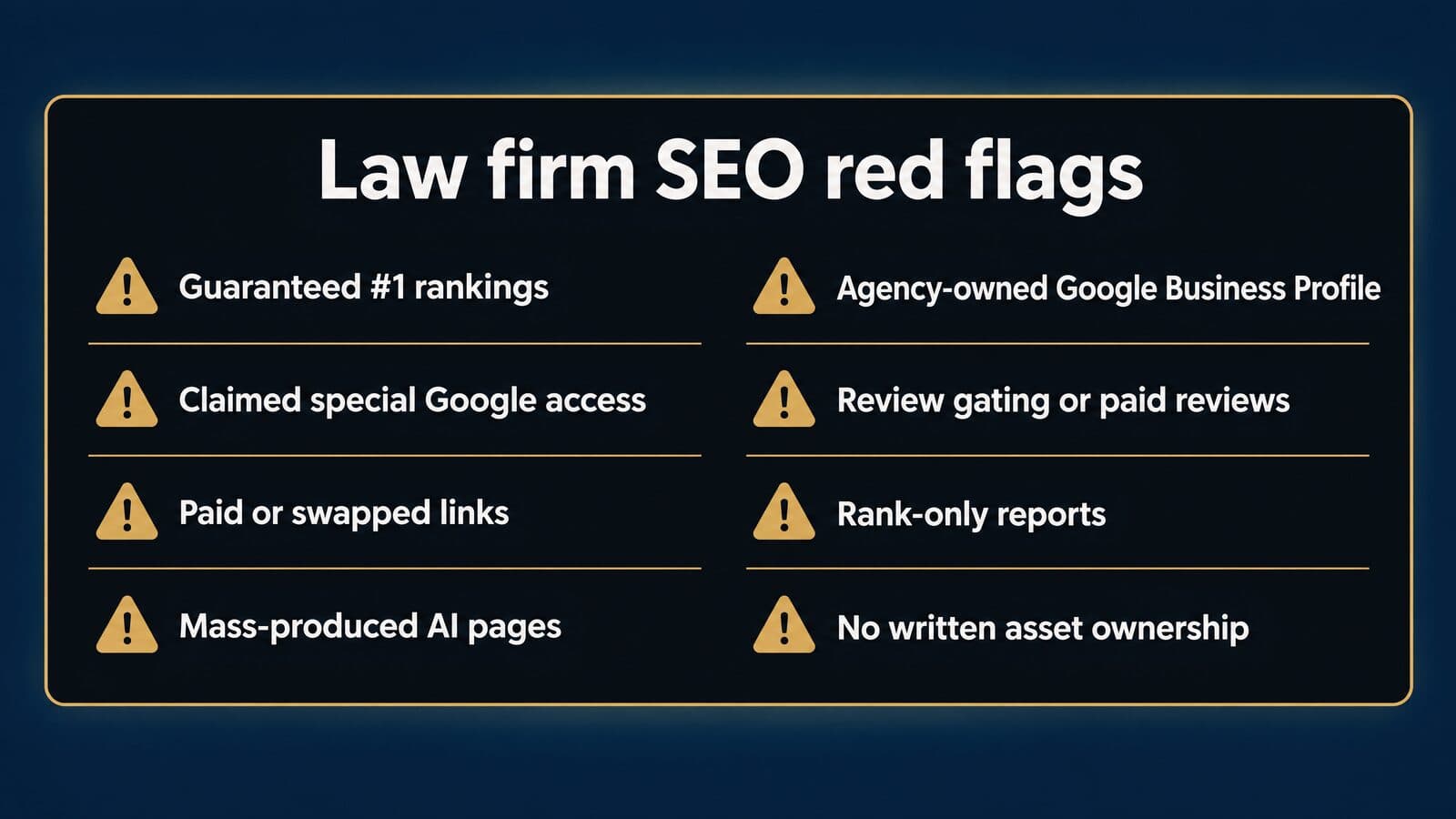
- Guaranteed #1 rankings. Google says "No one can guarantee a #1 ranking on Google," and its advice on a guaranteed first place is direct: "find someone else."
- Claimed special Google access or "priority submit." Google tells buyers to beware of SEOs that "allege a 'special relationship' with Google, or advertise a 'priority submit' to Google," and to be wary of tools that claim to be "acceptable" or "approved" by Google Search.
- Paid or swapped links. Google's link spam examples include exchanging money, goods or services for links. Google also says "You should never have to link to an SEO."
- Mass-produced AI pages. Generating many pages with AI "without adding value for users" is scaled content abuse under Google's spam policies.
- An agency-owned Google Business Profile. If the agency is the primary owner, you are renting your own local listing. See the clause above.
- Review gating or paid reviews. Google's Maps user-generated content policy bars incentives for reviews and selectively soliciting positive ones, and the FTC's rule at 16 CFR Part 465 bars incentives conditioned on a review's sentiment.
- Rank-only reports. Google's guidance on third-party SEO tools says such tools "don't have access to our internal ranking data. They can't guarantee performance." Reports should lead with calls, forms and signed cases (Part 5).
- No written asset ownership. Grow Law's guide advises getting ownership "in writing for your website, content, data, and Google Business Profile," and AttorneySync publishes a similar promise. If ownership is verbal, it isn't settled.
If an SEO has deceived you, Google's hiring page points U.S. complaints to the Federal Trade Commission's online complaint form, and complaints from outside the U.S. to econsumer.gov.
Link schemes and spam policies an agency can trip
Google's spam policies, last updated August 28, 2026, list 16 behaviors that can lower a site's rankings or remove it from results. Several are things an SEO agency could do in your firm's name without telling you: doorway abuse, expired domain abuse, keyword stuffing, link spam, scaled content abuse, site reputation abuse and sneaky redirects.
Link spam is the one law firms meet most often. Google's examples include paying for links, "links with optimized anchor text in articles, guest posts, or press releases distributed on other sites," low-quality directory or bookmark links, widely distributed footer or template links, and forum comments with optimized links. Sponsorships and paid placements are fine when marked: Google's guidance on qualifying outbound links asks for rel="sponsored" on paid links, still accepts rel="nofollow" "though sponsored is preferred," and uses rel="ugc" for user-generated content.
Scaled content abuse covers "Using generative AI tools or other similar tools to generate many pages without adding value for users." Google's guidance on generative AI content adds that "It is critical to manually factcheck and review all AI-generated content." For a firm, that means a lawyer review step, not just an editor. Site reputation abuse covers third-party content published "mainly because of that host's already-established ranking signals," and Google lists "white-label services" among the third-party creators it means. Expired domain abuse is buying an expired domain and repurposing it "primarily to manipulate search rankings by hosting content that provides little to no value to users."
Three newer changes are worth knowing. According to Google's changelog, on April 13, 2026 the malicious practices policy gained a "back button hijacking" section, and on April 14, 2026 Google said it "may now use spam report submissions to take manual action." On May 15, 2026 Google clarified that its spam policies apply to generative AI responses in Search, and the policy now names "attempting to manipulate generative AI responses in Google Search" as spam.
The firm carries the risk, as Google's hiring page says, and deceptive work can get a site "removed entirely from Google's index." So ask for three things in writing: a monthly list of every link built, confirmation that no paid link goes live without rel="sponsored", and a commitment that no expired domain will be bought or redirected in the firm's name.
What law firm SEO costs and how long it takes
As of October 2026, published law firm SEO prices run from about $2,000 to $60,000 a month across Hennessey Digital's three tiers, Rankings.io says competitive legal markets typically need $5,000 to $15,000 or more, and most legal agencies quote custom prices; confirm with each agency. For the full picture across ads, leads and SEO, see what a personal injury marketing agency costs across channels.
Published prices and tiers, as of October 2026
Few legal SEO agencies publish prices. The figures below are every published number we verified on October 22, 2026, with what each one covers. All are subject to change; confirm with the agency.
| Source | What it says | What it covers | Type of figure |
|---|---|---|---|
| Hennessey Digital tiers | $2,000 to $6,000; $6,000 to $12,000; $12,000 to $60,000 a month | Scoped by practice areas and markets | Agency's published tiers |
| Hennessey SEO vs PPC table | SEO $2,500 to $10,000+; PPC $5,000 to $50,000+ a month | Same page, different table | Agency claim |
| Rankings.io FAQ | $5,000 to $15,000+ a month | "Competitive industries like legal" | Agency claim, no rate card |
| WebFX | From $2,900 a month; averages $1,000 to $5,000; "most businesses spend $2,500" | All industries | Generalist's published price and estimates |
| Ahrefs survey | $2,917 a month average; agencies $3,209, freelancers $1,348 | 439 SEOs, global, all industries | Survey, page updated 2024 |
Sources: Hennessey Digital's law firm SEO page (both rows); Rankings.io's SEO companies post, whose own pricing is custom; WebFX's SEO pricing page; and Ahrefs' SEO pricing study, which also reports that 78.2% of SEOs charge a monthly retainer and that the most common hourly rate is $100 to $150.
Hennessey's page carries two different SEO ranges, one in its tiers and one in its SEO vs PPC table. The Ahrefs page disagrees with itself on the most common retainer band, giving 23% at $500 to $1,000 in its takeaways and 20.4% at $501 to $1,000 in the body. There is no reliable "average law firm SEO cost," and anyone who quotes one should show the source. Ask for an itemized proposal instead.
What drives the price of a legal SEO retainer
The main price drivers:
- Market competitiveness and case value. A personal injury practice in a large metro competes with well-funded firms for high-value cases, so it needs more content and more links than a niche practice in a small town.
- Practice areas and offices. Hennessey's published tiers scale on both; each additional practice area or location adds pages, profiles and tracking.
- Site condition and platform. A slow, poorly structured site or a locked proprietary platform means technical work, or a rebuild, before content can pay off.
- Content volume and lawyer review time. More pages cost more to write, and every page needs review by a lawyer at the firm.
- Link and PR budget. Digital PR that earns real coverage costs more than directory submissions, and is far safer.
- Call tracking and reporting depth. Tying leads to signed cases needs tracking numbers, CRM integration and analyst time.
- Spanish or multilingual content. Each language is a separate content program.
- AI search work. Agencies increasingly price it separately; Part 5 covers what is worth paying for.
How long law firm SEO takes
Google no longer gives a timeline. An archived March 2025 version of its hiring page said SEO changes typically take "from four months to a year" to show benefit, but that sentence is gone from the current page. Google's core updates documentation says core updates happen "Several times a year," that smaller, unannounced core updates can lift improved content without waiting for the next major update, and that "there's no guarantee that changes you make to your website will result in noticeable impact." Hennessey's own SEO vs PPC table claims "Time to results 3-12 months," which is an agency claim.
What follows is a typical sequence in my view, not a promise:
- Months 1 to 2: audit, technical fixes, Business Profile cleanup, call and form tracking. Measure fixes shipped and tracking verified.
- Months 2 to 6: practice-area and location pages, review requests, early link and PR work. Measure pages live, impressions and calls trending up in Search Console and call tracking.
- Months 6 to 12: compounding content, expansion into new practice areas or cities, stronger links. Measure qualified leads and signed cases by month.
Agency, in-house hire or hybrid
An in-house SEO knows your firm, your intake and your cases, but one person is one skill set. They still need writers, a developer and tools. An agency spreads the work across specialists in technical SEO, content, local and links. A hybrid model often fits mid-sized firms: keep content approval, intake knowledge and reporting in-house, and hire an agency for technical work and link building. For general context only, Ahrefs' all-industry survey found agencies averaging $3,209 a month against $1,348 for freelancers; those are global figures, not law firm prices.
Doing law firm SEO yourself
Google says that "If you run a small local business, you can probably do much of the work yourself," and points to its SEO Starter Guide. In my view, DIY works well for a solo or small firm in a modest market: a complete Google Business Profile, reviews requested from every client without gating, a few strong practice-area pages reviewed by you, and Search Console set up and checked monthly. It usually stops working at site migrations, multi-location builds, link building at scale and competitive personal injury metros, where the volume of work outruns a lawyer's evenings.
SEO vs Google Ads, LSAs and bought leads
SEO pays for work that builds an asset and takes months; Google Ads pays per click and works the day it launches; Local Services Ads pay per lead and depend on answering calls; bought leads or signed cases pay per result and leave you nothing when spending stops. Compare all four on cost per signed case. Where a channel involves paying a third party for clients, this is general information, not legal advice, and state rules vary.
How each channel charges and what you keep
The four channels bill for different units: a click, a phone lead and a signed retainer are not the same product.
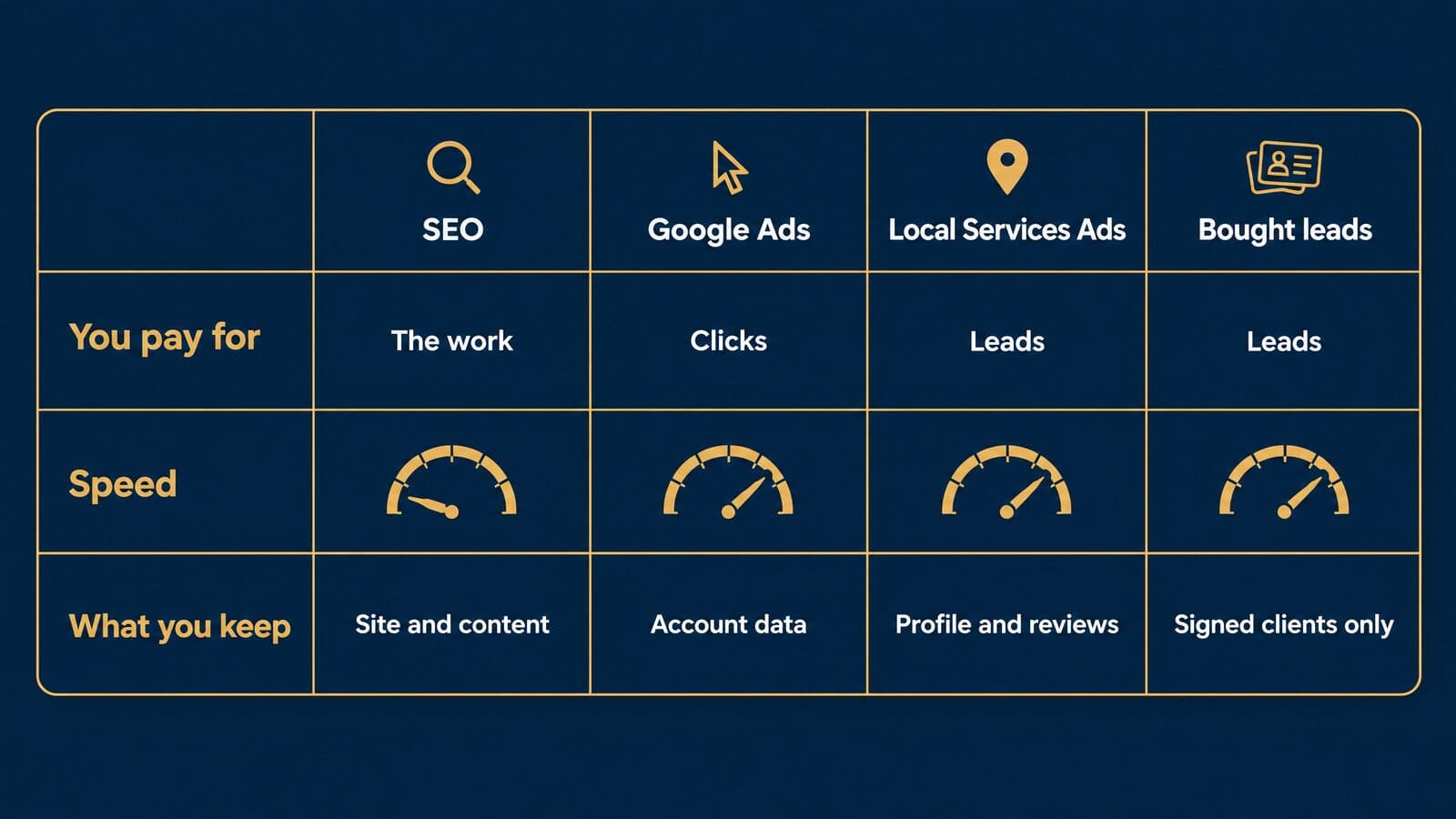
| Channel | You pay for | Speed to first cases | What you keep when spending stops | Main risk |
|---|---|---|---|---|
| SEO | The work, usually a monthly retainer | Slow; months, no guarantee | The site, content and whatever rankings hold | Slow and uncertain |
| Google Ads | Clicks; legal CPC $9.87, cost per lead $131.63 | Fast | Account data and keyword learnings | Results stop when spend stops |
| Local Services Ads | Leads by call or message | Fast once verified | The profile and its reviews | Missed calls can hurt ad ranking |
| Bought leads or signed cases | Each lead or signed retainer | Fast | The signed clients only | Vendor quality; Rule 7.2 and 5.4 limits |
The Google Ads figures come from LocaliQ's 2026 search advertising benchmarks, built from thousands of its customers' campaigns: for Attorneys and Legal Services, an average CPC of $9.87, CTR of 5.87%, conversion rate of 5.55% and cost per lead of $131.63, against an all-industry cost per lead of $66.69. PPC for law firms can run alongside SEO. It does not help organic rankings: Google's hiring page says advertising with Google has no effect on your organic presence.
Local Services Ads deliver leads as calls and messages. Google's LSA help page says you "Pay only for leads related to your business," and its Local Services Ads marketing page frames it as paying for customers rather than clicks. The "Google Verified" badge signals that a business "has passed Google's proprietary screening process," and Google warns: "If you regularly fail to answer calls or respond to messages, your ad ranking may be affected." Google publishes no per-lead price for legal categories, so any LSA cost figure you see is a vendor or advertiser estimate.
Bought leads and signed cases are sold by lead generators and acquisition vendors, priced per lead or per signed retainer; see what personal injury leads cost for current ranges. The structure matters. ABA Model Rule 7.2 bars giving anything of value for a recommendation, with Comment [5] addressing lead generators, and Rule 5.4(a) bars sharing legal fees with nonlawyers. State rules vary; check yours before signing any pay-per-case arrangement.
A cost-per-signed-case model you can fill in
Every channel reduces to the same formula: what you spent, divided by the cases you signed from it. Fill in the right-hand column with your own numbers for each channel.
| Line | Formula | Illustration (hypothetical) |
|---|---|---|
| A. Monthly cost | Retainer plus content and links, or ad spend plus management | $8,000 (inside Hennessey's $6,000 to $12,000 tier) |
| B. Qualified leads a month | Calls and forms that pass screening | 20 |
| C. Sign rate | Signed cases divided by qualified leads | 25% |
| D. Signed cases | B times C | 5 |
| E. Cost per signed case | A divided by D | $1,600 |
| F. Average fee per signed case | From your case records | Your number |
| G. Break-even cases a month | A divided by F | Your number |
The illustration is arithmetic, not a benchmark. The 20 leads and the 25% sign rate are made up to show how the lines connect; your own numbers will differ by practice area, market and intake quality, and they are the only ones that matter.
Run the same $8,000 through search ads at LocaliQ's legal average of $131.63 per lead and it buys about 61 leads before management fees. Those are form fills and calls, not screened leads, so apply your own screening rate and sign rate before comparing that number with the SEO row.
In my view, SEO's cost per signed case starts high and falls as content compounds, while paid channels hold steady only as long as spend does. Compare channels over 12 months, not month one.
For a reference point from the acquisition side: Mass Tort Marketing Agency, which sells signed-case acquisition, publishes 2026 cost-per-signed-retainer benchmarks that put mass tort cost per signed retainer at $1,800 to $15,000 depending on tort, claimant complexity and docket strength. Treat any vendor's benchmark, including that one, as a claim to test against your own numbers.
When SEO is the wrong channel
SEO is a slow channel with no guaranteed result, and some situations can't wait for it:
- A new mass tort with a short claim window. If filing deadlines arrive before content could plausibly rank, SEO's ramp is too slow for the docket.
- An urgent case-volume gap. A firm that needs signed cases this quarter to cover payroll can't bet on a months-long build.
- A brand-new firm in a saturated personal injury metro. In my view, a site with no history competing against firms with years of content and links should not rely on SEO alone for its first year.
- Intake that misses calls. Google says LSA ranking can suffer when calls go unanswered, and SEO leads are just as wasted when nobody picks up. Fix intake first; Part 5 covers it.
In those cases, paid search, LSAs, or buying signed cases from a compliant vendor can fill the gap while SEO builds in the background. Any vendor arrangement still has to fit Rule 7.2 Comment [5] and Rule 5.4, and your state's version of them. For per-tort numbers, see signed-retainer benchmarks by tort, and for the structural trade-offs, see agency versus lead vendor.
Splitting budget in a new firm versus an established one
No published source gives a reliable percentage split, so treat these as starting positions in my view, not formulas:
- New firm: a complete Business Profile and steady review requests first, paid search or LSAs for cash flow, and SEO foundations (technical setup, core practice pages, tracking) built in parallel.
- Established firm: protect existing organic and local share, use paid search to cover gaps in rankings, and test new keywords with ads before writing content for them.
- Mass tort firm: paid media and signed-case acquisition for new torts, and SEO for long-running dockets with steady search demand.
Whatever the split, revisit it every quarter using cost per signed case by channel, measured the way Part 5 describes. And whichever split you choose, two things now shape SEO itself: AI search and how you measure it.
AI search and Google's 2026 changes: what to ask
Google says optimizing for AI Overviews and AI Mode is still SEO, with no special requirements, markup or llms.txt file. So an agency's AI-search plan should look like good SEO plus measurement, and any promise beyond that needs Google documentation behind it before you pay for it.
What Google says about AI Overviews, AI Mode and GEO
Google's AI features documentation says "There are no additional requirements to appear in AI Overviews or AI Mode, nor other special optimizations necessary." A page used as a supporting link "must be indexed and eligible to be shown in Google Search with a snippet," and there is "no special schema.org structured data that you need to add." Indexing is the gate, which is why how Google indexing works is a better starting point than any GEO checklist.
In May 2026 Google added a guide to optimizing for generative AI features. Its central line: "From Google Search's perspective, optimizing for generative AI search is optimizing for the search experience, and thus still SEO." Its "Mythbusting" section says Google Search ignores llms.txt files and other "special" markup, which "will neither harm nor help," that "There's no ideal page length" for chunking, and that rewriting content just for AI, chasing inauthentic "mentions" and over-investing in structured data are things to skip ("Structured data isn't required for generative AI search"). The guide also warns: "Be wary of third-party tools that promise ranking success or claim to use 'internal' Google metrics," and it stresses "non-commodity content." Google's June 15, 2026 changelog entry repeats that llms.txt files "aren't needed for Google Search."
There is a line agencies must not cross. Google's spam policies were clarified on May 15, 2026 to cover "attempting to manipulate generative AI responses in Google Search."
ChatGPT search works separately. OpenAI's crawler documentation describes two robots.txt tokens: OAI-SearchBot, "used to surface websites in search results in ChatGPT's search features" (sites that block it "will not be shown in ChatGPT search answers"), and GPTBot, for content that "may be used in training our generative AI foundation models." Each setting is independent, and OpenAI says search changes can take "~24 hours." If you want an outside team on this, AI search optimization for law firms should start from these documents, not from a proprietary score.
Questions to ask an agency about AI search
Put these seven questions in writing and compare the answers side by side.
- Which Google documentation does your AI-search plan rely on? Google's hiring page now asks whether an SEO's "AEO"/"GEO" advice aligns with its generative-AI guidance.
- What will you change that you wouldn't do for normal SEO, and why? A good answer is short, because Google says the work is the same.
- Do you sell
llms.txt, content chunking or special markup as AI fixes? Google lists all three as things it ignores. - How will you report AI Overview and AI Mode impressions? Search Console's generative AI performance report shows them, and Google said on June 16, 2025 that AI Mode data counts toward Search Console totals.
- Do you recommend any change to the Search generative AI control in Search Console, and why? Google's page on controlling what you share describes this site-wide setting for AI Overviews and AI Mode, and changing it is a business decision, not a technical tweak.
- How do you handle
OAI-SearchBotandGPTBotin robots.txt for our goals? Blocking training and allowing search are separate choices. - Do any of your tools claim access to Google's internal data? Google's third-party tools guidance says such tools "can't guarantee performance."
The same Google page names Search Console as the first-party data source, so any AI-visibility claim should be checkable there.
Google updates and documentation changes since 2025
One rankings.io guide says the December 2025 and March 2026 core updates "specifically targeted" thin and AI-generated content and calls them "two consecutive" updates. Google's core updates documentation doesn't describe them that way, and a May 2026 core update followed. The dates and durations below come from Google's Search Status Dashboard, the changelog and the September 2025 Search Quality Rater Guidelines.
| Date | Change | What to ask your agency |
|---|---|---|
| 2025-03-13 | March 2025 core update (13 days 21 hours) | How did our pages move? |
| 2025-06-16 | AI Mode counted in Search Console totals | Are AI Mode impressions in our report? |
| 2025-06-30 | June 2025 core update (16 days 18 hours) | Same question |
| 2025-09-11 | Rater guidelines updated (182 pages) | How does our content show trust? |
| 2025-12-11 | December 2025 core update (18 days 2 hours) | Same question |
| 2026-03-27 | March 2026 core update (12 days 4 hours) | Same question |
| 2026-04-14 | Spam reports may lead to manual action | Is anything we do reportable? |
| 2026-05-07 | FAQ rich results stop showing | Are you still selling FAQ schema for stars? |
| 2026-05-15 | AI optimization guide; spam policies cover AI responses | Does your AI plan match it? |
| 2026-05-21 | May 2026 core update (11 days 21 hours) | Same question |
| 2026-07-24 | Review snippet guideline on fake and incentivized reviews | How do you request reviews? |
| 2026-10-01 | Gen-AI content guide updated | Who fact-checks AI drafts? |
The dashboard also lists spam updates in March, June, August and September 2026, plus an August 2025 spam update that ran 26 days 15 hours. Google's own advice is calmer than most agency newsletters: "most sites don't need to worry about core updates," smaller core updates happen without announcement, and there is "no guarantee" that changes after an update will restore anything.
Measuring law firm SEO: reports, KPIs and intake
Measure SEO the way the firm earns money: signed cases from organic search and the cost per signed case, supported by qualified calls and forms, answer rates and search visibility. Rankings and traffic explain the trend; they aren't the result. If you already tie spend to signed retainers for paid channels, use the same ledger for SEO.
KPIs that tie SEO to signed cases
Eight numbers cover what a managing partner needs. The first two are the outcome; the rest explain it.
| KPI | Definition | Where it comes from | Why it matters |
|---|---|---|---|
| Signed cases from organic | Retainers whose first touch was organic or local search | Case management or CRM plus call tracking | The outcome |
| Cost per signed case | SEO cost divided by those cases | Finance plus CRM | Compares channels (Part 4) |
| Qualified calls and forms | Contacts that pass screening | Call tracking and intake notes | Filters spam and wrong-practice calls |
| Answer rate and speed to response | Share of calls answered live; minutes to first reply | Phone system | Intake losses look like SEO failure |
| Organic clicks and impressions, non-brand | Search demand captured | Search Console | Early signal |
| AI Overview and AI Mode impressions | Generative AI report | Search Console | AI visibility trend |
| Business Profile calls and direction requests | Actions from the profile | Business Profile performance | Local results |
| Core Web Vitals pass | LCP 2.5 s, INP 200 ms, CLS 0.1 at the 75th percentile | Search Console and field data | Site experience |
The Core Web Vitals thresholds come from web.dev's Web Vitals guide; INP replaced FID on March 12, 2024, so any report still showing FID is using an outdated template.
Decide in advance whether first or last touch gets credit for multi-touch cases, apply it to every channel, and keep brand searches by referrals out of the SEO column. Agree the definitions before month one.
Tracking setup: GA4, Search Console and call tracking
GA4 is the only Google Analytics property type left: Google says Universal Analytics data became inaccessible starting the week of July 1, 2024. The firm should own the GA4 property and the Search Console property and grant the agency user access, as the ownership clauses in Part 4 require.
Search Console already includes AI Mode in its performance totals, and the generative AI report breaks out AI Overview and AI Mode impressions, so you don't need a separate tool to see the trend. Dynamic call-tracking numbers should be registered to the firm, so they survive an agency change. Then connect call outcomes to your intake CRM: a call is only useful data once someone records whether it became a consultation, a signed case or a decline.
What a monthly SEO report should contain
A useful report reads top-down: business result first, then the activity and search data that explain it. If the first page is a rankings chart, ask for the order to change.
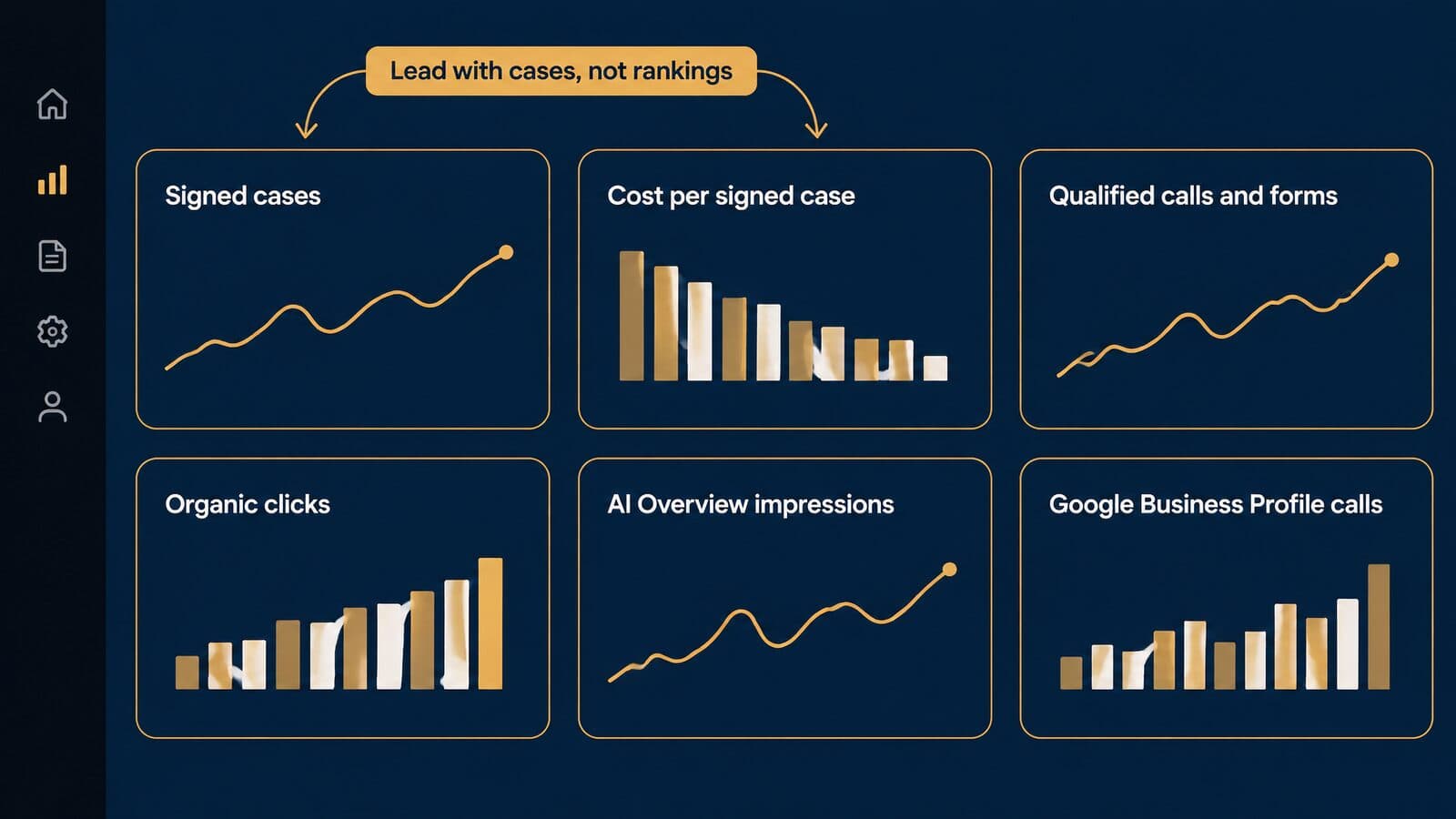
Ask for these eight sections, in this order:
- Signed cases and cost per signed case, this month and trailing 12 months.
- Qualified calls and forms by practice area and office.
- Answer rate and response time.
- Work shipped, with a change log. This is Google's question, "will you share all changes you make to my site with detailed recommendations and reasoning?", turned into a standing report item.
- Content published and the lawyer who approved it.
- Links and mentions earned, listed by URL.
- Search Console clicks, impressions and AI impressions, non-brand vs brand.
- Problems found and next month's plan.
Sections 1 to 3 need your intake data, so send it by a fixed date each month.
Reading an SEO report skeptically
Most misleading reports aren't false. They select. Watch for rank-only reports with no calls or cases; a keyword list the agency picked that excludes the terms you care about; date ranges that shift from month to month so comparisons never line up; traffic growth on blog posts that don't produce cases; brand searches counted as SEO wins; and missing call data "because tracking broke."
Rank checks should also match how clients actually search. A ranking checked from the agency's office tells you little about a searcher three ZIP codes away, which is why local rank tracking by ZIP code is the better method for a local practice. When something looks off, pull the same date range from your own Search Console.
Intake: where good SEO gets wasted
SEO can win the search and still lose the case at the phone. Clio's 2019 Legal Trends Report found that 57% of people who ever shopped for a lawyer contacted more than one firm, so a missed or slow answer can hand the case to the next result. Google's Local Services Ads help warns: "If you regularly fail to answer calls or respond to messages, your ad ranking may be affected."
My view: check answer rate, after-hours coverage and callback time before you blame the agency for low case counts. If calls go to voicemail at night, 24/7 legal intake may fix more than another quarter of content, and speed-to-lead and intake scripts cover what the person answering should say.
Switching SEO agencies without losing rankings
In my opinion, rankings usually survive an agency change when the firm owns its assets, keeps its URLs or redirects them, and hands the new agency a complete record. Traffic drops after a switch tend to come from lost content, broken redirects, lost links or lost account access, not from the switch itself.
The "traffic fell after the client left us" chart some agencies publish shows a process failure, and the steps below prevent most of it. Part 4 covers the contract clauses; this section executes them.
Before you give notice
Read three clauses first: the notice period, any exit fee, and who owns the site, content, links and accounts. Then confirm, before anyone knows you're leaving, that the firm holds admin access to the domain registrar, hosting, CMS, Google Business Profile, GA4, Search Console and the call-tracking account. Log in to each one yourself. Access that "the agency can add you to" is not access.
Export what you'll need to compare later: 12 months of reports, Search Console performance data, Business Profile performance, and a baseline of qualified calls and signed cases. Ask for a list of every link the agency built and every page it published, with dates.
If you're auditioning a replacement, give the prospective agency only read access to Search Console while it audits. That is Google's own advice: "only grant read access to Search Console (at this stage, don't grant them write access)."
The handover checklist
Work through this list with the outgoing agency, in writing, and tick each item only when the firm has verified it.
- Domain registrar login in the firm's name, with two-factor authentication on a firm device.
- Hosting and CMS admin accounts held by a firm employee.
- A full site backup and a content export, including images and drafts.
- A redirect map of every URL changed in the last year.
- Business Profile primary ownership moved to the firm, including practitioner profiles.
- GA4 property ownership transferred to the firm.
- Search Console ownership verified by the firm.
- Call-tracking numbers ported or transferred to the firm.
- The link and PR list, with any outreach or press accounts.
- The content calendar and unpublished drafts.
- Reporting history, exported in a format you can open without the agency's tool.
- Third-party tool accounts in the firm's name, or a written plan to replace them.
Items 4 and 8 cause the most damage when skipped: a missing redirect turns a ranking page into a 404.
The first 90 days with a new agency
Start with a read-only audit and a written findings list before any change ships. Make "no URL changes without redirects" a rule, not a preference. Keep the Business Profile name stable: Google's Business Profile guidelines say unnecessary information in a business name "could result in the suspension of your Business Profile," and a new agency eager for quick wins sometimes adds keywords there.
Check that structured data uses LegalService: schema.org describes LegalService as covering law firms and says the Attorney type "is deprecated." Check Core Web Vitals against the thresholds above. Agree the KPI definitions and the reporting date from the measurement section in the first two weeks.
At day 90, review the work against what the RFP promised. Google's hiring page reminds owners that "you are responsible for the actions of any companies you hire," which applies to the old agency's leftovers and the new agency's changes alike.
Sources and methodology
This guide was researched between October 22, 2026 and publication, using each agency's own pages, Google's documentation, the ABA Model Rules, state ethics sources, federal regulations and named industry data. Nothing was paid for, and no agency reviewed it before publication.
How this guide was researched
We read the two rankings.io lists; the Coalition Technologies, Consultwebs and Hennessey pages that ranked for the primary keyword; the LawRank, Juris Digital and Grow Law lists; and each profiled agency's about, home or pricing page. For rules and platforms we used Google Search Central, the Search Status Dashboard and the rater guidelines; the ABA Model Rules, some read via archived copies because americanbar.org blocked automated access; the Texas Center for Legal Ethics; eCFR and the Federal Register; Clutch's methodology; LocaliQ; Ahrefs; and Clio's 2019 report.
Search results were checked with US-set Brave Search because Google served a verification page to automated checks, so positions should be rechecked in Google. Profiles are alphabetical within groups and built only from published facts. We plan to review the guide quarterly; the next review is January 2027. Agencies can send corrections with a source link.
Primary sources, by topic
All sources were accessed October 22, 2026.
- Google hiring guidance: Do you need an SEO?, third-party SEO tools and advice, and the March 2025 archived hiring page.
- Google policies and updates: spam policies, the Search Central changelog, the Search Status Dashboard, core updates, review snippets and the rater guidelines.
- AI search: AI features, the AI optimization guide, the generative AI performance report, the Search generative AI control and OpenAI's crawlers.
- Local and ads: Business Profile guidelines, the Maps user-content policy, Local Services Ads help and LocaliQ's 2026 benchmarks.
- Ethics rules: ABA Model Rules 5.3, 5.4, 7.1, 7.2 and 7.3; the Texas Center for Legal Ethics; and 2Civility's report on Arizona's ABS licensing.
- Consumer protection: 16 CFR Part 465 on eCFR and the Federal Register penalty adjustment.
- Market data: Ahrefs' SEO pricing study, Clio's 2019 Legal Trends Report and the ABA lawyer-population profile as reported by 2Civility.
- Directories and awards: Clutch's methodology, TA's Inc. 5000 honoree release, Thomson Reuters on the FindLaw sale, Martindale-Avvo and Internet Brands Legal.
- Agency pages: the about, home, pricing and list pages for all 19 agencies, linked in each profile.
- Technical standards: web.dev Web Vitals, the INP announcement, and schema.org's LegalService and Attorney types.
What we could not verify
Nifty Marketing's site returned a 403 error, so it has no profile. Clutch directory pages, inc.com and the Arizona courts site blocked automated access, and Florida Bar pages returned 403. Ownership of most agencies is unpublished; ask each one directly. Live star ratings change daily and are excluded by design.