

Quick answer. Marketing for law firms is everything that gets the right people to hire your firm: strategy, reputation, channels, intake and ethics working together. A firm needs demand capture, which means being found by people already looking through search, the map pack, Local Services Ads and directories. It also needs demand generation, which means being known before the need arises through referrals, community work, video and content. Judge every channel by cost per signed case and fees collected, not clicks. Most firms lose more cases at intake than in advertising.
Key takeaways
- Referrals and self-directed search barely overlap: in Clio's 2019 survey of 2,000 consumers, 59% sought a referral, 57% searched alone, and only 16% did both.
- Clients shop around: in the same Clio 2019 study, 57% of people who had ever shopped for a lawyer contacted more than one firm.
- In Clio's 2024 secret-shopper study, only 40% of firms answered calls and 33% of 500 emailed firms replied.
- Choose where and how you will compete before buying tactics, using A.G. Lafley and Roger Martin's five strategic choices.
- Set an allowable cost per signed case from your fee model, then build the marketing budget backward from your case target.
- Google says there are no additional requirements or special optimizations needed to appear in AI Overviews or AI Mode.
- ABA Model Rules 7.1 to 7.3 bind lawyers only as adopted by each state, and New York changed its advertising rules effective June 1, 2026.
This guide is for solo and small-firm lawyers doing their own marketing, managing partners deciding where the next dollar goes, marketing directors who need a shared plan with the partners, and anyone vetting an agency. It follows the client journey from the event that creates a legal need to the signed fee agreement and the review or referral that comes after. Part by part it moves from strategy and research, to the math that sets a budget, to the channels, to intake, and finally to the ethics rules and a 90-day plan you can run.
A disclosure before we start: I run Mass Tort Marketing Agency, a plaintiff-side agency, so the mass tort and injury examples here lean on that work, while the sections on other practice areas rely on published evidence and are labelled when they are opinion. If your firm handles injury cases only, there is also a separate guide to personal injury lawyer marketing that goes deeper on that one practice.
What law firm marketing is and how it works
Law firm marketing is the work of making a firm the obvious choice for a specific kind of client, then making it easy for that client to find, trust and hire it. It covers positioning, channels, reputation and intake, and it is measured in signed cases and fees, not traffic.
A working definition of law firm marketing
Law firm marketing is the set of choices and activities that bring the right prospective clients to a firm and turn them into signed cases: deciding whom to serve, getting found where those people look, earning their trust with proof and reputation, and responding fast enough that they hire you instead of the next firm they called.
That definition has four jobs inside it. Being chosen is positioning: a reason a particular client should pick you. Being found is channels: search, referrals, directories, ads, video. Being trusted is reputation and proof: reviews, bios, results where your state allows them. Being easy to hire is intake: answering, screening and signing.
The field is crowded. The ABA's 2025 Profile of the Legal Profession counts 1,374,720 lawyers in the United States. ATRA, a tort-reform advocacy group, estimates that more than $2.5 billion was spent on more than 26.9 million ads for legal services in 2024. Yet planning is thin: in the ABA's 2022 Websites and Marketing TechReport, only 57% of respondents said their firm had an annual marketing budget, and none of the solo respondents had one.
Marketing, business development, advertising and intake
These four words get used interchangeably, and the confusion costs firms money because nobody owns the gaps between them.
Marketing is the whole system: who you serve, what you say, where you show up and how you measure it. In a small firm a partner owns it; in a larger one a marketing director does. Business development is the relationship side, usually done by lawyers themselves: lunches with referral sources, speaking, bar committee work, staying in touch with past clients. Advertising is the paid slice of marketing: search ads, Local Services Ads, TV, radio, billboards, paid social. Intake is the process that answers the phone, the form and the chat, screens the matter, checks conflicts and books the consultation.
Intake belongs inside marketing because it is the step where paid attention turns into fees. A firm can buy a strong lead and lose it to a voicemail box. If the person who sets the ad budget never hears how calls were handled, the firm will keep blaming the channel for a problem that sits at the front desk. Throughout this guide, intake is treated as a marketing function with its own metrics.
Demand capture and demand generation
Demand capture means meeting people who already know they need a lawyer and are looking now. A person arrested for DUI on Saturday night searches on Sunday morning. They click a search ad, scan the map pack, read a directory listing or land on a practice-area page. Local Services Ads, search ads, the map pack, directories and practice pages are all capture channels. They work fast and stop the day you stop paying or stop ranking.
Demand generation means making the firm known before the need exists. A business owner hears a lawyer speak about partnership disputes at a chamber breakfast. Two years later, when a co-owner walks out, that lawyer's name is the one they remember. Referral relationships, community work, video, TV, educational content and email newsletters generate demand. They build slowly and keep working after the spend stops.
Most firms need both. A firm that only captures demand competes on price per click against every other firm in the auction. A firm that only generates demand depends on memory and luck and misses the person searching tonight. The mix shifts by practice area, which is the subject of the practice-area section later in this guide, but very few firms can live on one mode alone.
The legal client journey, from trigger to referral
The client journey is the path a person takes from the moment a legal problem appears to the moment they recommend the firm to someone else. Marketing has a job at every stage, not only at the search.
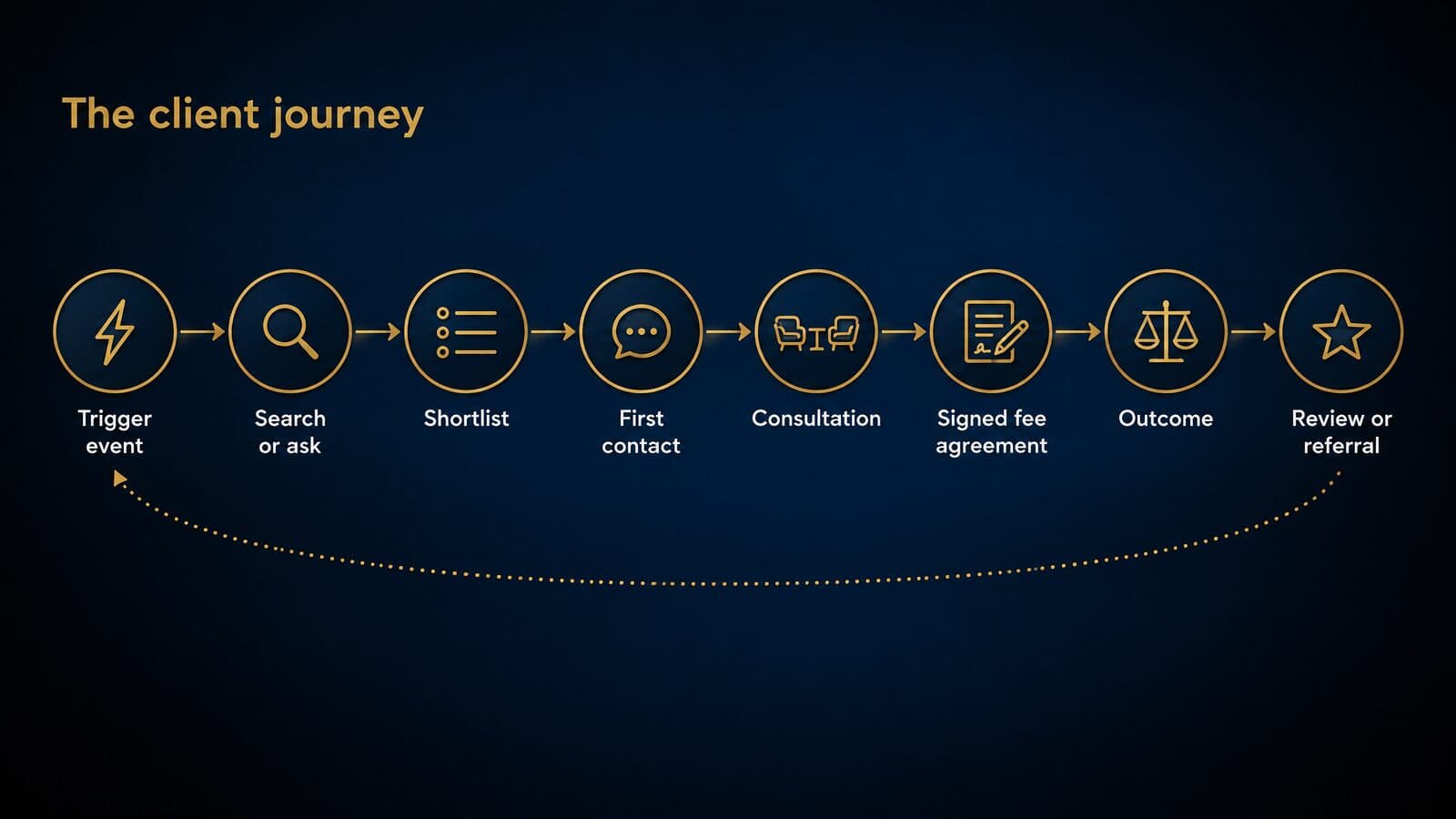
- Trigger event. A crash, an arrest, a divorce filing, a death in the family, a termination letter. Demand generation work done months earlier decides whether your name comes to mind.
- Search or ask. The person asks a friend, another lawyer or a search engine, or now an AI assistant. Referral relationships and search visibility both matter here.
- Shortlist. They narrow to a few firms. Reviews, directory profiles and the practice-area page decide who survives.
- First contact. A call, form, chat or text. Response speed and clarity decide whether the conversation continues.
- Consultation. The lawyer explains the process and fees. Clear next steps and plain language matter more than credentials alone.
- Signed fee agreement. The prospect becomes a client. A simple signing process, often electronic, removes the last excuse to wait.
- Outcome. The matter resolves. Communication during the case shapes how the client remembers the firm.
- Review or referral. A satisfied client leaves a review or sends a friend, which feeds stages two and three for the next person.
Law firm marketing terms to know
These are the terms used throughout this guide, spelled the same way in every section.
| Term | Plain meaning | Why it matters |
|---|---|---|
| Lead | Any person who contacts the firm about a possible matter | Raw volume; says nothing about fit |
| Qualified lead | A lead with a matter type, location and facts the firm accepts | The first number worth paying for |
| Consultation | A scheduled conversation with a lawyer about the matter | Shows intake turned interest into a meeting |
| Signed case | A matter with an executed fee agreement | The real unit of marketing output |
| Fee collected | Money actually received for the matter | The final test of a channel's value |
| Cost per lead (CPL) | Channel spend divided by leads | Easy to measure, easy to game |
| Cost per signed case (CPSC) | Channel spend divided by signed cases | The number to manage budgets by |
| Case value | Expected fee from a typical signed case of a given type | Sets how much you can afford per case |
| Attribution | Linking each signed case to the source that produced it | Without it, budget decisions are guesses |
| Map pack | The local business results with a map in Google Search | Where many urgent local searches end |
| Local Services Ads | Google's pay-per-lead ads with a verification badge | A capture channel billed by lead, not click |
| Intake | Answering, screening, conflict checking and booking | Where marketing turns into signed cases |
For more definitions, see the full legal marketing glossary.
How clients find and choose a lawyer
Clients use both referrals and their own searches, and many use only one of the two. A large share contact more than one firm, expect a reply within a day, and hire the firm that answers first and explains things clearly.
Referrals and self-directed search
The most detailed public breakdown of how consumers find lawyers is still Clio's 2019 Legal Trends Report. Clio sells practice-management and intake software, so treat this as vendor research. For that edition Clio surveyed 2,000 consumers and 2,507 legal professionals. It is the newest edition with this referral-versus-search breakdown that could be read in full, so the figures are dated, but the pattern is the useful part.
| Finding (Clio 2019) | Share |
|---|---|
| Sought a referral from someone they know | 59% |
| Searched on their own by some other means | 57% |
| Did both | 16% |
| Referral from friends or family | 32% |
| Referral from another lawyer | 16% |
| Referral from a non-legal professional | 9% |
| Used an online search engine | 17% |
| Visited a lawyer's website | 17% |
The overlap is the point. Clio found clients were nearly as likely to search on their own first (39%) as to seek a referral first (45%). Of the referral-first group, only 16% also looked on their own; of the search-first group, only 17% also asked for a referral. So the firm living on referrals is invisible to most people who search, and the firm living on ads is invisible to most people who ask. The common claim that referrals bring most clients so online marketing does not matter is not what this data shows.
Shopping around and response expectations
Many prospects call more than one firm. In the same Clio 2019 report, 44% of clients said they believe they need to talk to more than one lawyer, and 57% of those who had ever shopped for a lawyer contacted more than one firm. On the other side, 42% said that if they like the first lawyer they speak with, they will not need to speak with anyone else. The first good conversation often ends the search.
Expectations on speed were specific: 10% expected a response within an hour, 24% within a few hours and 45% within 24 hours. Clio's own summary is that replying after 24 hours misses the expectations of 79% of people who reach out. Only 5% said they would expect a reply after more than 72 hours.
The gap between belief and practice was wide. Of clients, 64% said they had contacted a firm that never responded, and 32% of those who had shopped did not expect a firm to get back to them. Meanwhile 89% of legal professionals said they respond to calls and emails within 24 hours.
For staffing, 79% within 24 hours means a same-day reply standard is the floor. Someone has to own evening and weekend messages, and voicemail cannot be the plan. Intake staffing models are covered in the intake section later in this guide.
What clients weigh before they hire
Clio's 2025 Legal Trends Report, which surveyed 1,000 U.S. adults and 1,702 legal professionals, says "experience and reputation remain two of the top considerations." Clients also weigh client reviews, free consultations, and clear and concise information. Clio adds that these considerations now outweigh responsiveness, which had been an even greater priority for clients in earlier editions.
Each of those factors maps to something a firm can build:
- Experience. Attorney bios that name matter types handled, years in practice, courts and bar admissions, in plain language.
- Reputation. A steady flow of reviews on Google and relevant directories, plus peer recognition where it is real.
- Reviews. A routine for asking every client at the same moment in each matter, covered in the reviews section later.
- Free consultations. If you offer them, say so on every practice page and in the ad copy. If you charge, state what the consultation includes.
- Clear information. Practice pages that explain the process, the timeline and the fee structure, and an intake script that gives next steps on the first call.
AI answers in the client's search
Some prospects now ask an AI assistant before they ask a lawyer. Clio's 2025 consumer survey found that more than half of consumers have used or would consider using AI to answer their legal questions. Of those who had used it, just over half said the AI answered the question sufficiently.
Two other figures matter more for marketing. In 28% of cases, consumers were directed by the AI to contact a lawyer. In 12% of cases, consumers were convinced by an AI that their legal problem was not worth pursuing. The first is a new referral path; the second is lost demand that no ad will ever see.
Note what these numbers do not say. They do not show that most clients find lawyers through AI, and the 28% applies to people who used AI, not to all consumers. For firms, the practical response is to publish clear, accurate answers to the questions clients ask, so that AI systems and people reading them both understand when a matter is worth a call. How to do that, and what Google says about AI Overviews, is covered in the SEO and AI answers section.
When a firm needs little marketing
Some firms need very little marketing. A solo with a full calendar of repeat estate-planning clients from three trusted financial advisors, or a firm that is already turning work away, may get more from raising rates than from buying ads. Capacity is a real constraint, and marketing that brings matters you cannot staff hurts reputation.
The risk is concentration. When most matters come from one or two referral sources, the firm's pipeline depends on those people. A referring lawyer retires, an advisor joins a firm with in-house counsel, or a competitor starts answering calls faster and gets the overflow. In my opinion, even a referral-rich firm should keep a basic search presence, a current Business Profile and a measured intake process, so it can tell when the stream is thinning before revenue shows it.
Build a law firm marketing strategy before tactics
A law firm marketing strategy is a small set of choices about which clients you serve, where, and why they should pick you over the alternatives. Tactics such as SEO, ads and social posts only work when they serve those choices.
Strategy, plan and tactics
Strategy is the set of choices: whom to serve, where, and on what basis you win. A family-law strategy might be: serve high-asset divorces in two suburban counties, win on financial expertise and discretion. A plan turns the strategy into goals, budgets, owners and dates for a period, such as a 12-month plan to grow signed high-asset divorce matters with a set budget and a named person accountable for each channel. Tactics are the specific actions: a practice page on business valuation in divorce, a referral lunch series with forensic accountants, a search campaign on high-asset divorce phrases in the two counties.
Five strategic choices for a law firm
The most useful structure I know comes from A.G. Lafley and Roger Martin's Playing to Win: How Strategy Really Works, written from their work together at Procter & Gamble. As summarized by Farnam Street, the book treats strategy as five linked choices: a winning aspiration, where to play, how to win, the capabilities required, and the management systems that support them. Each choice narrows the next.
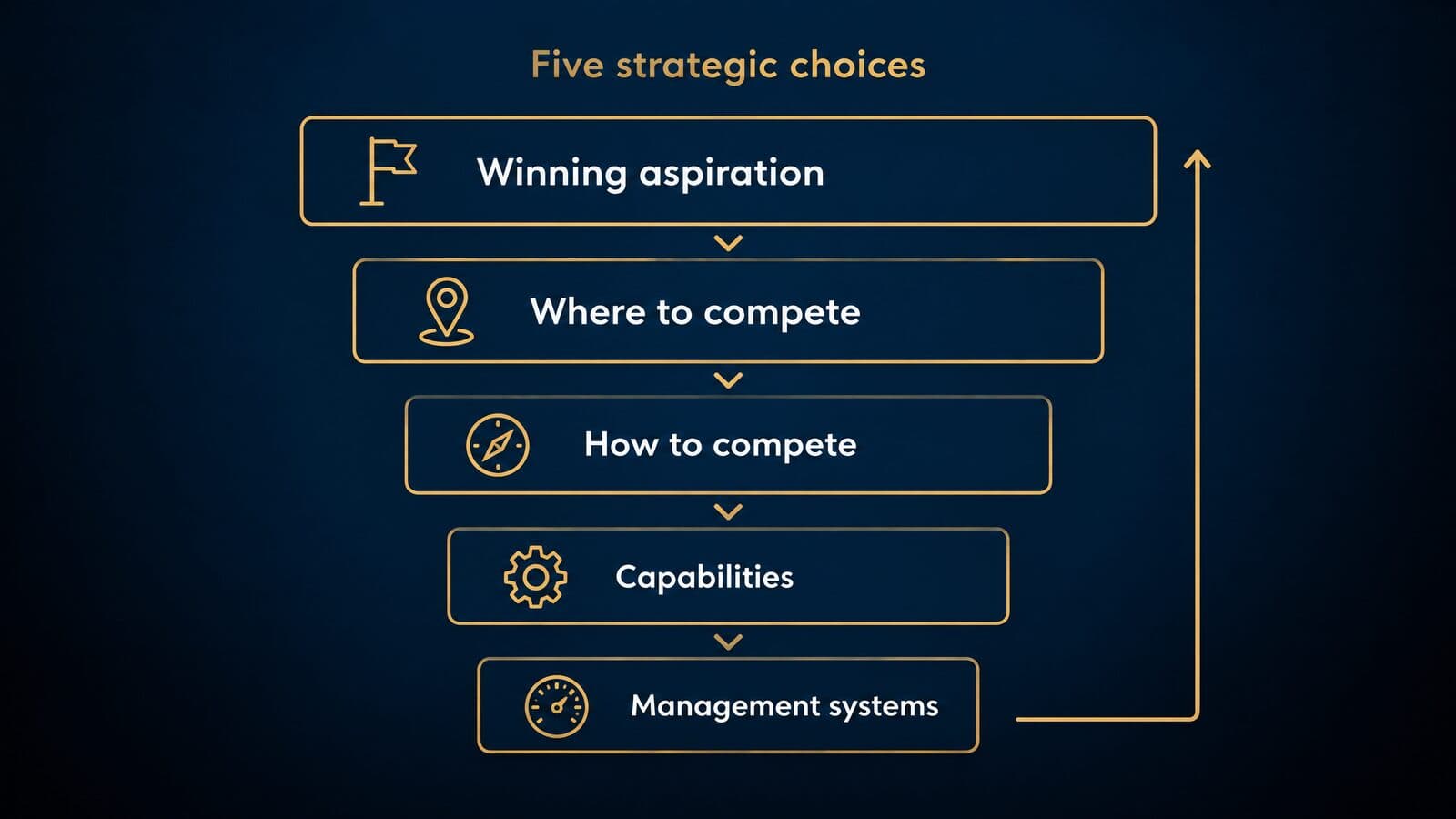
Adapted for a law firm, the cascade becomes the one-page strategy below. The examples are hypothetical firms, written to show the level of specificity each answer needs. You can copy the worksheet and fill in your own column.
| Choice | Question to answer | Example answer (estate planning firm) | Example answer (criminal defense firm) |
|---|---|---|---|
| Winning aspiration | What does success look like in three years? | The first call for business-owner estate plans in our metro | The defense firm local DUI and drug clients call first |
| Where to compete | Which clients, matters and places? | Owners of closely held businesses, two counties | DUI, drug and weapons charges in three county courts |
| How to compete | Why pick us over the alternatives? | Succession planning tied to the business, flat fees | Former prosecutors, same-hour callback, clear fee quotes |
| Capabilities | What must we be good at? | Tax coordination, advisor referrals, plain-language drafting | 24/7 answering, court-specific knowledge, quick bond help |
| Management systems | How do we run and measure it? | Monthly referral-source review, CPSC by source | Weekly intake review, call recording, CPSC by channel |
The worksheet only works if each answer rules something out. "Everyone in the state who needs a lawyer" is not a where-to-compete answer. Neither is "great service" a how-to-compete answer, since every competitor claims it.
Define what winning looks like
Winning should be defined in signed cases, case mix, fees collected and capacity, because those are the numbers that pay salaries. Website traffic, followers and impressions are useful diagnostics. They are not goals, because a firm can double traffic and sign no more cases.
A usable goal names the matter type, the volume, the place and the cost. A template:
By [date], sign [N] [matter type] cases a month in [area] at a cost per signed case under [$X].
Fill in each placeholder from your own numbers. Matter type and case mix matter because more low-value matters can mean less revenue. Capacity matters because a goal the firm cannot staff will damage reviews and referral relationships. The allowable cost per signed case comes from your fee model and is worked out in the marketing math section of this guide.
Where to compete: two versions of one firm
Where you compete is the choice that changes everything downstream: which keywords you buy, which directories matter, what your pages say and who answers the phone. The exercise below compares two versions of the same hypothetical family-law firm, one generalist and one focused, and then shows the same logic for an employment practice.
| Decision | Version A: generalist | Version B: focused |
|---|---|---|
| Geography | The whole state | Two adjacent counties where the partners appear in court |
| Matter types | Divorce, custody, adoption, support, protective orders | Contested custody and high-asset divorce |
| Client segment | Anyone with a family-law problem | Parents and business owners with complex finances |
| Channels | Broad search ads, every directory, general social posts | Local search on custody and asset phrases, accountant and therapist referrals |
| Message | Experienced, compassionate family lawyers | Custody and complex-asset divorce in our two counties |
| Intake | Takes every call, screens later | Screens on county, matter type and assets on the first call |
Version A competes with every family-law firm in the state, on every phrase, with no reason for a client to choose it. Version B gives up most of the market and becomes the clear answer for a narrow slice.
The same logic holds outside family law. A hypothetical employment firm could take any workplace dispute anywhere in the state, or it could represent employees in wage-and-hour and retaliation claims in one metro, partner with labor-friendly CPAs and unions for referrals, and write pages on the specific statutes involved. The focused version is easier to market because every tactic has a clear target.
How to compete: cost, differentiation or focus
How you compete is the basis on which clients choose you. The classic structure comes from Michael Porter's Competitive Strategy (Free Press, 1980), whose generic strategies are cost leadership, differentiation and focus, as summarized by EBSCO's research starter.
A cost-led law practice wins by being the efficient, predictable-price option: flat-fee packages, productized services such as uncontested divorces or simple wills, heavy use of templates and software, and fast turnaround. The marketing message is price certainty, and the business only works with tight processes and volume. Be careful with the examples often given for this model. Online legal-services companies are sometimes described as law firms that win on cost, but LegalZoom's own site says it "is not a law firm" and does not provide legal advice except through its subsidiary law firm. Describe the model, not those companies.
Differentiation means being chosen for something clients value and competitors do not offer: former prosecutors on a defense team, Spanish-speaking lawyers and staff, a trial record in a specific venue, evening hours. Focus means applying either approach to a narrow segment, like the Version B firm above. Most small firms are best served by focus plus differentiation, because they cannot match national firms on spend or online services on price. For injury practices, see the marketing strategies PI agencies actually use.
Capabilities and management systems
Capabilities are what the firm must be good at for the strategy to work. Management systems are the routines that keep those capabilities working without heroics.
For most firms the capability list is short: people who can answer and screen calls well at the hours clients call; lawyers who can explain the process and fee in plain language at consultation; a way to produce useful content and pages regularly; a review routine; and a tool stack that tracks each matter from first contact to fee collected.
The management systems are the meetings and reports that check those capabilities: a weekly intake review that listens to a sample of calls, a monthly report of signed cases and cost per signed case by source, and a quarterly look at whether the where-to-compete and how-to-compete choices still hold. I suggest revisiting the full one-page strategy once a year, or sooner if a major referral source changes or a new competitor enters. The team roles that run these systems are covered in the team and agency section near the end of this guide.
Research your clients and your real competitors
Research replaces guesses about why clients hire you and whom you actually lose them to. It takes a few weeks of interviews, intake data and search checks, and it usually changes at least one of the five choices.
Client interviews that do not lead the answer
Talk to recent clients, both those who signed and, where possible, people who consulted and hired someone else. Ask open questions and let silences run; the goal is the client's words, not confirmation of what you hoped. Use a script like this:
- Tell me what was happening when you first realized you needed a lawyer.
- What did you do first to find help?
- Who else did you contact or consider, and how did you hear about them?
- What were you most worried about when you first called a firm?
- What made you choose the firm you chose?
- What almost stopped you from going ahead?
- What did you expect the first call or meeting to be like, and how did it compare?
- If a friend had the same problem tomorrow, what would you tell them to look for?
Record the answers, with permission, and note the exact phrases people use for their problem. Those phrases become page headings, ad copy and search terms. Do not ask "Was our response time good?" or "Did you like our website?"; those questions supply the answer.
Mine intake calls, reviews and source questions
Your intake records already hold research data if you capture it properly. Make "How did you hear about us?" a required field with fixed options, such as search engine, map listing, a named directory, a referral from another lawyer, a referral from a friend or family member, TV, radio, social media, an AI assistant and other, plus a free-text box for detail. Fixed options make the data countable; the free text catches sources you did not list.
Review a sample of recorded intake calls each month for the words callers use and the questions they ask before they agree to a consultation.
Then read your reviews and your competitors' reviews. Look for repeated phrases about what clients valued and what annoyed them. Complaints about a competitor's slow callbacks or surprise fees point to a differentiation opportunity you can actually deliver.
Find out who really owns your search results
Your real online competitors are often not the firms you think. Open a private browser window and search your ten most important matter-plus-city phrases, such as "custody lawyer" plus your county or "DUI attorney" plus your city. For each search, record who appears: the ads, the map pack, the organic results, any AI Overview, and the sources it cites.
You will usually find a mix of local firms, national firms, legal directories and lead-generation sites. Each calls for a different response.
For data, Google Ads Keyword Planner shows how often people search for terms, how that has changed over time, and suggested bid estimates for your market. Google Search Console shows which queries already bring users to your site, with impressions, clicks and position. Pull both for your own area and date; national averages will not tell you what your market costs.
Five forces in a local legal market
Porter's five forces, as set out by Harvard Business School's Institute for Strategy and Competitiveness, are rivalry among existing competitors, the threat of new entrants, the threat of substitutes, the bargaining power of buyers and the bargaining power of suppliers. They apply neatly to a local practice and show where marketing pressure will come from.
| Force | What it looks like for a law firm | Question to ask |
|---|---|---|
| Rivalry | Local firms bidding on the same phrases and courting the same referral sources | How many firms are clearly focused on our matter type here? |
| New entrants | National firms, new solos and out-of-market advertisers entering our area | Who started advertising here in the last year? |
| Substitutes | Self-help forms, online legal services and AI answers | Which of our matters can a client handle without a lawyer? |
| Client bargaining power | Clients who compare quotes and switch easily | How often do prospects tell us they are calling other firms? |
| Supplier power | Lead vendors, ad platforms and directories that control access to clients | How much of our intake depends on one platform or vendor? |
A market with heavy rivalry and strong supplier power, such as an urban injury market where most leads come through a few platforms, rewards firms that build their own referral and brand demand. A market with strong substitutes, such as simple wills, rewards firms that move up to matters self-help cannot handle.
What the interviews, intake data and search checks reveal should shape how the firm presents itself: the words it uses, the proof it shows and the promise it makes. That is the job of brand and positioning, which comes next.
Brand, positioning and messaging for law firms
A law firm brand is the reason a prospective client remembers you, trusts you and picks up the phone. It lives less in your logo than in what you say about the work, the proof behind it, and how your intake team treats people on the first call.
The client and competitor research from the previous section is raw material. This section turns it into a position: a short, defensible statement of who you serve and why they should choose you, and then the words and habits that carry that position into every channel. Skip this step and every later channel ends up competing on price or on volume, which is the most expensive way to buy attention.
What a law firm brand is made of
A firm's brand has five working parts, and only one of them is visual.
- Name. Easy to say on the phone, easy to spell into a search bar, and identical in every listing.
- Visual identity. Logo, colors and type. These need to be clean and consistent, and that is most of their job.
- Voice. How the firm sounds in writing and on calls: plain, calm and specific, or formal and technical.
- Proof. The evidence behind your claims: credentials, years in a practice area, reviews, published work, peer recognition.
- Client experience. How fast you answer, whether people understand the next step, and how they feel after a consultation even if they do not hire you.
Firms often spend months on a logo and a weekend on intake scripts. The order should be reversed. A prospect who calls three firms remembers the one that answered, explained the process in plain words and followed up when promised. Fonts and colors help recognition only once the firm is already doing the things worth recognizing. Consistency and proof are what make a brand believable, and both are cheap compared with a redesign.
A positioning statement you can defend
A positioning statement is an internal sentence that forces you to name your client, the problem, your area and your difference. You will rarely publish it word for word, but every practice page, ad and intake script should be traceable back to it. Use this template:
For [client] facing [problem] in [area], [firm] is the [category] that [difference], because [proof].
Two filled-in examples, using hypothetical firms:
- Immigration (hypothetical): "For employers in the Houston area who need to sponsor skilled workers, Example Immigration Law is the business immigration practice that handles the full petition process in English and Spanish, because both partners have practiced only employment-based immigration for their whole careers."
- Employment (hypothetical): "For hourly workers in Ohio who believe they were not paid for overtime, Example Employment Law is the wage-and-hour firm that tells callers within one conversation whether their claim is worth pursuing, because the firm screens every inquiry with a lawyer rather than a call center."
Notice what is missing: no "best", no "aggressive", no promised outcomes. Every claim in the statement has to be true and provable, because ABA Model Rule 7.1 bars any "false or misleading communication about the lawyer or the lawyer's services", including statements that omit a fact needed to keep the whole from misleading. States adopt their own versions of that rule, so check yours. The ethics section later in this guide covers the detail. A good test: if a bar investigator asked you to prove each clause, could you hand over a document?
Plain-language messaging by audience
One position needs several messages, because the people who reach a law firm arrive in different states of mind.
- The person in crisis (arrested, injured, served with papers) wants to know three things fast: can you help, what happens next, and how do I reach you now. Short sentences, a visible phone number, and the next step in the first screen.
- The deliberating client or family (planning an estate, considering divorce, weighing an immigration path) wants to understand options and costs before calling. Give them process explanations, fee structure in general terms, and what to bring to a consultation.
- The referring lawyer wants to know exactly what you take, what you decline, how you handle fee division and how quickly you report back. They read your bio and case-type list, not your hero banner.
Across all three, plain words beat legal jargon. Here is a practice-page sentence before and after a rewrite:
- Before: "Our firm zealously advocates for clients in all matters pertaining to the dissolution of marriage, including equitable distribution and spousal maintenance determinations."
- After: "If you are getting divorced, the firm helps you divide property and debts fairly and work out whether either spouse will pay support. The first meeting covers what the process looks like in your county and what it is likely to cost."
The second version answers the reader's actual questions. It is also easier for search engines and AI assistants to quote, which matters for the channels in the next sections.
Keep the brand consistent across channels
Consistency is the cheapest brand work a firm can do, and the place most firms leak trust. Run this checklist once a quarter:
- Firm name, address and phone number are identical on the website, Google Business Profile, directories, bar listings and social profiles (the foundations section returns to these citations).
- Lawyer photos are current and the same across the site, profiles and directories.
- Practice-area names match everywhere: if the site says "workers' compensation", the directory listing should not say "on-the-job injury".
- The phone greeting states the firm name and the caller's next step, the same way every time, including after hours.
- Email signatures carry the same name, title, phone number and address format for every lawyer and staff member.
- Review responses use the firm's voice, never confirm that the reviewer is a client, and never disclose case details.
- Intake follow-up texts and emails use the same tone and sign-off as the website.
- Old logos, retired phone numbers and former office addresses are removed from every listing you control.
Marketing math: cost per signed case and KPIs
The number that matters is what you pay to sign a case compared with the fee that case is likely to earn. Clicks, impressions and even leads are steps toward that number, and a channel that looks cheap on any of them can be the most expensive once you count signed cases.
This section sets out the signed-case math every later channel is judged by: what your fee model lets you spend, how a dollar travels from spend to signed case, why cost per lead misleads, and the KPI ladder that replaces vanity reporting.
Your fee model sets the allowable cost per case
How you charge decides how much you can afford to pay for a new client, and how long you wait to get that money back. A contingency practice fronts the acquisition cost and recovers it, if at all, months or years later. A flat-fee practice recovers it in weeks. The table below sets out the five common models.
| Fee model | How fees arrive | Marketing implication | Example practice areas |
|---|---|---|---|
| Contingency | A share of the recovery, only if the case resolves in the client's favor | Acquisition cost is fronted and recovered late; screen hard and judge channels by fees collected | Personal injury, mass tort, employment, medical malpractice |
| Hourly | Billed as work is done, often against a retainer | Repeat and referral clients are worth more than one-off matters; nurture past clients | Business litigation, complex family law, IP |
| Flat fee | A set price per matter, usually paid up front or in installments | Fast payback; volume and conversion speed matter most | Estate planning, uncontested divorce, simple bankruptcy, traffic |
| Hybrid | A reduced hourly or flat component plus a contingent or success element | Model both streams; the fixed part funds acquisition while the contingent part pays later | Some employment and commercial cases |
| Subscription or retainer | A recurring monthly or annual fee for ongoing access | Lifetime value drives the budget; retention is part of marketing | Outside general counsel for small businesses, some estate and business plans |
This guide gives no contingency percentages: they vary by state, case type and stage of resolution, and state rules on them differ. One rule applies everywhere the ABA model is adopted: ABA Model Rule 1.5(c) requires a contingent fee agreement to be "in a writing signed by the client" stating how the fee is determined. That signed agreement is the "signed case" this guide counts. A verbal yes on the phone is not one, and your reporting should not treat it as one. Your state's version of Rule 1.5 may add requirements, so check it.
The chain from lead to fee, worked through
Cost per signed case (CPSC) is your marketing spend divided by the number of signed cases it produced. The same number can be built step by step: CPSC equals cost per lead (CPL) divided by the product of your contact rate, consultation rate and sign rate.
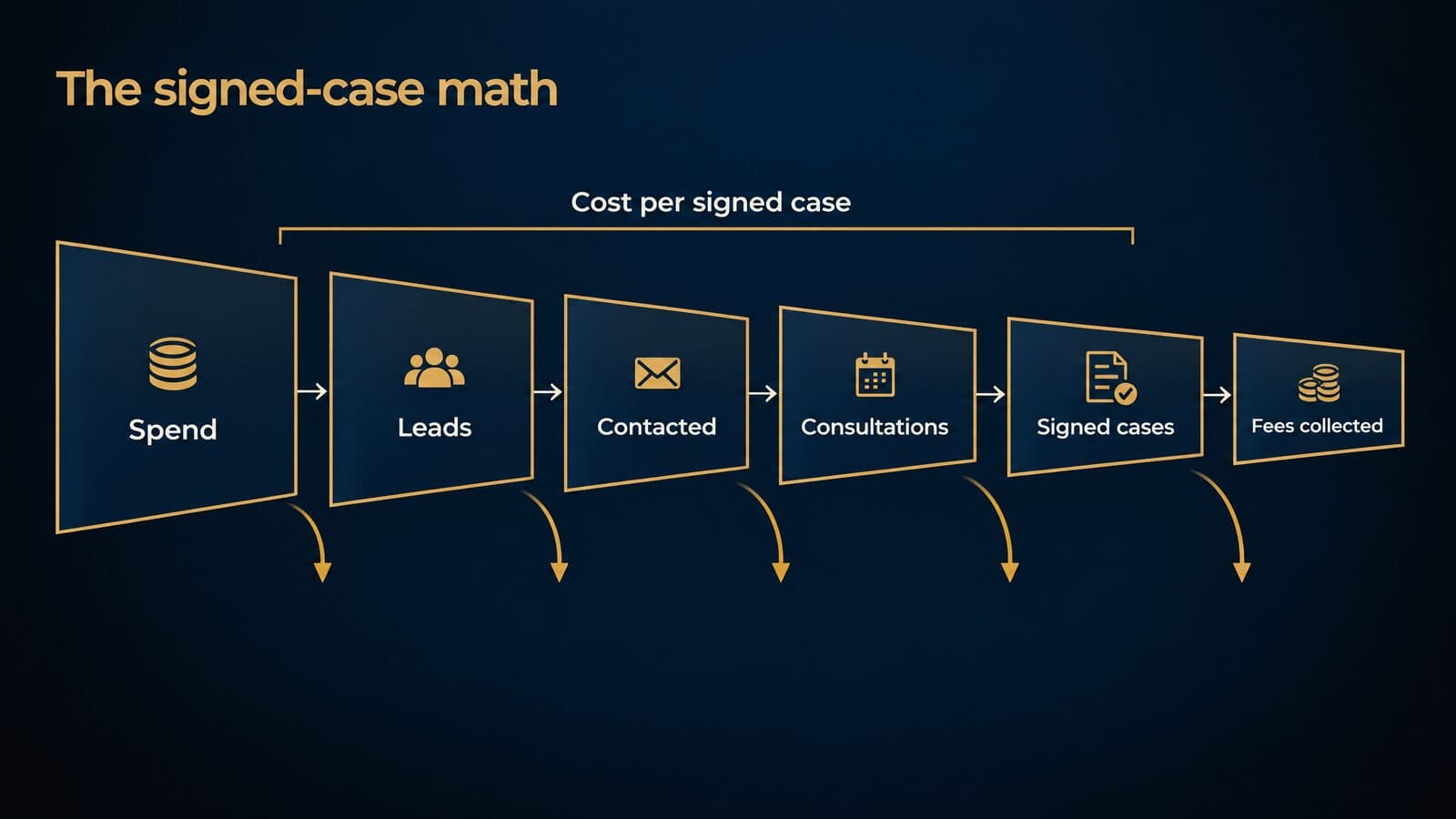
Writing it as a chain shows where money leaks. Every rate below 100% multiplies the real cost of each case. The table uses round numbers that are hypothetical, not a benchmark; they exist only to show the arithmetic.
| Step | Hypothetical input | Result |
|---|---|---|
| Monthly marketing spend | $10,000 | $10,000 |
| Leads received | 100 leads | CPL = $10,000 ÷ 100 = $100 |
| Contact rate | 70% reached | 70 people spoken to |
| Consultation rate | 40% of contacted book and attend | 28 consultations |
| Sign rate | 50% of consultations sign | 14 signed cases |
| Cost per signed case | $10,000 ÷ 14 | About $714 |
Now change one number. Suppose better intake lifts the contact rate from 70% to 90%, with everything else held the same. The firm now reaches 90 people, holds 36 consultations and signs 18 cases. CPSC falls from about $714 to about $556, without a dollar more in ad spend and without a single extra lead. That is why the intake section later in this guide matters as much as any channel: answering the phone is a lever on unit cost.
Run it the other way, too. If a vendor offers leads at half the price but your contact rate on them drops to 35%, the cheaper leads can produce the same or a higher CPSC. The formula forces that comparison into the open.
For one published reference point on the top of the chain, WordStream and LocaliQ's Google Ads Benchmarks 2026 report that the Attorneys and Legal Services category had a median cost per click of $9.87 and a cost per lead of $131.63, both the highest of any industry in their sample of 13,474 U.S. search campaigns run between April 2025 and March 2026. Those are category medians from one publisher's data, not figures for your practice area or city.
For the bottom of the chain, MTMA's Q1 2026 mass tort benchmark, published with its cost-per-signed-retainer benchmarks, puts the national median cost per signed retainer at $3,850 across 14 published tort categories, up from a Q4 2024 median of $3,100. Read it with its stated limits: the number of firms behind the national median is not tracked, a confidence interval is described as not computable, and the industry sources used to cross-check panel ranges are not named in the published methodology. It is a mass tort figure from self-reported data, not a general law firm benchmark, and it should not be applied to family, criminal or estate work.
Cost per lead versus cost per signed case
Cost per lead is easy to measure and easy to lower, which is exactly why it misleads. A channel can cut CPL by loosening targeting, by sending form fills from people outside your area or practice, or by counting duplicate and wrong-number contacts as leads. Each of those lowers CPL and raises the work your intake team does for nothing.
Cost per signed case pulls in everything CPL leaves out: lead quality, intake speed, consultation show rates and your closing ability. It also makes channels comparable. A referral that costs a lunch and a search lead that costs a few hundred dollars can be measured on the same scale once both are traced to signed agreements.
Be careful with outside figures. A 2026 review of why published law firm marketing benchmarks disagree found that published 2026 cost-per-signed-case figures "range from $69.99 to $11,500" and that only two of the five sources examined disclosed a methodology. Different denominators (leads, consultations, retainers), practice areas and markets explain much of the gap. Your own CPSC, tracked monthly by channel, is the only benchmark you can fully trust.
A practical rule: report CPL weekly to catch problems early, but make budget decisions only on CPSC and fees collected, measured over a long enough window for cases to sign.
The KPI ladder from impression to fee collected
The KPI ladder is a reporting structure that climbs from visibility to money, so that every metric you track connects to the one above it. Use it in place of the traffic and follower counts that fill most agency reports.
| Rung | Metric | Formula | Review cadence |
|---|---|---|---|
| Visibility | Impressions, branded searches | Counts from Search Console, ad platforms and profiles | Monthly |
| Response | Leads, cost per lead | CPL = spend ÷ leads | Weekly |
| Quality | Qualified lead rate | Qualified leads ÷ all leads | Weekly |
| Conversion | Consultation rate, sign rate | Consultations ÷ contacted; signed ÷ consultations | Weekly |
| Economics | CPSC, fees collected, return on spend | Spend ÷ signed cases; fees collected ÷ spend | Monthly and quarterly |
| Reputation | New reviews, referral share | Reviews per month; referred cases ÷ all signed cases | Monthly |
Three working notes make the ladder useful. First, define "qualified" in writing before you measure it: the right practice area, the right geography, within the limitation period, no conflict. Second, tag every lead with its source at intake so each rung can be split by channel. Third, return on spend for contingency work has to be measured on fees actually collected, which can lag a year or more, so track it by the month the case signed and update it as cases resolve. A channel that looks weak this quarter can turn out to be the best one once its cases pay.
How much to spend on law firm marketing
There is no reliable percentage-of-revenue rule for law firm marketing budgets. The sound method is to work backward from the number of signed cases you want and the most you can afford to pay for each one.
Why percentage-of-revenue rules fall short
Guides often state that law firms spend a fixed share of gross revenue on marketing, with a higher share for firms in growth mode. I looked for the primary source behind those figures and found none: no survey, no dataset, no method. Treat any such percentage as an unsourced rule of thumb.
The best neutral data shows how informal budgeting still is. In the ABA's 2022 Websites and Marketing TechReport, only 57% of respondents said their firm had an annual marketing budget. None of the solo practitioners surveyed had one, and only 29% of respondents in firms of 2 to 9 lawyers did. Twenty-six percent said their budget had increased over the past year, and 30% expected marketing to be more important the following year.
A percentage rule also ignores the variables that actually decide what a firm can spend: fee model, average case value, time to collect and conversion rates. Two firms with the same revenue can have very different allowable budgets.
Budget backward from a case target
This worksheet builds a budget from the signed-case math. The numbers below are the same hypothetical inputs used in the worked example above, so you can follow the arithmetic; replace each one with your own data.
- Set a signed-case target. Decide how many new signed cases you want per month. Hypothetical: 14.
- Estimate the average fee per case. Use your last two years of collected fees by case type, not your best outcomes. Hypothetical: $5,000 per matter.
- Choose an allowable CPSC. Decide what share of that fee you will spend to acquire the case, leaving room for case costs, staff and profit. Hypothetical: no more than $1,000 per signed case.
- Write down your conversion chain. Use your measured contact, consultation and sign rates. Hypothetical: 70%, 40% and 50%, which means one signed case for every 7.1 leads or so.
- Calculate required leads. Divide the case target by the combined rate (0.7 × 0.4 × 0.5 = 0.14). Hypothetical: 14 ÷ 0.14 = 100 leads.
- Calculate required spend and test it. Multiply leads by expected CPL. Hypothetical: 100 × $100 = $10,000, giving a CPSC of about $714, under the $1,000 ceiling. If the spend you need is more than you can afford, fix conversion before you raise the budget.
Step 6 is where most firms find the real constraint. If the plan fails the test, the cheapest fix is almost always in steps 4 and 5, not in finding cheaper leads.
Two edge cases change the worksheet. A contingency firm must also fund the gap between spend and collection, so add a cash-flow line: how many months of spend can you carry before fees arrive? And a brand-new firm has no conversion history, so run the worksheet with conservative guesses, spend a small test budget for two or three months, then rerun it with measured rates.
What to fund first at each firm stage
What a firm should fund first depends more on its stage than its size of ambition. The table below is my practitioner recommendation, not survey data; adjust it for your practice area and market.
| Firm stage | Fund first | Add next | Hold off on |
|---|---|---|---|
| New or solo | Google Business Profile, a clear website, a reliable phone answer, review requests | Referral relationships with other lawyers, one search channel in a tight area | TV, broad paid social, multi-year agency contracts |
| Small (2 to 9 lawyers) | Call tracking and intake process, practice-area pages, steady reviews | Search ads or Local Services Ads, email to past clients | Multiple agencies at once, untested lead vendors |
| Mid-size | A marketing lead or manager, CRM with source tracking, SEO content | Video, community sponsorships, a second paid channel | Channels you cannot measure to signed cases |
| Multi-office | Location pages and profiles per office, central intake standards | Regional brand campaigns, offline conversion import into ad platforms | Office-by-office vendors with separate reporting |
| National plaintiff | 24/7 intake, compliance review, vendor and lead auditing | Broadcast and streaming, co-counsel networks, docket monitoring | Volume deals without return terms or disqualification criteria |
The pattern across rows is the same: fund the things that make every later dollar work harder (answering, tracking, proof) before the things that bring in more volume.
How long each channel takes to produce cases
Timing matters for budgeting because some channels need months of spend before they produce a signed case. Google offers the only sourced statement here, and it covers SEO alone: its SEO Starter Guide says "some changes might take effect in a few hours, others could take several months," and that you "likely want to wait a few weeks to assess whether your work had beneficial effects in Google Search results." Everything else in the table below is practitioner experience, not measured data.
| Channel | First leads (practitioner range, labelled) | What slows it |
|---|---|---|
| Search ads | Days | Account setup, conversion tracking, approvals |
| Local Services Ads | Days to weeks | Verification and onboarding, license checks |
| Google Business Profile | Weeks to months | Verification, review volume, competition in the map pack |
| Organic SEO | Months to a year or more | Competition, site authority, content depth |
| Legal directories | Weeks | Profile completeness, category competition |
| Referral networks | Months | Relationship building, proving reliability to referrers |
| Paid social | Days to weeks | Creative testing, lead quality filtering |
| TV and streaming | Weeks to months | Production, media buying, frequency needed to build recall |
| Email to past clients | Days, for referrals and repeat matters | List quality, consent, clean data |
| Content and video | Months | Volume of material, distribution |
Plan the budget so faster channels carry the firm while slower ones mature, and judge each against the time it realistically needs before you cut it.
Which marketing channels fit which practice areas
Channel choice follows two things: how urgent the client's need is, and how much clients in that practice area rely on referrals. Place your practice area on those two axes and the right starting channels mostly choose themselves.
A demand-mode matrix for choosing channels
The demand-mode matrix is a simple two-by-two. One axis is urgency of need: urgent (a client needs help today or this week) versus considered (the client researches over weeks or months). The other is referral reliance: high (most clients come through another person) versus low (most clients search on their own).
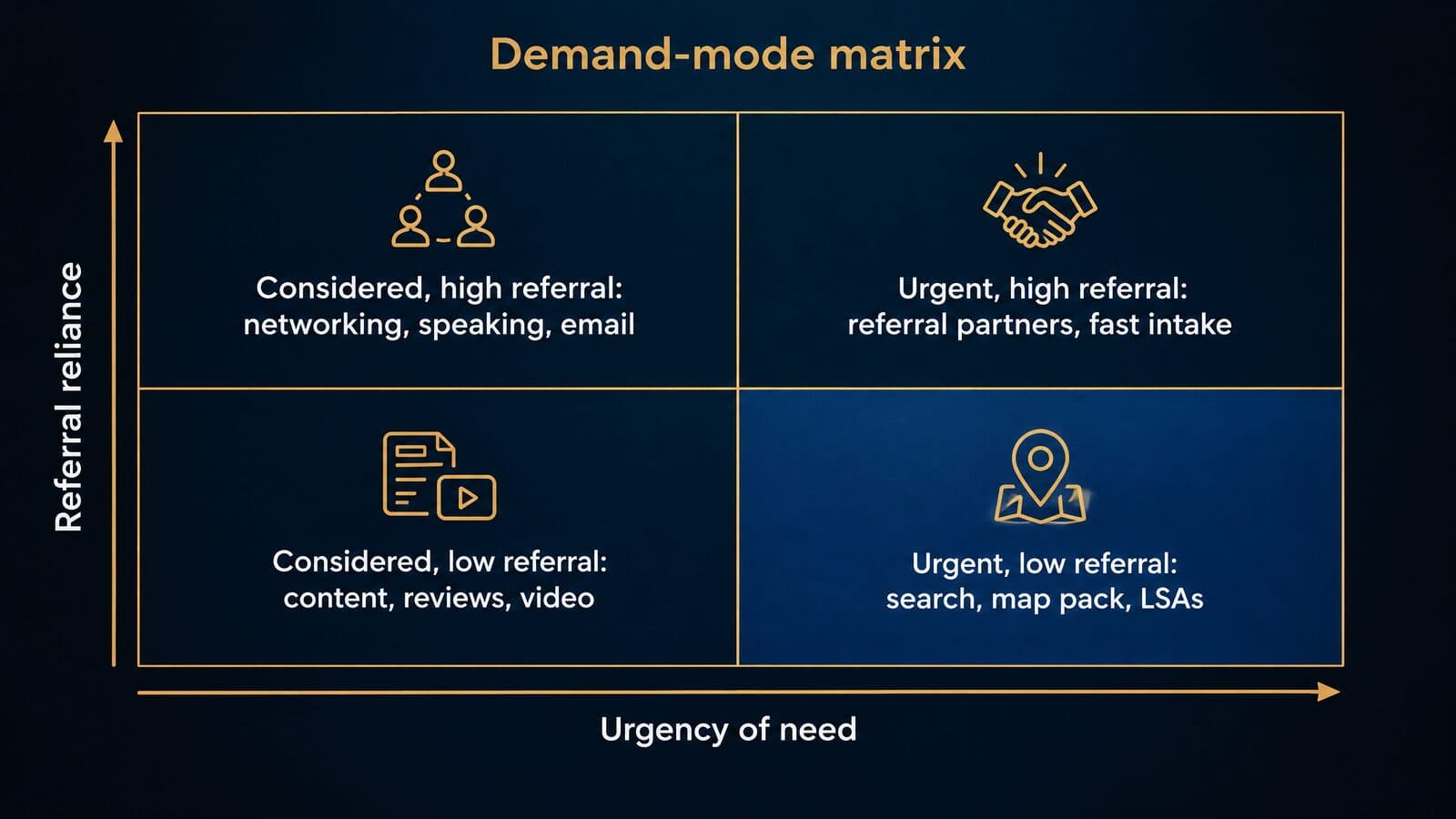
Each quadrant points to a different starting mix:
- Urgent, low referral. People search right away and pick from the first credible results. Lead with demand capture: search ads, the map pack, Local Services Ads, and an intake team that answers at once. Typical fits: injury, DUI, many criminal matters.
- Urgent, high referral. The need is immediate, but clients ask a trusted person first. Lead with referral partners who will send cases quickly, and intake fast enough that referrers are not embarrassed. Typical fits: serious criminal charges for professionals, some catastrophic injury, medical malpractice through other lawyers.
- Considered, low referral. Clients research on their own over time. Lead with content, reviews and video that answer their questions, then easy consultation booking. Typical fits: estate planning, uncontested divorce, many immigration matters, consumer bankruptcy.
- Considered, high referral. Clients and their advisers choose slowly and by reputation. Lead with networking, speaking, publishing and email that keeps you in mind. Typical fits: business law, IP, complex litigation, high-asset family law.
A practice can sit in more than one quadrant; a family firm may handle urgent protective orders and considered estate-related divorces. In that case, map each major case type separately and budget by case type.
Channel fit by practice area
The table below applies the matrix to common practice areas. It is practitioner judgment, not survey data, and local markets vary. One verified anchor: Google's Local Services Ads help page lists legal categories including bankruptcy, business, contract, criminal, DUI, disability, estate, family, IP, immigration, labor, litigation, malpractice, personal injury and traffic lawyer services, so most consumer practices can at least test that channel.
| Practice area | Demand mode | Lead channels | Support channels | Watch out for |
|---|---|---|---|---|
| Personal injury | Urgent, low referral | Search ads, map pack, LSAs, TV in larger markets | Reviews, lawyer referrals, video | High click costs, solicitation rules after accidents |
| Criminal defense and DUI | Urgent, low referral | Map pack, LSAs, search ads, 24/7 phone | Reviews, bail and jail-call visibility, directories | After-hours calls, jail-call timing |
| Family | Mixed, mostly considered | Practice pages, reviews, search ads | Video, seminars, therapist and accountant referrals | Emotional callers, conflict checks on both spouses |
| Estate planning | Considered, mixed referral | Content, reviews, seminars, consult booking | Email, financial adviser referrals | Price shoppers, long decision cycles |
| Immigration | Considered, mixed referral | Multilingual content, reviews, community outreach | Video, LSAs, consulate and employer networks | Notario fraud confusion, language access |
| Bankruptcy | Considered, low referral | Search ads, practice pages, LSAs | Reviews, content on options | Lead quality, debt-relief scam lookalikes |
| Employment | Considered, mixed referral | Practice pages, screening forms, lawyer referrals | Content, search ads | High rejection rates at screening |
| Workers' comp | Urgent, mixed referral | Search, LSAs, union and medical relationships | Multilingual intake, reviews | State-specific rules, low fees per case |
| Medical malpractice | Considered, high referral | Lawyer referrals, reputation, content | Search ads for specific harms | Most inquiries do not qualify |
| Business and IP | Considered, high referral | Referrals, LinkedIn, speaking, publications | Peer ratings, email newsletters | Long sales cycles, conflicts |
| Mass tort | Docket-driven, national | Lead generation, TV and streaming, co-counsel | Paid social, content on each tort | Compliance, vendor quality, timing |
Read the "Watch out for" column first. It usually decides whether a channel that fits on paper will work in your office.
Urgent matters: injury, criminal defense and DUI
Urgent practices win on speed. The client calls the first firm that looks credible and answers, so the lead channels are those that put a phone number in front of someone at the moment of need: the map pack, Local Services Ads and search ads. Intake has to answer live, at night and on weekends, because an arrest or crash does not wait for office hours.
Injury work adds broadcast in larger markets, since TV and streaming build the name recall that makes a prospect pick your result over a stranger's. Injury acquisition is expensive, so the signed-case math above is not optional. For current numbers on that side, see what personal injury leads cost. Criminal defense adds a timing problem: many calls come from jails or family members, so the firm's number and the call-handling process must work for collect and relayed calls.
Considered matters: family, estate, immigration, bankruptcy
In considered practices, the client reads before calling. They compare firms over days or weeks, often late at night, and they want to understand the process and the cost before they talk to anyone. Content that answers specific questions, reviews that describe the experience, and short videos of the lawyers explaining common situations do most of the work.
Make booking easy: an online scheduler, clear consultation fees or a clear statement that the first meeting is free, and a reminder sequence so booked consultations actually happen. Seminars still work for estate planning, especially in partnership with financial advisers. Immigration and bankruptcy both need multilingual intake and plain explanations that separate a licensed lawyer from the notarios and debt-relief companies that prey on the same audience.
Employment, workers' comp and medical malpractice
These practices screen out far more inquiries than they accept. Employment claims hinge on facts, dates and documents; medical malpractice needs a serious, provable injury and expert support before a firm can take it; workers' comp cases follow state systems with their own deadlines and limited fees. Marketing for these areas should be built around screening.
That means intake forms and scripts that ask the disqualifying questions early, polite and useful referrals out for cases you decline, and a strong network of other lawyers who send you the matters they cannot take. Referrals from other firms are often the best source in these areas, because the referring lawyer has already done a first screen. Search ads work best when tied to specific harms or employer practices rather than broad terms.
Business, IP and complex litigation
Business, IP and complex litigation work is chosen slowly, by people who often have advisers and who rely on reputation. Referrals from accountants, bankers, other lawyers and past clients lead. LinkedIn is the natural social channel: in the ABA's 2023 Websites and Marketing TechReport, respondents reported that 83% of firms with a social media presence were on LinkedIn.
Speaking at industry events, writing for trade publications and keeping an email newsletter that interprets new rules or decisions for clients do more here than ads. Peer ratings and recognitions matter because buyers and their advisers check them. Ads still have a role for narrow, high-value searches, but they support a reputation rather than create one.
Mass tort and class actions as a separate model
Mass tort and class action acquisition runs on a different model from local practice. It is national, it follows the litigation docket rather than local demand, and it depends on finding people who used a product or were exposed to a harm, often years earlier. Timing follows court events: consolidation, bellwether trials, settlement programs.
The scale is visible in federal court data. The Judicial Panel on Multidistrict Litigation's pending MDL docket report generated October 1, 2026 lists 162 MDL dockets, with 69,340 actions pending in the Johnson and Johnson talcum powder MDL (MDL-2738), 23,324 in the Bard hernia mesh MDL and 12,381 in the hair relaxer MDL. For the mechanics of acquisition by tort, see how mass tort marketing works. Lead buying, co-counsel arrangements and the rules that govern them are covered in the section on buying leads later in this guide.
Once you know your quadrant and your practice area's lead channels, you know which channels to fund first. Every one of them depends on the same foundations, which come next.
Website, practice pages and tracking foundations
A law firm website has two jobs: turn attention from every other channel into a call, form or booked consultation, and record which channel produced each signed case. Whatever the practice-area fit from the previous section points to, the search ad, the map listing, the referral and the TV spot all end up on the same pages, so this is where the foundations go first.
What a law firm website has to do
Most firms have a website. The ABA's 2023 Websites and Marketing TechReport found that 87% of respondents' firms had a website in 2023, and only 65% of solo practitioners. In the 2024 edition, 90% of respondents reported having a website, with solos at 70%. Having a site is not the same as having one that works. In the 2022 TechReport, only 25% of respondents reported having a client retain them directly through the firm's website.
That gap is usually a design and intake problem, not a traffic problem. A site that earns its keep does five things:
- Contact on every screen. A tap-to-call number and a short form or booking link stay visible on mobile without scrolling back to the top.
- Speed on a phone. Many people searching for a lawyer are on a phone, often stressed, sometimes standing at the scene. Heavy video headers and slow pop-ups cost calls.
- Clear matter fit. Within a few seconds a visitor should know whether the firm handles their kind of problem in their county.
- Proof. Attorney bios, reviews, credentials and, where the state allows, results.
- A next step. One plain call to action per page: call now, book a consultation, or send the details.
For pages built specifically to convert paid traffic, see this note on conversion-focused landing pages. For design inspiration across practice areas, browse these examples of strong law firm websites.
Anatomy of a practice-area page
The practice-area page does the heavy lifting in search and in paid campaigns. A homepage speaks to everyone; a practice page speaks to the person with one problem. Here is the outline I recommend, in order:
- A matter-specific H1 that names the problem and the place, such as "Divorce Lawyer in Dayton, Ohio", not "Family Law Services".
- Who the page is for, in two or three sentences that describe the situation in the client's words.
- How the process works, step by step from first call to resolution, with realistic stages rather than promised timelines.
- Costs and the fee model: contingency, flat fee, hourly or retainer, and what the client pays if the matter ends early.
- What to bring to the consultation: documents, dates, police report number, court papers, pay stubs.
- Local court or agency detail: which courthouse, which immigration office, which administrative board, and anything unusual about local procedure.
- Common mistakes to avoid before hiring a lawyer, written as guidance rather than fear.
- FAQs drawn from real intake calls, each answered in a short paragraph.
- Attorney proof: who handles this matter type, admissions and relevant experience.
- Reviews specific to the matter type where clients have written them.
- Related matters with links to sibling practice pages.
- A clear next step with phone, form and hours, repeated at the bottom.
One warning applies to firms that want a page for every suburb. Google's spam policies name "Having multiple domain names or pages targeted at specific regions or cities that funnel users to one page" as an example of doorway abuse. A city page earns its place only if it carries local substance: the courthouse, the office that serves that area, local procedure, and matters the firm has actually handled there. Twenty pages that differ only by the town name are a liability, and they rarely convert anyway.
Attorney bios, case results and testimonials
Bios are among the most-read pages on most law firm sites, because people hire a person, not a logo. A useful bio checklist:
- A recent, natural photo and the lawyer's full name and role.
- Practice areas in plain words, listed in order of focus.
- Bar admissions, courts and years in practice.
- Education, certifications and memberships, named accurately.
- Languages spoken, which matters a great deal for intake in many markets.
- Two or three sentences on how the lawyer works with clients.
- Links to articles, talks or videos the lawyer has produced.
Case results and testimonials carry more risk than any other element on the site. Bar rules generally prohibit statements that create unjustified expectations, and many states add disclaimer or substantiation requirements; the attorney advertising rules section later in this guide walks through the ABA text and four state examples. On the federal side, the FTC's Consumer Reviews and Testimonials Rule bans fake or false reviews and testimonials, including AI-generated ones. Use only real client words with written permission, keep the permission on file, and do not edit a testimonial in ways that change its meaning. State bar rules vary on testimonials, so confirm yours before publishing.
Track every case back to its source
If you cannot say which channel produced last quarter's signed cases, you cannot decide where next quarter's budget goes. Tracking for a law firm is a chain of five links, and a break anywhere loses the answer.
- Google Analytics 4. GA4 keeps user-level and key-event data for 2 months or 14 months. Check the setting and choose 14 months, because legal matters often take longer than two months to move from first visit to signed case.
- Call tracking. Phone calls are the main contact method in many practice areas. Use dynamic numbers by source so a call from a paid ad, a map listing and an organic visit can be told apart, while keeping the main firm number consistent in listings (see the citations section below).
- Form source fields. Hidden fields capture
utm_source,utm_campaignand theGCLIDwith every form submission, so the source travels with the lead. - A CRM with matter status. Each lead record moves through qualified lead, consultation, signed case and fee collected. Without matter status, you only know what produced inquiries.
- The "how did you hear about us" field. Ask it on every intake call and record the answer exactly. It catches referrals, TV and word of mouth that software cannot see.
The final link is sending signed cases back to the ad platforms through offline conversion import, which the paid search section covers. A privacy caution applies to all of this. Tracking pixels and analytics tags on intake forms can capture sensitive information about a person's legal problem, and the law on this is unsettled and varies by state. Have counsel review what your forms collect and which tags fire on them before launch.
Google Business Profile, reviews and legal directories
For local matters, the map pack and the review count often decide the shortlist before anyone reaches the website. A firm's Business Profile, its reviews and its directory listings are the first proof most local clients see, and each runs on rules set by Google, the FTC, the directory owner and the state bar. This section is general information, not legal advice; confirm the rules in your state before acting on it.
Business Profile rules that apply to lawyers
Google states plainly that there's no way to request or pay for a better local ranking. Local results are mainly based on relevance, distance and prominence, and Google says prominence draws on information such as how many websites link to the business and how many reviews it has.
Google's guidelines for representing a business treat lawyers as a special case. Lawyers are listed among "individual practitioners", and "A practitioner shouldn't have multiple Business Profiles to cover all of their specializations." A firm can have a profile, and individual lawyers can have their own, but one lawyer cannot run separate profiles for divorce, custody and adoption. The same guidelines say a rented mailing address the business doesn't operate from, a virtual office, isn't eligible, and that the name should reflect the business's real-world name. Satellite offices that nobody staffs are the most common way law firms get profiles suspended.
There is a known conflict here. Whitespark's 2026 Local Search Ranking Factors survey, in which 47 local search experts scored 187 factors, ranks primary Business Profile category first, proximity of the address to the searcher second and keywords in the business title third. Google's guidelines say including unnecessary information in the business name isn't permitted and could result in suspension. Experts surveyed by Whitespark rank the factor high; Google's rules forbid stuffing it. I would not recommend adding keywords to a firm's name that are not part of its real, registered name. Choose the most accurate primary category, use as few categories as possible, and put effort into reviews and the website instead.
Reviews within Google, FTC and bar rules
Reviews feed both local ranking and the client's decision, and three sets of rules shape how a firm can ask for them. The workflow below asks every client the same way, at the same point in every matter, which keeps the firm inside all three.
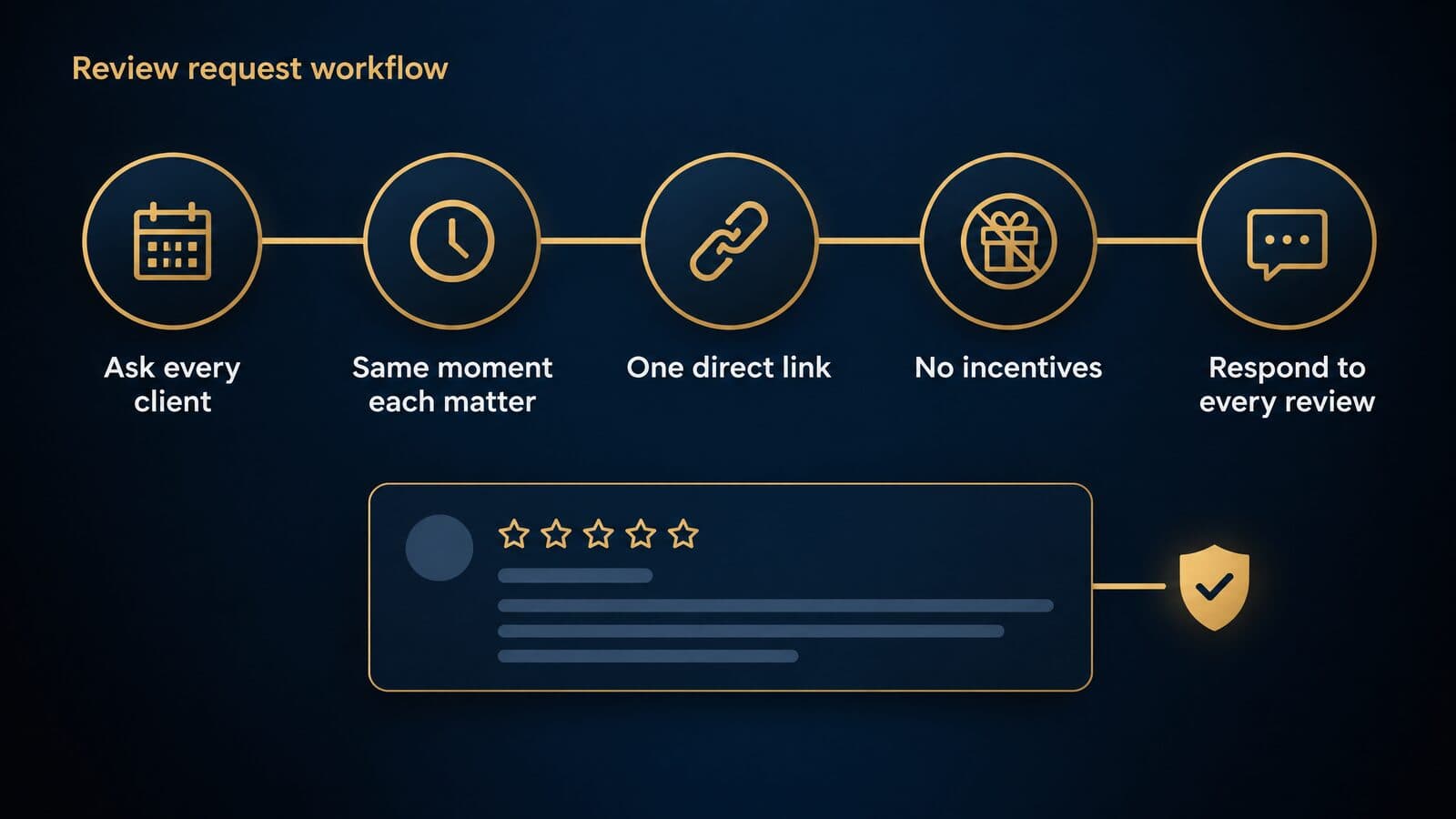
Google's rules. The Maps user-content policy prohibits reviews "that have been paid for, directly or in kind", incentives such as discounts or free services in exchange for a review, and businesses that "Discourage or prohibit negative reviews, or selectively solicit positive reviews from customers". It also treats reviews written by current or former employees as a conflict of interest. Asking only happy clients is selective solicitation, so the policy rules out the filtering tools that send unhappy clients to a private form.
The FTC's rules. The FTC's Consumer Reviews and Testimonials Rule, codified at 16 CFR Part 465, took effect on October 21, 2024. It bans fake reviews, buying reviews conditioned on sentiment, undisclosed insider reviews and suppressing reviews through groundless legal threats or intimidation. In December 2025 the FTC sent letters to 10 companies about possible violations and noted civil penalties of up to $53,088 per violation; that amount is adjusted for inflation, so re-check it.
Bar rules. Many states treat a firm's use of reviews in its own advertising as a testimonial subject to the state's advertising rules, and confidentiality duties limit how a lawyer may reply to a review. Never confirm that a reviewer was a client or discuss the matter in a reply. State rules differ, so check yours.
A review request workflow that fits all three:
- Ask every client. Every closed matter gets the request, regardless of how the lawyer thinks the client feels.
- Same moment each matter. Pick a fixed point, such as the day after the closing letter or settlement disbursement, and use it every time.
- One direct link. Send the profile's review link by text and email, with no landing page that screens sentiment.
- No incentives. No gift cards, discounts or fee reductions for reviews, positive or otherwise.
- Respond to every review. Thank people briefly, and answer negative reviews without revealing anything about the matter or the person's status as a client.
Legal directories and peer ratings
Legal directories split into two groups: listing and lead platforms that a firm joins or pays for, and peer ratings that select lawyers by a stated method. Both can send clients and both add credibility, but the economics differ and none of these companies publishes prices or lead volumes that a buyer can compare. The table below describes each by owner and by how the company says listing or selection works.
| Directory or rating | Owner | How listing or selection works (stated by the company) | Notes |
|---|---|---|---|
| Martindale-Hubbell | Martindale-Avvo (Internet Brands) | Lawyer directory and peer review ratings; connecting attorneys and clients since 1868 | Martindale-Avvo says its brands attract over 25 million monthly consumers (company claim) |
| Avvo | Martindale-Avvo (Internet Brands) | Lawyer profiles, consumer reviews and Q&A | Rating method not verified for this guide |
| Nolo | Martindale-Avvo (Internet Brands) | Consumer legal information with lawyer directory listings | Content-led traffic |
| Lawyers.com | Martindale-Avvo (Internet Brands) | Consumer-facing lawyer directory | Shares the Martindale-Avvo network |
| FindLaw | Internet Brands (since December 2, 2024) | Lawyer directory and legal information | Sold by Thomson Reuters to Internet Brands |
| Super Lawyers | Super Lawyers | Patented multiphase process, 12 indicators, state-by-state; 5% of lawyers in each state | Rising Stars: top 2.5 percent |
| Best Lawyers | Best Lawyers | Based entirely on peer review; anyone, including lawyers themselves, can nominate | One "Lawyer of the Year" per specialty and metro per edition |
Sources: Martindale-Avvo's about page, the Thomson Reuters announcement of the FindLaw sale, Super Lawyers' selection process and Best Lawyers' methodology.
Two practical points. First, the Martindale-Avvo brands and FindLaw now sit with the same parent, so buying several of them is less diversification than it looks. Second, under ABA Model Rule 7.2 Comment [2], directory listings that list lawyers by practice area, without more, are not impermissible "recommendations". Paid placements that endorse or vouch for a lawyer raise different questions. States adopt and interpret Rule 7.2 differently, and many have their own rules on how a peer rating may be described in an ad, so check your state before advertising a rating.
Citations and consistent firm details
A citation is any listing of the firm's name, address and phone number on another site: directories, bar association listings, chamber pages, data aggregators. Consistency matters because Google and clients both cross-check them, and a moved office or an old phone number can send calls to a dead line for years.
A simple audit, done once a year and after any move or rebrand:
- Write down the exact canonical name, address, suite format and main phone number, matching the Business Profile.
- Search the firm's name, old addresses and old phone numbers to find listings that carry outdated details.
- Fix the major directories, bar listings and data aggregators first, then local and niche sites.
- Keep the main number on listings even if tracking numbers run on ads and the website.
- Record logins for every listing in one place so staff turnover does not orphan them.
SEO, local search and AI answers
Google describes SEO as helping search engines understand your content and helping users decide whether to visit your site. For a law firm it is the slowest demand-capture channel to build and the most durable once built, because rankings keep producing calls without a per-click charge.
What SEO does for a law firm
SEO work falls into three groups. On-page work makes each practice page answer the matter it targets, with clear headings, useful detail and internal links. Technical work makes the site fast, crawlable and free of duplicate or broken pages. Off-page work earns links and mentions from other sites, such as bar associations, local news, community organizations and legal publications.
Google's starter guide is blunt: "There are no secrets here that'll automatically rank your site first in Google". It also says some changes take effect in hours and others can take several months, and that you should usually wait a few weeks before judging whether a change helped. That is the only timeline Google gives.
When hiring help, note Google's own warning: "No one can guarantee a #1 ranking on Google", so beware of anyone who claims to. The team and agency section near the end covers vetting in detail. For practice-specific depth, see SEO for personal injury lawyers and a full guide to SEO for lawyers.
Local SEO and the map pack
Local SEO earns a place in the map results for searches such as "custody lawyer near me". The levers are the ones covered above: the right primary category, a real office close to the people searching, a steady flow of genuine reviews, consistent citations and links from local organizations. Proximity is the factor a firm controls least, which is why a staffed office in the right part of town often matters more than any optimization.
Google dominates local search but is not alone. StatCounter measured Google at 85.19% and Bing at 9.89% of U.S. search engine share in September 2026. That second figure is why Bing Places and Microsoft Advertising deserve a few hours of setup even for a small firm.
Content marketing and legal blogging
The best legal content answers the questions clients already ask at intake. Pull a month of call notes and list every question: "Will I lose my house in Chapter 7?", "Can my employer fire me for filing a comp claim?", "How long does probate take in this county?". Each one is a candidate article or practice-page FAQ.
A workable content calendar for a small firm is modest: one substantial guide per month, built from intake questions, plus updates to existing practice pages when laws, forms or fees change. Fresh, accurate pages beat a high volume of thin posts.
Repurpose each guide rather than starting from zero. A lawyer can record a short video answering the same question, the guide becomes the month's email to past clients and referral partners, and short excerpts go to LinkedIn or Facebook. Only 31% of respondents in the ABA's 2022 TechReport said their firms produce video, so a firm that does it consistently stands out. Distribution matters as much as writing: link new guides from the relevant practice pages and share them with referral partners who get the same questions. For more, read how law firm blogs earn clients.
AI Overviews, ChatGPT and generative search
AI answers are now part of the search a client runs before calling a lawyer. Google announced on May 14, 2024 that it was bringing AI Overviews to everyone in the U.S., and in June 2026 Google said AI Overviews had over 2.5 billion monthly active users and AI Mode had surpassed one billion monthly users. Those are Google's own figures.
What does a firm need to do to appear? Google says there are "no additional requirements to appear in AI Overviews or AI Mode, nor other special optimizations necessary", and that AI Overviews often don't trigger. Google's generative AI optimization guide names AEO and GEO and says optimizing for generative AI search is "still SEO". Vendors selling special files or markup as a requirement for AI visibility are contradicting Google's own documentation.
Clicks change when AI answers appear. Pew Research Center's study of 900 U.S. adults' browsing in March 2025 found that people who saw an AI summary clicked a traditional result in 8% of visits, against 15% for those who did not, and that 18% of searches in the study produced an AI summary. No legal-specific figure was found. The practical response is to be the source those summaries cite: clear answers, named authors, accurate local detail. See AI search optimization (AEO and GEO) for law firms and AEO for personal injury lawyers.
Spam policies that catch law firm sites
Two of Google's spam policies catch law firms more than most businesses. Doorway abuse covers pages built to rank for similar queries, including city pages that funnel users to one page and substantially similar pages that read more like search results than a browsable site. The test is simple: would a visitor from that town find anything on the page that is specific to them?
Scaled content abuse covers many pages generated mainly to manipulate rankings, "no matter how it's created", and Google gives generative AI used to produce many pages without adding value as an example. A firm that publishes hundreds of near-identical AI-written pages on accident types or suburbs is inside that description. Fewer, better pages, reviewed by a lawyer, are safer and usually convert better.
Paid search, Local Services Ads and ChatGPT ads
Paid search captures demand the moment it appears, and its price is set by competition for the same clicks. Legal is the most expensive category in WordStream's 2026 benchmark data, so paid search pays only when intake converts and the firm measures signed cases rather than clicks.
Google Ads for law firms: structure and costs
WordStream and LocaliQ's Google Ads Benchmarks 2026, based on 13,474 U.S. search campaigns between April 2025 and March 2026 and reported as medians, put Attorneys and Legal Services at a $9.87 median cost per click (the highest of all industries), a 5.87% click-through rate, a 5.55% conversion rate and a $131.63 cost per lead (also the highest). The all-industry cost per click was $5.42. These are category medians as of WordStream's September 2026 update, not quotes for any keyword.
Keyword-level costs vary widely by market, matter type and month. Pull them from Google's Keyword Planner, which gives search volume trends and suggested bid estimates, for your own city and date. Treat any single "cost per click" quoted online without a market and date as an anecdote.
Structure decides whether that money produces cases:
- Campaigns by matter type and geography. Divorce and custody in one county should not share a budget with criminal defense statewide.
- Exact and phrase match themes around the matter, with tight ad groups per theme.
- Negative keywords for jobs, salaries, law school, free legal aid and practice areas you do not handle.
- An ad schedule matched to intake hours. If nobody answers at night, either staff the phones or stop the ads.
- Call assets with tracking, since many legal clients prefer to call.
- Landing pages per matter, not the homepage.
For managed campaigns, see PPC for law firms.
Local Services Ads and the Google Verified badge
Local Services Ads (LSAs) sit above standard search ads for many local queries and charge per lead rather than per click. Google's LSA help says advertisers pay only for leads related to their business and services, and warns that if a business regularly fails to answer calls or respond to messages, its ad ranking may be affected. Response time is part of the ranking, which makes intake a marketing variable.
Legal categories on that page include bankruptcy, business, contract, criminal, DUI, disability, estate, family, IP, immigration, labor, litigation, malpractice, personal injury and traffic lawyer services, plus general "Lawyers" and real estate lawyers.
The badge changed in 2025. Google announced that Google Verified would replace other LSA badges, including Google Screened and Google Guaranteed, starting in October 2025. Any advice to "get Google Screened" is out of date.
Whitespark's 2026 survey asked experts about LSA factors too. Experts surveyed by Whitespark rank budget and bidding first, then reviews, service selection, response times and verification. Google does not publish LSA cost per lead by practice area or market, so test with a modest budget and track signed cases.
Three habits help LSAs pay off. Choose only the service types the firm actually handles, since every lead you pay for should be one you can take. Log every lead that falls outside your categories or service area, check Google's current help pages for how to raise them, and watch whether the share of poor leads is rising. And answer LSA calls live during the hours the ads run; the help page's warning about unanswered calls means a missed call costs both the lead and future placement.
Microsoft Advertising and Bing
Bing held 9.89% of U.S. search share in September 2026, per StatCounter. That is a small slice, and how crowded legal terms are there varies by market, so check Microsoft's own keyword data for yours. Setup is fast: Microsoft's guide explains that advertisers already on Google Ads can import their campaigns into Microsoft Advertising and run the same ads on Bing, by connecting the Google account, choosing campaigns and import options, and scheduling the import. After importing, check budgets, negatives and landing pages; an import copies structure, not judgment.
ChatGPT ads for law firms
ChatGPT ads are new and still opening to legal advertisers. OpenAI said in January 2026 that it planned to test ads in the U.S. for the free and Go tiers, that Go costs $8 a month, and that Plus, Pro, Business and Enterprise subscriptions would not include ads. Users on those paid tiers will not see ads.
OpenAI's ad policy states that ads for legal services are permitted in the US only when the advertiser is licensed to practice law in the jurisdiction where the ad is shown, and that this includes personal injury and immigration services. The changelog shows legal services were permitted in the US from version 1.5 in August 2026. The policy also says legal-services approvals are rolled out gradually and reviewed manually case by case, and its placement rules exclude sensitive contexts such as mental and personal health conversations.
All of this is as of October 2026; OpenAI does not publish ad pricing or approval rates, and the policy changes often, so check the live page before planning a budget. For setup help, see ChatGPT ads for lawyers.
Send signed cases back to the ad platforms
Ad platforms optimize toward whatever you tell them is a conversion. If that is a form fill, the algorithm finds more people who fill forms, including spam and people outside your practice area. If it is a signed case, it learns what a good client looks like.
Google's tools for this are offline conversion import and enhanced conversions for leads, which Google describes as an upgraded version of offline conversion import that uses user-provided data. Capture the GCLID at intake, mark the matter as signed in the CRM, and upload it. Google says that from June 15, 2026 these uploads move to the Data Manager API, so check that your CRM integration has been updated.
Paid search options side by side
The table below compares the four paid search options covered above. Prices appear only where a published source gives them.
| Option | How you pay | Where it shows | Best for | Main limit |
|---|---|---|---|---|
| Google Search ads | Per click; legal median CPC $9.87 (WordStream 2026) | Google search results | Firms with tracked intake and clear matter targeting | Highest legal CPC and CPL of any category |
| Local Services Ads | Per lead | Above search ads for local queries | Local consumer matters in listed legal categories | Ranking depends on responsiveness; no published cost per lead |
| Microsoft Advertising | Per click | Bing and Microsoft search | Extending proven Google campaigns cheaply | Smaller audience, about 10% of U.S. search |
| ChatGPT ads | Not published by OpenAI | Free and Go tiers of ChatGPT | Early testers licensed in the target jurisdiction | Manual approvals; no ads on paid tiers above Go |
Every one of these channels captures people already looking. The next section turns to channels that make a firm known before the need arises: social media, video and broadcast.
Social media, video and broadcast advertising
Social media, video and broadcast advertising are demand generation: they make a firm known before a person needs a lawyer, so the firm's name comes to mind or gets typed into a search bar when the trigger event happens. They pay off only when the demand capture channels and intake covered elsewhere in this guide are ready to catch the response.
Search ads, map listings and practice pages meet people who are already looking. Everything in this section works earlier in the client journey, often months or years before the need exists. That changes how you judge it. A Facebook post or a TV spot rarely produces a signed case the same day, so measure it by branded search volume, "how did you hear about us" answers at intake, and the cost per signed case of the cases that trace back to it, not by likes or views.
Organic social by platform and practice area
Most firms already have some social presence. In the ABA's 2023 Websites and Marketing TechReport, respondents whose firms had a social presence reported LinkedIn at 83%, Facebook at 57% and Twitter at 33%. The 2024 edition found that respondents using social media as a marketing tool fell to 80%, down from 89% in 2022. Presence is common; results are uneven. The table below is my practitioner view of fit, not platform data, and it says nothing about each platform's advertising policies, which change and should be checked directly.
| Platform | Best fit | Content that works | Effort |
|---|---|---|---|
| Business, employment, IP, referral-led practices | Short commentary on rulings, deal and case news, referral-partner posts | Low to medium | |
| Family, estate planning, injury, local consumer work | Community posts, plain-language FAQs, event and seminar notices | Medium | |
| Consumer practices with a visual or personal brand | Short clips, behind-the-scenes, attorney introductions | Medium to high | |
| TikTok | Consumer practices aiming at younger clients | Short explainers answering one question each | High |
| YouTube | Any practice with recurring client questions | FAQ videos, process explainers, attorney bios | High at first, then low |
Two rules keep organic social useful. First, post where your clients and referral sources already spend time, which for a business litigator is LinkedIn and for a family lawyer is more often Facebook. Second, reuse: one recorded answer can become a YouTube video, a short clip, a LinkedIn post and a practice-page section, so the effort is spread across channels.
Paid social and lead forms
Paid social buys reach that organic posts cannot get on their own. Meta and other platforms let you target by location, age and interests, retarget people who visited your practice pages, and collect contact details inside the app through a lead form, so the prospect never has to load your website.
Lead forms are convenient for the prospect and dangerous for the firm. The person tapped a button while scrolling, so intent is lower than for someone who searched "divorce lawyer near me" and called. These leads can go cold fast. The fix is operational: route form submissions to intake instantly, call within minutes during business hours, and run the follow-up cadence described in the intake section below for anyone you cannot reach.
Three setup choices matter more than the creative:
- Ask one or two qualifying questions in the form (type of matter, state, date of incident) so intake can screen before calling.
- Put clear consent language on the form if you plan to follow up by text or automated call. The consent requirements are covered in the advertising rules section later in this guide, and they apply to every channel that collects phone numbers.
- Send the outcome (no answer, consultation booked, signed) back to the ad platform where possible, so the algorithm learns which people become clients rather than which people tap buttons.
For help structuring campaigns, see this overview of paid social advertising for law firms. Judge paid social on cost per signed case, the same yardstick used for search, because its cost per lead often looks cheap until you count how few leads sign.
YouTube and video for lawyers
Video lets a prospect hear and see a lawyer before calling, which helps in practices where trust decides the hire. The ABA's 2022 Websites and Marketing TechReport found only 31% of respondents said their firms produce video to market the practice, so many local markets still have room.
Start with organic video that answers the questions intake hears every week: what happens at a first consultation, how custody is decided, what to do after an arrest, how a contingency fee works. Keep each video to one question, title it in the client's words, and embed it on the matching practice page. An explainer series (one topic, five short videos) works well for considered matters such as estate planning or immigration.
Paid YouTube is a separate decision. Google's ad formats include skippable in-stream ads that viewers can skip after 5 seconds and non-skippable in-stream ads of 60 seconds or shorter. That means the first five seconds must name the problem and the firm, because most viewers decide there.
YouTube also sits inside the television audience now. Nielsen's The Gauge for July 2026 reported YouTube at a record 14.2% of TV usage, with overall streaming at 49.0%. For firms weighing video against broadcast, that blurs the line between "online video" and "TV". For targeting and creative options, see YouTube advertising for law firms.
TV, streaming, radio and billboards
Broadcast is the most expensive way to generate demand and the most familiar in plaintiff law. The American Tort Reform Association (ATRA), a tort-reform advocacy group that tracks legal advertising, states in its 2017 to 2024 legal services advertising report that television remains the most popular medium for legal services ads by dollars and by number of ads, and that an estimated 83% of TV ad dollars from 2017 to 2024 went to local spot TV.
The same report estimates the top 2024 legal-services advertiser was Morgan & Morgan, at an estimated $218,208,800 across the media it analyzed. ATRA's later Oregon-focused report covering 2021 to 2025 estimates that, across the United States, $4 billion was spent on more than 30 million legal services ads in 2025. Those are ATRA's estimates, and they show the scale a new advertiser competes against in large markets.
A smaller firm can still use broadcast in a narrower way:
- Local radio and streaming audio in one metro, which costs less to produce than TV.
- Connected TV (CTV) and streaming ads targeted by zip code, which avoid paying for viewers outside your service area.
- Billboards near courthouses, hospitals or highways that match the practice, used to build name recognition rather than to take calls directly.
Broadcast rules vary by state. Texas, for example, requires a specific spoken and on-screen disclosure at the start of television ads for legal services; the state rules section later in this guide covers this. Before buying airtime, confirm the phone line and intake team can handle a spike after each spot, and give each campaign its own tracking number. For production and buying, see TV, CTV and streaming advertising, and for creative examples, these personal injury commercials that work.
Referrals, networking, email and community
Referrals remain one of the main ways clients find a lawyer, and a referral network is built on purpose, inside the fee-division and gift rules. Email and community work keep the firm in mind with the people most likely to refer.
Clio's 2019 Legal Trends Report, a vendor study by a company that sells practice-management and intake software, found that 59% of clients sought a referral from someone they knew, 57% searched on their own and 16% did both. Referrals and search are two largely separate routes, so most firms need both. This section covers the referral route: other lawyers, non-lawyer contacts, past clients and the community. This section is general information, not legal advice; the rules cited are ABA Model Rules, and your state's version controls.
Build a lawyer referral network
The best referral partners are lawyers who regularly see your kind of matter but cannot or will not take it. Good targets include:
- Adjacent practices: an estate planner for an elder law firm, a family lawyer for a bankruptcy firm, a business lawyer for an employment litigator.
- Firms that are conflicted out, such as defense firms that cannot take the plaintiff side or large firms that cannot sue a client.
- Lawyers outside your geography or language who get calls they cannot serve.
Make referring easy and worthwhile. Send referrals back when you can, report on each referred matter (with the client's consent), and give partners one direct number that reaches a person. Track every referral by source in your case management system so you can see which relationships produce signed cases and fees, not just calls.
Fee sharing has rules. Under ABA Model Rule 1.5(e), a fee division between lawyers not in the same firm is allowed only if the division is in proportion to the services each lawyer performs or each lawyer assumes joint responsibility, the client agrees to the arrangement including each lawyer's share and that agreement is confirmed in writing, and the total fee is reasonable. States vary on how they apply this, so check your state's version before agreeing a split.
Non-lawyer referral sources and the gift rule
Accountants, financial advisors, doctors, chiropractors, realtors and clergy all hear about legal problems first. They can be valuable sources, but paying them is where firms get into trouble.
ABA Model Rule 7.2(b) says a lawyer shall not give or promise anything of value to a person for recommending the lawyer's services, with listed exceptions: reasonable advertising costs, the usual charges of a legal service plan or qualified lawyer referral service, buying a practice, non-exclusive reciprocal referral agreements that clients are told about, and nominal gifts. [Comment [4]](https://www.americanbar.org/groups/professional_responsibility/publications/model_rules_of_professional_conduct/rule_7_2_advertising/comment_on_rule_7_2/) limits a gift to a token item of the kind given for holidays or ordinary hospitality, and bars any gift tied to a promise or understanding that referrals will be made.
Comment [3] lets a firm pay employees, agents and vendors engaged in marketing or client development, such as publicists and business-development staff. That is different from paying a staff member or anyone else a bonus per referral, which may fall under the 7.2(b) restriction. Do not treat referral bonuses or per-case payments to non-lawyers as safe; check your state's rule and ethics opinions first, because states differ.
Email newsletters and past-client nurture
Past clients and referral partners are the cheapest audience you have, and email is the simplest way to stay in touch. The ABA's 2022 TechReport found 40% of respondents said their firms use email marketing, so most firms still leave this channel unused.
What to send, monthly or quarterly:
- A short note on a legal change that affects clients (a new law, a deadline, a tax rule for estate clients).
- A plain-language answer to one common question, linked to the matching page on your site.
- Firm news that matters to clients, such as a new office, a new attorney or a new practice area.
- A reminder of what the firm handles, so past clients know whom to refer.
Keep it useful and short; one topic per email works better than a digest. Segment by practice area so an estate client does not get criminal defense updates.
Commercial email has federal rules. The FTC's CAN-SPAM compliance guide requires honest header and subject lines, identification of the message as an ad, a valid physical postal address and a clear opt-out. Opt-out requests must be honored within 10 business days, the law makes no exception for business-to-business email, and each violating email can draw penalties of up to $53,088 as of the FTC's current guide, a figure adjusted for inflation that you should re-check. State bar rules on lawyer advertising may add requirements to marketing emails.
Speaking, PR and community work
Speaking and community work build reputation with the people who refer and the people who hire. They are slow, cheap in cash and expensive in partner time, so choose events where your clients or referral sources are in the room.
Options that tend to fit legal practices:
- Teaching continuing legal education (CLE) sessions, which puts you in front of lawyers who may refer matters outside their practice.
- Serving on bar association committees in your practice area.
- Seminars for the public, such as estate planning workshops at libraries or community centers.
- Sponsorships of local events, teams or charities. Comment [3] to Rule 7.2 lists sponsorship fees among the advertising costs a lawyer may pay, so they are treated as advertising.
- Local media: offering yourself as a source on legal questions in your field, and writing op-eds.
- Podcasts, either your own or as a guest on shows your clients or referral partners follow.
Track these like any channel. Ask at intake where the person heard of the firm, and log "seminar", "CLE" or "podcast" as a source. After a year, compare the signed cases from community work with the partner hours spent.
Buying leads and mass tort case acquisition
Buying leads is allowed under the ABA Model Rules when the vendor does not recommend the lawyer and the payment complies with the fee-sharing rules; the risk sits in how the vendor gets the lead, what it tells the consumer and how it is paid. This section is general information, not legal advice, and state rules and ethics opinions vary.
Many plaintiff firms buy leads to fill gaps that search and referrals leave, and mass tort firms often depend on it. Before buying, run the signed-case math from the marketing math section of this guide: the price per lead matters less than the share of those leads that become signed cases and the fees they produce.
Lead types and how each is priced
Vendors sell several different products under the word "lead". They differ in what you receive, how much screening has been done and where the risk sits. Prices vary by practice area, market, vendor and month, and no neutral price dataset exists, so this table compares models only.
| Lead type | What you get | How priced | Main risk |
|---|---|---|---|
| Shared lead | Contact details also sold to other firms | Per lead | Racing other firms; low contact rates |
| Exclusive lead | Contact details sold to you only | Per lead, higher than shared | Paying for unqualified or stale leads |
| Live transfer | A caller connected to your intake line | Per transferred call | Call quality depends on vendor screening |
| Signed retainer or case acquisition | A client who has signed with the firm | Per signed case or per retainer | Fee-sharing and recommendation rules; consent records |
| Co-counsel referral | A matter referred by another lawyer | Fee division agreed in writing | Rule 1.5(e) terms and client consent |
The further down the table, the more of the work the vendor does and the more the payment structure needs ethics review. A per-signed-case price can look like payment for a recommendation or like fee sharing with a non-lawyer, depending on how it is set up and on your state's rules. For background on campaign mechanics, see how mass tort advertising works.
What ABA Rule 7.2 says about lead generators
The ABA Model Rules address lead generators directly. [Comment [5] to Rule 7.2](https://www.americanbar.org/groups/professional_responsibility/publications/model_rules_of_professional_conduct/rule_7_2_advertising/comment_on_rule_7_2/) says a lawyer may pay others for generating client leads, such as internet-based leads, as long as the lead generator does not recommend the lawyer, any payment is consistent with Rules 1.5(e) and 5.4, and the lead generator's communications are consistent with Rule 7.1.
The same comment says a lawyer must not pay a lead generator that states, implies or creates a reasonable impression that it is recommending the lawyer, that it is making the referral without payment from the lawyer, or that it has analyzed a person's legal problems when deciding which lawyer gets the referral. Comment [2] defines a recommendation as a communication that endorses or vouches for a lawyer's credentials, abilities, competence, character or other professional qualities.
Rule 5.4 adds two limits. A lawyer or firm shall not share legal fees with a non-lawyer, subject to listed exceptions, and shall not let a person who recommends, employs or pays the lawyer to serve another direct or regulate the lawyer's professional judgment.
In practice, that means reading the vendor's landing pages and scripts. Phrases such as "we'll match you with the best lawyer for your case" or "a top-rated attorney will review your claim" can create the impression the comment warns against. Payment tied to fees, or a vendor that tells your intake team which cases to accept, raises Rule 5.4 questions. I am not giving compliance conclusions here: states adopt these rules with changes and issue their own ethics opinions, so check your state's rules and ethics opinions before signing any lead contract.
Mass tort and class action acquisition
Mass tort acquisition runs on different economics from local practice. A firm advertises nationally for people who used a specific product, screens them against qualification criteria (product use, dates, diagnosis, proof of use), signs those who qualify, and then either litigates or refers them to co-counsel who will. Much of the work happens inside multidistrict litigation (MDL).
Scale is visible in public data. The Judicial Panel on Multidistrict Litigation's pending MDL docket report generated October 1, 2026 lists 162 MDL dockets, including Johnson & Johnson Talcum Powder (MDL-2738) with 69,340 actions pending, Bard hernia mesh (MDL-2846) with 23,324, hair relaxer (MDL-3060) with 12,381, Depo-Provera (MDL-3140) with 6,412 and GLP-1 receptor agonists (MDL-3094) with 4,025.
Four variables decide whether a mass tort campaign pays:
- Timing: entering a tort before the MDL forms is cheaper and riskier; entering late means more competition and a clearer settlement picture.
- Qualification criteria: tight criteria cut sign-up volume but reduce the cases that fail later review.
- Co-counsel terms: who handles the litigation, how fees divide under Rule 1.5(e), and what the client is told and agrees to in writing.
- Volume and intake capacity: national campaigns produce large call volumes that intake must screen consistently.
A disclosure belongs here. Mass Tort Marketing Agency, which publishes this guide, sells mass tort and personal injury case acquisition, so weigh this section with that conflict of interest in mind. Nothing above is a claim about any vendor's results.
Questions to ask any lead vendor
Use these ten questions before signing with any lead seller, and get the answers in writing.
- How do you capture consent to call and text, and will you give me the consent record (time stamp, page, wording) for every lead?
- Is each lead exclusive to my firm, or sold to other firms, and how many?
- Where does the traffic come from: which ad platforms, websites and call centers, and do you use sub-vendors?
- Can I see and approve every ad, landing page and script used to generate my leads?
- Does any ad, page or script say or imply that you recommend my firm, or that the consumer is being matched to the best lawyer?
- What is your return or credit policy for leads that are duplicates, unreachable or outside the criteria, and how long is the return window?
- Which data fields come with each lead, and in what format do they reach my intake system?
- How fast is a lead delivered after the consumer submits it, and what happens after hours?
- How exactly is pricing set, and does any part of it depend on fees I collect? (Ask your ethics counsel to review the answer under Rule 5.4.)
- Can I speak with two current firm clients who have bought from you for at least six months?
A vendor that refuses to share consent records, ad creative or references is telling you something. Walk away.
Intake: where marketing turns into signed cases
Intake is where most marketing spend is won or lost: a lead that nobody answers costs the same as one that signs. Secret-shopper studies show many firms fail to answer calls and emails at all, which makes intake the cheapest place to improve cost per signed case.
Every channel above produces calls, forms and chats. What happens in the first minutes and days decides how many of those become consultations and signed fee agreements. Firms that spend heavily on advertising and lightly on intake are paying for leads they never convert.
What the secret-shopper studies found
Clio, a practice-management and intake software vendor, has run two secret-shopper studies of law firm responsiveness. For its 2019 Legal Trends Report, it emailed 1,000 law firms and phoned 500 chosen at random from the same group, through a third-party research company, posing as prospects with family, criminal, bankruptcy, employment and business matters. For 2024, Clio's press release on its secret-shopper study reports it emailed 500 firms and also called firms.
| Measure | Clio 2019 | Clio 2024 |
|---|---|---|
| Firms that replied to email | 40% (computed from 60% non-response) | 33% |
| Phone calls answered | 56% | 40% |
| Firms unreachable by phone | 27% | 48% |
| Email replies with clear next steps or cost | 28% gave next steps; 27% gave cost | 18% gave next steps or cost |
| Rate information by phone | 43% would not discuss rates | 41% offered rate information |
Read the table with care. The 2019 email figure is computed from Clio's statement that 60% of firms did not respond. The two studies asked somewhat different questions, so the bottom two rows are not exact like-for-like comparisons. The direction is clear, though: in 2024, Clio reports 48% of firms were essentially unreachable by phone and only one in three replied to email.
Quality was also weak among firms that did respond. Clio's 2019 scorecard rated 71% of email replies "Unsatisfactory". In 2024, Clio reports 84% of email replies came within eight hours, but just 18% gave clear next steps or cost information, and 73% of shoppers said they were unlikely to recommend the firms they contacted. Clio also claims firms using online intake tools see more potential clients and revenue; that is a vendor claim about the kind of software it sells.
Answer fast, around the clock
Clients expect quick replies. In Clio's 2019 consumer survey, 10% expected a response within an hour, 24% within a few hours and 45% within 24 hours, so a reply after 24 hours misses the expectations of 79% of those who reach out. The same report found 64% had contacted a law firm that never responded.
There is no reliable public multiplier for how much speed raises conversion, so skip the statistics that circulate and fix the measured problem: unanswered calls. Your staffing options:
- In-house intake staff during business hours, with a clear backup when they are busy.
- An answering service for overflow and after hours, given a script and a booking calendar.
- A legal intake vendor that screens, books and in some cases signs clients around the clock.
Language matters too. If your market has many Spanish speakers, staff bilingual intake or use a vendor that does; a caller who cannot be understood will call the next firm. For an outsourced option, see this overview of 24/7 bilingual legal intake.
A first-call opening template you can adapt:
- Greeting: "Thank you for calling [firm name], this is [first name]."
- Name and callback: "May I have your name and the best number to reach you if we get cut off?"
- Matter: "Briefly, what kind of legal issue are you calling about, and where did it happen?"
- Conflict basics: "Who is the other side, the person or company involved?" Collect names only, no details yet.
- Booking: "The next step is a consultation with [attorney]. I have [time] or [time]; which works better?"
Follow-up cadences for slower decisions
Many prospects do not sign on the first call. They are comparing firms, talking to family or waiting for a document, and a structured follow-up cadence keeps the firm in front of them without pressure.
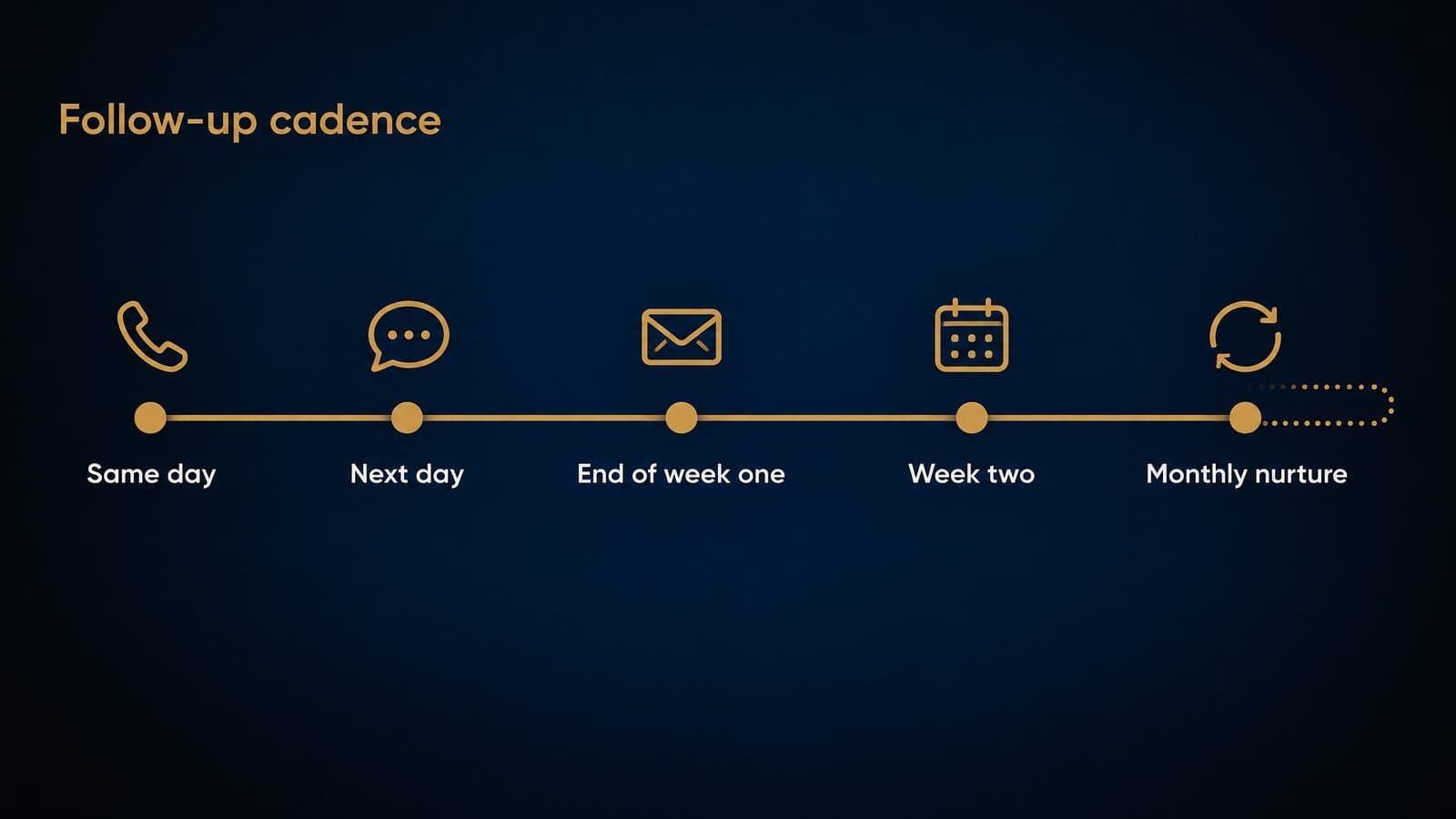
A cadence that suits most consumer practices:
| Step | When | Channel | Goal |
|---|---|---|---|
| First attempt | Same day as the inquiry | Call, then text if consented | Reach the person and book a consultation |
| Second attempt | Next day | Call and email | Answer open questions; offer times |
| Third attempt | End of week one | Call, text if consented | Check whether anything changed |
| Fourth attempt | Week two | Email with a useful resource | Leave the door open |
| Nurture | Monthly | Email newsletter | Stay in mind until the person is ready |
Adjust by practice. A criminal defense or injury prospect decides in hours or days, so compress the first three steps into the first 48 hours. An estate planning or immigration prospect may take weeks, so the monthly nurture does more of the work. Texts and automated calls need the consent covered in the TCPA section below. Log every attempt and its outcome so you can see where prospects drop out. For a fuller version built for high-volume plaintiff work, see this intake playbook.
Screening, conflicts and prospective-client duties
Intake creates legal duties before anyone signs. Under ABA Model Rule 1.18, a person who consults a lawyer about possibly forming a client-lawyer relationship is a prospective client. Even when no relationship follows, the lawyer may not use or reveal what that person said, except as Rule 1.9 permits, and receiving information that could be significantly harmful can disqualify the lawyer from representing an adverse party. State versions of Rule 1.18 differ, so confirm yours.
That is why intake should run a conflict check on names before taking details. Collect the prospect's name and the other side's name first, check them against your system, and only then hear the story.
A screening list keeps intake consistent and protects the firm's time. Common disqualifying criteria, set by each firm for each practice, include:
- The matter is outside your practice areas or jurisdiction.
- A conflict of interest exists with a current or former client.
- The deadline (such as a statute of limitations) has passed or is too close to act on.
- Required facts are missing, such as no diagnosis or no proof of use in a mass tort.
- The prospect already has a lawyer on the same matter.
Write the criteria down, train every intake person on them, and send declined prospects a written non-engagement letter so there is no confusion about whether the firm represents them.
From consultation to signed fee agreement
The last step loses more cases than firms expect. A prospect who had a good consultation can still drift away before signing.
Make signing easy. Send the engagement or fee agreement by e-signature during or right after the consultation, so the person can sign the same day from a phone. Contingent fees need extra care: under ABA Model Rule 1.5(c), a contingent fee agreement must be in a writing signed by the client and must state how the fee is determined. Many states add their own requirements, so use a form your state's rules support.
No-shows need their own follow-up. Call within the hour of a missed consultation, offer two new times, and put the person back into the follow-up cadence above if you cannot reach them.
Finally, track consultation-to-signed rates by marketing source. A channel that books many consultations but few signed fee agreements has a fit problem, an intake problem or both, and the signed-case math only works when you count the signed fee agreements, not the calls. Every channel in this guide, and every way of buying cases, is also governed by the advertising and solicitation rules covered next.
Attorney advertising rules, TCPA and privacy
Lawyer marketing is regulated twice: by your state's version of the ABA Model Rules of Professional Conduct, and by federal law on calls, texts, reviews and deceptive claims. This section is a plain-language summary for planning purposes. It is general information, not legal advice, and every rule below should be checked against your own state's text and ethics opinions before a campaign runs.
The order matters. Once a firm has signed its first clients from a new channel, the temptation is to scale the message that worked. Every scaled message is a communication about the lawyer's services, and every follow-up call or text is a regulated contact. The rules below apply to all of it, from the website footer to the retargeting ad to the intake team's third follow-up text.
One framing point before the detail. The ABA Model Rules are a template. They bind no lawyer until a state supreme court or legislature adopts them, and most states have adopted them with changes. When this section says "Rule 7.1", read it as "the ABA's model version of Rule 7.1, which your state may have adopted, amended or replaced".
ABA Model Rules 7.1 to 7.3 in plain terms
The core idea is short: say nothing false or misleading, do not pay people to recommend you, and do not pressure specific people who need a lawyer in real time. ABA Model Rule 7.1 covers the first, Rule 7.2 the second and Rule 7.3 the third. Three neighboring rules shape marketing money and intake data.
| Rule | What it says (short) | Marketing example |
|---|---|---|
| 7.1 | No false or misleading communication, including true statements that omit a needed fact | A settlement figure shown without context that implies every client gets that result |
| 7.2(a) and (b) | Any media is allowed; no paying for recommendations, with listed exceptions for ad costs, qualified referral services, nominal gifts and non-exclusive reciprocal referrals | Paying for ad space is fine; paying a person per referral is not |
| 7.2(c) | No claim of certified specialist status unless an approved or ABA-accredited body certified you and is named | "Board certified in civil trial law by" a named body |
| 7.3 | Solicitation is a contact aimed at a specific person known to need help; live person-to-person solicitation for gain is barred, with exceptions | A billboard is not solicitation; a hospital-room visit is |
| 1.5(e) | Fee splits between firms need proportional work or joint responsibility, written client consent to each share and a reasonable total | Co-counsel deals on referred cases |
| 5.4 | No fee sharing with nonlawyers; whoever pays cannot direct the lawyer's judgment | A vendor paid a percentage of fees |
| 1.18 | Prospective clients get confidentiality protection even if no engagement follows | Intake notes from a declined caller |
The ABA's [Comment [1] to Rule 7.3](https://www.americanbar.org/groups/professional_responsibility/publications/model_rules_of_professional_conduct/rule_7_3_direct_contact_with_prospective_clients/comment_on_rule_7_3/) says a communication aimed at the general public, such as a billboard, website or TV commercial, is not a solicitation, and Comment [2] says text messages are not live person-to-person contact. Rule 1.5(e) on fee division is on the ABA's Rule 1.5 page, Rule 5.4 on its professional independence page, and Rule 1.18 on its prospective client page.
The current structure dates from the ABA House of Delegates' August 2018 amendments to the advertising rules, which folded specialization into Rule 7.2(c). The constitutional background explains why the rules look this way. *Bates v. State Bar of Arizona (1977) protected truthful price advertising, Ohralik (1978) let states discipline in-person solicitation for gain, and Zauderer (1985) struck down Ohio's ban on illustrations. Shapero (1988) protected truthful targeted letters, and Florida Bar v. Went For It* (1995) upheld Florida's 30-day wait on direct mail after accidents. States vary on all of this, so read your own state's rules.
Results, testimonials and specialist claims
Results, testimonials and "specialist" language cause more grievances than any channel choice, because they are the claims most likely to mislead. Rule 7.2(c) allows a certified-specialist claim only when an approved or ABA-accredited body did the certifying and the ad names it. Comment [9] to Rule 7.2, on the ABA's comment page, says a lawyer may generally say they "concentrate in" or "specialize in" a field based on experience, subject to Rule 7.1. The word "expert" carries the same Rule 7.1 exposure and is barred outright in some states.
Testimonials vary most by state. Florida's Rule 4-7.13(b)(9) treats a testimonial as inherently misleading if the person is not qualified to judge the matter, is not describing their own experience, was given something of value for it, or the ad omits that the prospective client may not obtain the same or similar results.
A workable house standard, in my view, for any state:
- Show a past result only with the facts that make it understandable (case type, what drove the outcome, that results vary).
- Use only testimonials from real clients about their own matter, with written permission, and never pay for them.
- Say "certified" only with the certifying body named; otherwise describe experience in plain facts (years, case types, trial count you can document).
- Keep a file for each claim showing where the support came from.
Your state may be stricter than any of this, so run claims past its rules before they run.
State rules: New York, Florida, Texas and California
State rules differ more than most marketing guides admit, and they change. The four examples below are large advertising markets with verified, recent text. Treat them as illustrations of the range, not as a checklist for your state.
| State | Rule | What it requires | Source date |
|---|---|---|---|
| New York | Amended Rules 7.1 and 7.3 | "Attorney Advertising" label, mandatory past-results disclaimer and 30-day PI and mass tort solicitation ban all eliminated | Effective June 1, 2026 |
| New York | Rule 7.1 (current text) | No false or misleading claims; any media; named certifying body; name and contact of a responsible lawyer | NYSBA compilation August 10, 2026 |
| Florida | Rule 4-7.19(a) | File each ad with the Bar at least 20 days before first use; keep copies 3 years | Rules dated October 1, 2026 |
| Florida | Rule 4-7.20(g) | Website content is exempt from filing | Amended effective July 14, 2025 |
| Florida | Rule 4-7.18 | No written solicitation about an accident until more than 30 days have passed | Rules dated October 1, 2026 |
| Florida | Statute 501.139 | Ads may not pose as a medical, health or drug alert or public service announcement | 2025 statutes |
| Texas | Rule 7.04(a) | File ads with the Advertising Review Committee within 10 days of first dissemination | As reprinted by the Texas Center for Legal Ethics |
| Texas | S.B. 1189 | TV ads must open with "This is a paid advertisement for legal services," spoken and shown | Effective September 1, 2019 |
| California | Bus. and Prof. Code 6157.2 | No guarantee of success or promise of immediate cash or quick settlements; cost-responsibility disclosure in contingency ads | Effective January 1, 2026 |
The New York change is the one most guides still get wrong. A NYSBA article on the amendments explains that the rules effective June 1, 2026 largely adopt the ABA's 2018 model and drop the label, the disclaimer and the 30-day ban, and the current NYSBA rules compilation no longer contains the words "Attorney Advertising".
Florida's sources are the Rules Regulating The Florida Bar, Chapter 4 and Florida Statutes section 501.139, which also adds disclosures for ads about FDA-approved drugs or devices. Florida charges a filing fee; confirm the current amount with the Bar. The Texas filing deadline is from the rule as reprinted by the Texas Center for Legal Ethics, and the TV disclosure is in S.B. 1189. California's section 6157.2 also gives consumers statutory damages of $5,000 to $100,000 per unique ad. Many other states have their own filing, disclaimer or waiting-period rules, so check your bar's advertising page.
Direct mail and solicitation waiting periods
Waiting periods restrict who can contact an accident victim and when, and two of them are federal. After an air carrier accident, 49 U.S.C. section 1136(g)(2) bars unsolicited communications by an attorney or anyone acting for one about a potential injury or wrongful death action before the 45th day. Section 1139(g)(2) applies the same 45-day bar to rail passenger accidents. These apply to every lawyer in every state, and they cover agents and employees, which includes vendors who run outreach for you.
State rules add their own windows. Florida's Rule 4-7.18 bars written solicitation about an accident or disaster until more than 30 days have passed, the rule the Supreme Court upheld in Went For It. New York no longer has a plaintiff-side 30-day ban after June 1, 2026, but its Rule 4.5 still bars lawyers representing actual or potential defendants, or those who may defend or indemnify them, from contacting an injured person before the 30th day (15th in some cases). Other states set different windows or none, so confirm your state's rule before any mailing or outreach after a disaster.
TCPA consent for calls and texts
The Telephone Consumer Protection Act governs marketing calls and texts that use autodialers or artificial or prerecorded voices, and it has a private right of action. Under 47 U.S.C. section 227(b)(3), a person may recover actual loss or $500 per violation, whichever is greater, and a court "may, in its discretion" raise that to as much as three times the amount for willful or knowing violations.
For telemarketing, the consent standard is "prior express written consent", defined in 47 CFR 64.1200(f)(9) as a signed written agreement (electronic signatures count) that clearly authorizes the seller to deliver such messages and discloses that signing is not a condition of purchase. The FCC's "one-to-one consent" rule, which would have limited consent to a single seller, never took effect: the Eleventh Circuit vacated it on January 24, 2025, and FCC Order DA 25-621 repealed it in July 2025. The FCC's February 2024 declaratory ruling also says AI-generated and cloned voices count as artificial voices.
In practice: store the consent text, timestamp, page and source for every lead, and keep it when you buy leads. For deeper detail on TCPA consent and bar advertising rules, see the TCPA consent and bar advertising rules page. State call laws can add requirements.
Privacy, tracking and AI-written copy
Tracking tools on intake pages and AI-written marketing copy both create risks that the advertising rules did not anticipate. Ad pixels and analytics tags on an intake form can send details a prospective client typed (an injury, a charge, an immigration status) to a platform, and Rule 1.18 treats prospective clients' information as confidential. State privacy laws in this area vary and change, so have counsel review which tags fire on intake and thank-you pages before launch.
On AI, the ABA issued Formal Opinion 512, Generative Artificial Intelligence Tools, on July 29, 2024; read it before AI drafts client-facing copy. The FTC's February 2025 order against DoNotPay bars it from claiming its service performs like a real lawyer without evidence and required $193,000 in monetary relief. A lawyer still reviews every published word, in any state.
Team, agency and a 90-day marketing plan
The right team depends on budget and channel mix, and most firms end up with a hybrid: an owner who sets strategy, an intake lead who answers every inquiry, and outside specialists for paid media, SEO or video. What matters is that one named person owns the numbers from first click to fee collected.
The roles a law firm marketing program needs
A working program covers five jobs, even when one person holds three of them.
- Marketing lead. Owns the one-page strategy, the budget and the KPI ladder, approves spend, and reports to the partners monthly in signed cases.
- Intake manager. Owns speed, scripts, follow-up and the source field on every new matter. In my view this is the most underfunded role in legal marketing.
- Content and brand. Writes or edits practice pages, articles, video scripts and review responses, and keeps every claim inside Rule 7.1.
- Paid media. Runs search, Local Services Ads, paid social and video budgets, and feeds signed cases back into the ad platforms.
- Analytics. Keeps call tracking, form tracking, CRM fields and reports honest so channels can be compared by cost per signed case.
For a sense of what a senior hire costs, the BLS reports that the median annual wage for marketing managers was $166,790 in May 2025. That is an all-industry figure, not a law-firm salary, and many small firms cover the lead role with a partner plus outside help instead.
In-house, agency, fractional or hybrid
Each staffing model trades control against cost and range of skills, and the best fit changes as the firm grows. Prices vary too widely to quote responsibly; for pricing models and what drives them, see what a legal marketing agency costs.
| Model | Best for | Pros | Cons | Watch for |
|---|---|---|---|---|
| In-house team | Firms with steady volume and several channels | Control, speed, firm knowledge | Hard to hire every skill; key-person risk | Staff judged on activity, not signed cases |
| Agency | Firms needing specialist channels fast | Broad skills, tools, benchmarks across accounts | Less firm knowledge; conflicts with competing clients | Agency-owned ad accounts and data |
| Fractional lead | Small firms needing strategy without a full hire | Senior judgment part time | Limited hours; needs doers underneath | Plans with no one to execute them |
| Hybrid | Most growing firms | In-house owner and intake, outside specialists | Coordination work | Unclear ownership of results |
A practical rule: keep strategy, intake and data in-house, because they hold the firm's knowledge and client relationships. Rent execution skills that are hard to hire one at a time, such as paid search, technical SEO and video production. Revisit the split once a year against the KPI ladder.
How to vet a law firm marketing agency
Vet an agency on how it measures, what you own, and how it handles compliance, before you look at its creative work. Google's own advice on hiring SEO help is a good baseline: its page on whether you need an SEO says no one can guarantee a #1 ranking and suggests asking for examples of previous work.
- Reports in signed cases and fees collected by channel, not only clicks, leads or rankings.
- The firm owns every ad account, analytics property, call-tracking number, domain and Business Profile, with admin access from day one.
- Explains in writing who reviews ad copy for Rule 7.1 and your state's filing rules before anything runs.
- Makes no ranking or lead-volume guarantees and claims no special relationship with Google.
- Has a written conflict policy on serving competing firms in your market and practice area.
- Discloses how it buys or generates leads and keeps TCPA consent records for each one.
- Gives references from current clients in similar practice areas and markets you can call.
- Shows a sample monthly report and a sample offboarding plan.
- Names the people who will work on the account, not only the person selling it.
Apply every one of those tests to Mass Tort Marketing Agency too, including the conflict question, because an agency that sells leads in your market has interests that may differ from yours. For a longer structure, use a 10-point framework for choosing an agency.
Contract terms and red flags
Most agency disputes start with a contract nobody read closely. Before signing, settle five things in writing.
- Account ownership. Ad accounts, analytics, tracking numbers, domains and creative files belong to the firm, and the agency works inside them with granted access.
- Term and exit. A short initial term, a clear notice period, and no fee to take your accounts and numbers with you.
- Reporting. What is reported monthly, at what level of detail, and how signed cases are reconciled with the firm's CRM.
- Copy approval. No ad, page or message runs without written approval from a responsible lawyer at the firm.
- Data return. On exit, all lead records, consent records, call recordings and reports come back to the firm in usable formats within a set number of days.
Red flags include fees tied to a percentage of legal fees (a Rule 5.4 problem), guaranteed rankings, agency-owned phone numbers that would leave with them, refusal to share raw lead data, and contracts that renew automatically for long terms. Have your own counsel read the agreement; state rules differ on fee arrangements.
The 90-day plan at a glance
The 90-day plan fixes foundations first, launches one demand-capture channel second, and reallocates by cost per signed case third. It is deliberately narrow, because a firm that launches five channels at once cannot tell which one worked.

First month: foundations. Finish the one-page strategy. Set up call tracking, form tracking and a required source field in the CRM. Clean up the Google Business Profile. Fix intake: answer-rate checks, scripts and the follow-up cadence.
Second month: launch. Launch one demand-capture channel that fits the demand-mode matrix for your practice area, such as search ads, Local Services Ads or practice-page SEO. Start the review request workflow with every closed matter.
Third month: review and reallocate. Read the KPI ladder from spend to fee collected. Cut what is not producing consultations, fund what is, and add one demand-generation channel such as referral outreach, email or video.
A brand-new firm should spend most of the first month on referral relationships and its Business Profile, and launch paid search only once intake can answer every call. For a worked template, see a personal injury law firm marketing plan template.
Common law firm marketing mistakes
The same eight mistakes show up across practice areas and firm sizes.
- Tactics before strategy. Buying a channel before deciding where to compete and how to win.
- Judging by lead volume. Cheap leads that never sign cost more than expensive ones that do.
- Too many channels at once. Spend spreads thin and no channel reaches the volume needed to learn.
- Ignoring intake. Paying for calls that go to voicemail wastes the whole budget.
- Copying competitors. Their budget, case value and brand are not yours.
- Untracked sources. Without a source field on every matter, no channel can be judged.
- Unreviewed ads. Copy that skips lawyer review is how Rule 7.1 problems start.
- Buying leads without consent records. A lead with no stored consent is a TCPA risk, not an asset.
What is changing in 2026 and 2027
Five changes are already in the record, and each affects planning for next year. Google says AI Overviews have over 2.5 billion monthly users and AI Mode over one billion, while Pew found users clicked a result in 8% of visits with an AI summary versus 15% without. OpenAI's ad policy changelog shows legal services were permitted in the U.S. from August 2026. Google replaced the LSA badges with Google Verified starting October 2025. New York's rules changed June 1, 2026. And ATRA, a tort-reform advocacy group, estimated legal ad spend at $4 billion in 2025, up about 44%. What these mean for 2027 is judgment, not fact.
Sources and methodology
This guide was built from a keyword-gap review of a competing legal marketing agency's content, a reading of the search results and the leading guides for "marketing for law firms" and "law firm marketing" as of October 2026, and primary-source verification on October 22, 2026, with a fact-check pass on October 31, 2026. Every number is linked to its source on first use in each section.
Primary source groups, with the dates read:
- ABA Model Rules 1.5, 1.18, 5.4 and 7.1 to 7.3 with comments, the 2018 amendments page, the formal opinions index and the 2025 Profile of the Legal Profession; ABA Legal Technology Survey TechReports for 2022, 2023 and 2024.
- Clio Legal Trends Reports for 2019 and 2025 and Clio's October 2024 secret-shopper release (Clio sells practice-management and intake software).
- Google Business Profile, Maps, Local Services Ads, Ads and Analytics help pages; Google Search Central; Google blog posts through June 2026; OpenAI's ad policy v1.6 (September 2026).
- FTC, FCC, eCFR, the Eleventh Circuit and Cornell LII for federal statutes and Supreme Court cases.
- NYSBA's August 2026 materials, the Florida Bar's October 2026 rules PDF, Texas and California sources.
- ATRA, Nielsen, StatCounter, WordStream, Whitespark, Pew, the JPML and the BLS.
What could not be verified is said plainly in the text: marketing budgets as a share of revenue, agency prices, LSA lead costs, keyword-level CPCs, intake conversion rates by practice area, directory economics, AI referral traffic and state rules beyond the four examples. Where those gaps exist, the guide gives a method instead of a number.
For further learning, the Legal Marketing Association describes itself as the premier organization for legal marketing professionals, the ABA Law Practice Division publishes practice-management material, and many state bars run free practice-management programs. Competitor guides read for this page included those from Rankings.io, Lawyerist, Clio, MyCase and several agencies; they are not linked. This guide is general information, not legal advice, and it will be reviewed periodically as rules and platforms change.