

Quick answer. The best lawyer books depend on what you need right now. For legal writing, start with Legal Writing in Plain English. For persuading judges, Making Your Case. For plaintiff trial work, Rules of the Road. For negotiation, Never Split the Difference. For running a firm, The E-Myth Attorney. For wellbeing, The Happy Lawyer. For fiction, To Kill a Mockingbird. This guide is organized by need and by career stage, so you can go straight to the shelf that fits.
Key takeaways
- Pick books by the need you have this quarter, not by somebody's "top 10" ranking.
- Writing books pay off fastest for most lawyers, because almost every matter runs on letters, motions and briefs.
- Plaintiff trial books are expensive practice manuals. Across Trial Guides' catalog they are listed between $55 and $575 as of October 2026 (the $575 title is Anatomy of a Personal Injury Lawsuit), so buy the one that matches your current case stage and confirm the current price.
- Business and marketing books need a compliance filter before any idea goes live, starting with ABA Model Rule 7.1 on false or misleading communications.
- Mass tort lawyers have a narrative-nonfiction shelf of their own: A Civil Action, Exposure and Agent Orange on Trial.
- "Free lawyer books" means library lending and public-domain classics such as Holmes's The Common Law on Project Gutenberg, plus apps like Libby, not PDF sites.
- A book only matters if one idea from it gets applied. Use the worksheet in the firm-library section to turn each book into one test.
This page is written for five kinds of readers. The first is the personal injury or mass tort firm owner who reads for business and growth. The second is the litigator or new associate building trial, deposition and writing skill. The third is the law student or pre-law reader. The fourth is the lawyer who wants legal fiction or true legal drama for the evenings. The fifth is the managing partner or operations lead who is building a firm library or starting a book club.
Those readers type the same two words into a search box and mean four different things. "Lawyer books" can mean practitioner craft, the business of law, reading for law school, or novels about lawyers. When we checked Google's results for the term on October 22, 2026, its AI Overview ended by asking whether the searcher wanted law-school study, courtroom skills or fiction. That question is the reason this guide is sorted by need and stage instead of ranked from one to twenty.
Here is what you will get. Every book has a card with the author line, edition, publisher, year and length we could confirm on a publisher page or library catalog as of October 2026, with a price only where the seller lists one. There are tables to compare books inside each category, five-book reading paths by career stage, and a section on where to buy, borrow or read books free and legally.
The Best Lawyer Books at a Glance
A lawyer who reads only five books should cover five needs: writing, advocacy, negotiation, running the practice and wellbeing. Start with Legal Writing in Plain English, Making Your Case, Never Split the Difference, The E-Myth Attorney and The Happy Lawyer. Then add trial, damages or mass tort books that match your practice area.
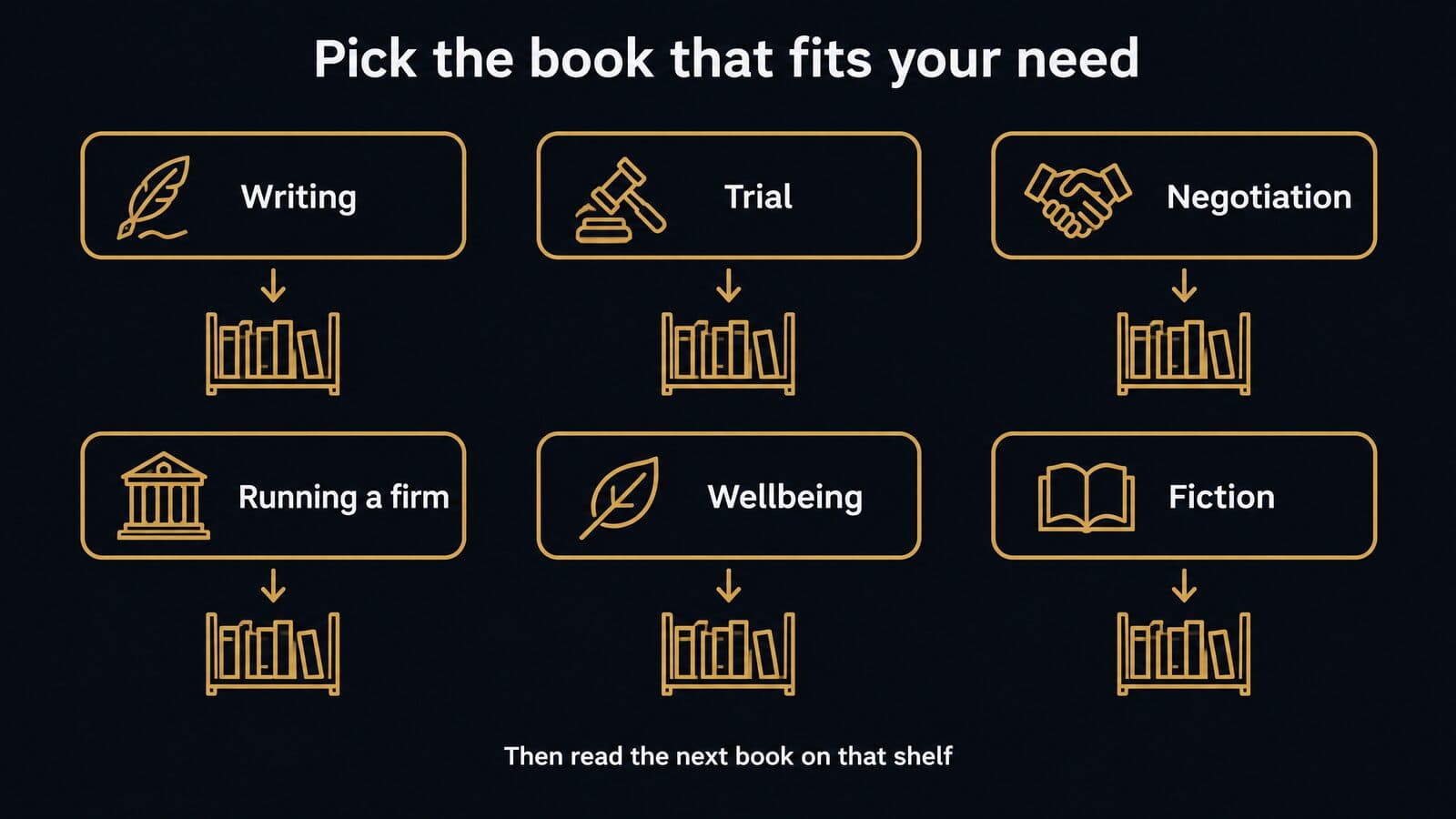
Start here: one book per need
The table below is the shortest path through this guide. Find the row that matches the problem on your desk this month, read the "Start with" book, and keep the "Then read" book for next quarter. Each title has a full card further down the page, in the section named for its category, with the edition and publisher we checked.
| If you need | Start with | Best for | Then read |
|---|---|---|---|
| Plain legal writing | Legal Writing in Plain English | Associates and any lawyer who drafts | Plain English for Lawyers |
| Persuading judges | Making Your Case | Motion and appellate writers | The Winning Brief |
| Persuasive writing models | Point Made | Brief writers who learn from examples | Storytelling for Lawyers |
| Proving liability at trial | Rules of the Road | Plaintiff trial lawyers | Polarizing the Case |
| Damages | David Ball on Damages 3 | PI litigators preparing for trial | Damages Evolving |
| Depositions | The Deposition Handbook | Litigators taking or defending depositions | 30(b)(6) |
| Settlement and demands | Winning Settlements | PI lawyers writing demands | Running with the Bulls |
| Negotiation | Never Split the Difference | Anyone who negotiates with adjusters or opposing counsel | Getting to Yes |
| Running a firm | The E-Myth Attorney | Firm owners stuck doing everything | Traction |
| Starting a practice | How to Start and Build a Law Practice | New solos | Solo by Choice |
| Intake and client experience | Unreasonable Hospitality | Intake managers and owners | The Client-Centered Law Firm |
| Mass torts | A Civil Action | Mass tort and toxic tort teams | Mass Torts in a World of Settlement |
| Wellbeing | The Happy Lawyer | Burned-out or restless lawyers | The Anxious Lawyer |
| Fiction | To Kill a Mockingbird | Evenings, book clubs, gifts | Anatomy of a Murder |
The "Start with" column is the book that solves the most common version of each problem with the least reading time or the broadest method. Legal Writing in Plain English, for example, is a 336-page text with exercises from the University of Chicago Press, so you can work through it in a few weeks. The "Then read" column goes deeper or narrower. Polarizing the Case follows Rules of the Road because it tackles one specific defense theme, and 30(b)(6) follows The Deposition Handbook because corporate depositions are a specialty inside a specialty. If a "Then read" book already matches your problem better, skip straight to it.
Two rows need a word of context. The settlement and damages books are Trial Guides practice manuals, priced like professional tools rather than trade books, so buy one at a time when a case calls for it. The mass tort row pairs a narrative (Jonathan Harr's account of a water contamination case) with a law professor's analysis of aggregate settlement, because the story teaches the stakes and the theory book teaches the structure. The fiction row is not a joke either: a good courtroom novel shows how a trial looks to people who are not lawyers, and the fiction section explains how to read one with that in mind.
Jump to your stage
The same books do not fit every stage of a legal career. Use the list below to go straight to the sections that will pay off first, then follow the five-book tracks in Reading Paths: Five-Book Tracks by Career Stage when you want a plan for the year.
- Law students and pre-law readers: go to Books for Law Students and New Lawyers first, then Legal Reasoning and Books on the Legal System. Pick one writing book from Best Books on Legal Writing and Persuasion before your first summer job.
- New associates (years one to three): start with Best Books on Legal Writing and Persuasion, because your work product is judged on the page before anyone sees you in court. Then read Books on Depositions, Damages and Settlement before your first deposition.
- Litigators: Trial Lawyer Books: The Plaintiff Canon and Books on Depositions, Damages and Settlement are your core shelf. Add Negotiation, Influence and Psychology Books for mediation and jury work.
- Firm owners and managing partners: Books on Running and Scaling a Law Firm and Marketing and Intake Books for Plaintiff Firms. Read the compliance filter in the marketing section before acting on any marketing book.
- PI and mass tort teams: The Mass Tort Reading List: Toxic Torts and Settlement for the case narratives and the settlement theory, then the settlement books in Books on Depositions, Damages and Settlement for single-event cases.
If you are not sure which stage you are in, use the problem test. Ask what cost you the most time or money last quarter: a rewritten brief, a weak deposition, a low settlement, an empty intake queue, or your own exhaustion. That problem tells you which section to open first.
How These Books Were Chosen and How to Use the Cards
Every book in this guide was checked against its publisher's page, the author's own site, or a library catalog in October 2026. There are no paid placements and no affiliate links, and each card shows the edition we checked so you can buy the right one.
Selection criteria and disclosure
A book made this list only if it met four tests. First, it has to be useful to a practicing US lawyer, a law student on the way to practice, or a firm leader. Second, it must be in print or legally available through a library or a public-domain archive. Third, it has to teach a specific method, such as a writing rule, a deposition sequence or a meeting cadence, instead of general motivation. Fourth, its edition has to be verifiable. Where we could not confirm a detail, the card says "check the current edition" instead of guessing.
Sources came in a fixed order. Publisher pages came first, because they are the authority on edition, length and list price. For trial books, we used Trial Guides' own product listings, with every sales claim attributed to the publisher. Where no publisher page was available, we used Open Library's catalog and said so in the sentence. We did not use retailer prices from Amazon, Barnes & Noble or Audible, because none were checked, and prices there move daily.
Now the disclosure. I am Tarun, and I run Mass Tort Marketing Agency, which handles lead generation, intake and marketing for personal injury and mass tort firms. We are not a publisher or a bookstore. Some authors on this list work in legal marketing too, including Michael Mogill, Chris Dreyer and Jack Newton. They are named with neutral facts only: Dreyer is bylined as CEO and founder of Rankings.io, and Newton was announced as Clio's CEO and co-founder in Clio's 2019 press release for his book.
It also helps to know that several popular book lists come from companies with books of their own to sell. Clio's list of 25 books, for example, discloses its bias on its CEO's book. That is normal and fair to state plainly. It is also why each card here carries a "Skip it if" line, so you get one honest reason not to buy every title.
How to read a book card
Each book recommendation follows the same pattern. The first paragraph says what the book is and the one problem it solves, with a practice scenario. The second paragraph describes the methods the book is known for, based on the publisher's description. The third paragraph gives one thing to try this month. The card then closes with four fields.
- Best for: the reader who will get the most from the book.
- Stage: student, new lawyer, litigator, firm owner, or any.
- Edition checked: the edition, publisher, year and page count we confirmed, or "check the current edition" where we could not.
- Skip it if: one honest reason the book may not suit you.
Prices appear only where the seller lists them on its own page, written as "listed at $X as of October 2026". Confirm the current price before buying, because list prices change. Audio availability is stated only where a publisher page shows an audiobook or audio edition; everywhere else, the tables say "Not verified" rather than assume.
Editions matter more than most lists admit. Plain English for Lawyers, for instance, is now in its seventh edition, © 2024, and its contents add a chapter on using artificial intelligence tools wisely. If a colleague hands you a used copy of an older edition, the core advice still holds, but you will miss the newest material.
What Lawyers Read: Craft, Business, Mindset, Fiction
Lawyers read for four reasons: to sharpen their craft, to run the business, to protect their mindset, and for pleasure. A good reading list covers all four, and the right mix shifts as a career moves from associate to owner.
The four reasons lawyers pick up a book
Craft. These are books that make the work product better: briefs, depositions, openings and negotiations. They are the most immediately useful books for a lawyer in the first decade of practice. In this guide, the craft shelf runs from Garner's writing books through the plaintiff trial canon to the negotiation classics. A craft book earns its price when it changes something you produce next week, such as the first paragraph of a motion or the order of questions in a deposition outline.
Business. These books treat the law firm as a business with systems, cash flow, a team and clients to win. They matter most to solos, small-firm partners and anyone with a payroll. The E-Myth Attorney, Traction and Foonberg's practice-building guide sit here, along with the marketing and intake books for plaintiff firms. They are also the books most likely to need a compliance check, because general business advice was not written with bar advertising rules in mind.
Mindset. These books deal with stress, focus, habits and leadership. Books like The Happy Lawyer and The Anxious Lawyer were written by lawyers for lawyers. Leadership books also fit here. The Legal Leadership Project's list of ten leadership books, for example, mixes general classics like The 7 Habits of Highly Effective People with lawyer-specific titles such as Lawyers as Leaders.
Pleasure. Legal fiction and true legal drama are the books lawyers read on vacation, and they are not wasted time. A novel like To Kill a Mockingbird shows how a trial reads to people who are not lawyers, which is exactly the audience a jury represents. Narrative nonfiction such as A Civil Action also does double duty for mass tort lawyers, because it tells the inside story of a toxic tort case.
There is no survey of what lawyers actually read, so this guide uses categories rather than percentages. Popular lists divide the field differently. Clio groups its 25 books into categories. VXT's list of 30 books splits fiction from nonfiction. The Legal Leadership Project focuses on leadership. Each split is reasonable for its audience. This guide uses need and stage because that is how a working lawyer decides what to read next.
Practice treatises versus reading-list books
There are two kinds of lawyer books, and they are bought differently. Practice treatises and state practice guides, from publishers such as Thomson Reuters, LexisNexis and James Publishing, are reference works. You look up a rule, a form or a jury instruction and close the book. They are usually updated by supplement or new edition, sold by subscription or as multi-volume sets, and kept in the firm library or a research database.
Reading-list books are read cover to cover. They teach a method or change how you think, and you rarely need the newest printing to benefit. This guide covers the second kind, plus a handful of references that every lawyer touches. The clearest example is Black's Law Dictionary. Its 12th edition, edited by Bryan A. Garner and © 2024, is listed at $89.95 for the standard hardbound by Thomson Reuters as of October 2026; confirm the current price before ordering.
If your question is about research platforms rather than books, see our guide to legal research tools and databases. A simple rule helps when budgets are tight: let the firm pay for treatises and databases that everyone uses, and let each lawyer choose one or two reading-list books per quarter tied to a skill they are building.
Best Books on Legal Writing and Persuasion
Start with Bryan A. Garner's Legal Writing in Plain English. Add Scalia and Garner's Making Your Case when you write for judges, and Ross Guberman's Point Made when you want models from top advocates.
Legal Writing in Plain English by Bryan A. Garner
Legal Writing in Plain English is a workbook for lawyers who write too much and say too little. Picture a second-year associate asked to rewrite a three-page client letter about a discovery dispute into one page the client will actually read. This book gives that associate a method instead of a red pen. It is frequently recommended to junior associates in practitioner forums, according to search snippets of those threads.
The University of Chicago Press describes the third edition as a text with exercises, part of its Chicago Guides to Writing, Editing, and Publishing series, and notes that an instructor's manual is available. That structure is the point. You do not just read about shorter sentences, active voice and putting the answer first; you practice them on exercises and compare your versions.
This month, take one letter or memo you sent last week, apply the book's principles to its first page, and compare word counts.
Best for: associates and any lawyer whose writing gets heavily edited. Stage: new lawyer. Edition checked: third edition, University of Chicago Press, © 2023, 336 pages. Skip it if: you already teach legal writing and want advanced brief strategy rather than fundamentals.
Making Your Case by Antonin Scalia and Bryan A. Garner
Making Your Case: The Art of Persuading Judges is written for the lawyer whose audience is a judge, in a brief or at the podium. Imagine drafting an opposition to summary judgment where the court has 40 other motions on its calendar. The book is about earning that judge's attention and trust in the first few pages.
The book pairs Justice Scalia with a legal-writing author, and it covers both written and oral argument. Its advice is general and practical: know your audience, lead with your strongest argument, respect the court's time, and prepare for questions. Garner's LawProse lists the book with a West publication date of 2008, and also lists an unabridged audio CD reading by the authors, which makes it one of the few writing books you can hear on a drive to court.
This month, reread the introduction of your last brief and cut anything that comes before your main point.
Best for: motion practice and appellate lawyers. Stage: litigator. Edition checked: West, 2008; audio CD read by the authors per LawProse; pages: check the current edition. Skip it if: you rarely write to courts, such as in a transactional practice.
Garner's style shelf: The Winning Brief, The Elements of Legal Style, The Redbook
Bryan A. Garner, who is also the editor of Black's Law Dictionary, has written a shelf of style books beyond the two above. His LawProse book list shows the current editions. Three of them suit different readers.
The Winning Brief: 100 Tips for Persuasive Briefing in Trial and Appellate Courts is the tip-by-tip companion to Making Your Case. Its format suits lawyers who want one rule to apply per brief rather than a book to read in one sitting. LawProse lists the third edition, and no fourth edition appears there.
The Elements of Legal Style is a style book in the tradition of a famous predecessor. Oxford University Press says it was "Inspired by Strunk and White's The Elements of Style", and adds an appendix of 80 major statements on prose style. OUP lists the second edition as a 288-page hardcover published in March 2002, at $36.99 as of October 2026; confirm the current price.
The Redbook: A Manual on Legal Style is a reference for citation-free style questions such as punctuation, capitalization and document design. It suits firms that want one house style for every lawyer and paralegal. LawProse lists the fifth edition, 2023. For word-choice questions, the same list includes Garner's Modern English Usage, fifth edition, 2022.
- The Winning Brief: best for brief writers who want quick rules; third edition per LawProse.
- The Elements of Legal Style: best for lawyers who want a short style guide; second edition, OUP, 2002, 288 pages.
- The Redbook: best for firms setting a house style; fifth edition, 2023, per LawProse.
Point Made by Ross Guberman
Point Made: How to Write Like the Nation's Top Advocates teaches by example. Instead of rules, it shows how well-known advocates actually open a brief, frame a fact or handle a bad precedent. Picture a lawyer stuck on the introduction of an appellate brief who needs to see five strong introductions before writing one.
According to Oxford University Press, the second edition adds eight lawyers, among them Lisa Blatt, Judy Clarke, Don Verrilli and Sri Srinivasan, plus examples from Affordable Care Act and same-sex marriage cases. The book's method is to break persuasive writing into specific techniques and then show each one in real filings, which makes it easy to copy a pattern into your own draft.
This month, choose one technique from the book and use it in the introduction of your next motion.
Best for: brief writers who learn best from models. Stage: litigator. Edition checked: second edition, OUP paperback, April 2014, 424 pages, listed at $42.99 by OUP as of October 2026 (confirm the current price); also available as an audiobook per OUP. Skip it if: you want grammar and plain-English basics first.
Plain English for Lawyers by Richard C. Wydick and Amy E. Sloan
Plain English for Lawyers is the short, classic case against legalese. It suits the lawyer who knows a contract clause or jury instruction is hard to read but cannot say why. Think of a paralegal and associate revising a firm's standard fee agreement so a client can understand it before signing.
The book works through habits that bloat legal prose, such as surplus words, long sentences and nominalizations, with exercises to practice each fix. The seventh edition comes from Carolina Academic Press, by Richard C. Wydick, late of UC Davis School of Law, and Amy E. Sloan of the University of Baltimore School of Law. Its contents list a tenth chapter titled "Use Artificial Intelligence Tools Wisely", which is useful for any firm drafting with AI assistants.
This month, run one firm template, such as an engagement letter, through the book's checklist.
Best for: students and lawyers who draft documents clients must read. Stage: any. Edition checked: seventh edition, Carolina Academic Press, © 2024; pages: check the current edition. Skip it if: you already own Legal Writing in Plain English and want brief strategy rather than another plain-English book.
Thank You for Arguing by Jay Heinrichs
Thank You for Arguing is a popular book on rhetoric, not a law book, and that is why lawyers like it. It explains persuasion in everyday settings, which helps when your audience is a client, a jury or a mediator rather than a judge. Picture a lawyer preparing to explain a low settlement offer to a frustrated client.
The subtitle sums up its approach: "What Aristotle, Lincoln, and Homer Simpson Can Teach Us About the Art of Persuasion." The book teaches classical rhetoric in plain language, including appeals to character, logic and emotion, and how to choose the right one for an audience. Penguin Random House lists the fourth edition, revised and updated, as a 480-page Crown paperback published April 2020.
This month, before your next difficult client call, write down which appeal you will lead with and why.
Best for: lawyers who persuade people more often than courts. Stage: any. Edition checked: fourth edition, Crown paperback, 2020, 480 pages, listed at $19.00 by Penguin Random House as of October 2026 (confirm the current price). Skip it if: you want legal-writing technique specifically.
Storytelling for Lawyers by Philip Meyer
Storytelling for Lawyers applies narrative craft to legal work. It suits the lawyer whose facts are strong but whose filings read like a timeline. Picture a PI lawyer drafting a demand letter or an opening statement who needs the reader to care about the client before reading the damages section.
Oxford University Press says the author is a law professor who also holds a master's degree in creative writing from the University of Iowa Writers Workshop. The book reads legal documents as stories, looking at character, plot, point of view and theme, and shows how lawyers use those elements whether they plan to or not. That framing carries straight into opening statements and the narrative section of a demand.
This month, rewrite the facts section of one demand letter so it opens with your client, not the collision.
Best for: trial lawyers and anyone who writes demands or openings. Stage: litigator. Edition checked: OUP paperback, March 2014, 256 pages, listed at $45.99 by OUP as of October 2026 (confirm the current price). Skip it if: you need grammar and clarity fundamentals before style.
The Tools of Argument by Joel P. Trachtman
The Tools of Argument is a short guide to the standard moves of legal argument, aimed at students and new lawyers who need names for the techniques they see in cases. Picture a first-year law student reading appellate opinions and trying to tell a policy argument from a textual one.
The book catalogs common argument types and counterarguments so a reader can spot them and use them deliberately. Open Library's catalog lists a 2013 edition from CreateSpace Independent Publishing Platform. We could not confirm the edition on a publisher page, so check the current edition before buying.
This month, take one opinion you are reading and label each argument the court uses.
Best for: law students and new lawyers. Stage: student. Edition checked: 2013 CreateSpace edition per Open Library; check the current edition. Skip it if: you are an experienced litigator looking for writing technique.
Legal writing books compared
The table puts the eight writing and persuasion books side by side. "Audio" says "Yes (publisher)" only where a publisher or author page shows an audio edition; "Not verified" means we did not find one, not that none exists.
| Book | Best for | Edition checked | Pages | Audio |
|---|---|---|---|---|
| Legal Writing in Plain English | Associates | 3rd ed., UChicago, 2023 | 336 | Not verified |
| Making Your Case | Writing for judges | West, 2008 | Check edition | Yes (publisher, audio CD) |
| The Winning Brief | Quick briefing rules | 3d ed. per LawProse | Check edition | Not verified |
| The Elements of Legal Style | Short style guide | 2d ed., OUP, 2002 | 288 | Not verified |
| Point Made | Learning from models | 2nd ed., OUP, 2014 | 424 | Yes (publisher) |
| Plain English for Lawyers | Plain drafting | 7th ed., CAP, 2024 | Check edition | Not verified |
| Thank You for Arguing | Everyday persuasion | 4th ed., Crown, 2020 | 480 | Not verified |
| Storytelling for Lawyers | Demands and openings | OUP, 2014 | 256 | Not verified |
If you buy only one, buy Legal Writing in Plain English; that is my pick for most readers because it improves every document, not just briefs. If you already write well and argue to courts, Point Made or Making Your Case is the better second book. Persuasion on paper is half the job. The other half happens in the courtroom, which is where the plaintiff trial canon begins.
Trial Lawyer Books: The Plaintiff Canon
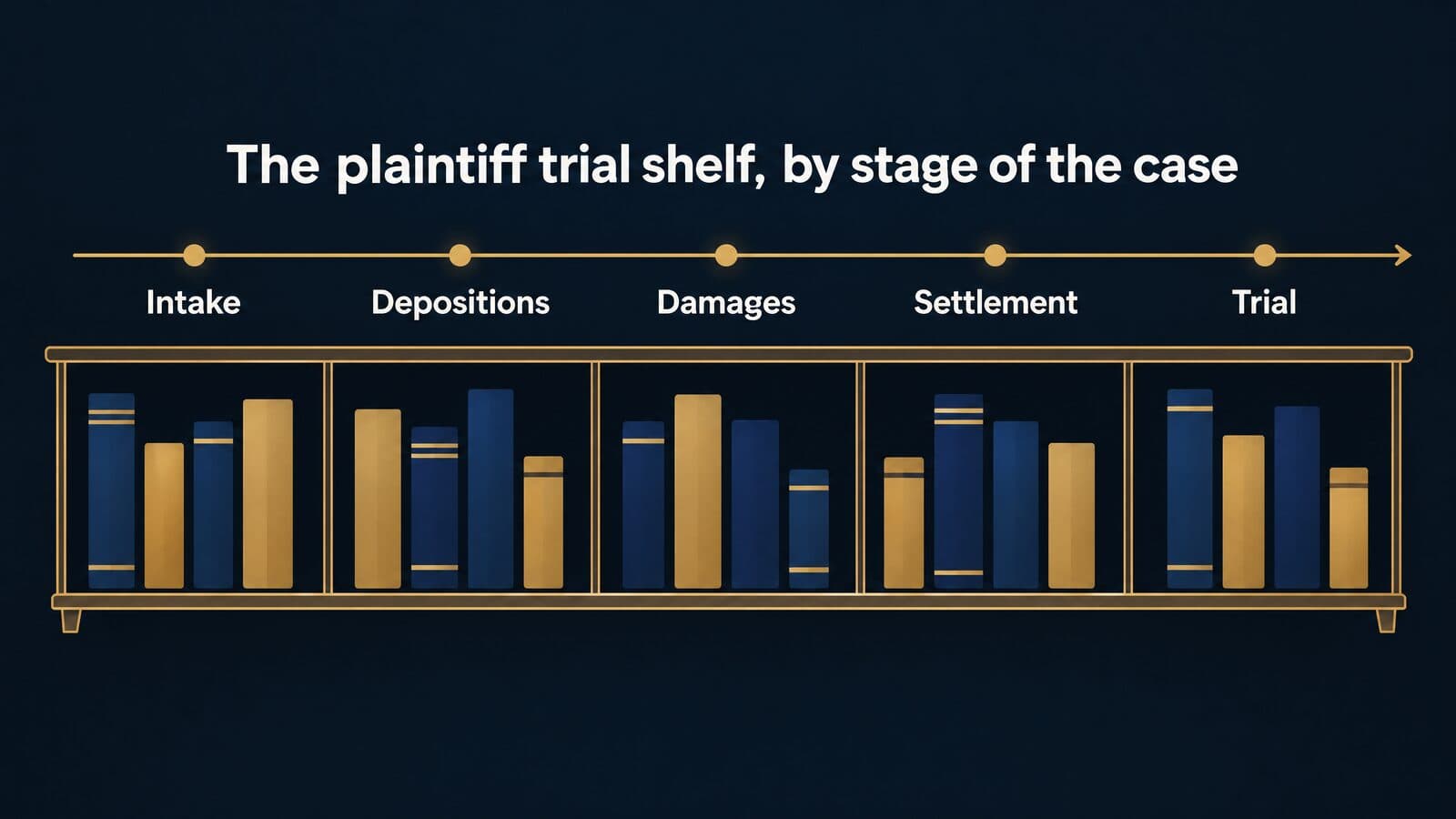
The plaintiff trial canon is Rules of the Road, Reptile, Polarizing the Case and Rick Friedman's trial books, plus a handful of classics on opening, closing and damages. Most of them are Trial Guides titles sold as practice manuals at practice-manual prices, not trade books you pick up at an airport.
That context matters before you buy. Trial Guides' Books for Lawyers collection page says the company has published "cutting-edge methods for handling and trying legal cases" since 2004. The same page claims it has more members of the Inner Circle of Advocates than all other legal publishers combined, and that every notable plaintiff's-bar book of the past 20 years "has been published or distributed by Trial Guides," naming Rules of the Road, David Ball on Damages, Reptile and Polarizing the Case. Those are the publisher's own claims. The Inner Circle of Advocates describes itself as "an organization of the best 100 plaintiff trial lawyers in the United States," which is likewise a self-description.
Rules of the Road by Rick Friedman and Patrick Malone
Rules of the Road: A Plaintiff Lawyer's Guide to Proving Liability is the book plaintiff lawyers hand to each other when a liability case feels soft. Its problem is how to turn a vague negligence standard into concrete rules the defendant's own witnesses will have to accept or look unreasonable rejecting.
The method, as the publisher describes it, centers on framing the case around safety rules the defendant should have followed and building discovery, depositions and trial around them. Trial Guides' product page stresses that the book "does not simply cover motor vehicle cases as the name may suggest," so it applies to medical, premises and product cases too. Trial Guides calls it "America's bestselling book for lawyers on proving liability" and its own "#1 bestselling book"; treat those as the publisher's claims.
This month, take one open file and write three candidate rules in plain language before your next deposition notice goes out. Test each rule by asking whether a juror would nod at it without knowing the facts.
Best for: plaintiff litigators who try or prepare liability cases. Stage: litigator. Edition checked: listed at $175 by Trial Guides as of October 2026 in paperback, hardcover and ebook, and $175 as an audiobook; confirm the current price. Skip it if: your practice is purely pre-suit settlement work and you never take depositions.
Reptile by David Ball and Don Keenan
Reptile: The 2009 Manual of the Plaintiff's Revolution is the book behind one of the most discussed plaintiff trial methods. The problem it addresses is jurors who sympathize with an injured plaintiff but still return small verdicts.
In general terms, the approach asks jurors to think about safety and danger to the community rather than about one plaintiff's sympathy, and it pairs that with safety-rule framing similar to Rules of the Road. The method is widely discussed, taught and argued over in trial-skills circles, and defense lawyers write about responding to it.
On the edition: Open Library's catalog lists a Balloon Press edition dated April 12, 2009, at 330 pages. Trial Guides names Reptile among books it "published or distributed," but no Reptile listing appeared in its current store feed when we checked in October 2026. Look for it through a law library or a used-book seller.
This month, read a defense motion targeting the method in your jurisdiction and note which phrases it asks the court to bar.
Best for: trial lawyers who want to understand the method and the defense response to it. Stage: litigator. Edition checked: Balloon Press, 2009, 330 pages, per Open Library; no current listed price. Skip it if: you want a step-by-step trial manual rather than a philosophy of jury persuasion.
Polarizing the Case by Rick Friedman
Polarizing the Case: Exposing & Defeating the Malingering Myth is for the soft-tissue, chronic-pain or traumatic-brain-injury case where the defense says your client is exaggerating. Imagine a rear-end collision with modest property damage, a client with real neck pain, and an IME doctor ready to testify about "secondary gain." That is the case this book is built for.
Trial Guides' page frames the subject as exposing and defeating the malingering myth. In general terms, the idea is to make the defense commit to the position that your client is lying, then show the jury what that accusation requires them to believe. The publisher calls it "the #3 book of all time at Trial Guides, just behind Rules of the Road and David Ball on Damages," which is its own sales ranking.
This month, list every defense document in one file that implies malingering and decide whether you want the defense to own that theme at trial.
Best for: PI lawyers handling disputed-injury and chronic-pain cases. Stage: litigator. Edition checked: listed at $135 new by Trial Guides as of October 2026; confirm the current price. Skip it if: your docket is mostly catastrophic-injury cases where credibility of the injury is not contested.
The Elements of Trial, Becoming a Trial Lawyer and The Way of the Trial Lawyer
Rick Friedman's three other trial books form a progression: basic skills, a career guide and a book about judgment.
The Elements of Trial, written with Bill Cummings, is what Trial Guides calls "the first practical text on the fundamental skills you need to know when handling a trial." It suits the associate who has a first bench trial on the calendar and has never actually laid foundation for an exhibit under pressure. The product page says the book is available for $45 to new lawyers and law students accepted into the publisher's New Lawyers Program.
Becoming a Trial Lawyer: A Guide for the Lifelong Advocate, now in its second edition, is the career book in the set. It is aimed at lawyers deciding how to grow into trial work over years rather than months. Trial Guides says it is available to students and lawyers practicing five years or less for $45 when registered for the same New Lawyers program.
The Way of the Trial Lawyer: Beyond Technique moves past skills. Its listed topics include "case selection" and "how to analyze your case's moral issues," which makes it the most useful of the three for a firm owner deciding which cases to take to verdict.
This month, check whether you qualify for the New Lawyers Program before paying list price.
- The Elements of Trial: best for associates preparing a first trial; listed at $95 in paperback and ebook and $145 as an audiobook by Trial Guides as of October 2026; confirm the current price.
- Becoming a Trial Lawyer: best for lawyers planning a trial career; second edition, listed at $125 by Trial Guides as of October 2026; confirm the current price.
- The Way of the Trial Lawyer: best for experienced litigators and firm owners choosing cases; listed at $145 by Trial Guides as of October 2026; confirm the current price.
Don't Eat the Bruises by Keith Mitnik
Don't Eat the Bruises: How to Foil Their Plans to Spoil Your Case is about the weaknesses in your own case and when to bring them up. Every plaintiff lawyer has a file with a bad fact: a prior injury, a gap in treatment, a social-media post. The question is whether you raise it first, how, and how much airtime it gets.
The subtitle states the problem: the defense's plan is to "spoil" the case with its weak points, and the book is about foiling that plan. Trial Guides describes Mitnik as "the senior trial counsel for Morgan & Morgan." The product copy also makes claims about when jurors decide, without citing a study, so read the method on its merits rather than on that marketing line.
This month, write down the three worst facts in your next trial file and draft one sentence for each that you would say in opening, if any.
Best for: trial lawyers preparing openings and voir dire around bad facts. Stage: litigator. Edition checked: listed at $165, and $165 as an audiobook, by Trial Guides as of October 2026; confirm the current price. Skip it if: you rarely reach opening statements and mostly settle in discovery.
Moe Levine on Advocacy
Moe Levine on Advocacy is for the lawyer who wants to hear how a master of the last century talked to juries, especially in summation on damages. It suits the litigator who has a closing to write and wants something more than a template.
Trial Guides calls the book a collection of Levine's "publicly available lectures and trial transcripts," and notes that he died in 1974.
This month, read one transcript aloud and mark every place where the speaker moves from fact to meaning. Then do the same with your last closing.
Best for: litigators writing closings and damages arguments. Stage: litigator. Edition checked: listed at $185 in hardcover, and $185 as an audiobook, by Trial Guides as of October 2026; confirm the current price. Skip it if: you need a systematic how-to rather than primary-source examples.
Win Your Case by Gerry Spence
Win Your Case: How to Present, Persuade, and Prevail--Every Place, Every Time is the trade-press entry in this section and by far the least expensive. It suits a newer lawyer, or a lawyer outside PI, who wants a readable book on persuasion in front of juries, judges and opponents before committing to a $175 practice manual.
Macmillan describes Spence as a "renowned trial attorney and New York Times bestselling author," and lists the book as an Audie Award finalist under Honors. In general terms, it is about the person doing the persuading: credibility, story and preparation, rather than evidence rules or a single framing method.
This month, read it before your next mediation and pick one preparation habit to keep.
Best for: new lawyers and non-PI litigators who want a first trial book. Stage: new lawyer. Edition checked: St. Martin's Griffin trade paperback, on sale November 28, 2006, 304 pages, listed at $19.00 by Macmillan as of October 2026; confirm the current price. Skip it if: you already own the Friedman books and want method rather than mindset.
Plaintiff trial books at a glance
Use this table to compare the nine trial books above before you pick one. If you only buy one this year and you try liability cases, the usual starting point is Rules of the Road; if you mostly fight over whether an injury is real, start with Polarizing the Case.
| Book | Author | Listed price (Oct 2026) | Audio | Best for |
|---|---|---|---|---|
| Rules of the Road | Rick Friedman, Patrick Malone | $175 | Yes, $175 | Proving liability |
| Reptile | David Ball, Don Keenan | Not listed | Not listed | Understanding the method |
| Polarizing the Case | Rick Friedman | $135 | Not listed | Malingering defenses |
| The Elements of Trial | Rick Friedman, Bill Cummings | $95 | Yes, $145 | First trial skills |
| Becoming a Trial Lawyer | Rick Friedman | $125 | Not listed | Trial career planning |
| The Way of the Trial Lawyer | Rick Friedman | $145 | Not listed | Case selection |
| Don't Eat the Bruises | Keith Mitnik | $165 | Yes, $165 | Bad facts in opening |
| Moe Levine on Advocacy | Moe Levine | $185 | Yes, $185 | Closings and damages |
| Win Your Case | Gerry Spence | $19.00 | Not listed | A first trial book |
Prices are as listed by the seller as of October 2026 (Trial Guides for all but Win Your Case, which is Macmillan's list price); confirm before buying. "Not listed" means we did not find an audio or price listing from the publisher, not that one does not exist. Several Trial Guides product pages also say print buyers get a coupon to buy the ebook for $20, so check the publisher's page for that offer before buying both formats.
Books on Depositions, Damages and Settlement
Depositions, damages and settlement each have a standard Trial Guides text: The Deposition Handbook and 30(b)(6) for discovery, David Ball on Damages 3 for damages, and Winning Settlements and Running with the Bulls for resolution. Read the one that matches where your docket sits right now, not the one with the best reputation.
The Deposition Handbook and 30(b)(6)
The Deposition Handbook, by Dennis Suplee and Nicole Reimann with David B. Markowitz, R. Kyle Busse and Alison R. Gutierrez, is the general deposition manual on this list. It suits the associate taking or defending a first set of fact-witness depositions who needs to know objection practice, witness preparation and how to keep a record clean. Trial Guides' collection page says the book is now in its sixth edition, and the product page says the newest edition covers remote depositions and "the first change to Rule 30(b)(6) in fifty years."
30(b)(6): Deposing Corporations, Organizations & the Government, Third Edition, by Mark Kosieradzki, is narrower and deeper. It is the book for drafting your first 30(b)(6) notice against a hospital system or a trucking company and then fighting about the designee's preparation. Trial Guides says it addresses "the 2020 amendment to Rule 30(b)(6) that establishes the need to 'meet and confer,'" and includes a rewritten section on using 30(b)(6) testimony at trial.
This month, pull your last corporate deposition notice and check whether you documented the meet-and-confer on its topics. If you did not, build that step into your template.
- The Deposition Handbook: best for associates taking and defending depositions; sixth edition per the publisher, listed at $185 by Trial Guides as of October 2026; confirm the current price.
- 30(b)(6): best for litigators deposing companies and agencies; third edition, listed at $195 by Trial Guides as of October 2026; confirm the current price.
David Ball on Damages 3 and Damages Evolving
David Ball on Damages 3 is the damages book in the canon. It solves the problem of a liability-strong case that comes back with a low number because nobody gave jurors a way to think about harm. If you have a client with a permanent injury and modest medical bills, this is where to start.
Trial Guides says the third edition "teaches you how to integrate the Reptile and Rules of the Road™ methods" into the damages method, and it refers to "the second edition's 2005 release." The publisher calls the series "America's bestselling text on proving damages," which is its own claim. In general terms, the book covers how to identify and present every category of harm, and how to talk to jurors about money without losing them.
Damages Evolving, by David Ball, Artemis Malekpour, Courtney Rowley and Nicholas Rowley, is the companion volume. Its product page lists it alongside the original, and the author line brings in the Rowleys, whose settlement books appear in the next card.
Before you build a damages model from a book, sanity-check the numbers. You can estimate motor vehicle case value by state as a rough reference point, then use the book's framework to explain the harm behind the figure.
- David Ball on Damages 3: best for PI litigators who prepare damages presentations; third edition, listed at $195 (paperback, hardcover, ebook) and $195 as an audiobook by Trial Guides as of October 2026; confirm the current price.
- Damages Evolving: best for readers who finished Damages 3 and want more; listed at $195 (paperback, ebook) and $195 as an audiobook by Trial Guides as of October 2026; confirm the current price.
Anatomy of a Personal Injury Lawsuit
Anatomy of a Personal Injury Lawsuit, Fourth Edition, is a reference set rather than a read-through book. It is what a firm keeps on the shelf so that an associate handed an unfamiliar case type can see the whole life of a PI case laid out by practitioners.
Trial Guides describes it as a "two-volume set edited by John Romano," "Written by over sixty contributing experts." It is also the most expensive book in the publisher's feed.
This month, if your firm buys it, assign one chapter per month to a different associate and have them present one change to your firm's checklist.
Best for: PI firms building a shared reference shelf. Stage: firm owner. Edition checked: fourth edition, two volumes, listed at $575 in paperback and ebook by Trial Guides as of October 2026; confirm the current price. Skip it if: you are buying for yourself alone and want a single method you can read in a weekend.
Winning Settlements and Running with the Bulls
Winning Settlements, Revised Edition, is the multi-author settlement book. It suits the lawyer whose cases resolve at mediation and who wants a better demand, a better mediation plan and a cleaner lien process. Trial Guides lists contributors including Nick and Courtney Rowley, Joe Fried, Randi McGinn, Charla Aldous and Patrick Malone. Its topics include demand letters, mediation and how to "Negotiate liens with providers, insurers, and Medicare," which is often where net recovery is actually won or lost.
Running with the Bulls: How to Win Top Dollar Settlements, by Nick Rowley and Courtney Rowley, is the more focused of the two. The publisher says it covers "how to write a demand letter that will open the defendant's insurance policy" and low-policy-limit cases. Picture a serious injury, a $25,000 auto policy and an adjuster who has not yet been given a reason to tender. That is this book's scenario.
One boundary. Both books are about single-case demands against an insurer or defendant. Aggregate settlements in mass torts work differently, with inventory deals, matrices and claims administrators. If that is your practice, read about how mass tort settlements are structured and see the Mass Tort Reading List section for books on the subject.
This month, rewrite your demand-letter template using one structural idea from either book and track the response on your next three demands.
- Winning Settlements: best for lawyers who resolve most cases at mediation; revised edition, listed at $95 by Trial Guides as of October 2026; confirm the current price.
- Running with the Bulls: best for lawyers working low-limits policies and time-limited demands; listed at $185 by Trial Guides as of October 2026; confirm the current price.
Matching the book to the stage of the case
The quickest way to choose among these books is to ask what question your docket is asking this month. A firm with forty cases in pre-suit needs a different book from one with six cases set for trial. Use this table as a reading map tied to the stage of the case.
| Case stage | Question you face | Read | Apply it to |
|---|---|---|---|
| Intake and case selection | Should we take this case to verdict? | The Way of the Trial Lawyer | Case acceptance criteria |
| Pre-suit demand | How do we open the policy? | Running with the Bulls; Winning Settlements | Demand letter template |
| Written discovery and depositions | How do we build the record? | The Deposition Handbook | Witness prep and objections |
| Corporate depositions | How do we pin down the company? | 30(b)(6) | Notice topics and meet-and-confer |
| Damages workup | How do jurors see the harm? | David Ball on Damages 3 | Damages outline |
| Mediation | How do we close the gap? | Winning Settlements; Getting to Yes | Mediation statement and lien plan |
| Trial | How do we prove liability? | Rules of the Road; The Elements of Trial | Safety rules and trial skills |
| Closing | How do we ask for the number? | Moe Levine on Advocacy | Summation draft |
Read one book per stage, not one per author, and write down the "apply it to" item before you open the book. Getting to Yes appears here because interest-based bargaining is useful at mediation; it is covered with the other negotiation books in the next section.
Negotiation, Influence and Psychology Books
Read Never Split the Difference for tactical empathy in negotiation and Getting to Yes for interest-based bargaining. Influence and Thinking, Fast and Slow explain why jurors, adjusters and clients decide the way they do, and Crucial Conversations covers the hard talks inside your own firm and with clients.
Never Split the Difference by Chris Voss
Never Split the Difference: Negotiating As If Your Life Depended On It appears on many lawyer reading lists, and it solves a specific problem: negotiations that stall because both sides are trading numbers instead of information. Picture an adjuster who repeats "that's what the file supports" on every call. The book is about getting past that line.
HarperCollins describes Voss as "a former FBI hostage negotiator," and the page claims "more than 5 million copies sold," which is a publisher figure. The ideas it is known for include tactical empathy, labeling the other side's emotions, mirroring their words, and asking calibrated "how" and "what" questions that make the other side solve your problem.
This month, on your next three adjuster calls, replace one demand-style statement with a calibrated question and note what information you get back.
Best for: lawyers who negotiate settlements by phone and in mediation. Stage: any. Edition checked: HarperCollins, on sale May 17, 2016, listed at $35.00 by HarperCollins as of October 2026; confirm the current price. Skip it if: you want a framework for multi-party deal structuring rather than one-on-one tactics.
Getting to Yes by Roger Fisher, William Ury and Bruce Patton
Getting to Yes: Negotiating Agreement Without Giving In is the classic of interest-based negotiation. It solves the problem of positional bargaining, where each side digs into a number and the only movement is splitting the difference. In a plaintiff practice, that looks like a mediation where both sides trade offers in $5,000 steps until lunch.
The methods it is known for include separating the people from the problem, focusing on interests rather than positions, inventing options for mutual gain and insisting on objective criteria. Penguin Random House's author bios describe Roger Fisher as director of the Harvard Negotiation Project and William Ury as co-founder of Harvard's Program on Negotiation. Open Library's catalog lists the original publication as 1981.
This month, before your next mediation, write the defendant's likely interests on one page: reserve setting, trial risk, a structured payment. Then draft one option that serves an interest of theirs without lowering your client's net.
Best for: lawyers preparing for mediation and law students learning negotiation. Stage: any. Edition checked: Penguin Books paperback, May 3, 2011, 240 pages, listed at $21.00 by Penguin Random House as of October 2026; confirm the current price. Skip it if: you have read it in law school and want tactics for a hard-bargaining counterpart.
Influence by Robert B. Cialdini
Influence, New and Expanded: The Psychology of Persuasion explains why people say yes. For lawyers, the useful version of that question is why a juror trusts one expert over another, why a client follows one intake specialist's advice and ignores another's, and why an adjuster moves after a particular kind of letter.
The book is known for its principles of persuasion, including reciprocity, commitment and consistency, social proof, liking, authority and scarcity. HarperCollins lists the expanded edition as on sale May 4, 2021, and its page claims "over 5 million copies," which is the publisher's figure. Read it as a description of how decisions get made, then decide which uses are appropriate in your practice; the last card in this section is about that line.
This month, review one client-facing script, such as your intake call or retainer explanation, and identify which principle each step relies on.
Best for: litigators, intake managers and firm owners who write persuasive communications. Stage: any. Edition checked: new and expanded edition, HarperCollins, 2021, listed at $35.00 by HarperCollins as of October 2026; confirm the current price. Skip it if: you want trial-specific persuasion rather than general psychology.
Thinking, Fast and Slow by Daniel Kahneman
Thinking, Fast and Slow is the long, careful book on how judgment goes wrong. For lawyers, it explains anchoring in settlement talks, hindsight in negligence arguments, and why a juror's first impression is so hard to move.
The book is known for its two-system model of thinking (fast and intuitive versus slow and deliberate) and its catalog of biases, including anchoring, availability and loss aversion. The excerpt on Macmillan's page includes Kahneman's line about "the Nobel Prize that I received in 2002," and the publisher claims more than 2.6 million copies sold.
This month, look at how your firm sets the first number in a demand and whether that number is based on comparable outcomes or on habit.
Best for: lawyers who value cases, set demands or study juror decision-making. Stage: litigator. Edition checked: Farrar, Straus and Giroux paperback, April 2, 2013, 512 pages, listed at $22.00 by Macmillan as of October 2026; confirm the current price. Skip it if: you want a short practical guide rather than a long survey of research.
Crucial Conversations
Crucial Conversations is the book for talks where stakes are high, opinions differ and emotions run strong. In a law firm that means telling a client their case is worth less than they hoped, giving a paralegal hard feedback, or confronting a partner about workload.
Open Library's catalog lists a 2021 McGraw-Hill Education edition at 304 pages. Crucial Learning, which teaches the method, says nearly half of the Forbes Global 2000 and more than three million people have used its courses, which is the company's own claim. In general terms, the book teaches how to keep a conversation safe enough that people keep talking, and how to separate the facts from the story you are telling yourself about them.
This month, use it to prepare one client call about a lower-than-expected settlement value.
Best for: lawyers and managers who handle difficult client and staff conversations. Stage: any. Edition checked: 2021 McGraw-Hill Education edition, 304 pages, per Open Library; check the current edition. Skip it if: your gap is negotiation with opponents rather than conversations with clients and colleagues.
One more title comes up on almost every lawyer reading list in this category: How to Win Friends and Influence People. It is often recommended for client relationships and networking; we did not check an edition, so look at what your library carries.
Using these books ethically with adjusters, jurors and clients
Persuasion books describe techniques; professional rules decide which techniques a lawyer may use. Every technique in this section has an ethical version and a version that would get a lawyer in trouble, and the line is drawn by your state's rules of professional conduct, not by the book.
Two general points are safe to make. First, communications about your services are governed by rules like ABA Model Rule 7.1, which says a lawyer "shall not make a false or misleading communication about the lawyer or the lawyer's services." That matters when Influence-style tactics show up in intake scripts or client letters. Second, rules on truthfulness toward opposing parties during negotiation are separate, and each state adopts its own version of the Model Rules, so check your state's rules before relying on a general summary. This is general information, not legal advice.
Within those limits, three guardrails keep negotiation books on the right side of the line:
- No deceptive anchors about facts. An aggressive opening number is a negotiation choice; a false statement about medical treatment, policy limits or a witness to support that number is not.
- Document offers and responses. Calibrated questions and labels work in conversation, but every offer, counteroffer and deadline belongs in writing, especially on time-limited demands.
- Confirm client authority. Tactical empathy with an adjuster does not replace your client's decision. Get settlement authority in writing before you signal a number, and explain the tactic you plan to use.
With clients, Crucial Conversations is a better guide than any negotiation tactic. Persuading clients honestly is part of running a firm that serves them, which is where the next section, on running and scaling a law firm, begins.
Books on Running and Scaling a Law Firm
The E-Myth Attorney explains why most practices stall on the owner, while Traction and Jay Foonberg's How to Start and Build a Law Practice supply the operating system and the startup checklist. Add The Five Dysfunctions of a Team when the problem is people, Profit First when it is cash, and Maister when you are pricing and staffing professional work.
Business books written for general companies only help a law firm when you translate them. A plaintiff practice has odd economics: contingency fees paid months or years after the work, case costs advanced from the firm's own account, and intake volume that swings with advertising. Read each book below with one question in mind: what would this look like on the firm's weekly scorecard? If you cannot answer that, the book is entertainment, which is fine, but it is not a management plan.
The E-Myth Attorney by Gerber, Armstrong and Fisch
The E-Myth Attorney is the law-firm version of Michael Gerber's E-Myth series, written for the lawyer who is drowning in casework and cannot step away for a week without the practice slowing down. The scenario it fits is familiar to most PI founders: you are the best trial lawyer in the building, you also approve every ad, review every demand and return the angry client calls, and growth has stopped because everything still routes through you.
The book is known for three ideas. First, the split between the technician (the lawyer doing the work), the manager and the entrepreneur, and the claim that most firms are run by an overloaded technician. Second, the instruction to work on the business, not only in it. Third, the push to document systems so that a trained person can deliver a consistent result without the owner present.
This month, pick one recurring process you personally touch every week, such as reviewing new-case intake memos, and write it down as a checklist someone else could follow. If you are planning to grow into several torts, pair the exercise with our guide to scaling a single-tort practice into multi-litigation operations.
Best for: owners who are the bottleneck in their own firm. Stage: firm owner. Edition checked: Wiley lists authors Michael E. Gerber, Robert Armstrong J.D. and Sanford Fisch J.D.; hardcover June 2010, 208 pages, listed at $28.00 by Wiley as of October 2026 (confirm the current price). Skip it if: you already run documented systems and want tactical detail on law-firm metrics.
How to Start and Build a Law Practice by Jay G. Foonberg
Foonberg's book is the startup manual for the lawyer opening a firm: office setup, getting the first clients, setting fees, billing and collecting, and the dozens of small decisions that sink new solos. Picture a lawyer leaving an insurance-defense firm to open a plaintiff shop next month, with a laptop, a bar number and no intake process. This is the book that turns that move into a checklist.
The American Bar Association describes it as a "classic ABA bestseller" that "has been used by tens of thousands of lawyers" and says it is "packed with over 600 pages". Its reputation rests on breadth and on practical, old-fashioned advice about client relations and getting paid, so most readers use it as a reference rather than reading it cover to cover.
This month, read the sections on fees and client relations before you sign another engagement letter, and compare its advice with your current retainer.
Best for: lawyers opening or recently opened a firm. Stage: new lawyer / firm owner. Edition checked: Fifth Edition, ABA; listed at $69 for non-members and $52 for members by the ABA bookstore as of October 2026 (confirm the current price); over 600 pages per the ABA. Skip it if: you already run an established firm with staff and systems.
Traction by Gino Wickman
Traction lays out the Entrepreneurial Operating System (EOS), a set of simple tools for running a small company: a one-page vision, quarterly priorities, a weekly scorecard and a fixed weekly leadership meeting. For a plaintiff firm it solves a specific problem: partners who talk about growth at a retreat and then lose the plan by February. BenBella says "More than 100,000 companies have discovered what EOS can do," which is the publisher's claim.
The ideas lawyers borrow most are the weekly scorecard of a handful of numbers (new leads, signed cases, cases filed, settlements, cash), quarterly "rocks" with one owner each, and a structured weekly meeting that works through an issues list instead of rehashing it. The book also asks every seat on the org chart to have a clear owner, which exposes the firm where the managing partner is also the intake manager and the marketing director.
This month, pick five numbers for a weekly scorecard and run one 60-minute leadership meeting against it. If you are adding torts, the scaling guide for multi-litigation firms shows where those numbers change.
Best for: firms with three or more leaders who need a meeting rhythm. Stage: firm owner. Edition checked: BenBella Books, April 2012 per the publisher; page count not listed, so check the current edition. Skip it if: you are a solo with no team to run the meeting with.
The Five Dysfunctions of a Team by Patrick M. Lencioni
The Five Dysfunctions of a Team: A Leadership Fable is a short business novel about a struggling executive team, followed by a model for fixing it. It fits the firm where partners agree in the meeting and then do their own thing, case managers hide bad news about a file, and nobody holds the intake team accountable for missed calls.
Lencioni's model stacks five problems: absence of trust, fear of conflict, lack of commitment, avoidance of accountability and inattention to results. The argument is that each one feeds the next, so a team that cannot argue openly cannot truly commit, and a team that has not committed will not hold each other to the plan. The fable format makes it one of the easier books to assign to non-lawyer staff.
This month, run one leadership meeting where each partner names one decision they disagreed with this quarter and never said so.
Best for: partner groups and leadership teams that avoid conflict. Stage: firm owner. Edition checked: Jossey-Bass (Wiley); Wiley's page lists the hardcover at April 2002, 256 pages, $27.00 as of October 2026 (confirm the current price), under a "20th Anniversary Edition" page title. Skip it if: your problem is process, not trust; read Traction first.
Managing the Professional Service Firm by David H. Maister
Maister's book is the classic text on how firms that sell expertise make money: leverage, the ratio of senior to junior professionals, pricing and the career path that keeps good people. It speaks directly to the owner deciding whether to hire a third associate or two more case managers, and to the firm wondering why revenue grows while partner income does not.
Maister is known for the idea that a firm's economics depend on matching the type of work (novel, experienced-based or routine procedure) to the right mix of senior and junior people. He also writes about client relationships and about firm culture as an economic asset rather than a perk. Contingency practices do not bill hours, but the leverage logic still applies to who handles pre-litigation files, who takes depositions and who tries cases.
This month, list every active case by stage and the person handling it, and ask whether senior time is going to routine work.
Best for: owners making hiring and staffing decisions. Stage: firm owner. Edition checked: Free Press, June 9, 1997, 384 pages per Simon & Schuster. Skip it if: you want something written for contingency-fee firms specifically.
Profit First by Mike Michalowicz
Profit First is a cash-management method for small businesses: take profit first from every deposit, then run the business on what remains. For a contingency firm, where a single settlement can make the quarter and case costs eat the operating account between settlements, it answers a practical question: how do I stop spending next year's fees on this year's advertising?
The method is built on separate bank accounts with set percentages (profit, owner pay, tax and operating expenses), regular transfers on a fixed rhythm, and a gradual shift of percentages over time. Applied to a plaintiff practice, many owners add a dedicated account for case costs so that advanced expenses never mix with overhead. That adaptation is a common practice choice, not something the book prescribes for law firms.
This month, open a separate account for case costs and move the next settlement's cost reimbursement into it. Then compare your ad budget with our notes on budget allocation and attribution for mass torts.
Best for: owners whose cash swings with settlement timing. Stage: firm owner. Edition checked: Portfolio hardcover, Feb 21, 2017, 224 pages, listed at $30.00 by Penguin Random House as of October 2026 (confirm the current price); audiobook read by the author, 7 hours 52 minutes. Skip it if: you need trust-accounting rules; those come from your state bar, not this book.
Solo and small-firm books: Solo by Choice and The Marble and the Sculptor
Carolyn Elefant's Solo by Choice is written for the lawyer deciding whether to open a solo practice and then running it in the first years. Her site calls the current version a "new third edition" and describes MyShingle.com as "the longest running blog on solo and small firm practice," both the author's own descriptions. It is a practical companion to Foonberg, with more on the modern solo's mix of technology, niche choice and marketing.
Keith Lee's The Marble and the Sculptor: From Law School to Law Practice is aimed at the new lawyer moving from school to practice, with advice on habits, skills and career choices. Open Library's catalog lists an American Bar Association edition from 2013 at 189 pages. It fits a firm owner handing a reading list to a first-year associate as well as a solo starting out.
- Solo by Choice: best for lawyers weighing or starting a solo practice; check the current edition (third edition per the author, year not listed).
- The Marble and the Sculptor: best for new lawyers in their first two years; ABA, 2013, 189 pages per Open Library.
Strategy and the future of the client: The Client-Centered Law Firm, Law Is a Buyer's Market, Playing to Win, Tiger Tactics
Jack Newton's The Client-Centered Law Firm argues that firms should design every step around the client's experience, from first contact to closing the file. Clio's October 22, 2019 press release says Newton, "CEO and Co-founder of Clio, has just announced his first book." For a PI firm the book is a prompt to map the client's journey and count the silent weeks. Much of that work runs on law practice management software, so read it alongside your case-management settings.
Jordan Furlong's Law Is a Buyer's Market argues that the market for legal services has shifted power toward clients and that firms must adapt how they price, deliver and compete. The author's site lists it at 244 pages, © 2017, with a Kindle price of C$9.99 as of October 2026 (confirm the current price). It is more useful for strategic thinking than for weekly tactics.
Playing to Win: How Strategy Really Works by A. G. Lafley and Roger L. Martin frames strategy as a set of linked choices: where to play and how to win. Open Library's catalog lists a Harvard Business Review Press edition from 2013. For a plaintiff firm, "where to play" means which case types and which markets; "how to win" means what you do better than the firm down the street. Once you have those answers, turn the ideas into a written PI marketing plan.
Tiger Tactics is a book by practicing small-firm owners. Author lines differ by edition: Open Library lists Tiger Tactics CEO Edition: From ZERO to Law Firm CEO (Different Middle Initial, LLC, 2023) with Jay Ruane, Ryan McKeen, Billie Tarascio, Jennifer Gore-Cuthbert and Sandy Van among the authors, so check which edition you are buying. Play Bigger also appears on several lawyer reading lists; we did not verify its details.
- The Client-Centered Law Firm: best for owners redesigning client communication; check the current edition.
- Law Is a Buyer's Market: best for strategic planning and pricing thinking; 244 pages, © 2017 per the author.
- Playing to Win: best for partners choosing case types and markets; HBR Press, 2013 per Open Library.
- Tiger Tactics: best for small-firm owners who want peer advice; CEO Edition, 2023 per Open Library.
Marketing and Intake Books for Plaintiff Firms
The most useful marketing books for PI firms combine a growth idea with an intake system, because more leads only matter if the firm answers, screens and signs them. Every tactic you take from a book must also pass your state's advertising rules before it runs.
Most marketing books are written by people who sell marketing, run a large firm, or both. That is not a reason to dismiss them; it is a reason to read them for the method rather than the numbers, and to test each idea on your own cost per signed case. The books below fall into three groups: founder and marketer books, practical channel books, and hospitality books that are really about intake.
Books written by PI firm founders and legal marketers
You Can't Teach Hungry: Creating the Multimillion-Dollar Law Firm is John Morgan's book on building a high-volume injury firm. Morgan & Morgan says it "was founded by John and Ultima Morgan in 1988" and describes itself as "America's Largest Injury Law Firm" with "over 1,100 attorneys," both the firm's own claims. The book's appeal for owners is the founder's view of advertising at scale, hiring and firm culture. Open Library lists a 2021 Trial Guides LLC edition, but the title did not appear in Trial Guides' current product feed on October 22, 2026, so check availability before you plan to buy it.
The Game Changing Attorney: How to Land the Best Cases, Stand Out from Your Competition, and Become the Obvious Choice in Your Market is by Michael Mogill. A Scribe Media case study describes "His company, Crisp," a legal marketing firm. The book focuses on brand, video and positioning a firm as the obvious choice in its market. Open Library's catalog lists a Lioncrest Publishing edition dated October 18, 2018, at 292 pages.
Niching Up: The Narrower the Market, the Bigger the Prize is by Chris Dreyer. Rankings.io's book page bylines him as "CEO & Founder, Rankings.io" and carries the site's own credential line, "WSJ bestselling author, Inc. 5000 (9x), featured in Forbes & Fast Company." The book argues for specializing narrowly, by practice area or market, so a firm can be known for one thing. For a plaintiff firm that might mean leading with one case type in one metro before expanding.
- You Can't Teach Hungry: best for owners planning high-volume growth; check availability and the current edition.
- The Game Changing Attorney: best for owners working on brand and video; Lioncrest, 2018, 292 pages per Open Library.
- Niching Up: best for firms deciding how narrow to go; 2022 editions per Open Library, so check the current edition.
Digital Marketing for Law Firms and How Good Attorneys Become Great Rainmakers
Chip LaFleur's Digital Marketing for Law Firms: The Secrets to Getting More Clients and Better Cases is a channel book: websites, search, paid ads and the mechanics of turning online visibility into cases. Trial Guides lists it at $95 in paperback or ebook and $95 as an audiobook as of October 2026 (confirm the current price). Use it to learn the vocabulary before you hire or audit a vendor, so you can ask sharper questions about tracking and lead quality.
How Good Attorneys Become Great Rainmakers: A Breakthrough Referral Marketing Process by Mark Powers and Shawn McNalis, described by Trial Guides as "Atticus law firm consultants," is about building a referral practice. Trial Guides lists it at $79.95 as of October 2026 (confirm the current price), as a distributed title. For PI firms, referrals from other lawyers, former clients and medical providers are a channel worth tracking as carefully as paid search.
- Digital Marketing for Law Firms: best for owners who manage marketing vendors; check the current edition.
- How Good Attorneys Become Great Rainmakers: best for firms building a referral network; check the current edition.
Hospitality books for intake: Unreasonable Hospitality and Setting the Table
Will Guidara's Unreasonable Hospitality: The Remarkable Power of Giving People More Than They Expect is a restaurant book that reads like an intake manual. Penguin Random House lists the Optimism Press hardcover at Oct 25, 2022, 288 pages, $32.00 as of October 2026 (confirm the current price), with an audiobook of 8 hours 38 minutes. The publisher says it "has sold over a million copies" and "was an inspiration for the Emmy Award–winning series The Bear." Its core idea is that service is a system plus a mindset: anticipate the guest, and make the moment personal.
Danny Meyer's Setting the Table makes a similar case from the owner of a restaurant group, centered on putting employees first so they can take care of guests. Open Library's catalog lists HarperCollins editions with a first publish year of 2006.
Translated to a plaintiff firm, these books are about three intake moments. First, answer speed: a caller who reaches voicemail after a crash often calls the next firm. Second, the warm handoff: the intake specialist introduces the case manager by name instead of saying "someone will call you." Third, follow-up cadence: a written schedule of calls and texts so a signed client never wonders what happened. If you cannot staff the phones around the clock, look at 24/7 live intake for plaintiff firms. For high-volume dockets, our guide to screening and signing claimants at scale covers scripts and qualification.
- Unreasonable Hospitality: best for intake managers and client-experience leads; Optimism Press, 2022, 288 pages.
- Setting the Table: best for owners building a service culture; HarperCollins, first published 2006 per Open Library.
The compliance filter: ABA Model Rules 7.1 to 7.3
General information, not legal advice: lawyer advertising rules vary by state, so check your state bar's version of each rule before you run anything.
General marketing books borrow from direct response: offers, deadlines, guarantees, testimonials and before-and-after results. Those tactics sell gym memberships well. In legal advertising they run straight into the professional conduct rules, so every idea from a marketing book needs a rule check before it becomes an ad.
ABA Model Rule 7.1 says "A lawyer shall not make a false or misleading communication about the lawyer or the lawyer's services." [Comment [3]](https://www.americanbar.org/groups/professional_responsibility/publications/model_rules_of_professional_conduct/rule_7_1_communication_concerning_a_lawyer_s_services/comment_on_rule_7_1/) adds that truthful results may mislead if they create "an unjustified expectation," and that an "unsubstantiated comparison" with other firms may also mislead. [Rule 7.2 Comment [5]](https://www.americanbar.org/groups/professional_responsibility/publications/model_rules_of_professional_conduct/rule_7_2_communications_concerning_a_lawyers_services_specific_rules/comment_on_rule_7_2/) allows paying for lead generation only if the generator does not recommend the lawyer, payment is consistent with Rules 1.5(e) and 5.4, and its communications comply with Rule 7.1.
Rule 7.3 defines solicitation as a communication "directed to a specific person the lawyer knows or reasonably should know needs legal services in a particular matter," and bars live person-to-person solicitation for pecuniary gain, with listed exceptions. [Comment [1]](https://www.americanbar.org/groups/professional_responsibility/publications/model_rules_of_professional_conduct/rule_7_3_direct_contact_with_prospective_clients/comment_on_rule_7_3/) says a billboard, banner ad, website or TV commercial aimed at the general public is not solicitation. States adopt their own versions, and lead generation also raises telemarketing rules; see TCPA and bar advertising rules for lead generation.
From reading to execution: book ideas mapped to channels
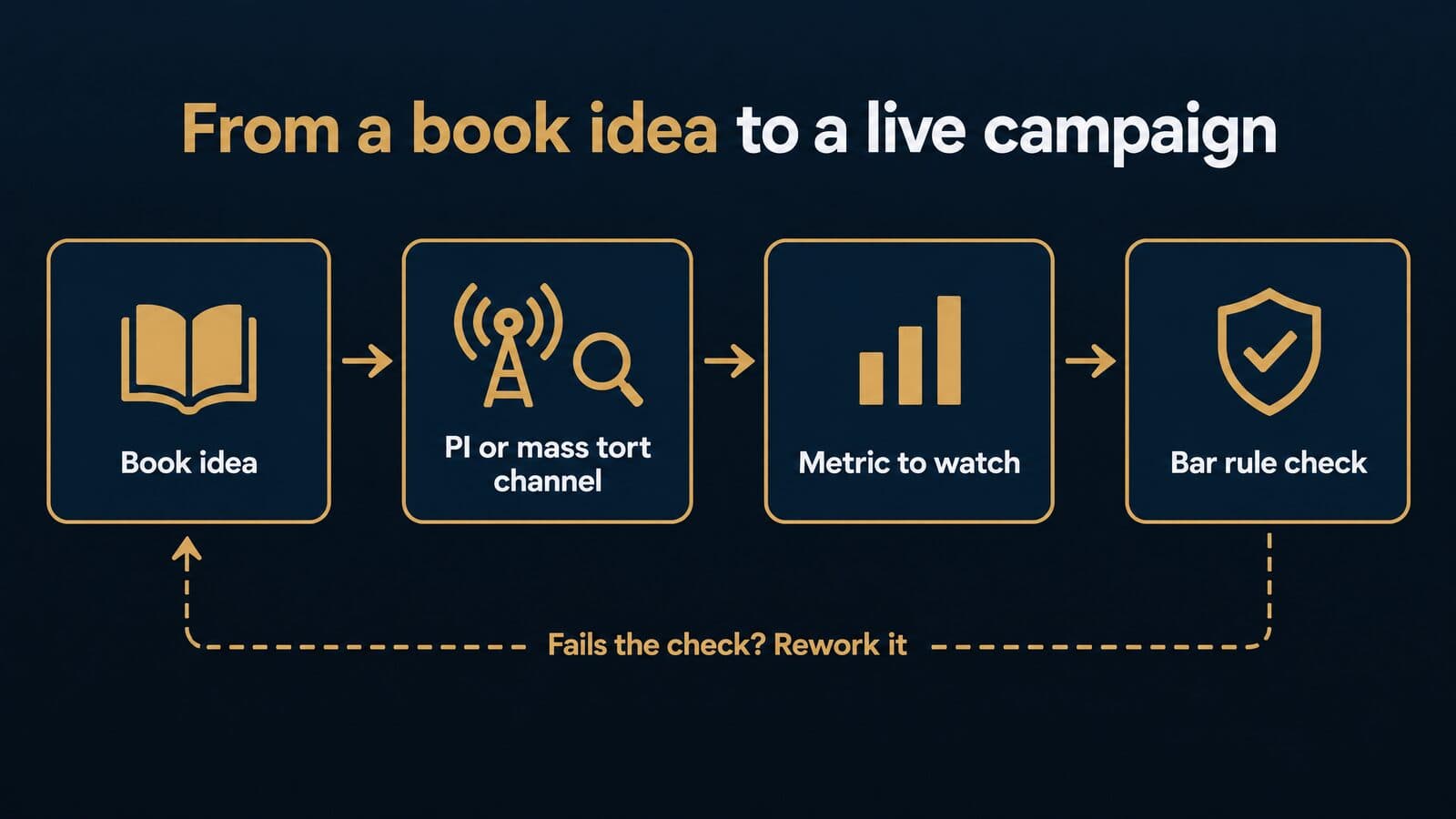
The table turns the books in this section into tests. Each row names the idea, where it runs, the number that tells you whether it worked, and the rule to check first. Treat the compliance column as a starting point for your own state's rules, not a sign-off.
| Book idea | PI or mass tort channel | Metric to watch | Compliance check |
|---|---|---|---|
| Niche focus (Niching Up) | One-tort landing pages and search | Cost per signed retainer | Rule 7.1: no unjustified expectations |
| Hospitality (Unreasonable Hospitality) | Intake calls | Speed to contact, sign rate | Rule 7.3: no live solicitation |
| Referral systems (Rainmakers) | Referral network | Referred signed cases | Rule 7.2 Comment [5] |
| Video and brand (Game Changing Attorney) | TV, CTV, YouTube | Cost per qualified lead | Rule 7.1 Comment [3] on results |
| Digital channels (Digital Marketing for Law Firms) | SEO and PPC | Cost per signed retainer | State filing and review rules |
| Client-centered service (Newton) | Follow-up and reviews | Retention, reviews | State rules on testimonials |
| Operating rhythm (Traction) | Weekly marketing scorecard | Leads to signed cases by source | Records your state requires |
Two rows deserve a note. The video row is where the most money goes for many PI and mass tort firms, and where results claims creep in fastest; if you run TV, CTV and streaming campaigns for mass torts, review every script against Comment [3]. The hospitality row is where most firms lose cases they already paid for. For the broader plan these rows feed into, see our piece on law firm marketing strategy.
My own view is that the only marketing number a book can change that matters is cost per signed case, tracked by source and by tort, so that is the column I would put at the top of any scorecard built from these books. Our cost per signed retainer benchmarks explain how that figure is defined and why it varies, and our complete personal injury lawyer marketing guide covers the channels in the table in more depth. Treat every idea above as a test with a review date, not a result.
The Mass Tort Reading List: Toxic Torts and Settlement
Mass tort lawyers should read the case narratives behind the field, A Civil Action, Exposure, Agent Orange on Trial and The Buffalo Creek Disaster, and one theory book on aggregate settlement, Richard Nagareda's Mass Torts in a World of Settlement. Add the opioid and "doubt" books for how corporate science and public health shape causation fights.
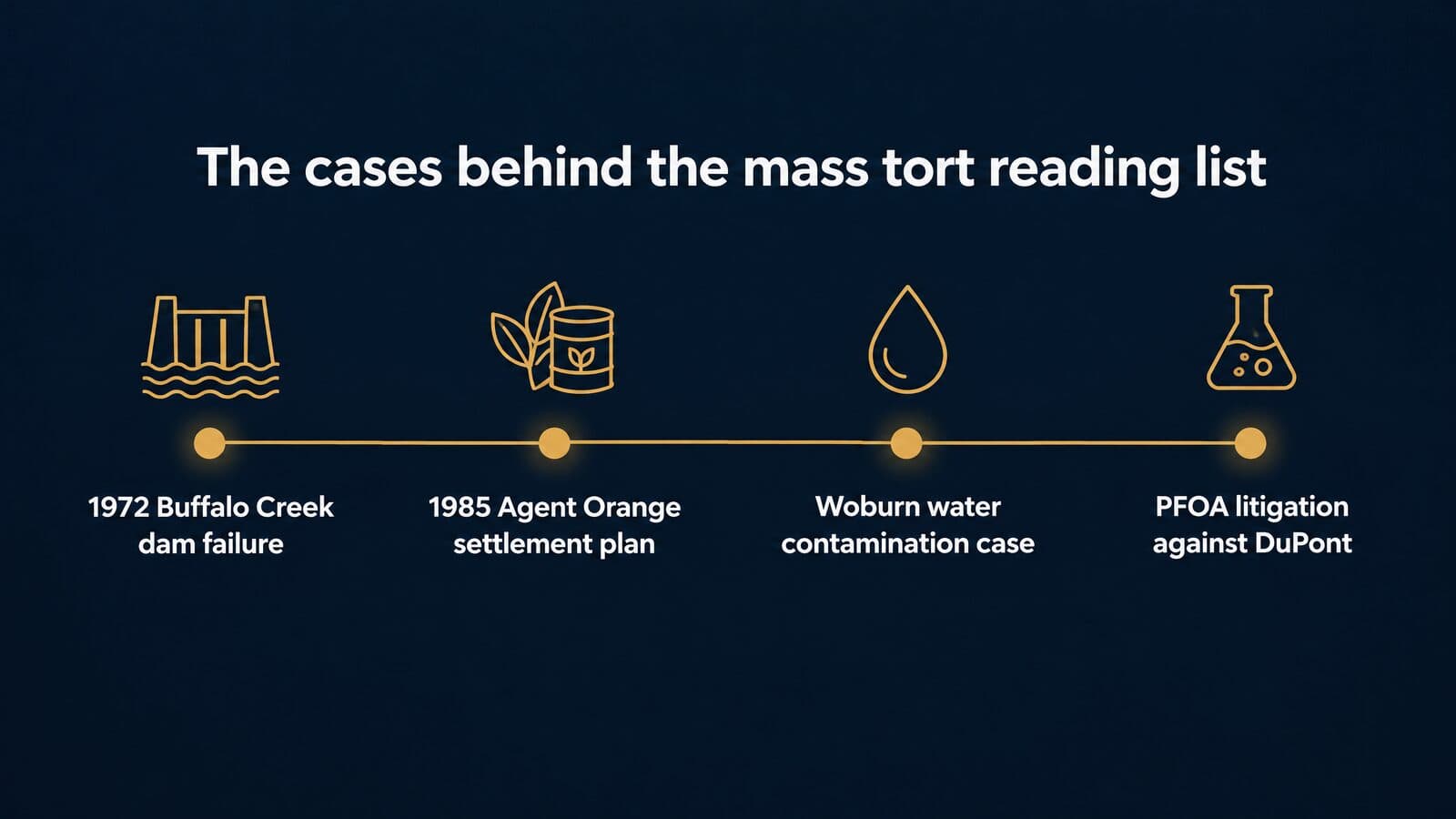
No ranking list of lawyer books we reviewed includes a mass tort section, yet these are the books that explain why firms in this field fail or succeed: case selection, years of funding, causation science and the settlement machinery at the end. Read them as case studies, not as templates. If you are new to the business side, start with how mass tort marketing campaigns actually run, then come back to these books for the litigation history.
A Civil Action by Jonathan Harr
A Civil Action is the narrative account of a contaminated-water lawsuit in Woburn, Massachusetts, and of the plaintiff lawyer who nearly bankrupted his firm pursuing it. Penguin Random House describes it as "The true story of one man so determined to take down two of the nation's largest corporations accused of killing children from water contamination." For any lawyer weighing whether to fund a long toxic case, it is the cautionary tale.
The book is read for three things: how case costs can outrun a firm's capital, how hard it is to prove that a specific exposure caused a specific illness, and how a trial structure and judge's rulings shape the result. The publisher calls it a National Book Critics Circle Award winner and lists the 1996 ABA Silver Gavel Award. The National Book Foundation lists it as a 1995 nonfiction finalist. For a parallel in current dockets, see a water contamination litigation still active today.
This month, have every partner read it and write down the point at which they would have stopped funding the case.
Best for: firm owners deciding whether to fund long toxic cases. Stage: litigator / firm owner. Edition checked: Vintage paperback, Aug 27, 1996, 512 pages, listed at $20.00 by Penguin Random House as of October 2026 (confirm the current price). Skip it if: you want legal doctrine rather than narrative.
Exposure by Robert Bilott
Exposure: Poisoned Water, Corporate Greed, and One Lawyer's Twenty-Year Battle against DuPont is Robert Bilott's first-person account of the PFOA litigation. Simon & Schuster says the case "soon spawns a class action suit on behalf of seventy thousand residents" and calls PFOA a "forever chemical" used in making Teflon. The publisher describes Bilott as "a partner at the law firm Taft Stettinius & Hollister, LLP in Cincinnati, Ohio."
The book is useful for its view of document discovery over years, the slow build of scientific proof, and the persistence a single toxic exposure case can demand. Booklist, quoted on the publisher's page, calls it a legal drama "in the grand tradition of Jonathan Harr's A Civil Action," which makes the two a natural pair. The publisher also calls it "The story that inspired Dark Waters." For where that history leads now, read our update on the current PFAS litigation.
This month, read it alongside your current PFAS or toxic exposure intake criteria and note which facts a claimant would need to prove.
Best for: lawyers handling environmental and chemical exposure cases. Stage: litigator / firm owner. Edition checked: Atria Books trade paperback, July 14, 2020, 400 pages, listed at $19.99 by Simon & Schuster as of October 2026 (confirm the current price). Skip it if: you have already followed the PFOA litigation closely.
Agent Orange on Trial by Peter H. Schuck
Agent Orange on Trial: Mass Toxic Disasters in the Courts is a law professor's study of the Agent Orange litigation brought by Vietnam veterans. Harvard University Press says it runs "From the first stirrings of the lawyers in 1978 to the court plan in 1985 for distributing a record $200 million settlement," a description written while the case was "now on appeal." Schuck is described by HUP as "Simeon E. Baldwin Professor of Law, Yale University."
Read it for the mechanics of a mass toxic case in federal court: the role of the judge in pushing settlement, the tension among plaintiff firms with different stakes, and the difficulty of distributing money fairly across claimants with different exposures and injuries. Those questions have not gone away; they have only grown with the size of modern dockets.
This month, compare its account of settlement distribution with how a current docket you follow allocates awards.
Best for: lawyers who want the legal history of aggregate toxic litigation. Stage: litigator / firm owner. Edition checked: Enlarged Edition, Belknap Press of Harvard University Press, 03/15/1988, 376 pages, listed at $49.00 by HUP as of October 2026 (confirm the current price). Skip it if: you want a page-turner; this is scholarship.
Mass Torts in a World of Settlement by Richard A. Nagareda
Nagareda's book is the theory volume on this list: an analysis of how mass torts are resolved through aggregate settlement rather than trial. The University of Chicago Press calls it "the first attempt to analyze the lawyer's role in this world of high-stakes, multibillion-dollar litigation," and names "asbestos, cigarettes, guns, the diet drug fen-phen, breast implants, and, most recently, Vioxx."
It is read for its framing of mass tort settlement as a kind of private administrative system, with lawyers effectively governing large groups of claimants. That framing raises the questions every mass tort owner faces: who controls a settlement, how fees and claimant interests line up, and what the firm owes each client in an aggregate deal.
This month, read the chapters on settlement design before your next inventory settlement discussion.
Best for: partners who negotiate or advise on aggregate settlements. Stage: firm owner / litigator. Edition checked: University of Chicago Press, 379 pages, © 2007. Skip it if: you are new to the field; read the narratives first.
The Buffalo Creek Disaster by Gerald M. Stern
The Buffalo Creek Disaster is the account of a 1972 coal-waste dam failure in West Virginia and the lawsuit that followed, "written by the young lawyer who took on their case and won," according to Penguin Random House. The publisher says that in February 1972 "an impoundment dam owned by the Pittston Coal Company burst," sending "a 130 million gallon, 25 foot tidal wave" into the hollow, and that "125 people were killed instantly."
The book is valued for its view of representing a whole community at once, of building damages for psychological harm, and of taking on a well-funded corporate defendant. It is shorter and more direct than A Civil Action, which makes it a good first assignment for associates joining a mass tort team.
This month, assign it to a new associate and ask for a one-page memo on how Stern organized the clients.
Best for: associates and case managers new to group litigation. Stage: new lawyer / litigator. Edition checked: Vintage paperback, May 06, 2008, 304 pages, listed at $18.00 by Penguin Random House as of October 2026 (confirm the current price). Skip it if: you need current procedure; the case predates modern MDL practice.
The opioid books: Empire of Pain and Dopesick
Patrick Radden Keefe's Empire of Pain is a portrait of the Sackler family, which Penguin Random House describes as a family "whose fortune was built by Valium and whose reputation was destroyed by OxyContin." PRH lists it as winner of the 2021 Baillie Gifford Prize and a 2021 National Book Critics Circle Awards finalist. For mass tort lawyers it shows how marketing, regulation and corporate structure shaped the opioid crisis that later became litigation.
Beth Macy's Dopesick: Dealers, Doctors, and the Drug Company that Addicted America tells the story from affected communities. Hachette says a Hulu limited series was "inspired by the New York Times bestselling book." It is the better book for understanding the people a firm represents.
- Empire of Pain: best for lawyers studying corporate conduct; Vintage paperback, Oct 18, 2022, 640 pages, listed at $19.00 by PRH as of October 2026 (confirm the current price).
- Dopesick: best for intake and client-facing staff; Little, Brown paperback, Aug 6, 2019, 400 pages, listed at $21.99 by Hachette as of October 2026 (confirm the current price).
Doubt Is Their Product and Merchants of Doubt
David Michaels' Doubt Is Their Product: How Industry's Assault on Science Threatens Your Health explains how industries have contested the science of harm. Oxford University Press says Michaels shows how "product-defense consultants have increasingly shaped and skewed the scientific literature, manufactured and magnified scientific uncertainty." For causation fights and expert challenges, it is background every mass tort litigator should have.
Naomi Oreskes and Erik M. Conway's Merchants of Doubt covers the same pattern across public issues; the book's site describes "seven compelling chapters addressing tobacco, acid rain, the ozone hole, global warming, and DDT." Open Library's catalog lists a Bloomsbury Press 2010 first U.S. edition of 355 pages.
- Doubt Is Their Product: best for litigators preparing for causation and expert fights; OUP hardcover, 23 April 2008, 384 pages, listed at $48.99 by OUP as of October 2026 (confirm the current price).
- Merchants of Doubt: best for broader context on contested science; Bloomsbury, 2010 per Open Library.
One more title belongs in this conversation but not on this list: John Grisham's The King of Torts. It is a novel. The publisher's synopsis describes a fictional public defender pulled into a case against a large pharmaceutical company, so treat it as fiction; it appears with the other novels in "The Best Legal Fiction and True Legal Drama."
Reading these books as a firm owner
Each book on this list is a case study in the three decisions that decide a mass tort practice: which cases to take, how to fund them, and how they end. The table frames each one as questions to ask your team, not as outcomes to expect.
| Book | Lesson for case selection | Lesson for funding and costs | Lesson for settlement |
|---|---|---|---|
| A Civil Action | Can we prove specific causation? | When would we stop funding? | Who decides when to settle? |
| Exposure | Is there a document trail to find? | Can we fund a multi-year case? | What does a class mean for clients? |
| Agent Orange on Trial | Do exposures differ across clients? | How do co-counsel share costs? | How will money be distributed? |
| Mass Torts in a World of Settlement | Does the docket fit aggregate deals? | Do fee terms match client interests? | Who controls the settlement? |
| The Buffalo Creek Disaster | Is there a defined, provable event? | Is the defendant able to pay? | How do we value non-physical harm? |
| Doubt Is Their Product | Is the science contested? | Can we afford strong experts? | How does doubt affect value? |
From my seat at Mass Tort Marketing Agency, the first column is where these books earn their keep: the hardest lesson in each of them is that a case that looked strong at intake was expensive or uncertain to prove. That is why our mass tort qualification criteria start with provable exposure and injury, and why the mass tort launch playbook puts case criteria before ad spend. If you want to talk through a launch, you can book a strategy call.
These books also show how settlements shape the field as much as trials do. The next section steps back from the business of litigation to how lawyers reason about the law itself.
Legal Reasoning and Books on the Legal System
Frederick Schauer's Thinking Like a Lawyer is the clearest primer on how legal reasoning works, and Gideon's Trumpet and Just Mercy show how the system actually treats real people.
Thinking Like a Lawyer, The Legal Analyst and An Introduction to Legal Reasoning
Thinking Like a Lawyer, by Frederick Schauer, is the book to hand anyone who asks what law school is actually training. Harvard University Press describes it as a "primer on legal reasoning ... aimed at law students and upper-level undergraduates." For a practicing lawyer, its value shows up when you draft a summary-judgment brief and need to explain why a precedent that looks adverse does not control. Schauer works through rules, precedent, authority and analogy in general terms, which is the toolkit you use every time you argue that your facts fall on the right side of a line.
The Legal Analyst: A Toolkit for Thinking about the Law, by Ward Farnsworth, takes a different route. Instead of walking through doctrine, it gathers analytical tools (incentives, rules versus standards, how people reason under uncertainty) and shows how each applies across legal problems. The University of Chicago Press lists it at 326 pages, © 2007, and notes that "an audiobook version is available."
An Introduction to Legal Reasoning, by Edward H. Levi, is the short classic. The University of Chicago Press Second Edition is © 2013, runs 128 pages, carries "a New Foreword by Frederick Schauer" and notes the book was "originally published in 1949." Levi's core idea is reasoning by example: courts move from case to case, and the categories shift as new facts arrive. That idea is directly useful when you argue that a product, a drug or a course of conduct belongs in a category the courts already recognize.
How to apply this month: take the weakest precedent in your current brief and write one paragraph distinguishing it the way Levi or Schauer would, by naming the fact that changes the category.
- Thinking Like a Lawyer: best for law students and any lawyer who wants the foundations stated plainly; Harvard University Press paperback, publication date 04/16/2012, 256 pages, listed at $26.00 by HUP as of October 2026 (confirm the current price). The 2012 date is the paperback's, not the first edition's.
- The Legal Analyst: best for litigators who like frameworks and audio learning; University of Chicago Press, © 2007, 326 pages, audiobook available.
- An Introduction to Legal Reasoning: best for anyone who wants the argument in 128 pages; Second Edition, University of Chicago Press, © 2013.
Free classics: Holmes and Blackstone
Two of the most cited books in the history of American law are free to read legally, today. Oliver Wendell Holmes's The Common Law is Project Gutenberg eBook #2449, marked "Public domain in the USA." Blackstone's Commentaries on the Laws of England is hosted by the Avalon Project at Yale Law School, covering the Introduction and Books One through Four from the edition "Oxford : Printed at the Clarendon Press, 1765-1769." Project Gutenberg also lists "Commentaries on the Laws of England, Book the First."
Why read them now? Holmes's lectures on torts deal with the ideas plaintiff lawyers argue every week, such as fault and the standard of the reasonable person. Blackstone is the classic statement of the English common law, and courts still turn to it when they look for the historical meaning of a common-law right. Neither is light reading. Both reward reading one lecture or one chapter at a time, with a specific question in mind.
How to apply this month: read Holmes's lecture on torts and write down one sentence you could use to frame the reasonable-person standard for a jury in plain words.
- The Common Law: best for tort lawyers and history-minded students; free at Project Gutenberg (#2449).
- Blackstone's Commentaries: best for appellate writers and anyone researching original meaning; free at the Avalon Project.
Gideon's Trumpet, Just Mercy and The Nine
Gideon's Trumpet, by Anthony Lewis, tells how one handwritten petition from a Florida prisoner reached the Supreme Court and produced the right to appointed counsel. The case, Gideon v. Wainwright, 372 U.S. 335, was decided March 18, 1963. Penguin Random House calls Lewis "a two-time Pulitzer Prize-winning journalist." For a lawyer, the book is a slow-motion view of how a cert petition, briefing and oral argument actually move a question of law, which is useful the first time you face an appeal that could change a rule.
Just Mercy: A Story of Justice and Redemption, by Bryan Stevenson, is the modern counterpart: a defense lawyer's account of capital cases and wrongful convictions. Penguin Random House lists it as "Winner of the Carnegie Medal for Excellence in Nonfiction" and "Winner of the NAACP Image Award for Nonfiction."
The Nine: Inside the Secret World of the Supreme Court, by Jeffrey Toobin, is a reported account of the Court's internal dynamics. Penguin Random House lists "WINNER 2008 J. Anthony Lukas Book Prize."
How to apply this month: after reading Gideon's Trumpet, outline the one legal question in your docket most likely to reach an appellate court and note what record you would need to preserve it.
- Gideon's Trumpet: best for new lawyers and appellate-curious litigators; Vintage paperback, Apr 23, 1989, 288 pages, listed at $18.00 by PRH as of October 2026 (confirm the current price); audiobook 7 hours 51 minutes.
- Just Mercy: best for anyone who wants to see client storytelling done well; One World paperback, Aug 18, 2015, 384 pages, listed at $21.00 by PRH as of October 2026 (confirm the current price).
- The Nine: best for readers who want the Court's inner workings; Vintage paperback, Sep 09, 2008, 480 pages, listed at $23.00 by PRH as of October 2026 (confirm the current price); audiobook 15 hours 50 minutes.
Tomorrow's Lawyers by Richard Susskind
Tomorrow's Lawyers: An Introduction to your Future, by Richard Susskind, is the book on where legal services are heading. Picture a managing partner deciding whether to hire two more intake specialists or invest in software that screens claims first. Susskind's argument about which legal work will be standardized, systematized and handled by technology is the frame that decision needs. Oxford University Press says the book is "based on 40 years of work in the field" (the publisher's description).
The Third Edition adds, in OUP's words, "new chapters on the impact of COVID-19, innovation in law, lawtech startups, and a model of understanding legal technology." The ideas the book is known for are general: legal work can be broken into tasks, many of those tasks can be done more cheaply by new providers or tools, and the lawyers who do well are the ones who redesign how they deliver work rather than waiting for clients to demand it. Use it alongside our analysis of where plaintiff acquisition is heading through 2030, which applies the same kind of thinking to how injured people find a firm.
How to apply this month: list the ten tasks in your intake or case-opening process and mark which could be standardized or handled by software, then pick one to test.
Best for: managing partners and lawyers planning the next five years. Stage: firm owner. Edition checked: Third Edition, Oxford University Press paperback, published 07 March 2023, 320 pages, listed at $24.99 by OUP as of October 2026 (confirm the current price). Skip it if: you need tactical guidance for this quarter; the book is about strategy and the direction of the market.
Books on Lawyer Wellbeing, Leadership and Focus
The Happy Lawyer and The Anxious Lawyer are written specifically for lawyers, and Atomic Habits and Deep Work help with the sustained focus that billable and contingency work both demand. Start with the research below to see why this shelf belongs in a practitioner's reading list at all, then pick the book that matches the problem you actually have.
A note before the cards: these are books, not treatment. Nothing here is medical or mental-health advice. If you or a colleague are struggling, every state has a lawyer assistance program, usually run through the state bar, and those programs are confidential.
What the wellbeing research found
The best-known data point is a 2016 study in the Journal of Addiction Medicine by Krill, Johnson and Albert, which surveyed 12,825 licensed, employed attorneys. It found that 20.6% screened positive for hazardous, harmful and potentially alcohol-dependent drinking, and that 28%, 19% and 23% experienced symptoms of depression, anxiety and stress, respectively. These are 2016 findings from one large study, not current rates, but they remain the reference point the profession cites.
A narrower and more recent data point comes from Bloomberg Law. Its quarterly Attorney Workload and Hours survey asked 614 in-house and law firm attorneys about well-being, and in an analysis published March 3, 2022, reported that Q4 respondents "felt burnout in their jobs 52% of the time," up from 44% in Q3 and 47% in Q2. Bloomberg Law said it was the first time since the survey began in 2020 that the figure passed half the time.
The profession's formal response is The Path to Lawyer Well-Being, published in 2017 by the National Task Force on Lawyer Well-Being, which in 2020 became the Institute for Well-Being in Law.
The Happy Lawyer and The Anxious Lawyer
The Happy Lawyer: Making a Good Life in the Law, by Nancy Levit and Douglas O. Linder, is for the lawyer who is good at the work and unhappy doing it. A typical reader is a fifth-year associate weighing a move from insurance defense to plaintiff work, or a solo wondering whether a niche would make the practice more satisfying. In general terms, it asks what makes a legal career satisfying and how choices about practice area, setting and daily tasks affect that.
The Anxious Lawyer: An 8-Week Guide to a Joyful and Satisfying Law Practice Through Mindfulness and Meditation, by Jeena Cho and Karen Gifford, is the practical one. The ABA bookstore calls it "a straightforward 8-week introductory program on meditation and mindfulness, created by lawyers for lawyers." Its structure is the selling point: one short practice a week, written with court deadlines and client calls in mind, so it fits a trial lawyer's calendar.
How to apply this month: if you read The Anxious Lawyer, do week one's practice before you open email for five working days; if you read The Happy Lawyer, write down the three tasks in your week you would keep and the three you would hand off.
- The Happy Lawyer: best for mid-career lawyers rethinking their path; Oxford University Press hardback, published 05 August 2010, 302 pages (OUP page).
- The Anxious Lawyer: best for litigators who want a structured, short practice; soft cover listed at $24 for non-members and $22 for ABA members by the ABA bookstore as of October 2026 (confirm the current price).
Lawyers as Leaders and the leadership classics
Lawyers as Leaders, by Deborah L. Rhode, is aimed at lawyers who end up running teams, firms or bar organizations without ever being taught how. Think of the partner who inherits a ten-person litigation group or the founder whose firm just passed twenty employees. Oxford University Press's blurb says leadership consulting "is a $45 billion industry" and calls this "the first serious book on this subject"; both are the publisher's marketing claims. The book's subject is how lawyers' training (skepticism, risk aversion, autonomy) can help or hurt them as leaders.
For a broader leadership list, the Legal Leadership Project publishes "10 Leadership Books Every Lawyer Should Read." Its picks, in order, are Leaders Eat Last (Simon Sinek), The 7 Habits of Highly Effective People (Covey), The Art of War (Sun Tzu), Drive (Daniel H. Pink), Emotional Intelligence (Daniel Goleman), Good to Great (Jim Collins), Multipliers (Liz Wiseman), Crucial Conversations (Patterson, Grenny, McMillan and Switzler), Lawyers as Leaders (Deborah Rhode) and Great Lawyer to Great Leader (Midja Fisher). Rhode's book is its number nine, and Leaders Eat Last is its number one.
How to apply this month: pick one recurring decision you currently make alone (case acceptance, staffing, a budget line) and delegate it with a written standard, then review how it went in four weeks.
- Lawyers as Leaders: best for partners and founders managing people for the first time; OUP hardcover, published 09 September 2013, 320 pages, listed at $78.00 by OUP as of October 2026 (confirm the current price).
- The Legal Leadership Project list: best for building a year of leadership reading; check the current edition of each title.
Atomic Habits, The 7 Habits and Deep Work
Atomic Habits, by James Clear, is about building small, repeatable behaviors instead of relying on willpower. For a lawyer, the obvious use is the work that never gets done because it is never urgent: updating case notes the same day, calling three past clients a week, or reviewing the intake log every Friday. Penguin Random House's author bio says the book "has sold over 20 million copies worldwide and has been translated into more than 60 languages" (a publisher claim). The ideas it is known for are making a habit obvious, easy and satisfying, and tying habits to the identity you want.
The 7 Habits of Highly Effective People, by Stephen R. Covey, is the older classic on personal effectiveness, built around priorities, proactive choices and working from principles. Simon & Schuster's 30th Anniversary Edition adds Sean Covey and a foreword by Jim Collins, and the publisher says "over 40 million copies sold" (its own claim).
Deep Work: Rules for Focused Success in a Distracted World, by Cal Newport, argues that the ability to concentrate without distraction on hard problems is rare and valuable. Its methods include scheduling long, protected blocks for demanding work and cutting the shallow tasks that fragment a day.
How to apply this month: block two 90-minute sessions a week for your hardest writing task, with phone and email closed, and keep the block for four weeks.
- Atomic Habits: best for anyone building a daily system; Avery hardcover, Oct 16, 2018, 320 pages, listed at $27.00 by PRH as of October 2026 (confirm the current price); audiobook read by the author, 5 hours 35 minutes.
- The 7 Habits of Highly Effective People: best for lawyers who want a priority framework; 30th Anniversary Edition, Simon & Schuster, May 19, 2020, 464 pages.
- Deep Work: best for litigators and writers whose best work needs long focus; Grand Central Publishing, Jan 5, 2016, 304 pages, trade paperback listed at $17.99 by Hachette as of October 2026 (confirm the current price).
Books for Law Students and New Lawyers
Law students should start with Getting to Maybe for exams, and new lawyers should start with The New Lawyer's Handbook and The Curmudgeon's Guide to Practicing Law. The student books teach how law school tests you; the new-lawyer books teach the unwritten rules of practice that nobody covers in class.
Before and during law school
Getting to Maybe: How to Excel on Law School Exams, by Richard Michael Fischl and Jeremy R. Paul, is the exam book. The problem it solves is specific: students who know the rules still score poorly because exams reward spotting the ambiguity and arguing both sides, not reciting doctrine. It explains why a "maybe" answer, well argued, beats a confident wrong one. Carolina Academic Press notes that the 1999 edition "has been replaced by a newer edition," so make sure you buy the Second Edition.
One L: The Turbulent True Story of a First Year at Harvard Law School, by Scott Turow, is the memoir many students read before they start. Open Library lists a first publish year of 1977 and a Grand Central Publishing edition from September 1, 1997, at 288 pages.
Levi's An Introduction to Legal Reasoning (covered in Legal Reasoning and Books on the Legal System) is a strong pre-law choice because it is short and shows the case method in action. Jay M. Feinman's Law 101 is another common pick; Open Library lists Oxford University Press editions from 2000 onward, so check the current edition. 1L of a Ride and Law School Confidential also appear on many student lists.
How to apply this month: take one old exam from a course you are in and write an answer that argues both sides of the closest issue, as Getting to Maybe recommends.
- Getting to Maybe: best for 1Ls and anyone who struggles with exams; Second Edition, Carolina Academic Press, 2023, 508 pages, paper, listed at $45.00 by the publisher as of October 2026 (confirm the current price).
- One L: best for pre-law readers; check the current edition.
- An Introduction to Legal Reasoning: best for pre-law readers who want the method; Second Edition, University of Chicago Press, © 2013, 128 pages.
- Law 101: best for a broad overview of US law; check the current edition.
The first years of practice
The New Lawyer's Handbook: 101 Things They Don't Teach You in Law School, by Karen Thalacker, covers the practical side of starting out: dealing with clerks and staff, managing a calendar, handling partners and clients. It fits the first-week associate who has passed the bar and still does not know how to set up a file or what to do when a deadline is missed. Open Library lists a 2009 first edition from Sphinx/Sourcebooks at 269 pages.
The Curmudgeon's Guide to Practicing Law, by Mark Herrmann, is short, blunt advice on how senior lawyers judge junior work: drafts, research memos, emails and reliability. Open Library lists an American Bar Association edition dated March 25, 2006, at 200 pages.
Letters to a Young Lawyer, by Alan M. Dershowitz, is a series of letters on ethics, ambition and the profession. Hachette's Basic Books trade paperback went on sale Apr 13, 2005, at 224 pages; Open Library dates the first edition to 2001.
For new lawyers headed to trial practice, Trial Guides says Rick Friedman's Becoming a Trial Lawyer "is available to students and lawyers practicing 5 years or less for $45.00 when registered for the Trial Guides New Lawyers program," per its product page as of October 2026 (confirm the current terms). The book itself is covered in Trial Lawyer Books: The Plaintiff Canon.
How to apply this month: before your next assignment, write a one-page checklist of what the assigning lawyer expects (format, deadline, scope), using The Curmudgeon's Guide as the template.
- The New Lawyer's Handbook: best for first-year associates and new solos; 2009 first edition per Open Library, check the current edition.
- The Curmudgeon's Guide to Practicing Law: best for associates who report to senior partners; ABA, 2006 per Open Library, check the current edition.
- Letters to a Young Lawyer: best for reflective reading on the profession; Basic Books trade paperback, 2005, 224 pages, listed at $18.99 by Hachette as of October 2026 (confirm the current price).
What pre-law reading lists have in common
University pre-law lists differ in detail but share a pattern. Google's results for "books every lawyer should read," observed on October 22, 2026, surfaced Baylor University's pre-law reading list, which according to the search snippet names Levi, Feinman's Law 101, a work by Epstein and The Federalist Papers. We did not open the Baylor page itself, so treat that summary as the snippet's, not ours.
Across lists like that, three threads repeat:
- Reasoning. A short book on how judges think and how precedent works, such as Levi or Schauer.
- Foundational documents. The Constitution, The Federalist Papers, and older sources like Blackstone, which are free to read online.
- Writing. At least one book on clear prose, usually Legal Writing in Plain English or Plain English for Lawyers, both covered in Best Books on Legal Writing and Persuasion.
The Best Legal Fiction and True Legal Drama
To Kill a Mockingbird tops the ABA Journal's 2013 ranking of the greatest law novels, and for modern legal thrillers the names to start with are John Grisham, Scott Turow and Michael Connelly. Fiction earns a place on a lawyer's shelf because it trains the storytelling and empathy that juries respond to.
The ABA Journal's greatest law novels
The most cited list of legal fiction is the ABA Journal's cover story "25 greatest law novels...ever!", dated August 1, 2013. The Journal "convened a panel of experts" and "composed a ballot that included more than 100 of the greatest novels ever written." Because of a tie at the bottom, the result is, in the Journal's words, the "top 25 legal novels (actually 26...)." The table below lists every entry with the year the Journal gives, from its ranking gallery.
| Rank | Novel | Author | Year |
|---|---|---|---|
| 1 | To Kill A Mockingbird | Harper Lee | 1960 |
| 2 | Crime and Punishment | Dostoevsky | 1866 |
| 3 | Bleak House | Dickens | 1852 |
| 4 | The Trial | Kafka | 1925 |
| 5 | Les Misérables | Hugo | 1862 |
| 6 | Billy Budd | Melville | 1924 |
| 7 | Presumed Innocent | Scott Turow | 1987 |
| 8 | The Scarlet Letter | Hawthorne | 1850 |
| 9 | The Bonfire of the Vanities | Tom Wolfe | 1987 |
| 10 | An American Tragedy | Dreiser | 1925 |
| 11 | The Paper Chase | John Jay Osborn Jr. | 1971 |
| 12 | Bartleby the Scrivener | Melville | 1853 |
| 13 | Native Son | Richard Wright | 1940 |
| 14 | The Stranger | Camus | 1942 |
| 15 | A Tale of Two Cities | Dickens | 1859 |
| 16 | A Time to Kill | John Grisham | 1989 |
| 17 | The Caine Mutiny | Herman Wouk | 1951 |
| 18 | Their Eyes Were Watching God | Zora Neale Hurston | 1937 |
| 19 | QB VII | Leon Uris | 1970 |
| 20 | The Firm | John Grisham | 1991 |
| 21 | The Count of Monte Cristo | Dumas | 1844 |
| 22 | The Handmaid's Tale | Margaret Atwood | 1985 |
| 23 | Anatomy of a Murder | Robert Traver | 1958 |
| 24 | The Fountainhead | Ayn Rand | 1943 |
| 25 (tie) | Old Filth | Jane Gardam | 2004 |
| 25 (tie) | The Ox-Bow Incident | Walter Van Tilburg Clark | 1940 |
To Kill a Mockingbird was published in 1960 and won the 1961 Pulitzer Prize for Fiction. In my view, Atticus Finch's closing argument is still the best study in fiction of how a lawyer talks to a jury that has already made up its mind.
Anatomy of a Murder, by Robert Traver, is the one trial lawyers tend to recommend to each other. Macmillan says it was "first published by St. Martin's in 1958" and "immediately became the number-one bestseller in America" (the publisher's description). My take: its courtroom scenes are the most procedural of any novel on the list, which is why it works as a trial lawyer's read.
The Journal's sidebar also explains what it left out. In Cold Blood was excluded because "it wasn't a novel," and the sidebar names Darkness at Noon, The Book of Daniel, Z and By Love Possessed as notable omissions.
Modern legal thrillers: Grisham, Turow and Connelly
John Grisham's The Firm is the modern thriller most lawyers have read: a young associate discovers his firm is not what it seems. Penguin Random House lists the Doubleday hardcover as published Feb 01, 1991, at 432 pages, and its author bio says Grisham "is a two-time winner of the Harper Lee Prize for Legal Fiction." It ranks 20th on the ABA Journal list.
For plaintiff lawyers, Grisham's The King of Torts is the closest fiction gets to mass torts. It is a novel, not a true story. In the publisher's synopsis, public defender Clay Carter "finds himself in the middle of a complex case against one of the largest pharmaceutical companies in the world, looking at the kind of enormous settlement that would totally change his life." The Doubleday hardcover was published Feb 04, 2003, at 384 pages.
Scott Turow's Presumed Innocent ranks seventh on the ABA Journal list, the highest of any modern thriller. Michael Connelly's The Lincoln Lawyer follows Mickey Haller, whom the publisher describes as "a criminal defense attorney who operates out of the backseat of his Lincoln Town Car." Hachette calls it "Inspiration for the #1 Netflix series The Lincoln Lawyer"; its current Little, Brown trade paperback went on sale Jun 28, 2016, at 480 pages. If you want more, Hachette's Novel Suspects site publishes a list of ten legal thrillers, all from its own imprints.
- The Firm: best for a first legal thriller; Doubleday hardcover, 1991, 432 pages.
- The King of Torts: best for mass tort and PI teams; Doubleday hardcover, 2003, 384 pages.
- Presumed Innocent: best for readers who want trial-centered suspense; check the current edition.
- The Lincoln Lawyer: best for fans of the series; Little, Brown trade paperback, 2016, 480 pages, listed at $19.99 by Hachette as of October 2026 (confirm the current price).
Why fiction makes better trial storytellers
Good legal fiction does three things a trial lawyer needs. It shows narrative structure: a beginning that sets the stakes, a middle where the facts complicate, and an ending that feels inevitable. That is the shape of a strong opening statement. It shows point of view: the same events told through the client, the defendant or a witness feel completely different, and choosing whose eyes the jury sees through is a strategic decision. And it builds empathy for people unlike yourself, which is what you ask jurors to do for your client.
The practical link is direct. Philip Meyer's Storytelling for Lawyers (covered in Best Books on Legal Writing and Persuasion) teaches the narrative techniques lawyers borrow from fiction, and Moe Levine on Advocacy (covered in Trial Lawyer Books: The Plaintiff Canon) shows how a plaintiff lawyer talks about human loss in plain words. Read a novel from the ABA Journal list, then reread your next opening statement and ask whose point of view it takes, where the stakes are set and whether a stranger would care by the end of the first page.
Reading Paths: Five-Book Tracks by Career Stage
Pick the track that matches your stage and read the five books in order, one per month.
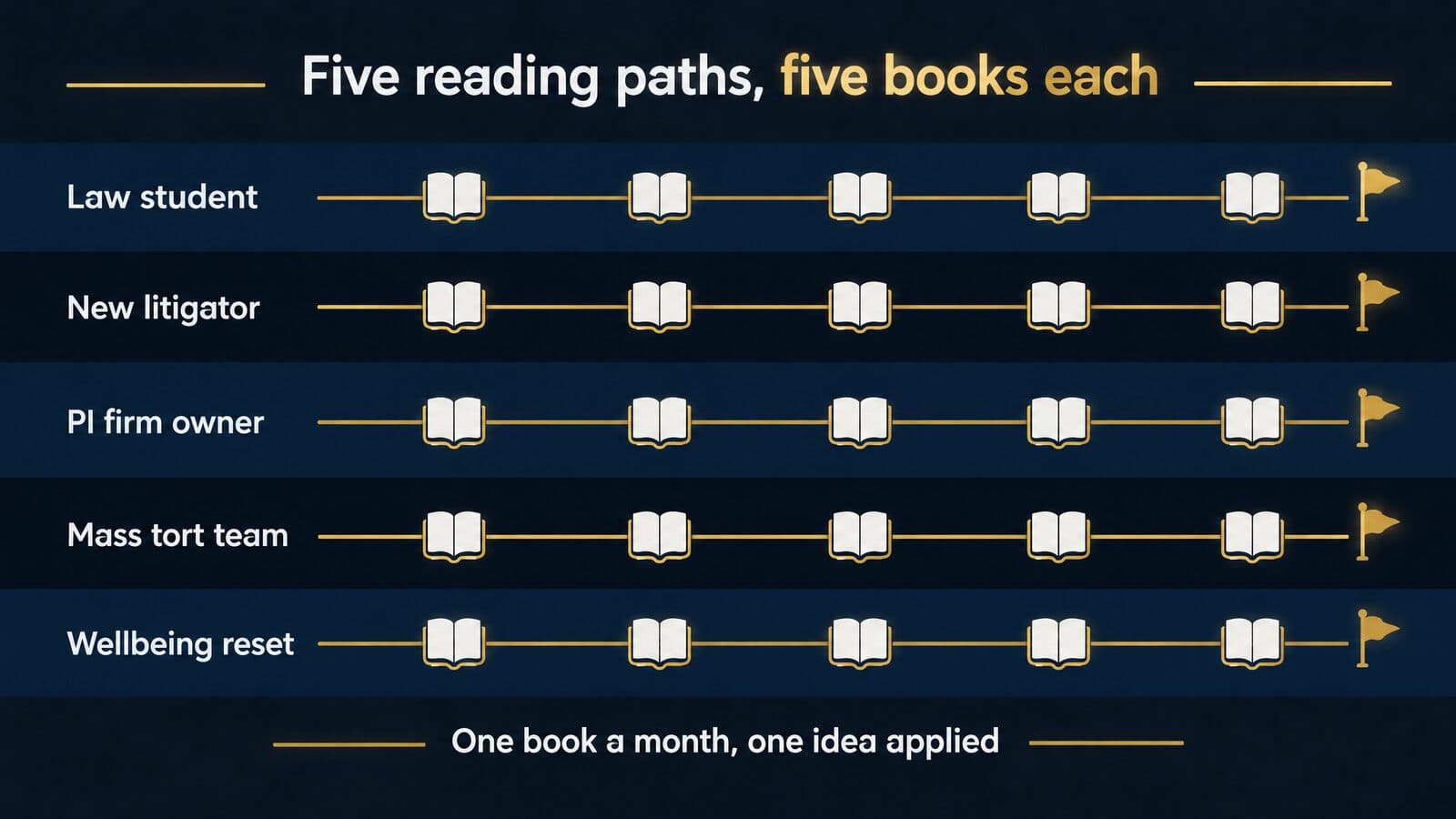
| Track | 1 | 2 | 3 | 4 | 5 |
|---|---|---|---|---|---|
| Law student | Getting to Maybe | Thinking Like a Lawyer | Legal Writing in Plain English | One L | To Kill a Mockingbird |
| New litigator | Legal Writing in Plain English | The Deposition Handbook | Rules of the Road | Never Split the Difference | The Curmudgeon's Guide |
| PI firm owner | The E-Myth Attorney | Traction | Profit First | Unreasonable Hospitality | Running with the Bulls |
| Mass tort team | A Civil Action | Exposure | Agent Orange on Trial | Mass Torts in a World of Settlement | Doubt Is Their Product |
| Wellbeing reset | The Happy Lawyer | The Anxious Lawyer | Atomic Habits | Deep Work | The 7 Habits |
How to use a reading path
- Choose one track. Pick the stage you are in now, not the one you want to reach. A new associate who jumps to the firm-owner track will get less from it than from the litigator track.
- Read one book a month. Five books takes five months. That pace leaves room to test ideas instead of collecting them.
- Pull one idea per book. Before you finish each book, write down the single idea you will apply in the next 30 days, who it affects and how you will know it worked.
- Run it as a test. Treat each idea as an experiment with an owner, a metric and a review date, not a permanent policy.
- Review at the end of the month. Keep what worked, drop what did not, then start the next book.
The book-to-practice worksheet in How to Build a Firm Library and Run a Book Club gives you a one-page template for steps 3 to 5, and it works for a solo reader as well as a whole team.
Where to Buy Lawyer Books and Find Them Free
Buy practice manuals from their publisher or the ABA bookstore, where members pay less; borrow trade books free through your public library; and read the true classics free from public-domain archives. Skip "free lawyer books PDF" sites, because the in-copyright titles they post are almost always unauthorized copies.
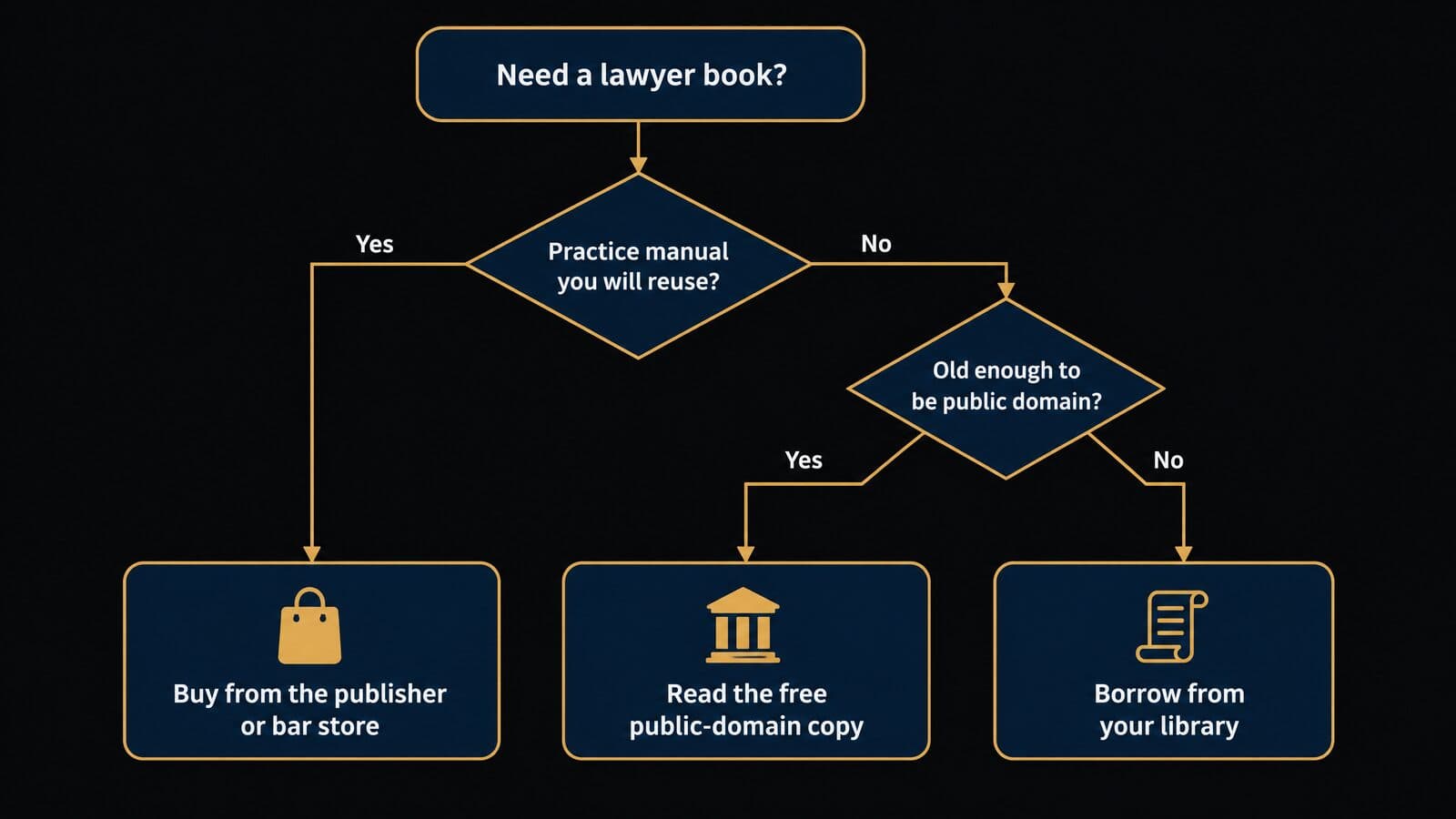
Once you have picked a track from the reading paths above, the next question is practical: which of the five books do you need to own, and which can you borrow? A simple rule works for most lawyers. Own the books you will mark up, quote in a brief or hand to a new associate. Borrow the books you will read once for ideas, such as most business, negotiation and narrative nonfiction titles. Read the public-domain classics online, for free, whenever you want to check a famous passage.
Publisher and bar association stores
Practice books are usually cheapest and most current when you buy them straight from the publisher. The American Bar Association's bookstore shows two prices on many titles. For example, it lists the fifth edition of Jay G. Foonberg's How to Start and Build a Law Practice at $69 for non-members and $52 for members, and The Anxious Lawyer by Jeena Cho and Karen Gifford at $24 for non-members and $22 for members, as of October 2026. If you already pay ABA dues, check the member price before you order anywhere else, and confirm the current price at checkout.
Plaintiff trial books mostly come from one specialist house. Trial Guides' own catalog says it has published "cutting-edge methods for handling and trying legal cases" since 2004. Its product feed, which we read in full on October 22, 2026, lists books from $55 at the low end (Conducting Voir Dire and Preparing for Voir Dire by Lisa Blue and Robert Hirschhorn) to $575 at the high end (the two-volume Anatomy of a Personal Injury Lawsuit, fourth edition). Several product pages, including David Ball on Damages 3, say print buyers get a coupon to add the ebook for $20. Those are listed prices as of October 2026; confirm the current price before you buy.
Treatise publishers such as Thomson Reuters, LexisNexis, James Publishing and NITA sell the multi-volume practice sets most firms keep in the research subscription rather than on the shelf. We did not check their prices, so we do not quote any. For the reference staple, Thomson Reuters lists the 12th edition of Black's Law Dictionary at $89.95 for the standard hardbound and $160 for the deluxe, as of October 2026; confirm the current price.
| Where | Best for | What to check first |
|---|---|---|
| ABA bookstore | Practice-management and wellbeing titles | Member price versus non-member price |
| Trial Guides | Plaintiff trial, damages and settlement manuals | New-lawyer pricing and the ebook coupon |
| University presses | Legal reasoning and writing texts | Current edition number |
| Treatise publishers | Multi-volume practice sets | Whether your research plan already includes it |
| Public library | Trade nonfiction and fiction | Holds list and audiobook copy |
Free and legitimate sources (and why to skip PDF sites)
The legitimate way to read lawyer books for free is through a library card or a public-domain archive. Libby, the library lending app, says that with it "you can enjoy free ebooks, digital audiobooks, and magazines from your library", and "all you need is a library card." Put a hold on the books in your reading path today, and you will often have the first one before you finish the current one.
Two foundational texts are fully free and fully legal. Project Gutenberg hosts Oliver Wendell Holmes's The Common Law as eBook #2449, marked "Public domain in the USA." Yale Law School's Avalon Project hosts Blackstone's Commentaries on the Laws of England, the introduction and Books One through Four, from the Oxford edition printed at the Clarendon Press in 1765–1769.
State law libraries are another free route. The Texas State Law Library publishes a Recommended Books & E-Books guide; we saw it in search results but could not open it, so check its contents yourself. Your own state's law library, your county law library and your law school's alumni access may offer e-book lending of practice titles that public libraries do not carry.
Avoid sites that offer "free PDF downloads" of in-copyright lawyer books. Those files are usually posted without the publisher's permission, they may carry malware, and they are often outdated editions. That last point matters for practice books: a pirated copy of an old edition of a writing or deposition manual can teach you a rule or a method that the current edition has already revised.
Audiobooks for commutes and court travel
Audio works well for narrative and idea books and poorly for manuals you need to annotate. The table lists only the audio editions we confirmed on a publisher's or author's own page. Audio availability for every other book in this guide was not verified, so check the publisher before assuming one exists.
| Book | Audio edition | Length or price (Oct 2026) | Source |
|---|---|---|---|
| Gideon's Trumpet | Download, read by Robertson Dean | 7 h 51 m | PRH |
| Atomic Habits | Read by the author | 5 h 35 m | PRH |
| Unreasonable Hospitality | Audiobook | 8 h 38 m | PRH |
| Profit First | Download, read by the author | 7 h 52 m | PRH |
| The Nine | Audiobook | 15 h 50 m | PRH |
| Deep Work | Audiobook download | $24.99 | Hachette |
| Point Made | Audiobook listed | Check the publisher | OUP |
| The Legal Analyst | Audiobook listed | Check the publisher | UChicago Press |
| Dopesick | Audiobook listed | Check the publisher | Hachette |
| Exposure | Listen sample on page | Check the publisher | Simon & Schuster |
| Making Your Case | Unabridged CD read by the authors | Check the publisher | LawProse |
| Rules of the Road | Trial Guides audiobook | $175 | Trial Guides |
| Moe Levine on Advocacy | Trial Guides audiobook | $185 | Trial Guides |
| Don't Eat the Bruises | Trial Guides audiobook | $165 | Trial Guides |
| The Elements of Trial | Trial Guides audiobook | $145 | Trial Guides |
| David Ball on Damages 3 | Trial Guides audiobook | $195 | Trial Guides |
| Digital Marketing for Law Firms | Trial Guides audiobook | $95 | Trial Guides |
Prices are listed prices as of October 2026; confirm the current price with the seller.
How to Build a Firm Library and Run a Book Club
Start with one shelf per role, rotate one book a month through a short book club, and require one applied idea from every book. A firm library earns its cost only when the ideas in it reach a written procedure, a template or a test.
A starter firm library by role
Build four short shelves rather than one long one. Each shelf should hold two to four books that the person in that role would actually reach for in a normal month.
- Attorneys: one writing book (Legal Writing in Plain English), one trial book (Rules of the Road), one damages or settlement book (David Ball on Damages 3 or Winning Settlements) and one deposition manual (The Deposition Handbook).
- Paralegals and case managers: the deposition manual, Anatomy of a Personal Injury Lawsuit as a shared reference, and a plain-English writing guide for client letters.
- Intake staff: Unreasonable Hospitality for the tone of the first call, plus your own scripts and qualification sheets. Pair the book with our onboarding reading for intake staff, which covers screening and signing claimants.
- Marketing and operations: Traction for the weekly meeting rhythm and Profit First for cash discipline, plus The E-Myth Attorney for whoever writes your procedures.
Running a monthly book club
A monthly book club works when it is short, scheduled and tied to a decision. Pick one book, give people four weeks, and assign a different discussion lead each month so the partners are not always the ones talking.
Use a fixed 45-minute agenda:
- Summary (5 minutes): the discussion lead states the book's main argument in two or three sentences.
- One idea (10 minutes): each person names the single idea most useful to their own role.
- Objection (10 minutes): someone argues why the idea will not work in this firm, under its rules, budget or caseload.
- Owner (5 minutes): the group picks one idea and names one person who owns testing it.
- Test (10 minutes): the owner describes the smallest version of the change that can run this month.
- Review date (5 minutes): put the follow-up on the calendar before the meeting ends.
The objection step is the one most firms skip and the one that protects you. A marketing book might suggest an offer or a guarantee that your state's advertising rules restrict, and the place to catch that is the book club, not the bar complaint. The compliance filter in the marketing section explains the ABA Model Rules that apply; check your own state's version.
The book-to-practice worksheet
The worksheet turns a book into a single, owned test with a review date. Fill out one page per book, keep the pages in one folder, and read them back at the end of each quarter to see which ideas survived.
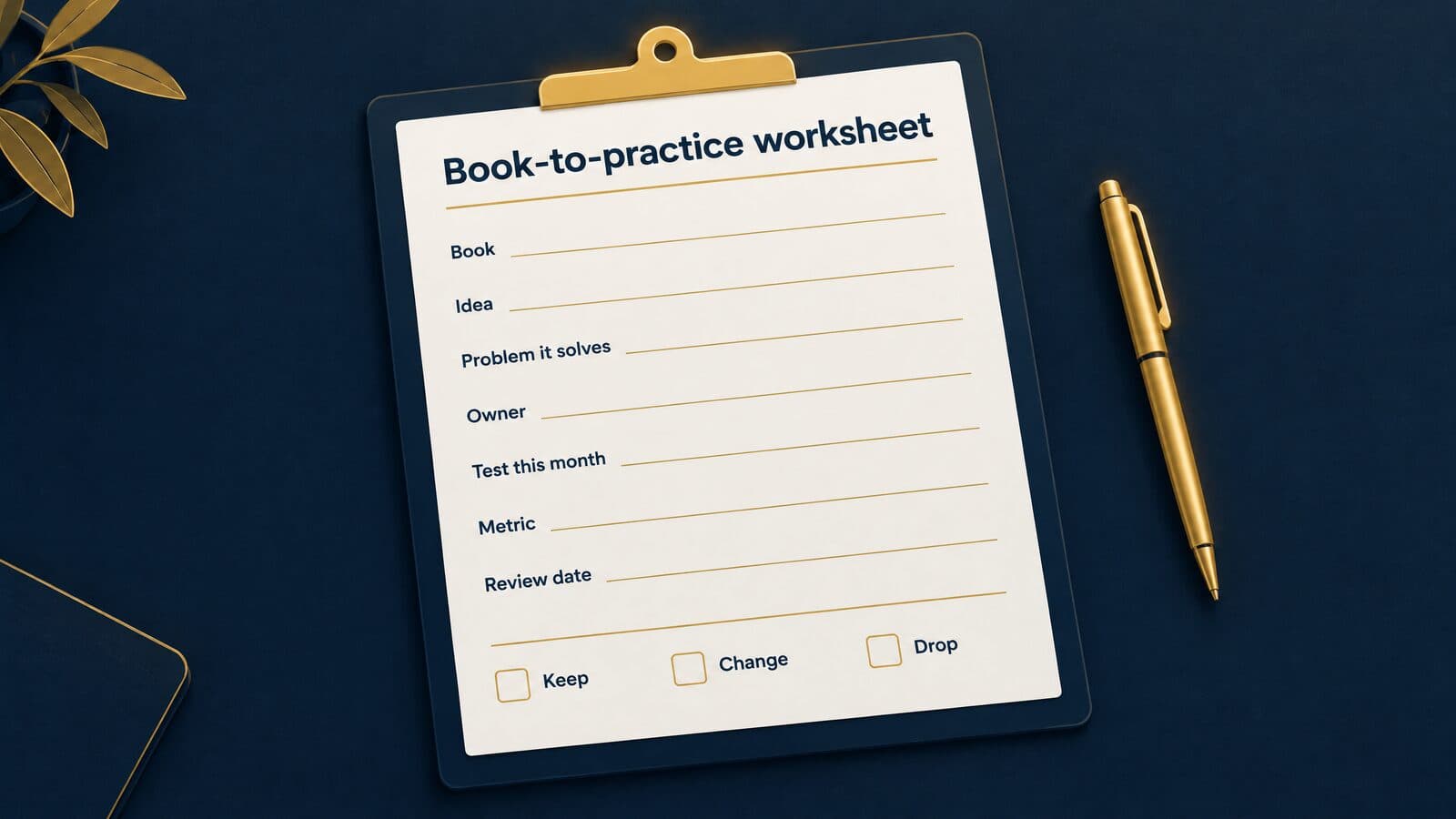
Use these fields, in this order:
- Book: title, author and the edition you read.
- Chapter or idea: the one idea you are testing, in your own words.
- Problem in our firm: the specific problem it might solve, such as slow callbacks, weak demand letters or a stalled weekly meeting.
- Owner: one named person, not a team.
- One test this month: the smallest change that could show whether the idea works.
- Metric: the number or observation you will check, such as callback time, response rate to demands, or whether the meeting ended on time.
- Review date: a calendar date, usually 30 to 45 days out.
- Keep, change or drop: the decision at review, with one sentence on why.
Be careful with the metric field. A single month of numbers rarely proves anything, and marketing numbers in particular move for reasons unrelated to the book you read; see why law firm marketing benchmarks disagree before you compare your results with someone else's. Treat every book idea as a hypothesis to test, not a promised result.
Here is a filled example. Book: Unreasonable Hospitality. Idea: give each caller one small, unexpected courtesy. Problem: callers who are not signed on the first call rarely answer the follow-up. Owner: the intake lead. Test: for one month, every first call ends with a clear next step and a named person who will call back. Metric: the share of follow-up calls that connect. Review date: five weeks out. Decision: keep, change or drop, with a reason.
Does reading count toward CLE, and can the firm deduct books?
This is general information, not legal or tax advice; continuing-education rules vary by state, so check your state bar and a tax adviser before relying on any of it. In the one state we checked, California, reading a book on your own is not listed as a way to earn credit. The State Bar says that, with a few exceptions, active licensees must complete 25 hours of MCLE in each three-year compliance period, and at least 12.5 of those hours must be participatory.
California's list of credit types allows self-study credit for provider-prepared activities whose attendance is not verified, prepared within the preceding five years, and for a graded self-test. It also allows credit for authoring or co-authoring written materials that have been published or accepted for publication and were not prepared in the ordinary course of employment. The same page lists activities the State Bar does not approve, including jury duty and one-on-one mentoring of less experienced attorneys. So in California, writing a published article about a book may count, while reading one does not. Other states were not verified.
On taxes, the only rule we verified is the general one. IRS Publication 334 says that to be deductible, a business expense must be both ordinary and necessary: "ordinary" means common and accepted in your field, and "necessary" means helpful and appropriate for your business. The same publication says depreciable property must have a useful life extending substantially beyond the year it is placed in service. It does not name books in the passages we read, and we make no claim about how a firm or an employee should treat book purchases. Ask your tax adviser, and keep receipts with a note on the business purpose.
Books as gifts
A book makes a good gift for a lawyer when it is either a reference they will keep for years or a story they would not buy for themselves. For a law student or new associate, a current writing guide or a well-chosen narrative book from the mass tort reading list is a thoughtful, modest choice. For a reference that lasts, the current 12th edition of Black's Law Dictionary, edited by Bryan A. Garner, is the obvious pick; check the edition before you buy so you do not give an old one.
For gift ideas beyond books, such as desk items and practical gear, see our guide to gifts for lawyers.
Sources and methodology
Every book fact in this guide was checked on October 22, 2026 against the publisher's own page, the author's site or a rule-maker's text, and prices are listed as of October 2026. Where a publisher page could not be reached, we used Open Library's catalog and labeled it as a secondary source.
We started from Google's results for "lawyer books", observed on October 22, 2026, to understand intent. The AI Overview ended by asking whether the searcher wanted law-school study, courtroom skills or fiction, which is why this guide is organized by need and stage. A Reddit thread that ranked for the term could not be fetched, so we quote nothing from it. Search positions vary by location and session and are not presented as fixed facts.
Primary sources used, all accessed October 22, 2026:
- University of Chicago Press, Legal Writing in Plain English, 3rd ed.
- LawProse, books by Bryan A. Garner
- Carolina Academic Press, Plain English for Lawyers, 7th ed. front matter
- Trial Guides, Books for Lawyers collection
- Wiley, The E-Myth Attorney
- ABA bookstore, How to Start and Build a Law Practice
- ABA Model Rule 7.1
- Penguin Random House, A Civil Action
- National Book Foundation, 1995 National Book Awards
- Harvard University Press, Agent Orange on Trial
- ABA Journal, the 25 greatest law novels (August 1, 2013)
- The Pulitzer Prizes, Harper Lee
- Project Gutenberg, The Common Law
- State Bar of California, MCLE requirements
- IRS Publication 334
This guide is reviewed at least twice a year, and sooner when a listed book gets a new edition. Mass Tort Marketing Agency is not a publisher or bookstore, earns nothing from any title here, and uses no affiliate links; the guide is written by Tarun, its founder.