

Quick answer. The best gifts for lawyers save time or make a long working day easier: noise-cancelling headphones, a temperature-controlled travel mug, a fine pen or leather portfolio, an ergonomic desk upgrade, a current Black's Law Dictionary for a new lawyer, or a handwritten note with a treat the whole office can share. Buy for how they work, not for the scales-of-justice aisle. A simple thank-you gift to your own lawyer is generally allowed; gifts to judges and government lawyers have tight limits.
Key takeaways
- Practical beats symbolic. Most lawyers work full time in law offices and some work more than 40 hours per week, so gifts that save time or ease the day get used.
- Run any idea through the CASE test (connection, allowed, specific, execution) before you buy.
- Budget follows the relationship. This guide uses five editorial tiers, from under $25 to $250+; no rule or survey sets a "right" amount for a client's thank-you.
- A client may give their lawyer a simple holiday gift or token of thanks under ABA Model Rule 1.8 Comment [6]; lawyers may not solicit a substantial gift.
- Judges and federal agency lawyers are different: Rule 3.13 limits judges, and executive-branch employees can usually accept only $20 per source per occasion.
- Firms thanking referral sources must keep it to a token, with no strings, and can deduct only $25 per recipient per year.
- For Christmas delivery in 2026, USPS recommends sending Ground Advantage by Thursday, December 17; alcohol can't go by mail, and power banks fly only in the carry-on.
The lawyer in your life seems to own everything already. They work long days, travel to hearings on short notice, and have been given enough scales-of-justice mugs to stock a courthouse cafeteria. Shopping for them feels harder than it should, and with about 1.37 million active lawyers in the U.S., plenty of people face the same problem every December, every graduation season and every time a case closes.
This guide is for family and friends, colleagues and staff, clients saying thank you, firms gifting clients and referral sources, and lawyers buying presents for lawyers on their own team or for themselves. It runs in a set order: quick picks first, then the CASE test for judging any idea, then picks by persona, by occasion and by budget and relationship, and finally the rules for clients, judges, government lawyers and firms. Prices for named products were checked on the vendors' own pages as of October 2026.
The Best Gifts for Lawyers at a Glance
The best gift for a lawyer is something they will use every working day or something that gives them time back. The strongest categories are practical gear (travel, tech and desk), personal items that can be engraved or monogrammed, wellness and time-back gifts, food the whole office can share, and legal humor where it fits the office.
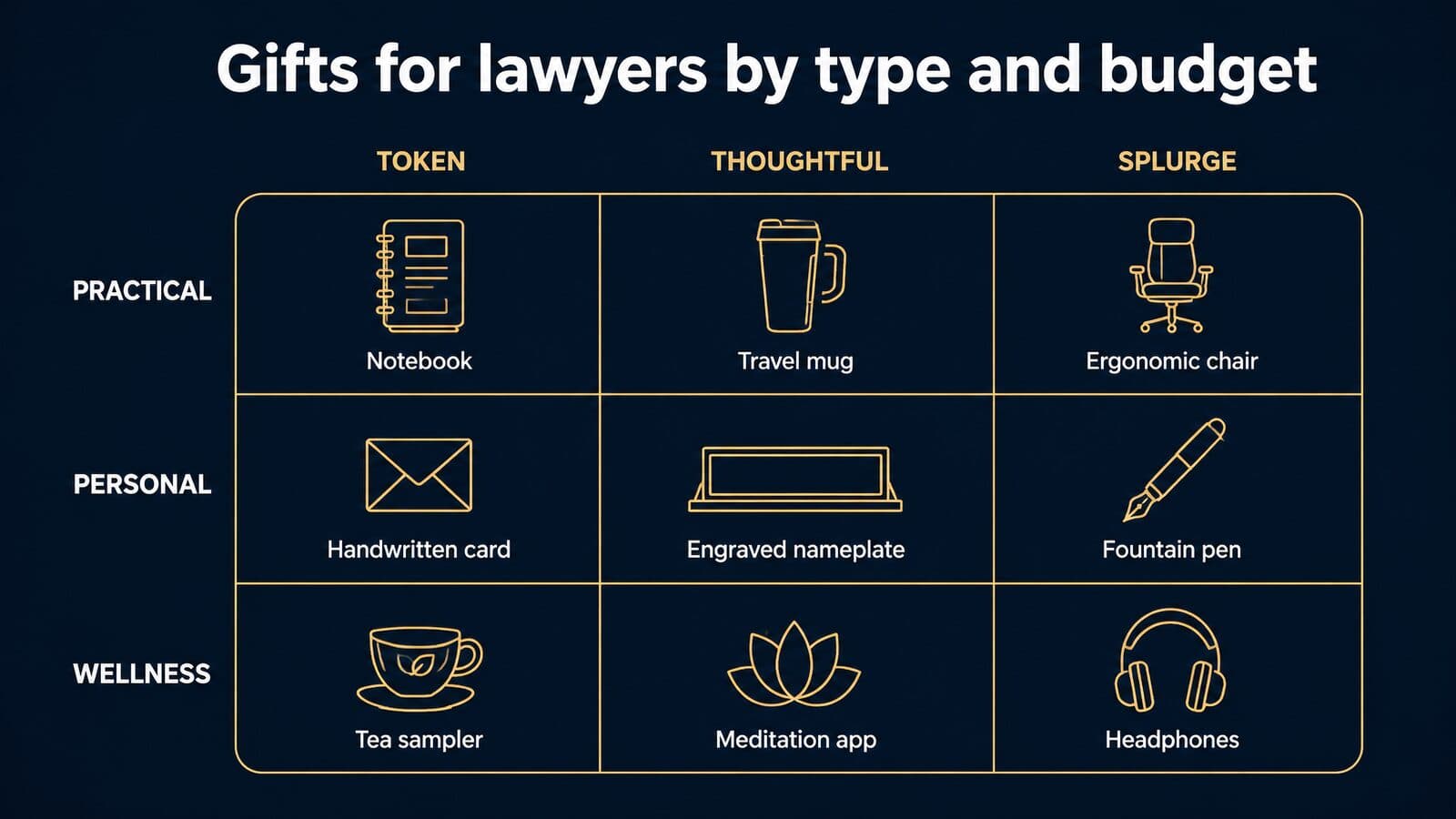
| If you're shopping for | Our pick | Budget tier | Why it works |
|---|---|---|---|
| Best overall | Noise-cancelling headphones | $250+ | Flights, focus and video calls |
| Under $25 | A quality notebook and pen set | Under $25 | Used daily |
| Under $50 | A cord and charger organizer | $25–$50 | Ends bag chaos |
| Under $100 | A leather portfolio | $50–$100 | Meetings and court |
| Luxury | An ergonomic chair | $250+ | Long drafting days |
| A new lawyer | Black's Law Dictionary, 12th ed. | $50–$100 | Current 2024 edition |
| Passing the bar | A frame for their bar admission certificate | $50–$100 | Marks a one-time moment |
| A client's thank-you | A handwritten card and a shareable treat | Modest | Allowed and personal |
| Funny | An "Allegedly" mug | Under $25 | Office-safe humor |
| A stressed lawyer | A meal delivery or cleaning service | $50–$100 | Gives back time |
| A coffee lover | A temperature-controlled travel mug | $100–$250 | Hot through a long call |
| A frequent flyer | A power bank under 100 Wh | $25–$50 | Allowed in a carry-on |
| A PI trial lawyer | A trial-week survival kit | $25–$50 | Small comforts on long days |
| A judge | A handwritten note | Token | Most gifts raise rules issues |
| A referral source (for firms) | A token holiday item | Token | Nominal, no strings attached |
Budget tiers are editorial suggestions for a type of gift, not measured market prices; prices vary by maker, so check before buying, and each row is explained in the section named for it below.
Find your gift by budget, occasion, persona or relationship
There are four ways into this page, and most readers only need one of them. If you already know what kind of person you are buying for, start with the persona sections. If a date on the calendar is driving the purchase, start with the occasion sections. If you are mainly worried about how much to spend, go to the budget ladder. And if you are a client, a court visitor or a law firm, read the rules sections before you buy anything at all.
- By persona: read Gifts for Lawyers Who Travel for Work, Gifts for the Tech-Savvy Lawyer, Gifts for the Stylish Lawyer, Gifts for Stressed and Overworked Lawyers, Office Upgrade Gifts for Lawyers, the funny, book, food and experience section, and Gifts for Personal Injury and Mass Tort Lawyers.
- By occasion: read Gifts for Law Students, Bar Takers and New Lawyers (law school, the bar exam and the swearing-in), Gifts for Career Milestones: Partner, Judge, Retirement, and Holiday Gifts for Lawyers and Shipping Deadlines.
- By budget and relationship: read Gifts for Lawyers by Budget and Relationship, which holds the budget ladder and the relationship table.
- By rules: read Can You Give Your Lawyer a Gift? The Ethics Rules, Gifts for Judges, Court Staff and Government Lawyers, and How Law Firms Should Gift Clients and Referral Sources.
The page uses five budget tiers throughout: Under $25, $25–$50, $50–$100, $100–$250 and $250+. Two other words appear in the client and referral rows: "token" and "modest". Those rows never get a dollar figure, and that is deliberate. No bar rule or survey sets a correct amount for a client's thank-you to their lawyer, and the ABA's referral rule speaks of a "token item" without naming any number. Putting a price on either would invent a standard that does not exist.
How this guide was put together
Mass Tort Marketing Agency is a legal marketing agency for plaintiff personal injury and mass tort firms, not a gift retailer. That matters for how you read the picks below. This page carries no affiliate links, no paid placements and no free products from any vendor named here. Because no maker paid for a mention or sent anything, there is no material connection to disclose under the FTC's Endorsement Guides, the rule that would otherwise require one.
The picks were chosen on stated criteria rather than hands-on testing, and I want to say that plainly. Each idea had to meet four tests: the lawyer would use it often, it fits the shape of legal work, the recipient can accept it under the gift rules that apply to them, and it is actually available to buy. Where a specific product is named with a price, that price was read on the vendor's own page as of October 2026, and you should confirm the current price before buying.
The rules content was read on primary sources: the ABA Model Rules and Model Code of Judicial Conduct, the State Bar of California's rules, federal regulations, IRS publications, USPS and the FAA. Where a fact came only from a secondary report, the sentence says who reported it. The page is re-checked before each holiday season, and the sources section at the end lists what was read and when. Where I give an opinion, such as "my rule of thumb", it is framed as one.
How to Choose a Gift a Lawyer Will Actually Use
A good lawyer gift passes four checks, which this guide calls the CASE test: Connection (the relationship and the reason), Allowed (whether the recipient may accept it), Specific (whether it fits their working day) and Execution (names, timing and delivery). Score each from 0 to 2. Allowed is a gate: a zero there ends the idea.
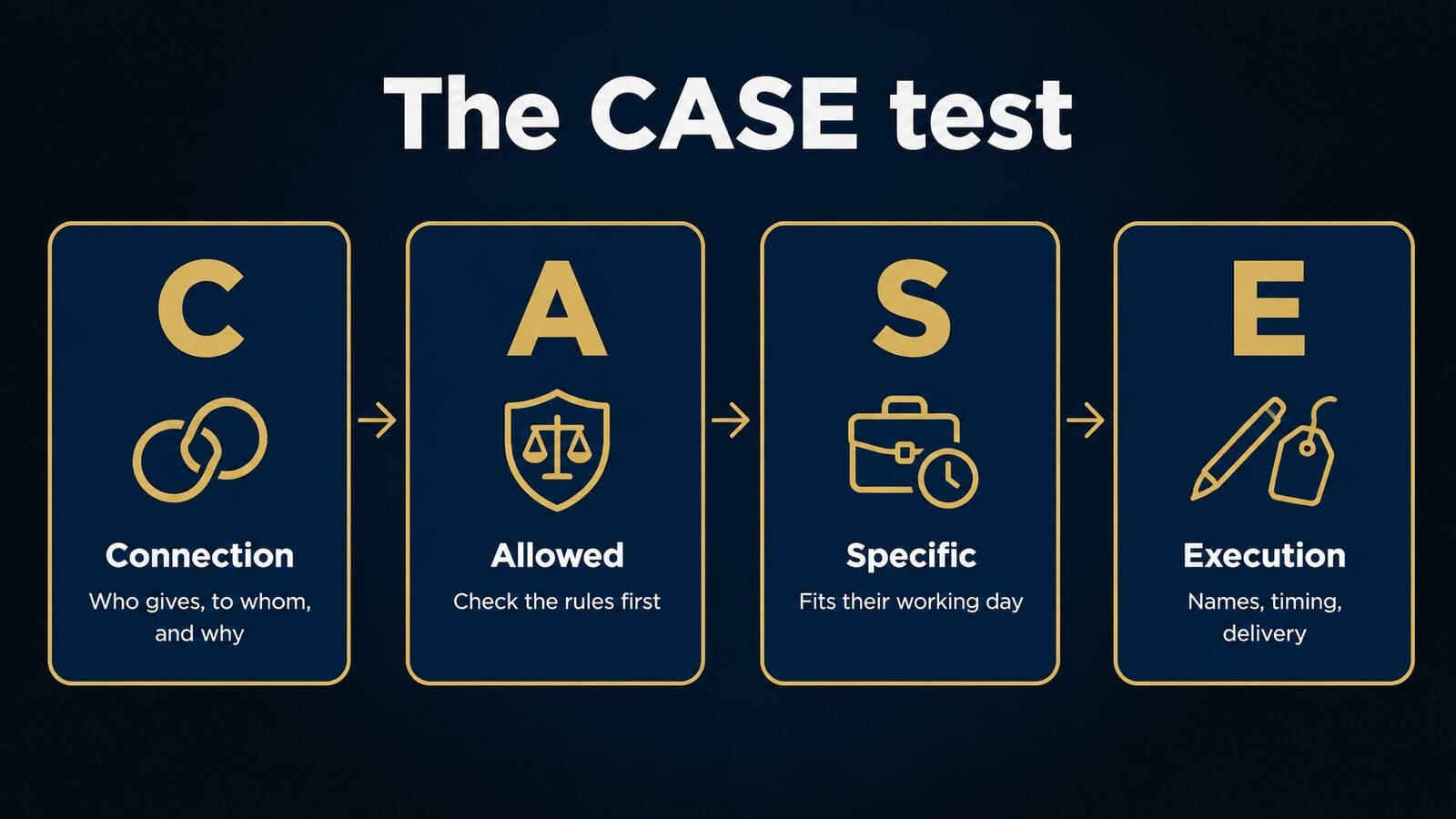
C is for connection: who is giving, to whom, and why
Start with the direction of the gift. An upward gift goes to a boss or senior partner; a sideways gift goes to a peer; a downward gift goes to staff; and there are client-to-lawyer gifts and firm-to-client or firm-to-referral-source gifts. Upward gifts should stay modest or become group gifts, because an expensive present to the person who reviews you can read as flattery. Closeness decides how personal the gift can be, and the reason (thanks, a milestone, a holiday) decides what the card says.
No survey of what lawyers actually want from gifts exists, so use what you can observe instead: their commute, their coffee order, the state of their desk, how full their calendar is and their practice area.
Score: 2 = a clear, fitting reason and relationship; 1 = fine but generic; 0 = could read as flattery or pressure.
A is for allowed: run the rules check first
Before you think about price or style, check whether the person can accept a gift from you at all. Four situations raise flags:
- A client thanking their own lawyer: a simple holiday present or token of appreciation is [permitted under Model Rule 1.8 Comment [6]](https://www.americanbar.org/groups/professional_responsibility/publications/model_rules_of_professional_conduct/rule_1_8_current_clients_specific_rules/comment_on_rule_1_8/); the ethics section below covers larger gifts.
- A judge or court staff: Rule 3.13 of the Model Code of Judicial Conduct bars judges from accepting gifts that would appear to a reasonable person to undermine their independence, integrity or impartiality; see the section on judges, court staff and government lawyers.
- A federal agency lawyer: executive-branch employees may generally accept unsolicited gifts of $20 or less per source per occasion, no more than $50 a year from one person, and never cash; the same section explains it.
- A referral source: a gift to someone who recommends a lawyer may be no more than a token item and is prohibited if tied to an understanding that referrals will continue; see the law firm section.
Many employers, in-house legal departments and government agencies also have their own gift policies, so ask if you are unsure. Firms can read more on how bar advertising and referral rules apply to law firm marketing.
Score: 2 = clearly allowed; 1 = unsure, check first; 0 = not allowed, stop.
S is for specific: does it fit their working day
"Lawyer" covers very different days. A litigator spends weeks preparing for hearings and may live out of a hotel during trial. A transactional lawyer sits through long drafting sessions and calls. In-house counsel juggle meetings across a company. Ask where they work (the office, home or the courthouse), whether they travel, and whether they share an office, since scents and noise affect neighbors. Then apply what I call the duplicate test: if they already own a good version, upgrade a different thing.
Three quick examples. A trial lawyer gets more from a garment bag than a desk ornament. An in-house counsel who moves between conference rooms will use a slim portfolio. A remote-first solo needs home-office gear, such as a document shredder, far more than a travel kit.
Score: 2 = solves a real daily friction; 1 = nice but occasional; 0 = shelf decor.
E is for execution: names, timing and delivery
Good execution is mostly care with details. Spell names, titles and firm names exactly; the nameplate section in Gifts for the Stylish Lawyer covers when "Esq." and "Hon." are appropriate. Allow lead time for engraving or monogramming. Deliver to where the lawyer will actually be: the front desk, their home, or the hotel during a trial. Time it sensibly: a client's thank-you works best after the case closes, and holiday gifts must beat carrier cut-offs, covered in the holiday section. Finally, write a card that says something specific.
Score: 2 = all four handled; 1 = one gap; 0 = misspelled or late.
Scoring the CASE test: three worked examples
Here is the scorecard in one table.
| Letter | Question | 0 points | 1 point | 2 points |
|---|---|---|---|---|
| C | Is the relationship and reason clear? | Reads as pressure | Generic | Clear and fitting |
| A | May they accept it? | Not allowed | Unsure | Clearly allowed |
| S | Does it fit their day? | Shelf decor | Occasional use | Daily friction solved |
| E | Names, timing, delivery right? | Misspelled or late | One gap | All handled |
Buy if Allowed scores 2 and the total is 6 or more; fix the weakest letter if the total is 4 or 5; drop the idea below 4.
| Scenario | C | A | S | E | Total | Verdict |
|---|---|---|---|---|---|---|
| Parent gives a new associate an engraved fountain pen | 2 | 2 | 1 | 2 | 7 | Buy |
| Paralegal gives the managing partner an expensive watch | 0 | 2 | 1 | 1 | 4 | Rethink |
| PI firm sends referring chiropractors baskets saying "keep the referrals coming" | 1 | 0 | n/a | n/a | Stop | Stop |
These are illustrative "for example" cases, not client stories. In the first, a parent buys a newly sworn-in associate an engraved fountain pen. The connection is obvious and the gift is plainly allowed. Specific scores only 1 because many lawyers type most of the day, so pair the pen with a good notebook. The engraving is spelled right and arrives before the swearing-in, so execution earns 2. Total 7: buy it.
In the second, a paralegal buys the managing partner an expensive watch. Nothing forbids it, but an upward luxury gift can read as flattery, so connection scores 0, and a watch is a personal taste item. Total 4: rethink. A group gift from the whole team or a sincere note works better.
In the third, a PI firm sends holiday baskets to referring chiropractors with a card saying "keep the referrals coming". The test stops at Allowed. Under ABA Model Rule 7.2 Comment [4], a gift is prohibited if it is given on an understanding that referrals will continue, and that card states the understanding in writing. The fix, covered in the law firm section, is a token item with a plain thank-you and no link to future business.
Gifts for Lawyers Who Travel for Work
Travel gifts suit litigators, lawyers who fly to hearings and depositions, and anyone with a long commute. The best ones make airports, hotel rooms and courthouse hallways easier, and they follow the airline rules on batteries and liquids so nothing gets taken away at security.
| Gift | Best for | Spec to check | Budget tier |
|---|---|---|---|
| Briefcase | Court and client meetings | Laptop sleeve size | $100–$250 |
| Convertible travel pack | Walkers and cyclists | Strap comfort | $100–$250 |
| Noise-cancelling headphones | Flights and focus | Battery hours | $250+ |
| Earbuds with good mics | Calls on the move | Fit and mic quality | $100–$250 |
| Temperature-controlled mug | Long calls | Battery hours | $100–$250 |
| Insulated tumbler | Commuters | Lid seal | $25–$50 |
| Power bank | Frequent flyers | Wh rating under 100 | $25–$50 |
| Garment bag | Trial trips | Folded size | $50–$100 |
| Packing cubes | Carry-on packers | Set sizes | $25–$50 |
| Cord organizer | Every bag | Pocket count | $25–$50 |
Budget tiers are editorial suggestions; prices vary by maker, so check before buying.
A briefcase or convertible travel pack
Picture a lawyer leaving a hotel at 7 a.m. with a laptop, a redweld of exhibits, a charger and a legal pad, then walking six blocks to the courthouse. A good bag makes that walk easier and keeps the files dry and in order. It also gets used every working day, which is the best argument for any gift.
Measure the laptop before buying, since sleeve sizes vary. Structured leather looks sharp in court; ballistic nylon is lighter and shrugs off rain. Look for a luggage pass-through sleeve that slides over a roller handle, an expandable gusset for files, and a sensible weight when empty. For lawyers who walk or cycle to work, a convertible brief-backpack with stowable straps is the better pick. Brand prices were not verified for this guide, so compare current prices across makers. Monogramming is an option if the bag is leather.
Budget tier: $100–$250, or $250+ for premium leather (prices vary; check before buying). Skip it if: they bought a new bag in the past year or their firm issues one.
Noise-cancelling headphones for flights and focus
Noise-cancelling headphones help on a flight to a deposition, in an open-plan office during a drafting sprint, and through a three-hour remote deposition where every word matters. They turn dead travel time into reading time.
Buy for comfort first, especially if the lawyer wears glasses, then battery life, then a microphone good enough for video hearings and calls, and a case that fits in a briefcase. One named option: the Bose QuietComfort Ultra Headphones (2nd Gen), listed at $449 on bose.com as of October 2026, with battery life of up to 30 hours (23 with Immersive Audio). For someone who prefers earbuds, the AirPods Pro 3 are listed at $249 on apple.com as of October 2026, with free engraving. Confirm the current price before buying.
Budget tier: $250+ for over-ear models, $100–$250 for earbuds (prices vary; check before buying). Skip it if: they already own a recent pair. Personalize: Apple's free engraving on the AirPods case.
A temperature-controlled travel mug
Coffee poured before a morning calendar call is cold by the third matter. A heated mug keeps it drinkable through a long call or a slow drive to a hearing, and it is the kind of small daily upgrade that people rarely buy for themselves.
The Ember Travel Mug 2+ is listed at $199.95 on ember.com as of October 2026; confirm the current price. It holds 12 oz, runs up to 3 hours on the go, holds a temperature between 120°F and 145°F, and the Black version works with Apple Find My. A cheaper alternative is a vacuum-insulated tumbler with a tight lid, in the $25–$50 tier. For the lawyer who never leaves the office, a desk mug warmer does the same job for less.
Budget tier: $100–$250 (prices vary; check before buying). Skip it if: they drink one quick coffee before court and that's it.
A power bank that is legal to fly with
A dead phone between a deposition and a flight home means missed messages from the office and no boarding pass. A power bank solves that, but only if it can legally go on the plane, so the rules come first.
The FAA says spare lithium batteries, "including power banks and cell phone battery charging cases, must be carried in carry-on baggage only," and they must come out of any bag that is gate-checked. The limit is 100 watt-hours (Wh) per battery; up to two spare batteries of 101–160 Wh are allowed with airline approval, and many airlines are stricter. Wh equals volts times amp hours. As an example, Anker lists its 337 Power Bank (PowerCore 26K) at 26,800mAh and 96.48 Wh, under its stated 27,027mAh (100 Wh) threshold for taking batteries on board. The U.S. listing read for this guide showed the unit sold out, so check availability. Whatever you buy, look for the Wh rating printed on the case and enough output for both a phone and a laptop.
Budget tier: $25–$50, or $50–$100 for laptop-capable models (prices vary; check before buying). Skip it if: they rarely fly and charge at their desk.
Garment bags, packing cubes and cord organizers
A garment bag gets a suit to a trial or hearing trip without a crease that shows on camera or in front of a jury. Look for one that folds to carry-on size.
Packing cubes keep a week of shirts, gym clothes and court clothes separate in one carry-on, which matters when a trial runs longer than planned.
A cord and charger organizer ends the tangle of laptop, phone and headphone cables at the bottom of a bag. Pick one with labeled pockets.
A toiletry kit for carry-on travel needs containers of 3.4 ounces (100 milliliters) or less in a quart-sized bag, so a pre-filled kit with travel bottles saves a stop at the airport shop.
- Garment bag: $50–$100 budget tier. Skip it if they travel only for one-day hearings.
- Packing cubes: $25–$50 budget tier. Skip it if they pack in a backpack and nothing else.
- Cord organizer: $25–$50 budget tier. Skip it if their bag already has a built-in tech pocket.
- Carry-on toiletry kit: Under $25 budget tier. Skip it if they always check a bag.
Prices vary by maker; check before buying. The section on personal injury and mass tort lawyers later adds a trial-week kit and gear for MDL travel.
Gifts for the Tech-Savvy Lawyer
Tech gifts work for lawyers when they respect client confidentiality. ABA Model Rule 1.6(c) requires a lawyer to "make reasonable efforts to prevent the inadvertent or unauthorized disclosure of, or unauthorized access to, information relating to the representation of a client," so anything that listens, syncs or prints needs a second look before it goes on their desk.
| Gift | What can go wrong | Safer setup | Verdict |
|---|---|---|---|
| Smart speaker | Hears client calls | Kitchen, not office | Home only |
| E-ink tablet | Notes sync to cloud | Check firm policy | Check sync |
| Smartpen | Notes sync to an app | Check firm policy | Check sync |
| Privacy screen | Nothing | Fit to screen size | Great |
| Cross-cut shredder | Strip-cut is weaker | Choose cross-cut | Great |
| Locking document bag | Lost key | Spare key at home | Good |
| Portable scanner | Cloud upload default | Scan to local drive | Good |
| Wi-Fi printer | Open network access | Secure the network | Check setup |
Smart speakers need a confidentiality caveat
A smart speaker is fine in a kitchen but a poor fit for a home office where client calls happen. The device listens for a wake word, and that is the problem in a room where privileged conversations take place.
Rule 1.6(c) asks lawyers to make reasonable efforts to protect client information. According to Holland & Knight's summary, ABA Formal Opinion 498 (March 2021) lists smart speakers and other listening-enabled devices among the technology lawyers working remotely should assess, and suggests some smart features may need to be turned off to avoid disclosing client confidences. ABA formal opinions are advisory rather than binding, though they are often cited as persuasive. Privacy settings also change: according to a MobileSyrup report, Amazon stopped supporting the Echo "Do Not Send Voice Recordings" setting on March 28, 2025, moving affected users to "Don't Save Recordings".
If you still want to give one, buy a current model. Amazon's newsroom says the Echo Dot Max delivers nearly 3x the bass of the Echo Dot (5th Gen), so the 5th Gen is no longer the newest Dot; check the current price. Suggest they review the device's privacy settings and use the microphone mute button during calls. A better idea for a home office is a quality speaker with no microphone at all.
E-ink tablets for reading and marking up
An e-ink tablet lets a lawyer read a brief and mark up a draft on a plane without a glowing screen, and it replaces a stack of printed pages in a bag. For anyone who still prints drafts to edit them by hand, it is a real change to the working day.
reMarkable's store lists the Paper Pro (now in color), Paper Pure, reMarkable 2 and reMarkable 1, with a 50-day satisfaction guarantee and free shipping and returns on its paper tablets. Prices were not verified for this guide, so check the current price. Look at screen size, pen feel, file-format support and how notes sync. That last point matters: notes that sync to a cloud service may be client information, so check the firm's technology policy before handing one over. A smartpen that digitizes handwritten notes raises the same sync question.
Budget tier: $250+ for most premium models (prices vary; check before buying). Skip it if: their firm locks down devices and won't approve it.
Privacy screens, shredders and locking document bags
None of these is legally required by name, but each is a practical way to make the "reasonable efforts" of Rule 1.6(c) easier.
A laptop privacy filter narrows the viewing angle so the passenger in the next seat or the person at the next coffee-shop table can't read a draft settlement agreement. Buy it for the exact screen size.
A cross-cut shredder suits a home office, where client papers otherwise end up in household recycling. Cross-cut shreds into small pieces rather than long strips.
A locking document bag or case keeps files secure in transit between office, home and court, and signals to anyone else that the contents are private.
- Laptop privacy filter: $25–$50 budget tier. Skip it if they never work in public.
- Cross-cut shredder: $50–$100 budget tier. Skip it if they work only from a firm office with secure disposal.
- Locking document bag: $50–$100 budget tier. Skip it if they are fully paperless.
Prices vary by maker; check before buying.
Legal research and AI subscriptions: who actually pays
Legal research platforms are usually bought by the firm under a contract, and pricing is generally not public, so they make awkward personal gifts. You may pay for something the lawyer already has through work.
Some lawyers also get research access through their bar association. Fastcase, for example, grew largely through bar member-benefit partnerships before it merged with vLex into vLex Group in April 2023, and Clio then completed its acquisition of vLex in November 2025. Before buying anything, ask what their bar or firm already provides.
AI tools raise the same firm-policy question plus confidentiality: many firms limit which tools can touch client data. Better personal options are a book, a course, or paying for a tool the lawyer has already chosen. To see what is out there, see our comparison of legal research tools and read about legal AI tools lawyers use.
Portable monitors, scanners and compact printers
A portable monitor gives a lawyer a second screen in a hotel room or a trial war room, which makes comparing a transcript against an exhibit far easier. Check that it connects to their laptop with a single cable.
A portable document scanner turns a stack of client papers into searchable files at a client's kitchen table or in a courthouse hallway.
A compact laser printer suits a home office, where a lawyer needs a clean copy of a filing at 10 p.m. Laser beats inkjet for crisp text and lower running costs.
For the scanner and printer, treat Wi-Fi and cloud features as a setup question: scan to a local drive and keep the printer on a secured network.
- Portable monitor: $100–$250 budget tier. Skip it if they always work at a docked desk.
- Portable document scanner: $100–$250 budget tier. Skip it if their office handles all scanning.
- Compact laser printer: $100–$250 budget tier. Skip it if they rarely print.
Prices vary by maker; check before buying. Gear covers the working day, but the gifts people remember most often reflect the lawyer's own style and the space they work in, which is where the next section begins.
Gifts for the Stylish Lawyer
Stylish gifts for lawyers work best when they are understated and built for daily use: a monogrammed portfolio or laptop sleeve, a correctly engraved nameplate, a fine pen, and small court-day accessories. Personalization is what makes them feel chosen, so get the name and title exactly right.
The table below sorts the options in this section; the budget tiers are editorial suggestions for each category, and prices vary by maker, so check before buying.
| Gift | Best for | Personalize? | Budget tier |
|---|---|---|---|
| Leather portfolio | Meetings and depositions | Yes, initials | $50–$100 |
| Laptop sleeve | The lawyer who works between offices | Yes, initials | $25–$50 |
| Monogrammed brief | A milestone year | Yes, initials | $250+ |
| Desk nameplate | A new office or title | Yes, full name | $25–$50 |
| Business card case | A small add-on | Yes, initials | Under $25 |
| Fine ballpoint | Signing and margin notes | Yes, engraving | $250+ |
| Fountain pen | The lawyer who writes by hand | Sometimes | $25–$50 to start |
| Cufflinks | Court and formal events | Sometimes | $50–$100 |
| Tie bar | Court days | Rarely | Under $25 |
| Pocket square or silk scarf | Court and client meetings | Rarely | $25–$50 |
| Compact umbrella | Courthouse walks | No | Under $25 |
A personalized bag, portfolio or laptop sleeve
A leather portfolio is the object that sits on the table at every meeting. It comes out at a deposition, a mediation, a partner meeting and a client intake, and it holds the legal pad the lawyer will write on all day. A laptop sleeve or a monogrammed brief does the same work for the lawyer who carries a machine between home, the office and court.
Buy on leather grade first. Full-grain leather keeps the outer surface of the hide and tends to age well; "genuine leather" is a lower grade despite the reassuring name; bonded leather is made from scraps and glue and tends to peel. Pick a color that works with courtroom suits: black, dark brown and navy are safe, while tan reads as more casual. Initials usually belong in a small, debossed corner rather than a large central monogram. A business card case in the same leather makes a smaller add-on, or a stand-alone gift under $25.
Personalize: three initials, or initials plus the year they were admitted to the bar.
Budget tier: $25–$100 for a sleeve or portfolio, $250+ for a full brief (prices vary; check before buying). Skip it if: they already carry a bag they love and have used for years.
A desk nameplate engraved the right way
A nameplate is a small gift with a lot of room for error, which is why it deserves its own etiquette. By convention in the United States, "Esq." follows the name of an admitted lawyer, as in "Jordan Lee, Esq.", and it is not combined with "Mr." or "Ms." in front of the name or with "J.D." after it. Judges are addressed as "The Honorable" or "Hon." on a nameplate or envelope. These are conventions, not rules, and practice varies by state, by firm and by personal preference. Plenty of lawyers dislike "Esq." on their own desk and prefer plain first and last names.
The safe move is to check before you engrave. Look at their bar profile or firm bio for the exact spelling and middle initial, and ask a colleague whether they use a title at all. Confirm the firm name too, because firms rename after mergers and partner changes, and an engraved plate with last year's name is hard to fix. For materials, walnut, brass and glass all look professional; measure the desk, since a long plate can crowd a small workspace.
Personalize: full name as they use it professionally, with a title only if you know they want one.
Budget tier: $25–$50 (prices vary; check before buying). Skip it if: they hot-desk or work mostly from home.
Fine pens and fountain pens
A good pen earns its keep every day. Lawyers sign engagement letters and settlement papers, write margin notes on deposition outlines, and hand a pen across the table to a client at the moment that matters most to that client. A pen is one of the few objects a client actually sees in their lawyer's hand, which is why a fine one feels personal rather than generic.
At the top of the range, the Montblanc Meisterstück Platinum-Coated Classique Ballpoint is listed at $560 on montblanc.com as of October 2026, and the product page offers complimentary engraving of names or initials; confirm the current price before ordering. For someone who already writes by hand, a fountain pen is the more personal path. Look at nib size (fine or extra-fine suits small handwriting and cheap legal pads), whether it takes a converter for bottled ink or cartridges only, and an ink that dries quickly and does not feather on thin paper. A starter fountain pen in the $25–$50 tier is the kind choice for someone new to them.
Round out the gift with a quality notebook and a refill or ink set, which turns a pen into a usable kit. For the lawyer who still writes personal letters, a wax-seal kit with their initial is a charming extra.
Personalize: engraved initials on the barrel or cap, where the maker offers it.
Budget tier: $25–$50 for a starter fountain pen, $250+ for a luxury ballpoint (prices vary; check before buying). Skip it if: they draft everything on screen and sign with a stylus.
Accessories for court days
Small accessories make a conservative courtroom outfit feel like the wearer's own, without the fit risk of buying clothes.
Cufflinks or a tie bar are classic choices for anyone who wears French cuffs or a tie to court; keep the design simple, in silver or a muted finish, so it works with a dark suit.
A pocket square or a silk scarf adds a little color without breaking courtroom norms. Pick quiet patterns and avoid anything that reads as a novelty print.
A compact umbrella earns its place on the walk between the parking garage and the courthouse, especially in a city where the lawyer cannot show up to a hearing soaked.
A shoe-care kit and a lint roller kept in the briefcase are the practical end of the range: inexpensive, easy to give to a colleague, and used before every appearance.
- Cufflinks: $50–$100 budget tier. Skip it if they never wear French cuffs.
- Tie bar: Under $25 budget tier. Skip it if they rarely wear a tie.
- Pocket square or silk scarf: $25–$50 budget tier. Skip it if their style is strictly plain.
- Compact umbrella: Under $25 budget tier. Skip it if they drive into a covered courthouse garage.
- Shoe-care kit: $25–$50 budget tier. Skip it if they already keep one at the office.
- Lint roller: Under $25 budget tier. Skip it if it is the whole gift; pair it with something.
Gifts for Stressed and Overworked Lawyers
The best gifts for stressed lawyers give back time or create a short, private break in the day; meals, cleaning and errands beat novelty stress toys. Avoid treating any gift as a fix for burnout, and skip alcohol unless you know the person well.
The table below sorts the options by what they actually give and whether they suit a shared office. Budget tiers are editorial suggestions; prices vary, so check before buying.
| Gift | What it gives | Shared-office friendly? | Budget tier |
|---|---|---|---|
| Meditation app | Short guided breaks | Yes, with headphones | $25–$100 |
| Desk zen garden | A tactile pause | Yes | Under $25 |
| Handheld massager | Relief for neck and shoulders | Home use is better | $25–$50 |
| Acupressure mat | A lie-down reset at home | No, home only | $25–$50 |
| Aromatherapy diffuser | Scent and white noise | No, home only | $25–$50 |
| Spa set | A slow evening | Yes | $25–$50 |
| Tea sampler | A caffeine-light ritual | Yes | Under $25 |
| Meal delivery | Dinner handled | Delivered at home | $50–$100+ |
| House cleaning | A weekend back | Delivered at home | $100–$250 |
What the research says about lawyer stress
The most cited data point comes from a 2016 study published in the Journal of Addiction Medicine by Krill, Johnson and Albert, with authors from the Hazelden Betty Ford Foundation and the Wisconsin Lawyers Assistance Program. It surveyed 12,825 licensed, employed attorneys. In that sample, 28% reported symptoms of depression, 19% symptoms of anxiety and 23% symptoms of stress, and 20.6% screened positive for hazardous, harmful or potentially alcohol-dependent drinking. These are 2016 figures from one large study, not current rates for the profession, but they explain why lawyer well-being became a formal topic of discussion.
The following year, the National Task Force on Lawyer Well-Being published The Path to Lawyer Well-Being, a set of recommendations for firms, courts, regulators and law schools. In 2020 the Task Force became the Institute for Well-Being in Law.
The gift lesson, in my view, is modest. A wellness gift is a kind gesture, not treatment, and no evidence we found shows that any particular gift improves anyone's well-being. A card that says "I see how hard you've been working" may matter as much as whatever comes with it.
A meditation or mindfulness app subscription
For the lawyer who eats lunch at their desk between a morning hearing and an afternoon call, a guided ten-minute session is one of the few breaks that fits. A meditation app works on a phone with headphones, needs no extra space, and can be used in a parked car before walking into court.
Calm sells gift subscriptions as "Gift a Year" and "Gift a Lifetime"; we could not verify a price, so check the current price before buying. Think about renewal before you give one. According to Calm's support page, a subscription bought on the web is cancelled through the profile settings, while one bought through Apple is billed and cancelled by Apple, so tell the recipient who controls it to avoid a surprise charge later. When comparing apps, look for sessions short enough for a lunch break and offline downloads for flights and courthouses with weak signal.
Budget tier: $25–$100 (prices vary; check before buying). Skip it if: they already pay for a meditation app.
Desk accessories for a five-minute reset
Small desk items are cheap and easy to give, but be honest about which ones get used.
A desk zen garden, a small tray of sand with a rake, gives restless hands something to do during a long call. It is quiet, scent-free and fine for a shared office.
A handheld massager helps with the neck and shoulder tension that comes from hours at a keyboard; it is better suited to home than to a firm office, where the noise can carry.
A stress ball or fidget item is a low-cost, high-novelty gift. It may get squeezed for a week and then live in a drawer, so treat it as a stocking stuffer rather than the main present.
A small desk plant is another quiet reset; see the office upgrade section below for low-light options.
- Desk zen garden: Under $25 budget tier. Skip it if their desk is already crowded.
- Handheld massager: $25–$50 budget tier. Skip it if they share an office.
- Stress ball or fidget item: Under $25 budget tier. Skip it if you want the gift to last.
An aromatherapy diffuser, with shared-office manners
A diffuser suits the lawyer who works late at a home desk and wants the room to feel less like an office at 10 p.m. Many models double as a soft light and a source of gentle white noise, which helps on a long night of drafting.
Look for automatic shut-off when the water runs out, quiet operation and a mode that runs on plain water with no oil. Then think about where it will live. Scent in a shared office or a reception area can bother colleagues and clients, and some people react badly to fragrance, so the polite choice is home use or an unscented setting.
Budget tier: $25–$50 (prices vary; check before buying). Skip it if: they share an office or work mostly at the firm.
Time-back gifts: meals, cleaning and errands
Prepaid meal delivery during a trial or a deal closing means dinner is handled on the nights when no one in the house has time to cook. Set it up for specific dates with their partner or assistant, so meals arrive during the crunch rather than the week after.
A house-cleaning service gives back a weekend. A single deep clean or a short series of visits works better than an open-ended plan, because the recipient does not have to manage a vendor.
An errand or concierge service covers the dry cleaning, returns and pharmacy runs that pile up during a long matter.
A spa or massage appointment, booked with a flexible date, is the pampering version of the same idea and a stronger choice than a boxed spa set.
When giving any of these, avoid plans that renew automatically and check that the voucher does not expire before their schedule clears. A prepaid credit works much like a gift card; the budget section below covers the trade-offs of gift cards.
- Meal delivery: $50–$100 budget tier. Skip it if they have strict dietary needs you don't know.
- House cleaning: $100–$250 budget tier. Skip it if they are private about their home.
- Errand or concierge service: $50–$100 budget tier. Skip it if they live somewhere with no local provider.
- Spa or massage appointment: $100–$250 budget tier. Skip it if they dislike being touched by strangers.
Why alcohol is a risky default
A bottle of wine or whiskey is the default lawyer gift for many people, and it is the one I'd think hardest about. In the 2016 study of 12,825 attorneys described above, 20.6% screened positive for hazardous, harmful or potentially alcohol-dependent drinking, and the authors concluded that attorneys experience problematic drinking "at a higher rate than other professional populations."
There are practical reasons too. You may not know who is in recovery. Some firms and government offices limit alcohol in the workplace. A bottle sitting on a desk in a client-facing office reads badly, especially in a practice whose clients are dealing with injuries or loss. If you know the person enjoys a good bottle, deliver it to their home rather than the office, and my suggestion is to have a non-alcoholic alternative in mind if you are unsure. Shipping wine raises its own problems, covered in the holiday section below.
Office Upgrade Gifts for Lawyers
Office upgrades are the gifts lawyers notice every day: better coffee, a chair that survives long drafting days, a plant or piece of art that makes the room feel like theirs, and a desk set up for video hearings. Big-ticket upgrades usually come from a spouse, a group or the firm.

The right upgrade depends on the space, so the table starts there. Budget tiers are editorial suggestions; prices vary by maker, so check before buying.
| Space | Best upgrade | Budget tier | Who usually buys it |
|---|---|---|---|
| Firm kitchen | Espresso machine | $250+ | The firm or a group |
| Private office | Plant or art | $25–$100 | Colleague or friend |
| Home office | Ergonomic chair | $250+ | Spouse or family |
| Video hearings | Webcam and key light | $50–$250 | Family or self |
| Paper-heavy desk | Organizer and label maker | $25–$50 | Assistant or peer |
| Shared workspace | Noise-free, scent-free items | Under $50 | Anyone |
An espresso machine for the office or home
Coffee is the fuel of document review weekends and 7 a.m. trial prep. An espresso machine at home or in a small firm kitchen saves a daily trip out and makes the early start a little more pleasant, which is why it works as a group gift from a team to a partner.
The Breville the Barista Express (BES870) is listed at $699.95 on breville.com as of October 2026; confirm the current price. Breville lists an integrated conical burr grinder with dose control, 16 grind settings and a "15 bar Italian pump". Before buying any machine, check the counter space, how long daily cleaning takes, and whether the office already has a coffee service. For a smaller budget, a pod machine or a good burr grinder for someone who already brews at home is the lower tier.
Budget tier: $250+ for an espresso machine, $50–$250 for a pod machine or grinder (prices vary; check before buying). Skip it if: the firm kitchen already has one.
An ergonomic chair, the big-ticket upgrade
A lawyer can spend eight hours in a chair drafting a brief, then another three on a video deposition. A chair that supports that kind of day is the upgrade they will feel more than any other item in this guide, and the one they are least likely to buy for themselves.
The Herman Miller Aeron Chair is listed at $2,305 for the default configuration on the Herman Miller Store as of October 2026, with a 12-year warranty; confirm the current price. It comes in three sizes, A (Small), B (Medium) and C (Large), and Herman Miller says the design debuted in 1994 and was created by Bill Stumpf and Don Chadwick. Sizing is the catch with any premium chair. Buy one only if you know their size, or give a card that promises the chair and let them choose and order it. At this price it is usually a spouse, family or group gift, or a firm purchase for a new partner. A seat cushion or a lumbar support pillow is the under-$50 alternative that still helps.
Budget tier: $250+ for a premium chair, under $50 for a cushion or lumbar support (prices vary; check before buying). Skip it if: the firm already supplies ergonomic seating they like.
Plants and art that make an office feel like theirs
A low-light, low-water plant, such as a succulent or a snake plant, survives weeks of neglect during trial. A self-watering pot makes it nearly foolproof.
A framed art print, or a piece from a local artist, gives a private office some character. A framed photo from a trip they loved is a more personal version.
Two pieces of advice. Avoid strongly scented flowers in shared spaces, and ask before hanging anything in a firm office, because some firms control what goes on the walls.
- Low-light plant and self-watering pot: $25–$50 budget tier. Skip it if they travel for weeks at a time.
- Framed art print: $50–$100 budget tier. Skip it if you don't know their taste.
Organizers for paper-heavy practices
Plenty of legal work has moved to screens, but litigation still produces paper: exhibit sets, deposition binders, trial notebooks and courtesy copies for the court. A desk built for that paper saves time when a lawyer needs one document in a hurry.
A desk file sorter keeps active matters upright and visible instead of in a pile.
A label maker brings order to binders, file folders and the cables behind the desk.
A document tray system separates incoming, outgoing and to-review stacks.
A cable tray clipped under the desk hides the chargers and cords that collect around a laptop dock.
- Desk file sorter: Under $25 budget tier. Skip it if their practice is fully paperless.
- Label maker: $25–$50 budget tier. Skip it if their assistant already runs one.
- Document tray: Under $25 budget tier. Skip it if their desk has no room.
- Cable tray: Under $25 budget tier. Skip it if they use a standing desk with built-in cable management.
Home-office and video-hearing upgrades
Remote depositions and video hearings put the camera in charge of how a lawyer presents.
A monitor riser lifts the screen to eye level, which improves posture over a long day.
A laptop stand does the same for a laptop and puts its built-in camera at a flattering height.
A webcam at eye level gives a clearer picture than most built-in cameras and keeps the lawyer from looking down at the judge.
A soft key light placed in front of the face, not behind it, removes the shadowy look of a window at their back.
A lap desk suits the lawyer who reviews documents from the couch at night, and a standing-desk converter lets them stand during long calls.
When setting up, aim for the camera at eye level, light in front of the face and a neutral background. Privacy screens and portable monitors are covered in the tech section above.
- Monitor riser: Under $25 budget tier. Skip it if they use an adjustable monitor arm.
- Laptop stand: $25–$50 budget tier. Skip it if they always dock to an external screen.
- Webcam: $50–$100 budget tier. Skip it if their monitor has a good built-in camera.
- Key light: $25–$50 budget tier. Skip it if their desk faces a window.
- Lap desk: $25–$50 budget tier. Skip it if they never work away from a desk.
- Standing-desk converter: $100–$250 budget tier. Skip it if they already have a sit-stand desk.
Funny, Book, Food and Experience Gifts for Lawyers
Legal humor, books, food and experiences are the easiest gifts to get right for a friend or colleague and the easiest to get wrong in a client-facing office; the rule of thumb is that jokes stay at the lawyer's expense, food gets shared, and experiences fit the person's actual calendar.
The matrix below shows how each gift style tends to land depending on who you are buying for.
| Gift style | For a boss | For a client-facing office | For a close friend |
|---|---|---|---|
| Legal humor mug | Careful | Skip | Safe |
| Law-themed decor | Careful | Careful | Safe |
| Books | Safe | Safe | Safe |
| Shareable food | Safe | Safe | Safe |
| Alcohol | Careful | Skip | Careful |
| Experiences | Careful | n/a | Safe |
These ratings are editorial judgment, not rules.
When legal humor lands and when it backfires
Funny gifts for lawyers are popular because the profession has a deep store of shared jokes. An "Allegedly" mug, a pair of lawyer socks, an "Objection" desk sign, a custom "Exhibit A" rubber stamp and a decision-maker paperweight (the kind with "settle" and "go to trial" faces) are all reliable picks for a friend or a peer who shares the sense of humor.
Humor lands when it is an inside joke among lawyers or lives on a back-office desk. It backfires when the joke is about suing people, padding bills or the other side, and especially when it sits in a reception area or conference room. Anything that mocks clients is out. In a personal injury firm the stakes are higher, because the waiting room and conference room are part of how injured clients judge whether the firm takes them seriously; that client experience is part of good personal injury marketing strategies, so keep litigation jokes out of client view.
- "Allegedly" mug: Under $25 budget tier. Skip it if they work in a client-facing office.
- Lawyer socks: Under $25 budget tier. Skip it if their humor is dry.
- "Objection" desk sign: Under $25 budget tier. Skip it if clients see their desk.
- "Exhibit A" stamp: Under $25 budget tier. Skip it if they hate desk clutter.
- Decision-maker paperweight: Under $25 budget tier. Skip it if they handle sensitive matters where the joke could be misread.
Law-themed decor without the kitsch
Law-themed decor can look smart or silly, and the difference is mostly restraint. A framed print of the Constitution or the Bill of Rights suits almost any office. A Latin-maxim print, in clean typography, is a quiet nod to law school. Scales-of-justice bookends in a simple, modern style hold a shelf of treatises without shouting. A vintage map of the city where their court sits connects the gift to their own practice.
My view: one classic piece in good materials beats a desk full of gavels. Plastic gavels and Lady Justice figurines tend to read as kitsch, and they often end up in a drawer.
- Framed Constitution print: $50–$100 budget tier. Skip it if they already have one on the wall.
- Latin-maxim print: $25–$50 budget tier. Skip it if they prefer plain walls.
- Modern bookends: $25–$50 budget tier. Skip it if their books live on a firm shelf.
- Vintage city map: $50–$100 budget tier. Skip it if they practice across many cities.
Books as gifts, by type
Books are the safest gift style in the matrix, as long as you match the book to the reader. Five types work well for lawyers.
- Legal humor and true courtroom stories, for light reading on a flight.
- Biography and legal history, for the lawyer who reads about the profession's past.
- Writing and argument craft, for anyone who drafts briefs or argues motions.
- Well-being, chosen gently and with a note, never as a hint.
- Practice building, for the new or solo lawyer; the new-lawyer section below names one.
A signed or first edition makes a lovely gift, but only when you know their taste well. For more ideas, see these books lawyers recommend. A book subscription, covered under experiences below, is the gift version for heavy readers.
Budget tier: Under $25 to $25–$50 for most books, $100–$250+ for a signed or first edition (prices vary; check before buying). Skip it if: they already have a two-year reading pile.
Food and treats the whole office can share
Food is the gift style that suits nearly every relationship, and it works best when everyone can share it. A gourmet snack box for the team, good chocolate, a coffee sampler or a fruit or bakery delivery all land well at a law office.
Shareable beats personal for offices. Avoid perishables before weekends and holidays, when the office may be empty, and label anything with common allergens. If the recipient works at a court or a federal agency, read the judges and government section below first, because food is not automatically exempt from the gift rules there.
- Gourmet snack box: $50–$100 budget tier. Skip it if the team is tiny.
- Chocolate: Under $25 to $25–$50 budget tier. Skip it if you don't know about allergies.
- Coffee sampler: $25–$50 budget tier. Skip it if they only drink tea.
- Fruit or bakery delivery: $50–$100 budget tier. Skip it if it would land on a Friday afternoon.
Experience gifts and subscriptions
Dinner at a restaurant they have mentioned, theater or concert tickets for a free weekend, or a cooking or wine class with their partner all count. Subscriptions keep giving after the day itself: a coffee subscription for the office or a book subscription for a reader.
Give a date window rather than a fixed date, because trial and closing calendars move without warning. Firms buying tickets for clients or referral sources should know that tickets are treated differently for tax purposes; the tax section below explains.
- Restaurant dinner: $100–$250 budget tier. Skip it if they rarely get a free evening.
- Theater or concert tickets: $100–$250 budget tier. Skip it if their calendar is unknown to you.
- Cooking or wine class: $50–$100 budget tier. Skip it if they dislike group activities.
- Coffee subscription: $25–$50 budget tier. Skip it if they cut back on caffeine.
- Book subscription: $25–$50 budget tier. Skip it if they read only on a tablet.
Local, sustainable and small-business gifts
A gift from a local maker or artist, such as a hand-thrown mug, a leather card case or a small print of the courthouse, carries a story that a chain-store item does not. Sustainable choices fit the same spirit: a refillable pen and notebook replaces disposables on a lawyer's desk for years. A donation in their name is another option, covered in the budget section below.
- Local maker or artist piece: $25–$100 budget tier. Skip it if you can't find someone whose work fits their taste.
Everyday gifts like these work at any time of year, but a legal career also has its set moments when a gift is expected, starting with graduation and the bar exam.
Gifts for Law Students, Bar Takers and New Lawyers
The early-career moments that call for a gift are law school graduation, bar exam season, passing the bar and the swearing-in, and the first job. The best gifts at this stage are practical (a bar-prep care kit, a current law dictionary, a good bag) or keepsakes that mark a one-time moment, such as a frame for the bar admission certificate.

The path into the profession is long. The Bureau of Labor Statistics lists the typical entry-level education for lawyers as a "Doctoral or professional degree", and that degree is followed by a licensing exam, a character review and an admission ceremony. Bar prep calls for gifts that remove chores, passing the bar for a keepsake, and the first job for something they would otherwise buy themselves.
The table below maps the occasions in order. Budget tiers are editorial suggestions for a category of gift, not measured prices; prices vary by maker, so check before buying.
| Occasion | Typical timing | Gift ideas | Budget tier |
|---|---|---|---|
| Starting law school | Late summer | Desk lamp, quality backpack, coffee gift card | $25–$50 |
| Graduation | Spring | Diploma frame, campus map print, suit tailoring | $50–$100 |
| Bar prep | The weeks before the exam | Survival kit, prepaid meals | $25–$50 |
| Bar results and swearing-in | Months after the exam; varies by state | Certificate frame, engraved keepsake, dinner | $50–$100 |
| First job | Varies | Bag, bar membership, CLE course | $100–$250 |
| First court appearance | Varies | Handwritten card, pen, celebration lunch | Under $25 |
Bar prep survival kits for exam season
The bar exam is in the middle of a transition, which matters if you are timing a gift. The National Conference of Bar Examiners says its NextGen bar exam debuted in July 2026, first given in Connecticut, Guam, Idaho, Maryland, Missouri, the Northern Mariana Islands, Oregon, Palau, the Virgin Islands and Washington. Arizona, Iowa, Kentucky, Minnesota, Nebraska, New Mexico, North Dakota, Oklahoma, South Dakota, Tennessee, Vermont and Wyoming follow with first administrations in July 2027. NCBE also states that "Between July 2026 and July 2028, most jurisdictions will transition from the legacy UBE to the NextGen UBE." The next NextGen dates are February 23–24, 2027 and July 27–28, 2027. Jurisdictions still on the legacy exam keep their own dates, so check the candidate's state before you plan.
A bar-prep kit works because it is a gift of time and comfort during weeks when the candidate has neither. Here is a kit you can assemble yourself:
- Noise-blocking earplugs for library or apartment study.
- Highlighters in several colors and a pack of page flags.
- A good desk lamp with a warm, adjustable light for late sessions.
- Healthy snacks that can sit on a desk: nuts, dried fruit, granola bars.
- A refillable water bottle.
- A sleep mask for the nights when nerves keep them up.
- Prepaid meals or a meal-kit credit for the final two weeks.
- A handwritten note that says, in so many words, "no need to reply."
- A pre-booked dinner for the evening after the exam, with the date on the card.
Budget tier: $25–$50 for the kit (prices vary; check before buying), more if you add prepaid meals. Skip it if: the candidate has asked friends and family to stay away until the exam is over; send only the note and the dinner reservation.
Gifts for passing the bar and the swearing-in
Passing the bar is a once-in-a-career moment, which is why keepsakes do well here. The new lawyer will hang the admission certificate in an office for decades, and most certificates arrive unframed. A frame sized to the certificate, with acid-free matting, is the single most useful gift of the day. Measure the certificate first, or give the frame with a promise to take it to a framer together.
Other good picks: an engraved keepsake with the admission date, such as a paperweight or a small plaque; a celebration dinner with family; and a professional headshot session, since the new lawyer will need a photo for bar directories, the firm website and professional profiles. A business card case is another option, covered in the style section above.
Swearing-in ceremonies vary by state and by court. Some are large group ceremonies and some are small and personal. Ask the new lawyer what the day will look like before you plan a gift around it.
Budget tier: $50–$100 for a frame or headshot session (prices vary; check before buying). Skip it if: their firm or school already presents framed certificates. Personalize: engrave the admission date and jurisdiction on the frame plate or keepsake.
Law school graduation gifts
Graduation day is for the degree, but the bar exam usually follows within weeks, so the best graduation gifts often look ahead. Picture a graduate who walks across the stage in May and starts a commercial bar course the following Monday. A gift that helps with that summer counts twice.
Ideas that work: a diploma frame (measure the diploma before you buy); a print or map of their law school's campus or city; quality luggage or a weekend away booked for after the bar exam; and paid tailoring for the suit they will wear to interviews and their first court dates. A practical bar-prep gift from the section above can also be part of a graduation present.
When choosing, think about cost pressure. Gifts that save money tend to land better than decor.
Budget tier: $50–$100 for a frame or tailoring; $100–$250 for luggage (prices vary; check before buying). Skip it if: they are moving cross-country this summer; a bulky frame can wait until they settle.
A current law dictionary
New lawyers spend their first year looking up terms they half-remember from school, often while a partner waits for a memo. A desk dictionary is still the quickest way to confirm a definition before a filing goes out, and the print edition has a second life as a keepsake on the office shelf.
The standard is Black's Law Dictionary, now in its 12th edition, edited by Bryan A. Garner (2024). It is listed at $89.95 for the standard hardbound and $160 for the deluxe edition on Thomson Reuters as of October 2026; confirm the current price. Make sure you buy the 12th edition, since older editions still circulate on resale sites. Many lawyers also use the dictionary online through a legal research service, so the print copy is partly a symbol of the new career. The deluxe edition makes more sense as a graduation or swearing-in gift than as a working copy.
For anyone joining a plaintiff firm, our free mass tort marketing glossary covers the business vocabulary of plaintiff practice (intake, signed cases, case criteria). It is a free extra to point them to, not a gift.
Budget tier: $50–$100 standard, $100–$250 deluxe (prices vary; check before buying). Skip it if: they already own the 12th edition. Personalize: a bookplate with their name and admission year.
A practice-building book
Some new lawyers already know they want to open their own firm. For them, a book about running a practice is more useful than another craft book. The scenario: an associate who spends evenings sketching a business plan for a solo practice, with no one in the office to ask about marketing, hiring or cash flow.
One example of the category is The Game-Changing Attorney by Michael Mogill. According to a Scribe Media case study, Mogill's company is Crisp, a law-firm marketing company. As a rule of thumb, books on running a practice suit lawyers who plan to open a firm, and books on craft (writing, trial skills, negotiation) suit associates still learning the work; the books section above covers the craft side.
Budget tier: Under $25 (prices vary; check before buying). Skip it if: they plan a long career at a large firm or in government and have no interest in running a business.
Bar association membership and CLE
Bar membership is a cost every new lawyer faces, which makes it a practical gift. Picture a first-year associate who wants to join a practice section to meet lawyers in their field, but whose firm only pays mandatory state bar dues.
The American Bar Association's membership page lists membership types including Law Student, Recent Law School Grads & Bar Candidates, First Year/Young Lawyer, Solo Lawyer and Small Firm (2-9 Attorneys). It also describes a CLE Member Benefit Library with "over 500 programs." Law students can join up to five ABA member groups free, so a membership gift matters more after graduation than during school. The page does not show dues, and state and local bar dues vary, so check the cost before you buy. Ask the bar whether it accepts payment on another person's behalf; do not assume a gift-membership product exists. A simpler alternative is to pay for a specific CLE course or section event they have mentioned.
Budget tier: $100–$250 (prices vary; check before buying). Skip it if: their employer already pays for bar and section memberships.
Gifts for Career Milestones: Partner, Judge, Retirement
Later-career milestones (making partner, opening a firm, a major result, a judicial appointment, retirement) call for a gift that marks the moment rather than another desk gadget. For judges, the rules on who may give what are strict, so most people should send a card or letter instead of an object.
Making partner or opening a firm
Making partner and opening a firm are both moments when a lawyer's name goes on something. That is the angle for the gift. A partner announcement is often followed by a new office, new business cards and a heavier book of business; a new firm starts with an empty office and a first invoice.
Ideas that suit the moment:
- Engraved crystal or a desk clock from the team, with the date of the promotion.
- For a new firm, a framed copy of the firm's first invoice or first dollar. Ask the founder for a copy discreetly, or give an empty frame with a note saying it is waiting for that invoice.
- A quality briefcase upgrade. Bags are covered in the travel and style sections above; for this occasion, choose the best one your budget allows.
- Commissioned art for the new office, such as a local artist's print of the city where the firm is based.
Partner gifts often come from a group, so coordinate. A new partner who receives five fountain pens has received one gift and four duplicates. One person should collect contributions and choose a single piece.
- Engraved crystal or desk clock: $100–$250 budget tier (prices vary; check before buying). Skip it if their office is minimal and they dislike decor.
- Framed first invoice: $25–$50 budget tier. Skip it if the firm is not yet billing.
- Commissioned office art: $250+ budget tier. Skip it if they have not chosen an office yet.
A big verdict, settlement or firm anniversary
A big result belongs to a team: the lawyers, paralegals, investigators and assistants who worked the case. The best celebration gift reflects that. A catered lunch for the whole trial team, held the week after the result, thanks everyone at once and does not single out the dollar figure.
Other ideas: a framed press clipping about the result, if the case was covered and the client is comfortable with publicity; or a courtroom-sketch style print in a generic style for the lead lawyer's office. For a firm anniversary (10, 25 or 50 years), an engraved plaque with the founding date works for the office lobby.
Two cautions. First, celebrate the team and the work, not the amount; a gift engraved with a settlement figure can raise client confidentiality questions and reads as boastful. Second, if you are a client who wants to thank your lawyer after your own case, read the ethics section below on timing first.
- Catered team lunch: $250+ budget tier for a full team (prices vary; check before buying). Skip it if the team is spread across cities; send individual treat boxes.
- Framed press clipping: $50–$100 budget tier. Skip it if the result is confidential.
- Anniversary plaque: $100–$250 budget tier. Skip it if the firm already has one planned.
Judicial appointments and investitures
An appointment to the bench is rare. The ABA's Profile of the Legal Profession counts more than 1,400 Article III federal judges, and 484 female federal judges, in a profession of more than a million lawyers. For family and close friends, a gift for the investiture marks one of the biggest days of a career.
Ideas for family and close friends: a framed investiture program or photograph from the ceremony; engraved bookends for chambers; and a handwritten letter recalling the judge's path to the bench. The letter is often the gift that is kept longest.
Lawyers who may appear before the judge, and court staff, face specific limits on what they can give. Those rules are explained in the judges and government section below; if you are a practicing lawyer, read it before sending anything beyond a card.
- Framed investiture program or photo: $50–$100 budget tier (prices vary; check before buying). Skip it if there was no formal ceremony.
- Engraved bookends: $50–$100 budget tier. Skip it if you are a lawyer with matters before that court.
Retirement gifts for attorneys
A retiring lawyer has received plenty of desk gifts over the decades. What they have not received is a record of what the career meant to other people. A memory book of letters from colleagues, mentees and former clients (with the clients' permission, and without case details) is the classic retirement gift for a reason.
Other ideas: a travel experience they talked about for years; gear for the hobby they postponed (fly fishing, woodworking, a good camera); a donation to a law school scholarship in their name, covered in the donations section below; and their old office nameplate re-mounted on a wooden base as a keepsake.
Retirements often come with a firm party and a group gift. Your personal gift should be something only you could give.
- Memory book of letters: $25–$50 budget tier for printing (prices vary; check before buying). Skip it if you have less than a month to collect letters.
- Travel experience or hobby gear: $250+ budget tier. Skip it if you do not know their plans.
- Re-mounted nameplate: $25–$50 budget tier. Skip it if the nameplate belongs to the firm.
Law Day and the legal calendar
Law Day has a legal basis: 36 U.S.C. §113 says "May 1 is Law Day, U.S.A." Some calendars promote April 30 as "National Lawyers Day," but we could find no statutory basis for it, so treat it as informal. Law Day is a good excuse for a card or a team lunch at a firm; it is not a gift-giving holiday in the way December is.
Gift moments across a legal year:
- Law school start (late summer).
- Finals season at the end of each term.
- Graduation (spring).
- Bar exam (February and July for NextGen jurisdictions).
- Swearing-in ceremonies (dates vary by state).
- Firm anniversaries and partner announcements.
- The holidays, covered in the holiday section below.
- Law Day (May 1).
- A client's case closing; see the ethics section below on timing.
Gifts for Personal Injury and Mass Tort Lawyers
Plaintiff lawyers in personal injury and mass torts spend long stretches in trial, travel to hearings in consolidated litigation and manage large, slow-moving dockets with lean teams. The best gifts for them are practical: a trial-week kit, travel gear that survives hearing trips, comfort for document-heavy days, and thanks for the intake and support staff who keep cases moving.
Mass Tort Marketing Agency works with plaintiff PI and mass tort firms on how mass tort firms find claimants, which is why this section goes further than a general gift list. The table matches each recipient on a plaintiff team with a gift that fits and a rule worth checking.
| Recipient | Good gift | Avoid | Rule to check |
|---|---|---|---|
| PI trial lawyer | Trial-week kit | Alcohol during trial | None |
| Mass tort lawyer | Carry-on garment bag | Bulky gear | Airline battery limits |
| Firm owner | Time-back gift | Gifts tied to referrals | Rule 7.2(b)(5) |
| Intake specialist | Catered team meal | Gift cards as "tax-free" perks | Employee gift tax |
| Paralegal or case manager | Desk upgrade | Joke gifts about clients | None |
| Co-counsel | Token holiday gift | Anything like a fee split | Rule 1.5(e) |
A trial-week survival kit for PI trial lawyers
Trial days start early and run late. A personal injury lawyer in trial may be in the office before 7 a.m. preparing witnesses, in court all day, and back at the desk until midnight working on the next day's examinations. There is no time to shop for a lost tie or a dead phone charger. A trial-week kit fixes small problems before they become distractions.
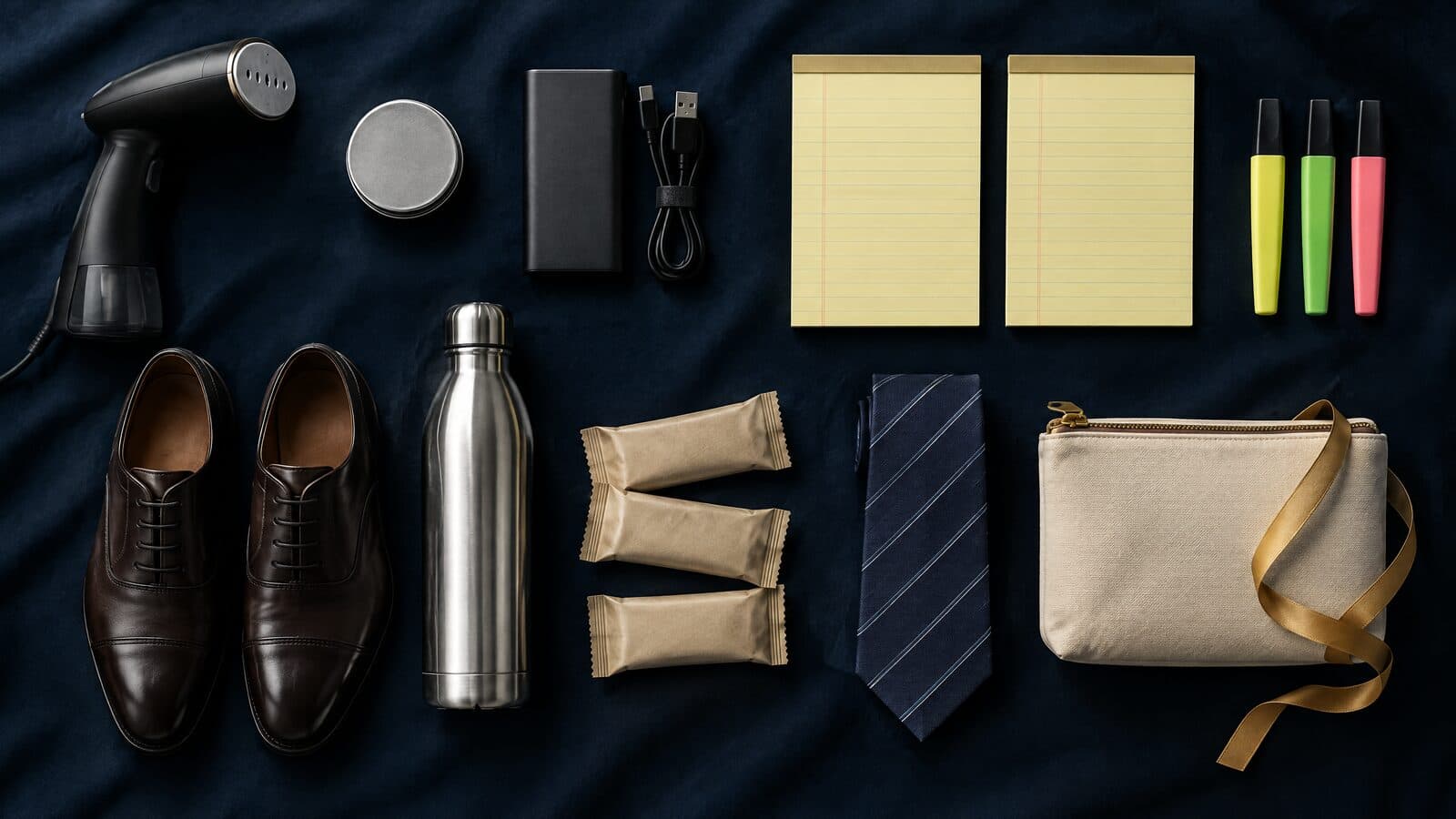
Here is a kit you can put together:
- A compact garment steamer for the hotel room or office.
- A lint roller.
- A spare tie or scarf in a neutral color.
- Comfortable dress shoes or cushioned insoles for long days standing.
- Throat lozenges for openings, examinations and closings.
- A refillable water bottle.
- Protein or granola bars for the lunch break that gets cut short.
- A phone charger and power bank (the travel section above covers airline rules for batteries).
- Highlighters, tabs and legal pads.
- A spare pair of reading glasses.
- Hotel-room snacks for late prep sessions.
- A prepaid team dinner for the night after closing arguments.
- A handwritten good-luck card.
Courthouse security rules vary, and a lawyer carrying the kit into court may have items refused at screening, so leave out anything sharp, pressurized or questionable. Give the kit before trial starts.
Budget tier: $25–$50 assembled yourself; $50–$100 with the steamer and shoes (prices vary; check before buying). Skip it if: the lawyer's firm already provides trial kits; give the team dinner instead.
Travel gear for mass tort lawyers on the MDL circuit
Much of mass tort work runs through multidistrict litigation. Under 28 U.S.C. §1407, when civil actions sharing common questions of fact are pending in different federal districts, the Judicial Panel on Multidistrict Litigation may transfer them to one district "for coordinated or consolidated pretrial proceedings." For lawyers, that means regular trips to a transferee court that may be far from home, often for a one-day status conference that needs a full day of travel each way.
Gifts that make those trips easier: a carry-on garment bag (the travel section above covers the general pick); a hearing-binder travel organizer that keeps exhibits flat and in order; a travel pillow and a small white-noise machine for hotel nights; an airport lounge day pass for long layovers; and a compact hotel-room coffee kit for early starts. Firms that are growing from one tort into several face more of these trips; see our guide on scaling from one tort to a multi-litigation docket.
- Hearing-binder travel organizer: $25–$50 budget tier (prices vary; check before buying). Skip it if they work fully paperless.
- Travel pillow and white-noise machine: $25–$50 budget tier. Skip it if they rarely stay overnight.
- Airport lounge day pass: $25–$50 budget tier. Skip it if they already hold a lounge membership.
- Hotel-room coffee kit: Under $25 budget tier. Skip it if they do not drink coffee.
Gifts for document-heavy, long-cycle litigation
Mass tort and complex PI matters can run for years and generate enormous records: medical files, discovery productions, deposition transcripts. That means long days at a desk, often standing or reading on screens. Comfort gifts in this setting get daily use for a long time.
Ideas: an anti-fatigue mat for a standing desk; a wrist rest and a footrest for long review sessions; a good task lamp that lights paper without glare; a second monitor (covered in the office section above); and an e-ink tablet for reading long documents (covered in the tech section above). Check what the firm already supplies before buying.
- Anti-fatigue mat: $50–$100 budget tier (prices vary; check before buying). Skip it if they do not use a standing desk.
- Wrist rest and footrest: $25–$50 budget tier. Skip it if the firm provides ergonomic equipment.
- Task lamp: $50–$100 budget tier. Skip it if their office has strong natural light.
Gifts for the PI or mass tort firm owner
A PI or mass tort firm owner runs a business as well as a docket: payroll, case acquisition, cash flow across long fee cycles, and a team that depends on them. In my opinion, the most useful gift for a firm owner is usually time, not another object. A time-back gift, such as the meal delivery or cleaning services covered in the stress section above, gives back hours the owner would spend on chores.
Other ideas: a business book (see the practice-building book above); a session with a business coach who works with law firm owners; or a ticket to a conference or CLE program they have mentioned wanting to attend.
Software and marketing are firm purchases, not gifts. An owner deciding how to grow should compare options for personal injury lawyer marketing or weigh law practice management software on the firm's budget, with the firm's own vendor review. If you refer cases to this owner or receive referrals from them, the law firm section below covers what is allowed.
- Business coach session: $250+ budget tier (prices vary; check before buying). Skip it if they already work with a coach.
- Conference ticket: $250+ budget tier. Skip it if you cannot confirm their schedule.
Thank-you gifts for intake teams and support staff
Intake specialists take calls from injured people at difficult moments. For many clients, the intake specialist is the first voice of the firm, and their work decides whether a case is signed and how the client feels about the firm from the first day. Paralegals and case managers then carry those cases for months or years. A thank-you gift for this team is about recognition as much as the item.
Ideas that work:
- A catered team meal, scheduled during working hours so everyone can attend.
- A public thank-you at a team meeting, naming specific contributions.
- Ergonomic headsets for staff who are on the phone all day.
- Chair cushions or lumbar supports.
- A handwritten note from a partner naming a specific call or case milestone, without client details.
Firms that want to understand the work behind those calls can read about mass tort intake teams and what good mass tort intake looks like. One caution for employers: gift cards given to employees are taxable, which the tax section below explains.
- Catered team meal: $250+ budget tier for a team (prices vary; check before buying). Skip it if staff work remotely; send individual delivery credits instead.
- Ergonomic headset: $50–$100 budget tier. Skip it if the firm's phone system requires a specific model.
- Handwritten note: free. Never skip it.
Holiday Gifts for Lawyers and Shipping Deadlines
Holiday gifts for lawyers that work in an office are shareable, useful or personal, and they arrive on time. In 2026, USPS recommends mailing Ground Advantage and First-Class packages by Thursday, December 17 for Christmas delivery in the contiguous U.S., and personalized items need extra lead time.
Holiday gifts that work in a law office
Picture a firm reception desk in mid-December: a stack of gift baskets, some addressed to people who left the firm, some melting, some with no card. Good presents for lawyers at the holidays avoid that pile. They are either shareable (so the whole office benefits), useful (so they survive past January) or personal (so they are clearly meant for one person).
Ideas:
- A team treat box for the office (see the food section above for picks).
- A desk item from the earlier sections, such as a quality notebook or a cord organizer.
- A card with a specific note about the year you worked together.
- A winter desk plant, such as a small potted evergreen or amaryllis bulb.
- A calendar or planner for the new year.
For mixed offices, use inclusive, non-denominational cards ("Happy holidays" or "Best wishes for the new year"). Send firm-wide gifts to the office and personal gifts to the home. If any recipient is a judge, court employee or government lawyer, read the judges and government section below before sending anything. Firms sending gifts at scale to clients and referral sources should read the law firm section.
- Winter desk plant: Under $25 budget tier (prices vary; check before buying). Skip it if the office has no natural light.
- Planner or calendar: Under $25 budget tier. Skip it if they rely on a firm-wide digital calendar.
USPS holiday shipping dates for 2026
USPS publishes recommended send-by dates for holiday delivery. These are the 2026 dates for delivery by December 25 in the contiguous United States.
| USPS service | Send by for delivery by Dec. 25 (contiguous U.S.) |
|---|---|
| USPS Ground Advantage | Thursday, Dec. 17 |
| First-Class Mail | Thursday, Dec. 17 |
| Priority Mail | Friday, Dec. 18 |
| Priority Mail Express | Saturday, Dec. 19 |
USPS adds a caveat worth repeating: "Actual delivery date may vary and is based on origin, destination, Post Office acceptance time, and other conditions." Alaska, Hawaii and U.S. territories have earlier dates, listed on the same USPS page. Private carriers and online marketplaces publish their own holiday cut-offs, which we did not verify, so check each one.
Personalization and lead-time checklist
Personalized gifts fail in two ways: the name is wrong or the gift arrives late. Both are avoidable with a few steps before you order.
- Confirm the exact spelling of the recipient's name and their current title (Partner, Of Counsel, Judge).
- Confirm the current firm name; firms merge and rename, and an outdated name on an engraved gift cannot be fixed.
- Ask the seller for its engraving turnaround and its holiday order cut-off.
- Add a buffer of several days to that cut-off.
- Choose office or home delivery, and confirm the address.
- Check whether the office closes around the holidays.
- Include a gift receipt for anything sized, such as clothing or shoes.
- Write the card before you order, so the gift does not wait on the note.
- Save the tracking number and check it the week of delivery.
- Plan a backup gift, such as a handwritten card with a promised dinner, in case the cut-off passes.
Why you can't mail a bottle of wine
Wine is a common holiday gift, but you cannot send it through the Postal Service. USPS Publication 52, section 424 states: "Intoxicating liquors and taxable liquors, including those obtained under a prescription or as a collector's item, are nonmailable." The underlying federal law is 18 U.S.C. §1716.
Private carriers and state alcohol-shipping laws have their own rules, which this guide did not verify. If you want to send wine or spirits, my advice is to buy from a licensed retailer that handles delivery and confirms it can ship to the recipient's state. Whether alcohol is a good gift for a lawyer at all is a separate question, covered in the stress section above.
Delivering gifts to a law office
Law offices have reception desks, mailrooms and sometimes strict building security. A few habits help a gift reach the right person:
- Address the package to the person's full name, firm name and floor or suite.
- Expect reception or the mailroom to sign for it; label perishables clearly so they are not left overnight.
- Check whether the building limits courier access or requires deliveries at a loading dock.
- Send perishables early in the week, never on a Friday.
- Do not send gifts to a courthouse.
- During a trial, ask the lawyer's assistant where they are; they may be in a hotel near the court for weeks.
The next section turns from what to buy to how much to spend and who may accept a gift.
Gifts for Lawyers by Budget and Relationship
How much to spend on a gift for a lawyer depends on your relationship with them, not on what they earn. Family and close friends spend the most, colleagues and staff keep it modest or pool their money, and clients and referral sources stay at a token or modest level. No bar rule or survey sets a "right" amount, so the tiers below are a starting point, not a standard.
The budget ladder: what each tier buys
The five tiers below are editorial budget tiers, not survey data. Nobody publishes reliable figures on what people spend on gifts for lawyers, so treat each tier as a rough guide to what a category usually costs. Prices vary by maker; check before buying. The example ideas come from the persona and occasion sections earlier in this guide, where each one is explained in full.
| Budget tier | What it usually buys | Good for | Example ideas |
|---|---|---|---|
| Under $25 | Consumables and small desk items | Colleagues, staff, office swaps | Tea sampler, legal pads, desk plant |
| $25–$50 | A quality everyday item | Friends, peers, mentors | Insulated tumbler, cord organizer, desk nameplate |
| $50–$100 | A noticeable upgrade | Close friends, bosses as a group | Leather portfolio, cross-cut shredder, food gift |
| $100–$250 | A tool used every day | Family, close friends, group gifts | Briefcase, earbuds, portable monitor |
| $250+ | A long-life splurge | Spouse, parents, family groups | Ergonomic chair, espresso machine, e-ink tablet |
Read the ladder from the relationship side, not the item side. A $40 notebook from a paralegal to a partner can feel generous, while the same notebook from a spouse after a promotion can feel like an afterthought. When you are unsure, drop one tier and add a handwritten note.
The $250+ tier is usually a spouse, family or group gift. A single colleague giving at this level can make the recipient uncomfortable, especially when there is a reporting line between you. Very large family gifts, such as helping a new lawyer with a down payment, run into a different set of rules. The IRS annual gift-tax exclusion is $19,000 per recipient for 2026, and each spouse gets their own exclusion. If you are planning anything near that figure, ask a tax adviser before you write the check.
Gifts by relationship, from spouse to mentor
The relationship decides the budget tier and the kind of gift that lands well. Use this table to match the two, then go to the persona or occasion sections for specific picks.
| Relationship | Budget tier | Good fits | Avoid |
|---|---|---|---|
| Spouse or partner | $100–$250+ | Splurge upgrade, experience | Work-only gadgets |
| Parent of a new lawyer | $50–$250 | Briefcase, fine pen, framed diploma | Joke gifts about lawyers |
| Friend | $25–$100 | Book, food, experience | Anything branded with scales |
| Colleague or peer | Under $25–$50 | Consumables, desk items | Personal or scented items |
| Boss or supervising partner | Group gift | Shared treat, note | Solo expensive gift |
| Mentor | $25–$100 | Book plus a letter | Generic gift card |
| Client to their lawyer | Modest | A card counts | Cash, lavish items |
| Firm to client | See the law firm section | See the law firm section | Mid-case gifts |
| Referral source | Token | See the law firm section | Anything tied to referrals |
Gifts that go up the ladder, to a boss or supervising partner, are best given as a pooled group gift or replaced by a note. A group gift spreads the cost, removes any hint of flattery, and lets the team buy one thing the boss will actually use rather than five small things they won't. If your boss is a federal employee, the rules are stricter: an executive-branch employee may give an official superior items other than cash worth $10 or less per occasion, plus food shared in the office. The government section below covers that rule in detail.
A mentor gift works best as a modest item paired with a specific letter. Name the advice that changed how you work, the case where they backed you, or the habit you picked up from them. The item can be small, such as a book they mentioned or a good notebook, because the letter is what they will reread.
Gifts by practice setting, from BigLaw to public interest
Where a lawyer works shapes what they need and what they are allowed to accept. According to the Bureau of Labor Statistics, legal services employed 52% of lawyers in 2025, self-employed lawyers made up 11%, local government 8%, state government 7% and the federal government 5%. Each setting calls for a slightly different gift.
- Large-firm associates. Time is the scarce resource. Time-back gifts (meal delivery, cleaning, errands) and travel gear usually beat another desk object. See the stressed-lawyer and travel sections.
- In-house counsel. Many companies have their own gift policies, especially for anyone near procurement or contracts. Keep it modest and personal, or ask what the policy allows.
- Solo practitioners. They buy their own tools, so a business or time-saving item they would not splurge on lands well: a scanner, a better chair, a monitor.
- Government lawyers. Federal agency lawyers face firm dollar caps, and state and local lawyers follow their own state's ethics law. See the government section below before buying anything.
- Public-interest and legal aid lawyers. A donation to their organization often means more than an object. See the donation section below.
- Plaintiff personal injury and mass tort lawyers. Trial weeks, travel and long-cycle cases shape their days. See the section on gifts for personal injury and mass tort lawyers.
Gifts for female and male attorneys
The profession is close to even and moving. The ABA's 2025 Profile release reports that 41% of lawyers were female and 58% male in 2025. The ABA Profile of the Legal Profession adds that most law students, most federal government lawyers and most law firm associates are now women, while "women remain a minority in the higher echelons of the profession."
So shop for the person's work and taste, not their gender. A woman trying a case needs the same garment steamer, power bank and throat lozenges as anyone else in that courtroom. Skip gendered novelty items, such as "lady lawyer" mugs or "for him" whiskey sets, which tend to read as an afterthought. For apparel, bags and portfolios, fit, carry style and color matter far more than a "for her" or "for him" label.
Gifts for the attorney who has everything
The lawyer who has everything usually has the money to buy it. The median annual wage for lawyers was $159,670 in May 2025, according to BLS, so another object rarely impresses. Try one of these five moves instead.
- Upgrade one thing they use every day. Their pen, mug or bag, chosen from the stylish-lawyer or travel sections.
- Give consumables they will use up. Good coffee, tea or a food gift from the food section, so nothing adds clutter.
- Give time. Meals, cleaning or errands from the time-back gifts in the stressed-lawyer section.
- Give an experience with a flexible date. A busy trial calendar makes fixed-date tickets risky.
- Write a letter. A specific, handwritten letter is the one gift they cannot buy for themselves.
Gift cards versus physical gifts
A gift card trades the personal touch for convenience and choice. A physical gift shows you thought about the person, but it can miss. A specific gift card splits the difference: their usual coffee shop, a bookstore they love, or a restaurant near the courthouse says you know their habits, while a generic card says you ran out of time.
Gift cards also hold their value longer than many people assume. Under Regulation E, most gift certificates, store gift cards and general-use prepaid cards can't expire earlier than five years after they were issued or last loaded. Two cautions apply. Federal agency lawyers can't accept cash, and the $20 per-occasion cap still applies to anything else, so see the government section below. Employers giving gift cards to staff should read the tax section first.
A donation in their name
A donation suits public-interest lawyers, retirees and the attorney who has everything. The need is real: the Legal Services Corporation's 2022 Justice Gap study found that low-income Americans "do not get any or enough legal help for 92% of the problems that have had a substantial impact on them," and that 74% of low-income households had at least one civil legal problem in the past year.
Pick a cause the person already cares about: a local legal aid organization, a state or local bar foundation, or a scholarship fund at their law school. Then tell them in a card which one and why. On tax, the deduction belongs to you as the donor, not the honoree. The IRS says you cannot deduct the value of gifts other than deductible charitable contributions, and IRS Topic 506 adds that gifts to individuals are not deductible. From tax year 2026, non-itemizers may deduct up to $1,000 ($2,000 joint) of cash gifts to certain qualified organizations. This is general information, not tax advice.
Can You Give Your Lawyer a Gift? The Ethics Rules
Yes, within limits. Under ABA Model Rule 1.8, Comment [6], a lawyer may accept a client's gift if it meets general standards of fairness, and a simple holiday present or token of appreciation is permitted. A lawyer may not solicit a substantial gift or prepare a will or deed that gives the lawyer one, unless they are related. States adopt their own versions of the rule.
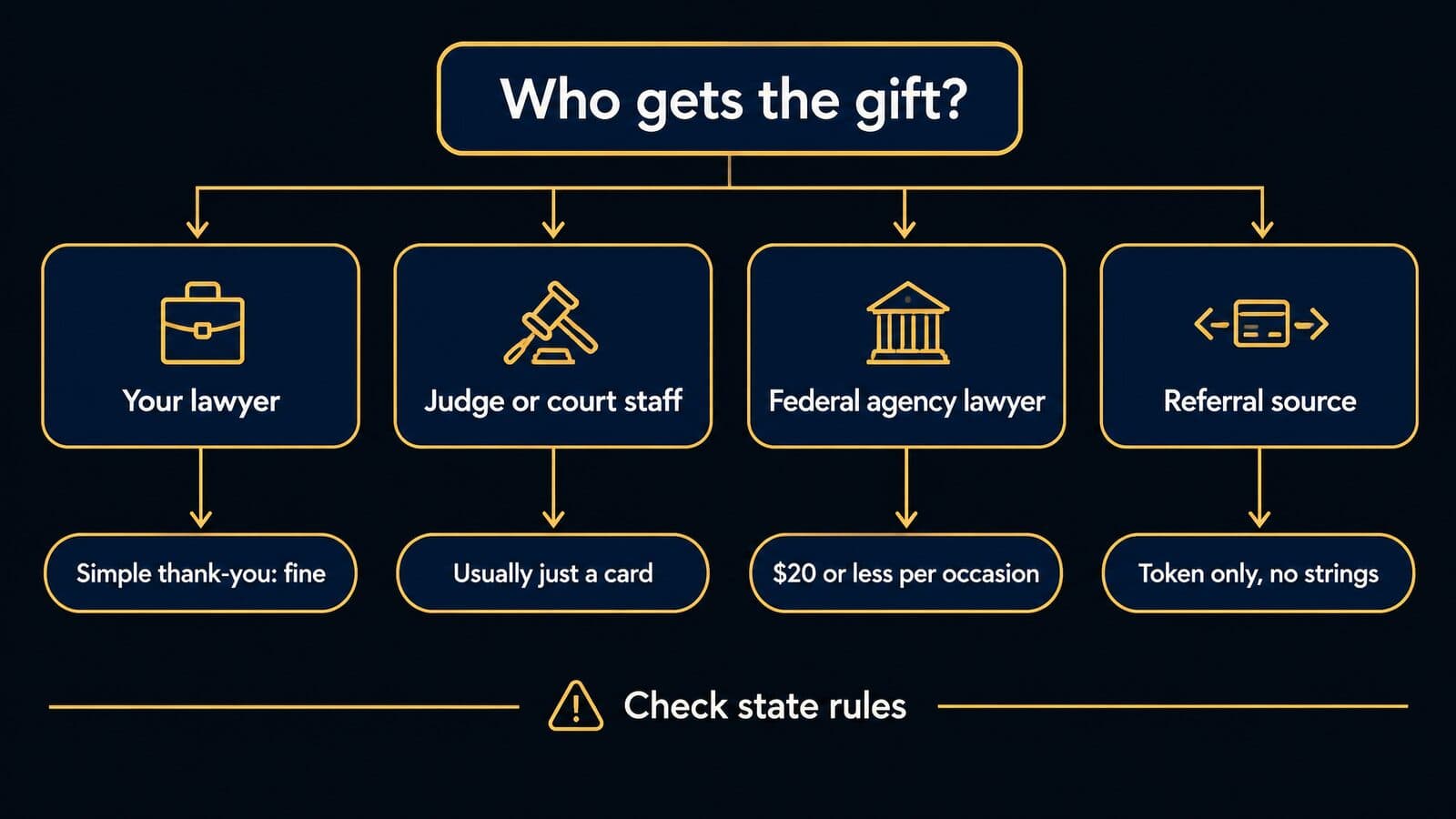
This section summarizes model and sample rules for general information; it is not legal advice, so check your own state's rules or ask a lawyer before acting on it.
What ABA Model Rule 1.8(c) says
The rule on client gifts sits in the conflict-of-interest rules, which tells you what it is worried about: a lawyer using their position of trust to benefit themselves. The first sentence of ABA Model Rule 1.8(c) reads: "A lawyer shall not solicit any substantial gift from a client, including a testamentary gift, or prepare on behalf of a client an instrument giving the lawyer or a person related to the lawyer any substantial gift unless the lawyer or other recipient of the gift is related to the client."
In plain words, the rule bans two things. First, a lawyer can't ask a client for a substantial gift, and that includes asking to be left something in a will. Second, a lawyer can't draft a document, such as a will, trust or deed, that gives the lawyer or someone related to them a substantial gift. Both bans drop away when the lawyer or recipient is related to the client. "Related" covers a spouse, child, grandchild, parent, grandparent or other relative, plus anyone with whom the lawyer or client keeps a close, familial relationship.
Rule 1.8(k) extends the solicitation ban across the firm: a prohibition that applies to one lawyer in a firm applies to all of them.
One point about the word "Model". The ABA Model Rules are a template. Each state's supreme court or bar adopts its own version, sometimes word for word and sometimes with real changes. The rule that binds your lawyer is their state's version, which is why the California comparison below matters.
Small gifts are fine; substantial gifts carry risk
The rule bans asking, not receiving. Comment [6] to Rule 1.8, titled "Gifts to Lawyers", sets the standard in its first sentence: "A lawyer may accept a gift from a client, if the transaction meets general standards of fairness." The same comment gives the example everyone can work with: a simple present at a holiday or as a token of appreciation is permitted.
A more substantial gift is not banned outright. The lawyer may accept it, but the client (or, later, the client's heirs) may be able to undo it under the doctrine of undue influence, which the comment says treats client gifts as presumptively fraudulent. And a lawyer may not suggest a substantial gift, except to a relative.
Two more comments fill in the edges. Comment [7] says that where a substantial gift needs a legal instrument such as a will or conveyance, the client should get the detached advice another lawyer can provide, unless the client is a relative. Comment [8] says a lawyer may seek to be named executor of a client's estate or to another paying fiduciary role, but that the appointment is subject to the conflict analysis under Rule 1.7.
Notice what the rule does not do: it never defines "substantial" in dollars. There is no $50 line, no $100 line and no survey that sets a right amount for a client's thank-you. The test is fairness. For a client, the practical reading is simple. A thank-you card, a box of good chocolates or a desk plant fits the comment's own example. A car, a vacation or a bequest is a different conversation, and the lawyer may need to decline it or send you to another lawyer first.
How California's rule differs
California shows how far a state can move from the model. Its current Rules of Professional Conduct took effect November 1, 2018, and Rule 1.8.3, "Gifts from Client", replaced former rule 4-400.
| Question | ABA Model Rule 1.8 | California Rule 1.8.3 |
|---|---|---|
| May the lawyer accept a simple gift? | Yes, if fair | Yes, if fair and no undue influence |
| Holiday or token example in the comment? | Yes | No |
| May the lawyer solicit a substantial gift? | No, unless related | No, unless related |
| May the lawyer draft an instrument giving themselves a gift? | No, unless related | No, with two exceptions |
| Relatives exception? | Yes | Yes, Probate Code definition |
| Independent-review option? | Not in the rule text | Yes, certificate of independent review |
The biggest practical difference is the drafting exception. Under California's rule, a lawyer may prepare an instrument giving themselves or a related person a substantial gift if the recipient is related to the client, or if the client was advised by an independent lawyer who signs a certificate of independent review under Probate Code §21384. "Related persons" follow the Probate Code's definition.
The comment is also worded differently. California's Comment [1] says a lawyer may accept a client's gift "subject to general standards of fairness and absence of undue influence." It adds that sending a client a wedding announcement does not violate the rule just because it might prompt a gift, and that discipline is appropriate where impermissible influence occurs, citing Magee v. State Bar (1962) 58 Cal.2d 423. Unlike the ABA comment, it does not use the holiday or token example. Other states vary too; check yours.
When to give: timing around a pending case
Timing matters as much as the gift. The rules don't set a calendar, but the fairness standard points to a practical habit: give after the matter is over. That means after the case closes and after any money has been paid out, not while the outcome or the fee is still being worked out.
Avoid giving while settlement negotiations are live or while a fee question is open. A gift at that moment can look like an attempt to influence how hard your lawyer pushes or what they charge, even when it is meant as simple gratitude. If you are a mass tort client, the wait may be longer than you expect, because settlement programs often pay claimants in stages. This guide to how mass tort settlements are paid out explains why, and the cleanest time to say thank you is once funds have been disbursed.
Never give cash, a check or anything that looks like an extra fee. If you want to recognize the whole team, a shared food gift for the office or a card addressed to the paralegals and case managers by name is usually welcome, though some firms limit what staff may accept. When in doubt, ask the office manager. A card alone is always enough.
Gifts that cross the line
Most gifts to lawyers are fine. These are the ones that aren't, or that put your lawyer in an awkward spot.
- A gift the lawyer asked for. Soliciting a substantial gift is barred by Rule 1.8(c).
- A bequest in a will your lawyer drafted. Barred unless you are related or, in some states, you get independent advice first (Comment [7]).
- A gift tied to the outcome. "If we win, you get..." looks like an extra fee and should be avoided.
- A gift big enough to invite an undue-influence challenge. Your heirs could try to undo it under Comment [6].
- Gifts to opposing counsel, an insurance adjuster or anyone on the other side. No rule above is written for this, but plain judgment says it looks like an attempt to influence the case.
- Anything to a judge or juror connected to your case. ABA Model Rule 3.5(a) bars a lawyer from seeking to "influence a judge, juror, prospective juror or other official by means prohibited by law." The next section explains the judicial side.
Gifts for Judges, Court Staff and Government Lawyers
If you are a lawyer or party who may appear before a judge, the answer to "can I give this judge a gift?" is usually no. The ABA Model Code of Judicial Conduct bars judges from accepting gifts that would appear to undermine their independence, integrity or impartiality. Federal judges have stricter rules, and federal agency lawyers can generally accept only $20 per source per occasion. A greeting card is the safe choice.
| Recipient | Main rule | Generally OK | Avoid |
|---|---|---|---|
| State judge (MCJC-based code) | Rule 3.13 | Greeting cards, plaques, ordinary social hospitality | Gifts from lawyers likely to appear |
| Federal judge | Judiciary gift regulations §620 | Special-occasion gifts from relatives and friends | Anything from someone with business before the court |
| Federal court employee (not a judge or personal staff) | §620 | Up to $50 per occasion, $100 a year from one person, if otherwise allowed | Gifts from those doing business with the court |
| Federal agency lawyer | 5 CFR part 2635 | Up to $20 per occasion, $50 a year per source | Cash, gift cards over the cap |
| State or local government lawyer | State ethics law | Ask the agency's ethics officer | Assuming federal limits apply |
What the Model Code of Judicial Conduct allows
The ABA's Model Code of Judicial Conduct is the template most state judicial codes start from, and its gift rule is Rule 3.13. Rule 3.13(A) says: "A judge shall not accept any gifts, loans, bequests, benefits, or other things of value, if acceptance is prohibited by law or would appear to a reasonable person to undermine the judge's independence, integrity, or impartiality."
Rule 3.13(B) then lists what a judge may accept without publicly reporting it, unless the law or part (A) says otherwise. First, items with little intrinsic value, such as plaques, certificates, trophies and greeting cards. Second, gifts from friends, relatives or others, including lawyers, whose appearance in a case would require the judge to step aside anyway. Third, ordinary social hospitality. Items (4) through (8) add discounts and opportunities open to non-judges on the same terms, contest prizes, scholarships, complimentary resource materials from publishers for official use, and gifts tied to a household member's own business that only incidentally benefit the judge.
Rule 3.13(C) covers gifts a judge may accept but must report under Rule 3.15. These include gifts tied to a public testimonial, invitations to bar-related events, and gifts from a party or lawyer "who has come or is likely to come before the judge." Reporting is not the same as clearance: part (A) still applies.
The lawyer's side mirrors this. Model Rule 3.5(a) bars lawyers from seeking to influence a judge by means prohibited by law, and Model Rule 8.4(f) makes it misconduct to "knowingly assist a judge or judicial officer in conduct that is a violation of applicable rules of judicial conduct or other law." States adopt their own judicial codes, so check the state's code or ask the court administrator.
Federal judges and court employees
Federal judges follow the Judicial Conference's Regulations on Gifts (Guide to Judiciary Policy, Vol. 2C, Ch. 6, last revised July 27, 2021). Under §620.35(a), a judge or court employee may not accept a gift from anyone seeking official action from or doing business with the court, or from anyone whose interests may be substantially affected by their duties.
Section 620.35(b) lists exceptions. They include gifts incident to a public testimonial that are "fairly commensurate with the occasion", complimentary books and resource materials related to official duties, and gifts from a relative or friend on a special occasion, "such as a wedding, anniversary, or birthday", if they fit the occasion and the relationship.
There is a dollar-value exception, but read it carefully. Gifts of $50 or less per occasion, up to $100 a year from one person, are allowed only for an officer or employee "other than a judge or a member of a judge's personal staff." Judges and their chambers staff do not get that exception. Section 620.30 bars soliciting gifts, and the regulations implement 5 U.S.C. §§7351 and 7353.
The practical reading: a lawyer who practices in that court should mark an investiture or a retirement with a card or a letter, not a gift. Family members and close friends can give gifts that suit the occasion and the relationship.
State courts and California's Rule 3.5
State rules apply to state judges and to the lawyers who appear before them. California is a clear example of a strict lawyer-side rule. Its Rule 3.5(a), in the State Bar of California's rules, says a lawyer "shall not directly or indirectly give or lend anything of value to a judge, official, or employee of a tribunal," except as permitted by statute, an applicable code of judicial conduct or the standards for tribunal employees. The rule does not bar lawful contributions to a judge's election or confirmation campaign fund.
Beyond the ABA model and California's rule, this guide did not verify any state's judicial gift code or dollar thresholds, and they do vary. Before giving anything to a state judge, a clerk or court staff, check that state's code of judicial conduct and the court's own policy. The court administrator's office can usually tell you what staff may accept.
Federal government lawyers and the $20 rule
Lawyers at federal agencies follow the executive-branch gift rules in 5 CFR part 2635. The core exception, in 5 CFR §2635.204(a), lets an employee accept unsolicited gifts worth $20 or less per source per occasion, as long as gifts from any one person under that exception don't exceed $50 in a calendar year. The exception does not cover cash or investment interests, and the employee can't pay the difference to keep part of a bigger gift. A $40 gift is not a $20 gift with a $20 refund.
Section 2635.204(b) allows gifts clearly motivated by a family relationship or personal friendship rather than the person's job. The history of the relationship and whether the friend or relative pays personally both count.
Some things are not "gifts" at all. Under §2635.203(b), modest food and non-alcoholic refreshments, such as coffee and donuts, offered other than as part of a meal are excluded, as are greeting cards and items of little intrinsic value such as plaques. The rule's own example treats a $25 logo music player as having real value, so it doesn't qualify. Food is not automatically exempt: a meal or a bottle of wine is a gift.
For gifts to a superior, §2635.304(a) allows items other than cash worth $10 or less per occasion on traditional gift occasions, plus food shared in the office. The rule's example is a succulent bought for $10 or less. State and local government lawyers follow state law, which this guide did not verify, so ask the agency's ethics officer.
Gifts to Avoid and How to Write the Card
The gifts that go wrong for lawyers are the ones that break a rule, embarrass them in front of clients or assume too much about their private life. The card is the one gift almost every recipient can accept, so it deserves more care than the gift itself.
Gifts to avoid
- Always-listening devices for a home office. Client confidentiality makes them a poor fit; see the tech section.
- Alcohol when you don't know them well. Many people don't drink, for many reasons; see the stressed-lawyer section.
- Cheap scales-of-justice kitsch. It tends to end up in a drawer; see the decor advice in the funny and book gifts section.
- Jokes about clients or suing people. Fine among friends, risky on a desk clients can see; see the humor advice.
- Lavish gifts from clients. They invite undue-influence questions; see the ethics section above.
- Cash or gift cards to government lawyers. Cash is never covered, and the $20 cap applies; see the government section.
- Anything to a judge in a pending matter. See the judges section above.
- Gifts to the other side's lawyer or adjuster. They look like an attempt to sway the case.
- Mid-case gifts from a personal injury firm to its own clients. Firm rules restrict these; see the law firm section.
- Strong scents in shared offices. Candles and perfume can bother colleagues and clients nearby.
Why the card matters more than the gift
A good card is the one gift that clears almost every rule on this page. Greeting cards are expressly allowed for judges under Model Code Rule 3.13(B)(1), and they are excluded from the federal executive-branch definition of a gift under 5 CFR §2635.203(b). A client, a court clerk and a federal agency lawyer can all accept one.
What makes a card good is specificity. Name one moment (the hearing where they stayed calm, the phone call that came at 9 p.m.), one quality you noticed, and ask for nothing. Skip the outcome, the money and any mention of future work.
Thank-you note templates
Adapt these four templates in your own words. Replace everything in brackets, and keep the specific detail: it is what makes a note sound like you.
1. A client to their lawyer after the case closes
Dear [Name], now that everything is wrapped up, I wanted to thank you properly. I still think about [specific moment], when you [what they did]. You made a hard stretch of my life feel manageable, and you always explained where things stood. Thank you for your patience and your care. With gratitude, [Your name]
2. A parent to a new lawyer who passed the bar
[Name], I remember [specific moment from law school or bar prep], and I knew then you would get here. Passing the bar is the result of every early morning and every weekend you gave up. I am proud of the work, and prouder of the person who did it. Congratulations, counselor. Love, [Your name]
3. An associate to a mentor who is retiring
Dear [Name], when I started, you told me [specific advice], and I still use it every week. You also [specific thing they did for you], which I have never forgotten. Thank you for the time you gave someone who had not earned it yet. I hope retirement is full of [their interest]. Warmly, [Your name]
4. A lawyer's note to a judge on an investiture or retirement (a card only, no gift)
Dear Judge [Name], congratulations on your [investiture / retirement]. I have admired [specific quality, such as your preparation or courtesy to self-represented litigants] in your courtroom, and I am glad [the court / the bar] will have your example. With respect and best wishes, [Your name]
The remaining sections of this guide are written for law firms that give gifts to clients, referral sources and their own teams.
How Law Firms Should Gift Clients and Referral Sources
For law firm owners and marketing managers, the short answer is that your firm can thank clients and referral sources, but three rules set the limits: Rule 1.8(e) on financial help to clients during litigation, Rule 7.2(b)(5) on nominal gifts to people who recommend the firm, and the IRS's $25 business-gift deduction cap. From here on, this guide speaks to you as the firm.
Mass Tort Marketing Agency works with plaintiff personal injury and mass tort firms, and these questions come up most often around referral relationships and case closings. This section and the tax section below are general information about the ABA Model Rules and sample state rules, not legal or tax advice. Each state adopts its own version of the rules, so check your state's rules and ethics opinions, and ask your ethics counsel or tax adviser before you set a policy.
The order of the subsections follows the life of a matter: what you may do while a case is pending, what is common after it closes, how to thank the lawyers and non-lawyers who send you cases, and how to turn all of it into a written policy that the whole firm follows.
Client gifts during a case: what Rule 1.8(e) prohibits
ABA Model Rule 1.8(e) opens with a flat bar: "A lawyer shall not provide financial assistance to a client in connection with pending or contemplated litigation," followed by three exceptions (ABA Model Rule 1.8). The first lets you advance court costs and litigation expenses, with repayment contingent on the outcome. The second lets a lawyer for an indigent client pay those costs outright. The third, added by the ABA House of Delegates in August 2020 according to ABA Bar Leader Weekly, allows modest gifts for food, rent, transportation, medicine and other basic living expenses, but only for indigent clients represented pro bono. Even then the lawyer may not promise those gifts before retention, seek reimbursement, or advertise a willingness to give them.
The comments close the door on the plaintiff-firm reading. Comment [10] says lawyers may not subsidize lawsuits, "including making or guaranteeing loans to their clients for living expenses" (Rule 1.8 comments). Comment [13] says the pro bono exception does not reach litigation where the lawyer may recover a fee, "such as contingent-fee personal injury cases." The comments call the exception "narrow."
For a PI or mass tort firm, the practical reading is simple. Advancing filing fees, expert costs and record charges under (e)(1) is allowed. Gift baskets, gift cards, rides, rent help or cash to a current PI client raise a financial-assistance question under your state's Rule 1.8(e), so don't send them without checking your state's rule and its ethics opinions. My rule of thumb: a plain greeting card at the holidays, or a short note after a hard deposition, is the safe mid-case gesture.
Rule 1.8(k) applies these prohibitions to every lawyer in the firm once one lawyer is covered, so a single partner's goodwill basket is a firm problem. And as a sensible line even outside the pro bono exception, never promise, hint at or advertise gifts to prospective clients.
Client gifts after the case closes
Once the matter is closed and the funds have been distributed, a thank-you note and a modest token are common relationship gestures. That is a practice, not a rule, and it works best when the timing is clean: wait until settlement funds are disbursed and the file is closed, so the gift cannot read as part of the representation or as an advance against the recovery.
Never condition a gift on a review or a referral. A gift given on the understanding that referrals will follow runs into Rule 7.2, whose Comment [4] prohibits gifts offered "in consideration of any promise, agreement or understanding" that referrals would be made or encouraged (Rule 7.2 comments). Reviews carry a second problem: the FTC Endorsement Guides treat payment or free products as a material connection that must be disclosed "clearly and conspicuously" when it could affect how readers weigh an endorsement. A thank-you gift sent in exchange for a five-star review is exactly that kind of connection.
Two habits keep post-case gifts clean. Send the gift without any request attached, and get written consent before naming a client publicly, including in a social media post thanking them. Many clients, especially in injury and product cases, would rather their matter stay private.
Thank-you gifts for referring attorneys and co-counsel
Model Rule 7.2(b) starts from a prohibition: "A lawyer shall not compensate, give or promise anything of value to a person for recommending the lawyer's services" (ABA Model Rule 7.2). Paragraph (b)(5) then permits "nominal gifts as an expression of appreciation that are neither intended nor reasonably expected to be a form of compensation for recommending a lawyer's services." Comment [4] defines the ceiling in words, not dollars: "The gift may not be more than a token item as might be given for holidays, or other ordinary social hospitality." No dollar figure appears in the ABA text, so don't treat any number you hear as the rule.
The exception is fairly new. The ABA House of Delegates adopted Resolution 101 amending the advertising rules on Monday, August 6, 2018, and that package added (b)(5). States vary. California's Rule 7.2(b)(5) allows "a gift or gratuity" to a person whose recommendation resulted in employment, provided it was not given on a promise or understanding of future referrals, and the word "nominal" does not appear in its text (State Bar of California Rules of Professional Conduct). Read your own state's version before relying on either.
A gift must never stand in for a referral fee. Fee division between lawyers in different firms is governed by Model Rule 1.5(e): the split must track the work performed or joint responsibility, the client must agree in writing to each lawyer's share, and the total fee must be reasonable. Rule 7.2(b)(4) separately allows reciprocal referral agreements only if they are not exclusive and the client is told about them. For mass tort work, where co-counsel splits and common-benefit assessments are negotiated up front, a holiday gift to co-counsel is a courtesy layered on a written fee agreement, never a substitute for one.
For where referral relationships sit in the wider plan, see where referrals from past clients and other attorneys fit in a PI marketing plan. For paid lead generation, which Comment [5] treats separately, read the advertising and lead-generation side of Rule 7.2.
A firm card that thanks without asking for anything:
Thank you for trusting us with your client this year. We know what it means to send someone you care about to another firm, and we took that seriously at every step. We hope the new year brings you and your team good health and a little more time off. With appreciation from all of us.
| Recipient | Rule to check | Generally OK | Red flags |
|---|---|---|---|
| Referring lawyer at another firm | 7.2(b)(5); 1.5(e) | Token holiday gift, card | Gifts scaled to referral volume |
| Co-counsel | 1.5(e) | Token gift, shared celebration | Gifts in place of a fee split |
| Doctor or chiropractor | 7.2(b)(5); state runner laws | Token holiday item | Anything tied to sending patients |
| Former client who refers | 7.2(b)(5) | Card, token | Promised rewards for referrals |
| Anyone soliciting at hospitals or scenes | Cal. B&P §6152 and similar | Nothing | Any payment at all |
The column to read first is "Red flags." Every flag describes the same thing in a different setting: a gift whose size or timing moves with the number of cases sent. Once a gift tracks volume, it starts to look like compensation for a recommendation, which is what Rule 7.2(b) bars.
Doctors, chiropractors and other non-lawyer referral sources
Rule 7.2(b) says "a person," not "a lawyer," so the nominal-gift limit covers the treating physician, chiropractor, physical therapist or body-shop owner who mentions your firm. Comment [2] explains that a communication is a recommendation if it "endorses or vouches for a lawyer's credentials, abilities, competence, character, or other professional qualities," and that, outside the listed exceptions, lawyers may not pay others for recommending them.
State statutes add a second layer. California Business and Professions Code §6152(a) makes it unlawful to act as a "runner or capper" or to solicit business for attorneys in and about jails, hospitals, courts and public places, and to solicit someone else to do it. Section 6152(b) presumes fraudulent a liability release signed within 15 days after confinement begins or before release, whichever comes first. Many states have similar statutes, so check yours before any arrangement with a person who meets injured people.
Treating providers often have their own gift policies, so ask the office manager before sending anything. A card and a shareable holiday item for the front desk is the usual ceiling. For the broader picture, see how car accident firms build referral sources without crossing these lines.
A firm gift policy and gift log
A written policy matters because Rule 1.8(k) turns one lawyer's misstep into everyone's, and because gift decisions are often made by staff in December with no time to check the rules. A one-page policy that covers these eight points is enough for most plaintiff firms:
- Who approves gifts, by name or role, and who can approve exceptions.
- Firm-set caps by recipient type (the firm chooses them; no rule sets a dollar figure).
- A restricted-recipient list: judges, court staff, government lawyers and current PI clients.
- Approved card language, with no "keep them coming" or other referral asks.
- A rule to log every gift (see the records section below for the template).
- A policy for gifts that staff receive from vendors, experts and clients.
- A pre-holiday screen of the mailing list against the restricted list.
- An annual review of the policy, the log and any rule changes.
Keep the policy short enough that a new intake specialist can read it in five minutes. A long policy that nobody reads protects no one.
Holiday gifting at scale
Firms that send dozens or hundreds of holiday gifts should place one bulk order with multi-address shipping rather than buying piece by piece, and should order early enough to meet the USPS dates listed in the holiday section above. Screen the list against your restricted-recipient list before anything ships.
My opinion on branding: unbranded gifts get kept, and heavily branded gifts get regifted. Two ideas follow from that. For clients and referral sources, an unbranded tea or coffee sampler is easy to share and leaves nothing behind. For your own staff, a branded item set (a mug, a notebook and a pen) builds team identity without pretending to be a client gift. A firm holiday card program, with handwritten notes from the lawyer who knew each recipient, often does more than either. Small imprinted items can fall outside the $25 tax cap; see the tax section below.
Gifts are not a referral strategy
A thank-you gift keeps a relationship warm. It does not build a referral network, and it does not answer the phone when a referred caller rings at 9 p.m. on a Saturday. Referral volume comes from structured referral development: knowing who sends cases, staying in regular contact, and reporting back on how each referred client was treated. The other half is making sure referred callers reach a person, which takes 24/7 live intake rather than voicemail.
That is the work Mass Tort Marketing Agency does for plaintiff firms. If you want help with intake and plaintiff acquisition, you can book a strategy call with our team.
Tax Rules for Business Gifts From Law Firms
A firm can deduct no more than $25 per recipient per year for business gifts under IRC §274(b)(1). Incidental costs such as engraving, packaging and shipping don't count toward the $25, and items that could be gifts or entertainment, such as event tickets, are generally treated as nondeductible entertainment.
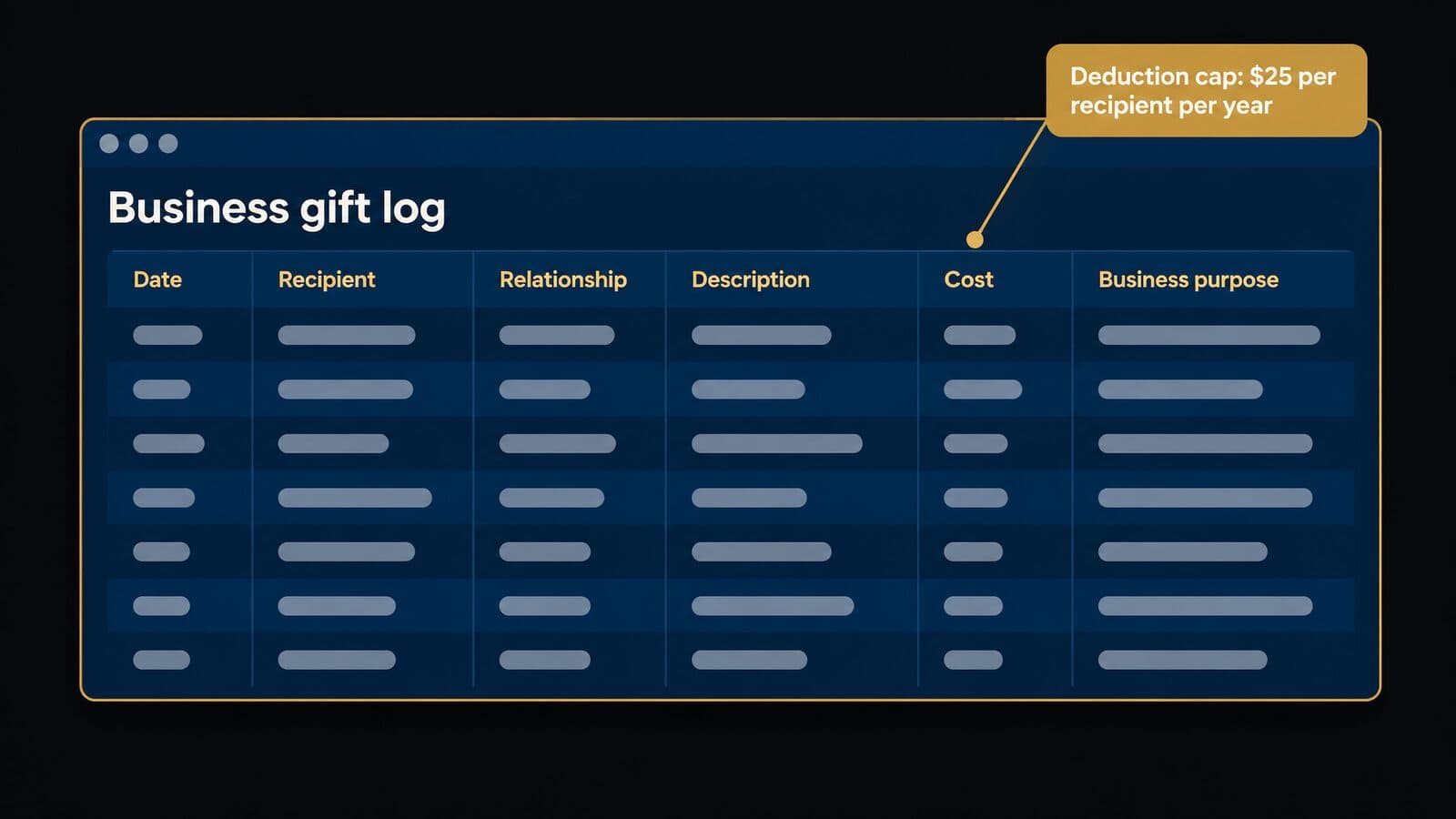
This is general information about federal tax rules, not tax advice; ask your tax adviser how they apply to your firm.
The $25 per-recipient limit
The statute disallows a deduction for gifts to any individual "to the extent that such expense, when added to prior expenses of the taxpayer for gifts made to such individual during the same taxable year, exceeds $25" (26 U.S.C. §274). IRS Publication 463 puts it plainly: "You can deduct no more than $25 for business gifts you give directly or indirectly to each person during your tax year."
"Indirectly" matters for firms. A gift to a company meant for a particular person's use counts as a gift to that person, and a gift to a client's or referral source's family member is generally a gift to the client or referral source. Pub. 463 also treats spouses who both give gifts as one taxpayer, and treats a partnership and its partners as one taxpayer; the statute applies the limit "to the partnership as well as to each member thereof." Three partners each sending the same referring lawyer a gift do not get three $25 deductions.
Pub. 463's own worked example: three $80 gift baskets, $240 in total, sent to a company and taken home by three executives produce a deduction of $75, which is $25 times three. A simpler case: if your firm spends $60 on a referring lawyer's holiday gift, it deducts $25.
What doesn't count toward the $25
Two kinds of items fall outside the definition of a gift. The first is an item costing $4.00 or less with the firm's name "clearly and permanently imprinted" that is one of a number of identical items distributed generally, such as branded pens. The second is a sign, display rack or other promotional material for use on the recipient's business premises.
Incidental costs are also excluded. Pub. 463 says engraving, packaging, insuring and mailing "are generally not included in determining the cost of a gift for purposes of the $25 limit," and gift wrapping counts as incidental. There is a catch for gift baskets: an ornamental basket is not incidental if its value is substantial compared with the fruit or food inside it.
Gift or entertainment: tickets and meals
Pub. 463 is direct: "Any item that might be considered either a gift or entertainment will generally be considered entertainment." The same passage carves out packaged food or beverages that you give a client to use at a later date, which you treat as a gift.
That distinction matters because, in the publication's words, "In general, entertainment expenses are nondeductible," including entertaining guests at theaters and sporting events. So the courtside seats you hand a referring lawyer are not a $25 deductible gift, and they are usually not deductible at all. A boxed holiday cake or a coffee sampler shipped to the same lawyer is a gift, subject to the $25 cap. If your firm budgets for tickets, budget for them as a nondeductible cost, and confirm the treatment with your tax adviser.
Gifts to employees: what is taxable
Gifts to your own staff follow different rules, in IRS Publication 15-B. The firmest one: cash and cash equivalents, including gift cards, "no matter how little, are never excludable as a de minimis benefit." A $25 gift card to every paralegal is taxable wages.
Non-cash gifts are different. Pub. 15-B lists low-value holiday or birthday gifts other than cash, flowers or fruit given in special circumstances such as illness or a family crisis, occasional parties, and occasional theater or sports tickets as de minimis examples. Employee achievement awards for length of service or safety can be excluded if they are tangible property given in a meaningful presentation, with deduction limits of $400 per employee per year for non-qualified-plan awards and $1,600 for all awards.
| Gift to staff | Usually taxable to the employee? | Why (Pub. 15-B) |
|---|---|---|
| Gift card, any amount | Yes | Cash equivalent |
| Holiday ham or turkey | Usually no | Low-value non-cash holiday gift |
| Flowers during an illness | Usually no | Special-circumstance item |
| Occasional team party | Usually no | Listed de minimis example |
| Occasional theater or sports tickets | Usually no | Listed de minimis example |
| Length-of-service award | Excludable if rules are met | Tangible property, $400 and $1,600 limits |
For intake teams and support staff, the practical result is that a branded item set, a catered lunch or a holiday ham is simpler for payroll than a gift card, which has to run through wages.
Records to keep
Pub. 463's Table 5-1 lists what to record for gifts: the cost, the date, a description of the gift, the business purpose and the business relationship. You don't always need each recipient's name: "A general listing will be enough if it is evident that you aren't trying to avoid the $25 annual limit." A simple log covers all of it:
| Date | Recipient | Relationship | Description | Cost | Business purpose |
|---|---|---|---|---|---|
| [date] | [name] | Referring attorney | Holiday tea sampler | [cost] | Relationship thank-you |
| [date] | [name] | Former client | Card and coffee sampler | [cost] | Post-closing thank-you |
Keep the log with the firm's gift policy and review it before each holiday season, so the same names are checked against both the $25 cap and the restricted-recipient list.
Sources and methodology
This guide was researched from search results, leading gift guides and primary sources: the rule texts, regulations, statutes, IRS publications and vendor pages listed below, all read and checked as of October 2026.
How this guide was researched
We reviewed search results for the four target phrases (gifts for lawyers, gifts for attorneys, gift ideas for attorney and lawyer presents) on Bing, U.S. desktop, and on a second web index. We also collected the questions people type into search autocomplete and the questions in common FAQ sections; those became the FAQ below. We read the leading gift guides for coverage, to see which occasions, relationships and questions they answered and which they skipped.
Every rule and regulation, and nearly every figure, was read on its primary source; the exceptions are named below. Product prices were read on each vendor's own page on October 22, 2026; prices change, so confirm the current price before buying. Where we relied on secondary coverage (Holland & Knight, MobileSyrup, LawSites, Legal IT Insider, Scribe Media and iPhone J.D.), or on an ABA source we could not open directly (the August 2020 Bar Leader Weekly item on Rule 1.8(e)(3)), the text names the source in the sentence.
We did no hands-on product testing. The guide has no affiliate links, no paid placements, and we received no free products. Refresh plan: prices and availability before each holiday season; rules and IRS publications each January and whenever the ABA, IRS, USPS or NCBE publish updates; NextGen bar exam dates as NCBE posts them.
Primary sources, as of October 2026
- BLS Occupational Outlook Handbook, Lawyers (page modified August 27, 2026)
- ABA 2025 Profile of the Legal Profession (December 8, 2025) and the ABA Profile page
- ABA Model Rules 1.5, 1.6, 1.8 and its comments, 3.5, 7.2 and its comments, and 8.4
- ABA Model Code of Judicial Conduct Rule 3.13
- ABA 2018 advertising-rule amendments
- State Bar of California Rules of Professional Conduct (2026 compilation)
- Cal. Bus. & Prof. Code §6152
- Guide to Judiciary Policy, Vol. 2C, Ch. 6 (revised July 27, 2021)
- 5 CFR §2635.203, §2635.204 and §2635.304
- 26 U.S.C. §274
- IRS Publication 463 (2025) and IRS Publication 15-B (2026)
- IRS gift-tax FAQ and IRS Topic 506
- 12 CFR §1005.20 (Regulation E gift cards) and 16 CFR §255.5 (FTC Endorsement Guides)
- LSC Justice Gap study (2022)
- USPS 2026 holiday shipping dates and USPS Publication 52, §424
- FAA PackSafe lithium batteries and the TSA liquids rule
- NCBE NextGen bar exam
- 36 U.S.C. §113 (Law Day) and 28 U.S.C. §1407 (multidistrict litigation)
- Krill, Johnson and Albert (2016), PMID 26825268 and The Path to Lawyer Well-Being (2017)
- Vendor pages read October 22, 2026: Bose, Apple, Ember, Anker, Breville, Herman Miller, Montblanc, Thomson Reuters, reMarkable, Calm and Amazon's newsroom